Yellowstone Food Chains Vocabulary Slides Yellowstone Science • ENL Vocabulary Grades 3–4
🌿 Food Chain Words
Yellowstone Food Chains
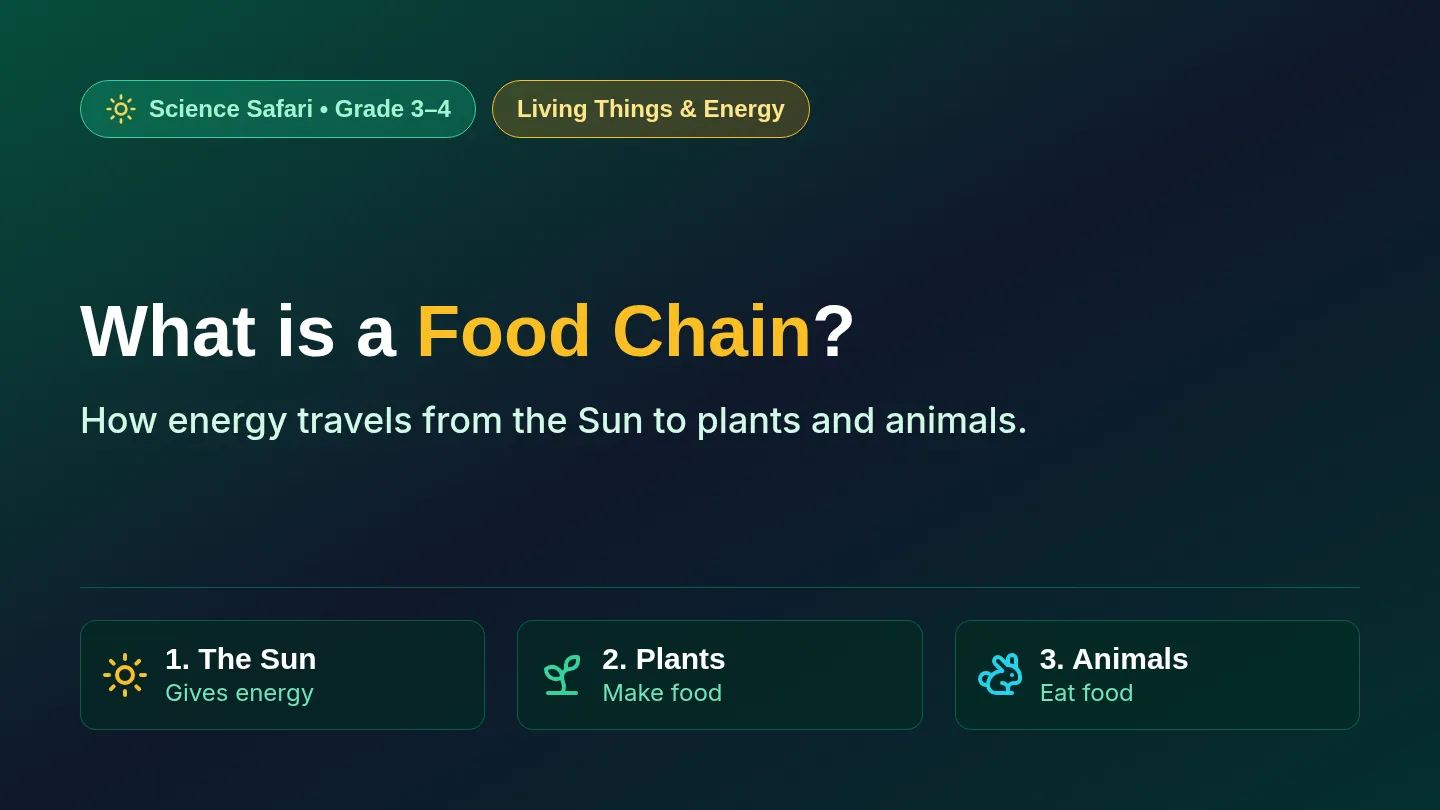
Learn the 5 key vocabulary words to understand how energy moves from the sun to plants and wild animals!
☀️ Sun
➡️
🌿 Producer
➡️
🦌 Prey
➡️
🐺 Predator
Word 1 of 5 Spanish cognate: cadena alimentaria
🔗
Food Chain
Definition:
A path that shows how food energy moves from one living thing to another.
➡️ The arrow means: "gives energy to"
⚡
Energy Moves Up!
Sentence Starter:
"A food chain shows how energy moves."
🗣️ Say it together: "Food Chain!" 👋 Gesture: Link index fingers together like chain links!
Word 2 of 5 Spanish cognate: el sol
☀️
The Sun
Definition:
The bright star in space that gives light energy to start every food chain.
🌟 Big Science Fact: Without the sun, no plants can grow and no animals can live!
🌞
Energy Starter
All food chains begin here!
Sentence Starter:
"The sun gives energy to the plants."
🗣️ Say it together: "The Sun!" 👋 Gesture: Raise both hands overhead in a giant shining circle!
Word 3 of 5 Spanish cognate: productor
🌿
Producer
Definition:
A plant that makes its own food using sunlight, water, and air.
🌾 Yellowstone Examples: Willow trees, prairie grasses, and river plants!
🌱 🌳 🌾
Plants = Producers
They produce their own food!
Sentence Starter:
"A willow tree is a producer."
🗣️ Say it together: "Producer!" 👋 Gesture: Crouch low and slowly "grow" up toward the sun!
Word 4 of 5 Spanish cognate: presa
🦌
Prey
Definition:
An animal that is hunted and eaten by another animal for food energy.
🐾 Yellowstone Examples: Elk, beavers, rabbits, and field mice!
🦌 🦫 🐭
Plant-Eaters
Hunted by predators!
Sentence Starter:
"The elk is prey for the wolf."
🗣️ Say it together: "Prey!" 👋 Gesture: Cup hands behind ears to listen alertly like an elk!
Word 5 of 5 Spanish cognate: depredador
🐺
Predator
Definition:
An animal that hunts, catches, and eats other animals for food energy.
🏔️ Yellowstone Examples: Gray wolves, grizzly bears, and red-tailed hawks!
🐺 🐻 🦅
Top Hunters
Keep prey populations in balance!
Sentence Starter:
"The gray wolf is a predator."
🗣️ Say it together: "Predator!" 👋 Gesture: Hold up curved wolf paws and make a gentle hunt motion!
Vocabulary Review Turn & Talk with a Partner!
Connect the Word to Its Role!
☀️
Sun
Energy Source
Starts the chain
🌿
Producer
Plant (Willow)
Makes its food
🦌
Prey
Plant Eater (Elk)
Hunted animal
🐺
Predator
Hunter (Wolf)
Eats other animals
👥 Partner Task: Point to any card above. Say the word and act out the hand gesture!
Ready for Worksheet! 📝
Yellowstone Food Chains Teacher Guide Teacher Guide • Grades 3–4 ENL Science Focus Yellowstone Food Chains Lesson
Yellowstone Food Chains & Energy Flow
Exploring Producers, Consumers, Predators & What Happens When Links Break
Pacing: 45–60 Minutes
Core Focus: Food Chains & Energy
Content Objective
Students will identify the components of a food chain (Sun , Producer , Prey/Consumer , Predator ) and sequence two Yellowstone food chains using energy arrows.
Language Objective (WIDA Aligned)
Students will explain causal relationships using sentence frames: "Wolves disappeared because [people hunted them]" and "The arrow means [gives energy to]."
Key Food Chain Terms & Multilingual Cognates
Producer 🌿 Sp: productor
A plant that produces its own food using sunlight.
🌱 TPR: Crouch and "grow" hands upward toward the sun!
Prey 🦌 Sp: presa
An animal hunted and eaten by a predator (elk, mouse).
👀 TPR: Cup hands around ears like a listening deer.
Predator 🐺 Sp: depredador
An animal that hunts other animals for food energy.
🐾 TPR: Flash wolf paws and pretend to track prey!
Lesson Pacing & Guided Routine
Time
Phase
Instructional Steps & ENL Supports
0–8 min
1. Do Now Warm-Up
Students open to top of worksheet: "Why did wolves disappear from Yellowstone?" Guide completing the sentence starter with word bank clues (hunted, trapped).
9–22 min
2. Chain & Energy Flow
Slides 2–3. Teach the Arrow Rule: ➡️ means "gives energy to" ! Model Sun ➡️ Willow ➡️ Elk ➡️ Wolf. Choral chant with finger-pointing.
23–35 min
3. Broken Chain Reaction
Slides 4–6. What if the top predator is missing? Discuss elk multiplying and eating willows. Connect to book reading and ecosystem balance.
36–50 min
4. Partner Practice
Slide 7. Turn & Talk partner practice. Students independently or in pairs complete Parts 1–5 on the Yellowstone Food Chains Activity.
☀️
Key Teaching Anchor: Always emphasize that every single food chain starts with the Sun ! Plants don't eat other things; they capture light to produce food energy.
Yellowstone Food Chains • Teacher Guide Page 1 of 2
Yellowstone Food Chains Activity 🌿
Yellowstone Food Chains Explorer
Energy Flow, Living Things & Predator-Prey Balance
Name:
Date:
☀️ Do Now
Quick Think: Why did wolves disappear from Yellowstone?
Complete the sentence starter below:
Sentence Starter: Wolves disappeared from Yellowstone because
Word Bank Clues:
people hunted them ranchers trapped them people were afraid
Food Chain Vocabulary Bank Use these 4 words for Part 1:
☀️ Sun Energy Source
🌿 Producer Plant (makes food)
🦌 Prey Eats plants / hunted
🐺 Predator Hunts other animals
Part 1
Food Chain Roles: Write the matching word on each blank line.
🐺
An animal that hunts other animals for food:
__________
🦌
An animal that is hunted and eaten by a predator:
__________
🌿
A plant that produces its own food with sunlight:
__________
☀️
The big star that gives all energy to start the chain:
__________
Part 2
Build the Yellowstone Chain: Put the 4 living things in order!
Choose from: Sun • Willow Tree • Elk • Gray Wolf
Step 1: Energy
☀️
___________
➡️
Step 2: Producer
🌿
___________
➡️
Step 3: Prey
🦌
___________
➡️
Step 4: Predator
🐺
___________
The Arrow Rule (➡️): The arrow points in the direction that energy moves!
"gives energy to"
Yellowstone National Park • Food Chains Lesson Turn page for Chain Detective Practice ➡️
🔍 Food Chain Detective: Practice & Chain Reaction
Trace energy arrows, test your food chain rules, and see what happens when a link breaks!
Part 3
Yellowstone Grassland Chain: Order these 4 living things!
Number each from 1 to 4:
🦅 Red-Tailed Hawk Predator
Order #
☀️ Sun Energy Source
Order #
🌾 Prairie Grass Producer
Order #
🐭 Field Mouse Prey / Plant Eater
Order #
Yellowstone Food Chains Answer Key Teacher Reference • Answer Key & Scoring Guide Yellowstone Food Chains Focus
Food Chains Activity Answer Key
Solutions, Exemplar Sentences & ENL Food Chain Evaluation
Grades 3–4 • Science & Language
Do Now: Wolf Disappearance Exemplar Sentence Starter Solution
Exemplar Answer: "Wolves disappeared from Yellowstone because people hunted and trapped them all / humans were afraid of them ."
Acceptable Variations: "people hunted them", "ranchers trapped them", "hunters killed the wolves", "humans did not understand wolves".
Part 1: Vocabulary Match
1. Hunts other animals: Predator
2. Hunted and eaten: Prey
3. Plant (makes food): Producer
4. Star (gives energy): Sun
Part 2: Yellowstone Food Chain Order
Energy Sequence:
☀️ Sun ➡️ 🌿 Willow ➡️ 🦌 Elk ➡️ 🐺 Wolf
Arrow Check (➡️): Points toward who gets the energy ("gives energy to")
Part 3: Grassland Chain Order
☀️ Sun #1
🌾 Grass #2
🐭 Mouse #3
🦅 Hawk #4
Sun ➡️ Prairie Grass ➡️ Field Mouse ➡️ Red-Tailed Hawk
Part 4: True / False Rules
1. All chains start with sun: TRUE
2. Arrow points to who gets energy: TRUE
3. Producer hunts other plants: FALSE
Part 5: Broken Link Cause-and-Effect Sentences
Question 1 (Elk population):
"When wolves disappeared, the elk population grew huge because no predators hunted them / nothing kept them in check ."
Question 2 (Why predators matter):
"Predators are important in a food chain because they keep prey animals / elk in balance so the plants don't disappear."
ENL Food Chains Scoring Rubric
Skill Area
Mastered (3 pts)
Developing (2 pts)
Emerging / Support (1 pt)
Do Now & Cause Sentence
Completes Do Now using "because" with accurate historical reason.
Completes Do Now with simple phrase (e.g., "people killed them").
Copies a word without completing the clause.
Food Chain Sequencing
Accurately places Sun ➡️ Producer ➡️ Prey ➡️ Predator in both chains.
Correctly orders 1 chain; switches 1 organism in the second.
Puts organisms in reverse or random order.
Vocabulary & Arrow Rule
Defines producer/predator/prey & explains arrow means energy flow.