Science Studies Weekly • Fourth Grade Page 1 of 2 • Form B Turn over for Part 4–6
Name:
Week 1 Formative Assessment FORM B
Part 4: How the World Changes Refer to article to answer questions 10–12
A balance B predictability C consistency D change
A the reasons why an event happens and its results B the exact speed of moving particles C how to prevent any objects from changing D the physical textures of different minerals
A to find out if one event is directly causing another event to occur B to invent complicated math formulas without observations C to ensure natural phenomena never happen again D to make all scientific objects have identical dimensions
Part 5: How We Describe Our World Refer to article to answer questions 13–15
A the brightness of different lights B the size of an object in relation to other objects C how long an object has existed on Earth D the smell and taste of different substances
A the size of a part in relation to other parts of the whole B the weight of an entire system added together C the time taken for a chemical change D the number of scientists working on a project
A by guessing B by counting C by illustrating D by assuming
Part 6: ELA Article Questions Refer to article “How the World Is Organized”
Explain what the word “system” means as it is used in the article. Write a complete sentence.
Select the two sentences from the article that provide context clues explaining what a “system” is.
A A system is a group of parts that work together. B To help them investigate, scientists and engineers use models. C Sometimes systems can be damaged if one part of a system isn’t working. D You can see systems everywhere.
A a visible piece of an organism B a detailed laboratory recipe C a version or model of something D a large machine built by an engineer
Science Studies Weekly • Fourth Grade Page 2 of 2 • Form B End of Assessment
Correct: A change
Rationale: Stability means conditions stay constant or balanced; change represents variation or disruption.
11
Correct: D the reasons for an event and its results
Rationale: Cause explains "why" something occurred, while effect identifies "what" resulted from that cause.
12
Correct: A to find out if one event is causing another event to happen
Rationale: Investigating cause-and-effect establishes causal mechanisms rather than mere coincidences.
PART 5: HOW WE DESCRIBE OUR WORLD (Q13–15) 1 pt each
13
Correct: B the size of an object in relation to other objects
Rationale: Scale relates relative dimensions, distances, and times across macroscopic and microscopic realms.
14
Correct: C the size of a part in relation to other parts of the whole
Rationale: Proportion deals with ratios and comparative relationships between individual components and the entire entity.
15
Correct: A by counting
Rationale: Quantities represent measurable amounts, numerical values, and frequencies obtained through counting or tools.
PART 6: ELA ARTICLE QUESTIONS (Q16–18) Q16: 2 pts | Q17: 2 pts | Q18: 1 pt
16
Constructed Response Scoring Guide (2 Points Total) 2 pts rubric
Exemplar Answer: "A system is a group of parts that work together to do a job or function as a whole."
2 pts (Full Credit): Mentions both parts/pieces AND that they work together in a complete sentence.
1 pt (Partial Credit): Mentions parts OR working together, or incomplete fragment without clear connection.
0 pts (No Credit): Incorrect definition (e.g., defines a tool, energy, or unrelated term).
17
Correct: B and D (2 pts total: 1 pt per correct sentence)
• B: A system is a group of parts that work together. | • D: Sometimes systems can be damaged if one part of a system isn’t working.
Rationale: Sentence B explicitly provides the definition, while sentence D illustrates the interdependent relationship of parts within a system.
18
Correct: D a version of something
Rationale: In the context of scientific models, a representation is a version, replica, or diagram that portrays a real-world object or phenomenon.
Science Studies Weekly • Fourth Grade TEACHER KEY • Page 2 of 2 • Form A End of Key
10
Correct: D change
Rationale: Stability indicates that things remain steady and constant over time; change is its direct opposite.
11
Correct: A the reasons why an event happens and its results
Rationale: Cause-and-effect links an action, force, or trigger (cause) to the resulting outcome (effect).
12
Correct: A to find out if one event is directly causing another event to occur
Rationale: Testing cause-and-effect allows scientists to determine direct relationships rather than coincidences.
PART 5: HOW WE DESCRIBE OUR WORLD (Q13–15) 1 pt each
13
Correct: B the size of an object in relation to other objects
Rationale: Scale refers to relative magnitude, comparing how big or small something is compared to standard references.
14
Correct: A the size of a part in relation to other parts of the whole
Rationale: Proportion defines the ratio between the components of an object and the whole structure.
15
Correct: B by counting
Rationale: Quantities involve numerical data that can be tallied or measured precisely.
PART 6: ELA ARTICLE QUESTIONS (Q16–18) Q16: 2 pts | Q17: 2 pts | Q18: 1 pt
16
Constructed Response Scoring Guide (2 Points Total) 2 pts rubric
Exemplar Answer: "Based on the article, a system is a group of parts or objects that work together to accomplish a job."
2 pts (Full Credit): Mentions both group of parts AND working together in a clear sentence.
1 pt (Partial Credit): Mentions only one key element (e.g. "a bunch of parts"), or incomplete fragment.
0 pts (No Credit): Incorrect concept (e.g. defines energy, an experiment, or an animal).
17
Correct: A and C (2 pts total: 1 pt per correct sentence)
• A: A system is a group of parts that work together. | • C: Sometimes systems can be damaged if one part of a system isn’t working.
Rationale: Statement A provides the direct definition, and statement C provides contextual evidence that system components depend on one another.
18
Correct: C a version or model of something
Rationale: In science texts, a "representation" refers to a diagram, scale model, or simulation that stands for a real physical object or concept.
Science Studies Weekly • Fourth Grade TEACHER KEY • Page 2 of 2 • Form B End of Key
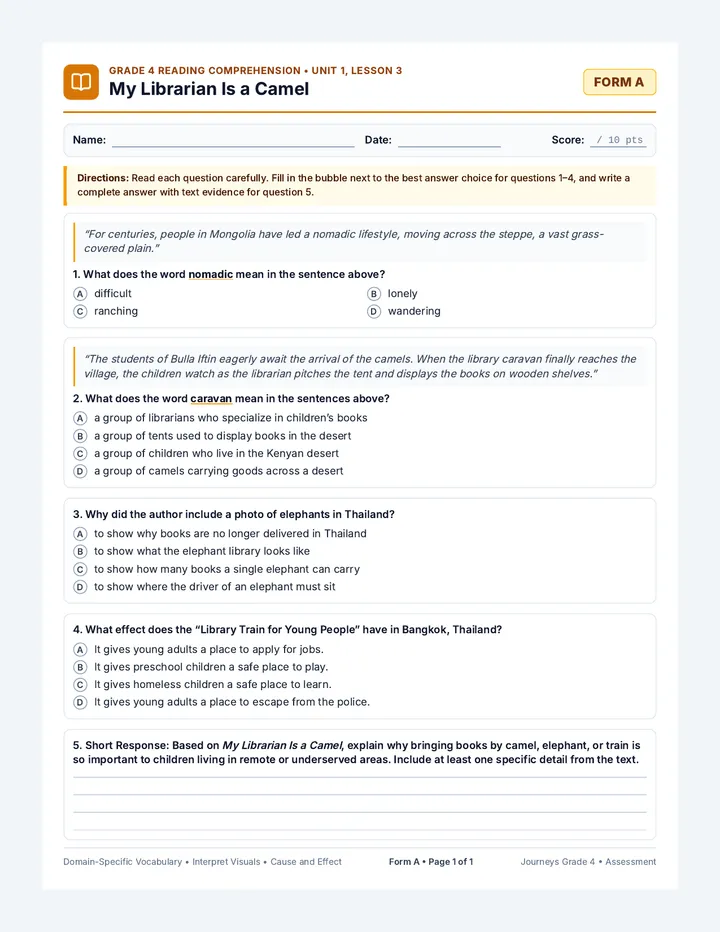
“The students of Bulla Iftin eagerly await the arrival of the camels. When the library caravan finally reaches the village, the children watch as the librarian pitches the tent and displays the books on wooden shelves.”
F a group of librarians who specialize in children’s books G a group of tents used to display books in the desert H a group of children who live in the Kenyan desert I a group of camels carrying goods across a desert
9 Why did the author include a photo of elephants in Thailand?
A to show why books are no longer delivered in Thailand B to show what the elephant library looks like C to show how many books a single elephant can carry D to show where the driver of an elephant must sit
10 What effect does the “Library Train for Young People” have in Bangkok, Thailand?
F It gives young adults a place to apply for jobs. G It gives preschool children a safe place to play. H It gives homeless children a safe place to learn. I It gives young adults a place to escape from the police.
Mark Student Reading Level: Independent Instructional Listening
STOP
Cause and Effect, Interpret Visuals, Domain-Specific Vocabulary Page 2 of 2 • Form A Grade 4, Unit 1 • Lesson 3
A staying permanently in one town B wandering or moving from place to place C feeling lonely and depressed D farming crops on steep hillsides
8 Read the sentences from the text below. What is the best definition of a caravan?
“The students of Bulla Iftin eagerly await the arrival of the camels. When the library caravan finally reaches the village, the children watch as the librarian pitches the tent and displays the books on wooden shelves.”
F a group of camels and travelers journeying together across the desert G a wooden building used as a permanent library warehouse H a club of children who write stories about desert animals I a large canvas tent used exclusively for sleeping
9 What was the author’s primary purpose for featuring a photograph of elephants in Thailand?
A to help readers visualize what the elephant mobile library looks like in real life B to demonstrate why wild elephants can be dangerous to humans C to show why book deliveries are no longer permitted in Asia D to teach trainers how to direct elephants along rocky trails
10 What positive effect does the “Library Train for Young People” provide for children in Bangkok, Thailand?
F It provides high-speed transportation across national borders. G It provides homeless children with a safe, caring space to learn and read. H It provides older teenagers with full-time railroad conductor jobs. I It offers free lodging for tourists visiting Thailand.
Mark Student Reading Level: Independent Instructional Listening
STOP
Cause and Effect, Interpret Visuals, Domain-Specific Vocabulary Page 2 of 2 • Form B Grade 4, Unit 1 • Lesson 3
8
Correct: I Skill: Domain-Specific Vocabulary
caravan = a group of camels carrying goods across a desert
Context Clue: The sentence links “the arrival of the camels” to “when the library caravan finally reaches the village.”
9
Correct: B Skill: Interpret Visuals
to show what the elephant library looks like
Rationale: The accompanying photograph visually depicts the specialized book-carrying harness affixed to the elephant for deliveries in the jungle.
10
Correct: H Skill: Cause and Effect
It gives homeless children a safe place to learn.
Rationale: In Bangkok, decommissioned train carriages were transformed into a classroom and library to offer vulnerable street children sanctuary and education.
Journeys Weekly Tests • Grade 4, Unit 1 • Lesson 3 TEACHER KEY • Page 2 of 2 • Form A End of Key
8
Correct: F Skill: Domain-Specific Vocabulary
caravan = a group of camels and travelers journeying together across the desert
Context Clue: The passage refers to the camels arriving together carrying the traveling library supplies.
9
Correct: A Skill: Interpret Visuals
to help readers visualize what the elephant mobile library looks like in real life
Rationale: Photographs in informational texts provide concrete visual evidence of authentic settings and delivery equipment.
10
Correct: G Skill: Cause and Effect
It provides homeless children with a safe, caring space to learn and read.
Rationale: The railway train library in Bangkok provides essential shelter, adult guidance, and literacy education for vulnerable children.
Journeys Weekly Tests • Grade 4, Unit 1 • Lesson 3 TEACHER KEY • Page 2 of 2 • Form B End of Key