A comprehensive third-grade science lesson exploring the International Space Station, microgravity, astronaut life, and orbital research through structured visuals, simplified text, and engaging activities.
Write the letter for where astronauts eat and sleep: [ _____ ]
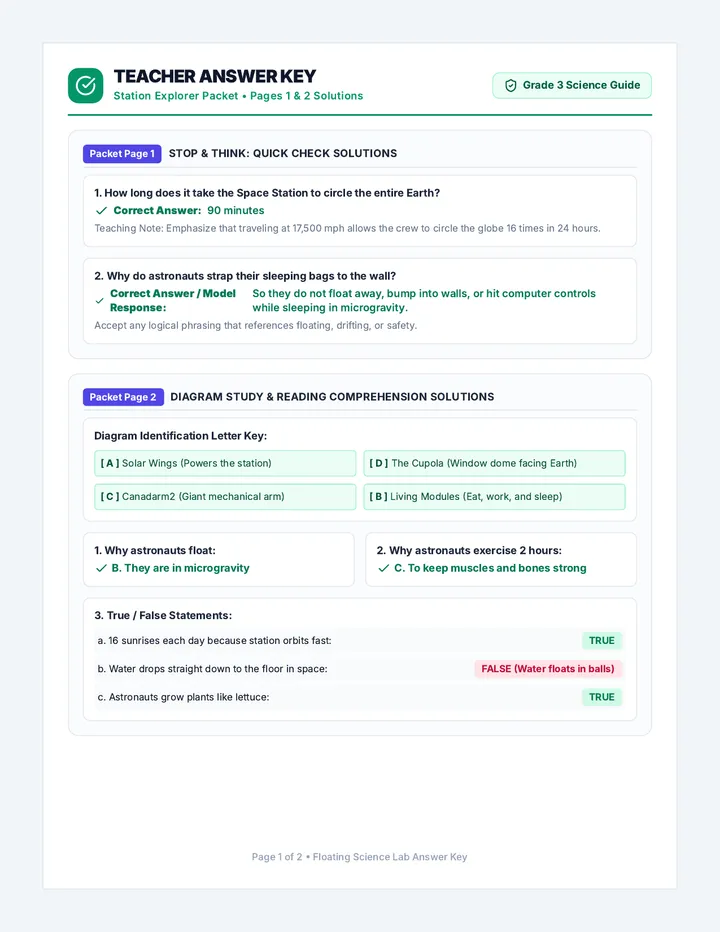
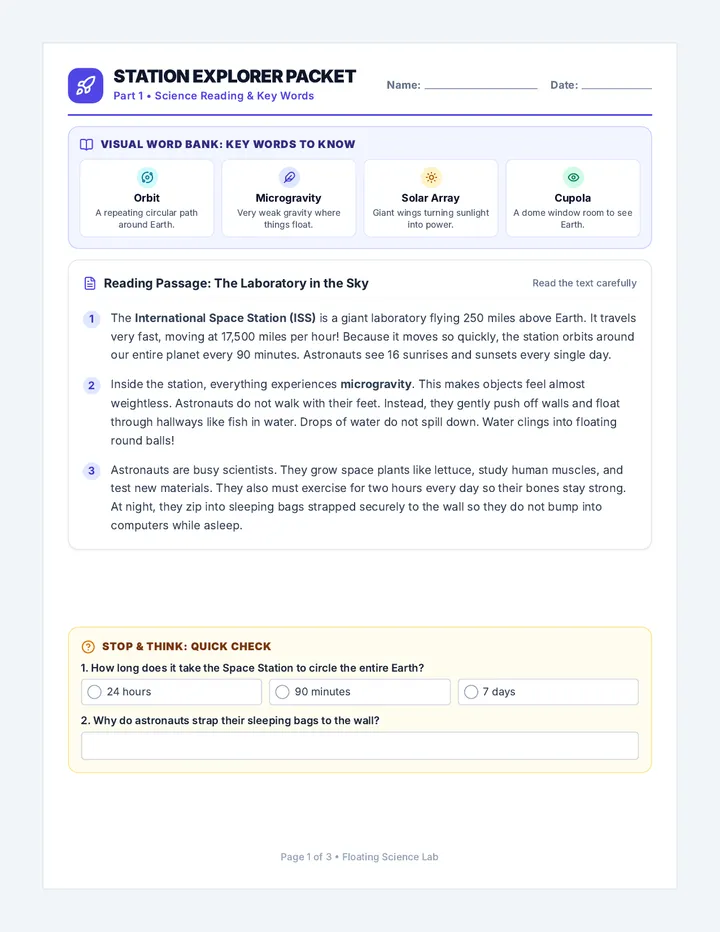
1. Why do astronauts float inside the Space Station?
A. Fans blow air upward
B. They are in microgravity
C. Space suits have helium
D. The station has magnetic floors
2. Why must astronauts exercise for two hours every day?
A. To practice for Olympic games
B. To pass the time before bedtime
C. To keep muscles and bones strong
D. To charge the station's batteries
3. Read each sentence. Circle TRUE or FALSE:
a. Astronauts see 16 sunrises each day because the station orbits so quickly.
TRUE FALSE
b. Water in space drops straight down onto the floor just like on Earth.
TRUE FALSE
c. Astronauts grow plants like lettuce to learn how food grows in space.
TRUE FALSE
Page 2 of 3 • Floating Science Lab
Station Explorer Packet
Part 3 • Life in Orbit & Science Mission
Name:
Activity 1: Match the Problem to the Space Solution
Draw a straight line connecting each challenge to how astronauts solve it:
1 Floating while trying to sleep
2 Bread crumbs floating in air
3 Weak muscles from floating
A Eat tortillas instead of bread
B Exercise on machines 2 hours daily
C Strap sleeping bags to the wall
Activity 2: Earth vs. Space Station Comparison
Activity
On Planet Earth
Aboard the Space Station
Drinking Water
Poured into an open glass
Walking / Moving
Feet step on floor
|
| Sunrises in 24 Hours | 1 sunrise per day |
|
Activity 3: Design Your Orbital Experiment
Imagine you are a scientist on the ISS. Complete the sentence stem and write 2-3 sentences explaining what you would test in microgravity!
If I could test any experiment on the Space Station, I would test:
Draw a sketch of your floating experiment here: Use pencil & labels
Page 3 of 3 • Floating Science Lab
Feet step on floor
Floating, gliding, or gently pushing off walls and handrails.
Sunrises in 24 Hours
1 sunrise per day
16 sunrises (and 16 sunsets) every 24 hours.
Activity 3
Design an Experiment: Scoring Guide
Exemplar Student Response:
"If I could test any experiment on the Space Station, I would test if sunflowers can grow toward LED lamps when there is no gravity pulling their roots down. I would measure their green stems every week to see if they turn toward the light!"
Quick 3-Point Scoring Guide:
3 Pts: Proposes a clear test related to microgravity/space (plants, floating liquids, human movement) with reasoning.
2 Pts: Names an experiment or object to test but lacks detailed explanation of how it relates to microgravity.
1 Pt: Incomplete sentence or ideas not connected to space science conditions.