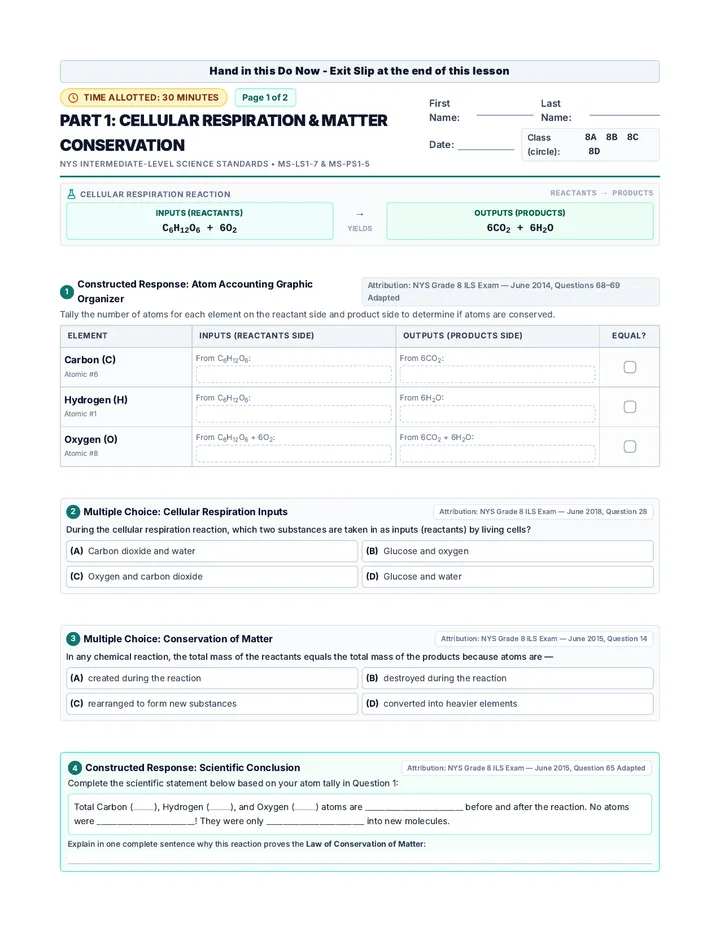
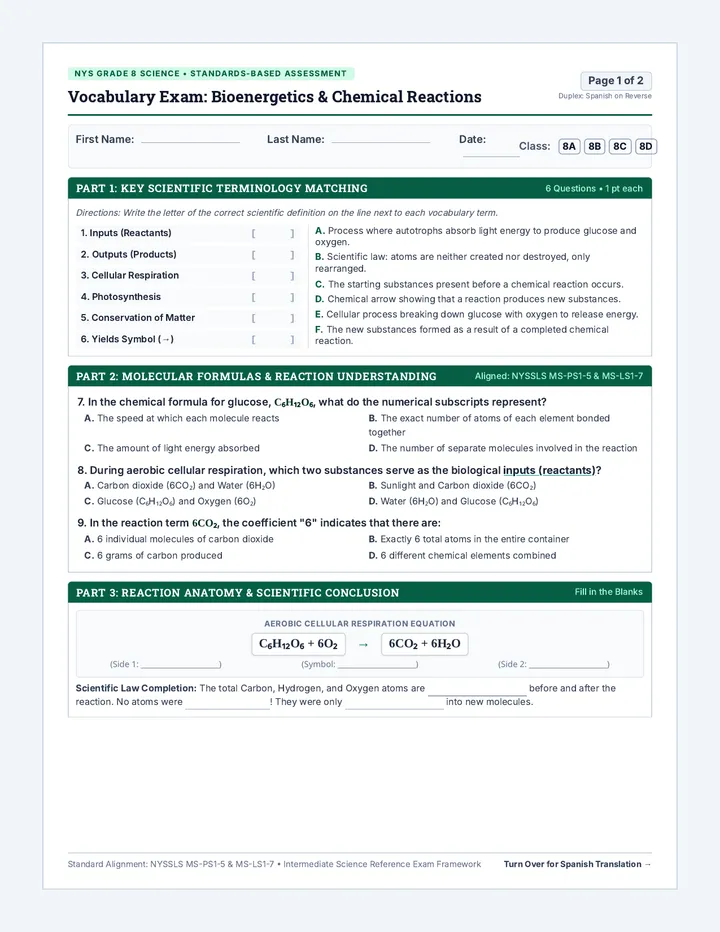
1. Subscripts: In CO₂, the small 2 applies only to Oxygen (1 C, 2 O).
2. Coefficients: In 6CO₂, multiply the entire molecule by 6 (6 C, 12 O).
3. Add Across Terms: In 6CO₂ + 6H₂O, total Oxygen = 12 (from CO₂) + 6 (from H₂O) = 18 Oxygen.
Turn page over for Spanish Translation • Keep this reference in your science binder Page 1 of 2
Ciencias de 8.° Grado de NYS • Referencia de Estudio Estudiantil
Guía de Estudio
MS-LS1-6 • MS-LS1-7 • MS-PS1-5
1. LISTA MAESTRA DE VOCABULARIO CIENTÍFICO CLAVE Términos Esenciales Evaluados
| Término y Símbolo | Definición Científica | Papel en los Seres Vivos |
|---|---|---|
| Respiración aeróbica | Reacción biológica donde las células descomponen glucosa con oxígeno produciendo ATP, CO₂ y H₂O. | Ocurre en mitocondrias; provee energía celular a los seres vivos. |
| Fotosíntesis | Proceso donde autótrofos captan energía luminosa para sintetizar glucosa y oxígeno a partir de CO₂ y H₂O. | Ocurre en cloroplastos; almacena energía química en enlaces. |
| Entradas (Reactivos) | Sustancias químicas iniciales situadas a la izquierda de la flecha en una ecuación química. | Materia prima molecular necesaria para iniciar una reacción. |
| Salidas (Productos) | Nuevas sustancias químicas situadas a la derecha de la flecha al término de la reacción. | Se forman cuando los enlaces se rompen y reorganizan. |
| Produce (→) | Flecha de reacción que indica una reorganización o transformación química ocurrida. | Apunta de reactivos hacia productos; significa "produce" o "reacciona para formar". |
| Conservación de materia | La materia no se crea ni se destruye; el número total de átomos y la masa se mantienen iguales. | Cada átomo inicial debe aparecer en los productos finales. |
| Glucosa (C₆H₁₂O₆) | Molécula de azúcar simple de seis carbonos con alto contenido de energía química. | Sintetizada en fotosíntesis; consumida en respiración celular. |
2. MODELOS DE ECUACIONES QUÍMICAS Y CONTABILIDAD ATÓMICA Comparación de Ambos Sistemas
Fotosíntesis (Almacena Energía) Plantas / Cloroplastos
6CO₂ + 6H₂O + Luz → C₆H₁₂O₆ + 6O₂
Respiración Celular (Libera Energía) Células / Mitocondrias
C₆H₁₂O₆ + 6O₂ → 6CO₂ + 6H₂O + Energía ATP
1. Subíndices: En CO₂, el 2 pequeño aplica solo al Oxígeno (1 C, 2 O).
2. Coeficientes: En 6CO₂, multiplica toda la molécula por 6 (6 C, 12 O).
3. Suma Términos: En 6CO₂ + 6H₂O, total de Oxígeno = 12 (en CO₂) + 6 (en H₂O) = 18 Oxígenos.
Reverso de Página 1 • Mantén esta guía de referencia en tu carpeta de ciencias Página 2 de 2
Q9. Inputs of Photosynthesis Correct: B
Rationale: The inputs are 6CO₂ and 6H₂O in the presence of sunlight. Option A gives the products of photosynthesis (or inputs of respiration); C and D omit necessary molecular partners.
NYS Intermediate Science Assessment Key • Grade 8 Continue to Scoring Rubric (Page 2) →
NYS Grade 8 Science Assessment • Educator Reference
Page 2 of 2
Constructed Response Rubrics
PART 3 SOLUTIONS: ATOM ACCOUNTING GRAPHIC ORGANIZER 3 Points (1 pt per element row)
| ELEMENT | INPUTS (Reactants Side) | OUTPUTS (Products Side) | EQUAL? |
|---|---|---|---|
| Carbon (C) | From 6CO₂ = 6 atoms | From C₆H₁₂O₆ = 6 atoms | 6 = 6 |
| Hydrogen (H) | From 6H₂O = 12 atoms | From C₆H₁₂O₆ = 12 atoms | 12 = 12 |
| Oxygen (O) | 6CO₂ (12) + 6H₂O (6) = 18 atoms | C₆H₁₂O₆ (6) + 6O₂ (12) = 18 atoms | 18 = 18 |
Scientific Conclusion Solutions: Total Carbon (6), Hydrogen (12), and Oxygen (18) atoms are conserved / equal / identical before and after the reaction. No atoms were lost / destroyed / created! They were only rearranged / reorganized into new molecules.
PART 4 CONSTRUCTED RESPONSE SCORING & EXEMPLARS NYSED 2-Point Rubric Format
Question 10: Cellular Respiration & Law of Conservation (1 pt) [MS-PS1-5]
Exemplar Student Response (English): "Cellular respiration proves the Law of Conservation of Matter because the exact same 6 Carbon, 12 Hydrogen, and 18 Oxygen atoms in the reactants are accounted for in the products, showing that no atoms were created or destroyed."
Respuesta Ejemplar (Español): "La respiración celular demuestra la conservación de la materia porque los mismos 6 átomos de carbono, 12 de hidrógeno y 18 de oxígeno en los reactivos están presentes en los productos, demostrando que ningún átomo se creó ni se destruyó."
Question 11: Synthesis of Both Reactions (2 pts) [MS-LS1-6 / MS-LS1-7]
Exemplar Student Response (English): "During photosynthesis, plant chloroplasts produce glucose (C₆H₁₂O₆) and oxygen (O₂) as outputs; organisms then take in these exact molecules as the required inputs for cellular respiration to release usable energy, while releasing carbon dioxide and water which plants recycle."
Respuesta Ejemplar (Español): "Durante la fotosíntesis, las plantas producen glucosa y oxígeno como salidas; luego los organismos toman estas mismas moléculas como entradas necesarias para la respiración celular con el fin de liberar energía utilizable, completando el ciclo."
NYSED Intermediate Science 2-Point Scoring Rubric
Score 2
Clearly explains that photosynthesis outputs (glucose & O₂) become cellular respiration inputs, showing a full cycle of matter.
Score 1
Identifies the molecules correctly but does not fully explain how one reaction's outputs become the other's inputs.
Score 0
Incorrect, completely off-topic, or restates the prompt without scientific explanation.
Grading Scale: Total 12 Points • 11-12 (Level 4), 9-10 (Level 3), 7-8 (Level 2), 0-6 (Level 1) End of Answer Key