Cell Energy Exam Sheets
Hand in this Do Now - Exit Slip at the end of this lesson
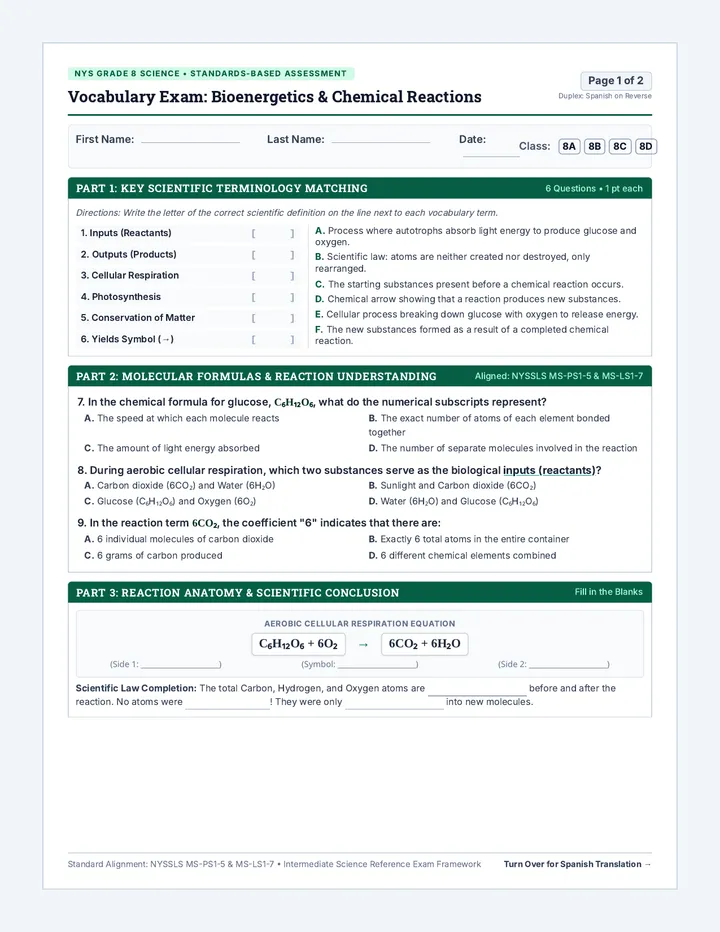
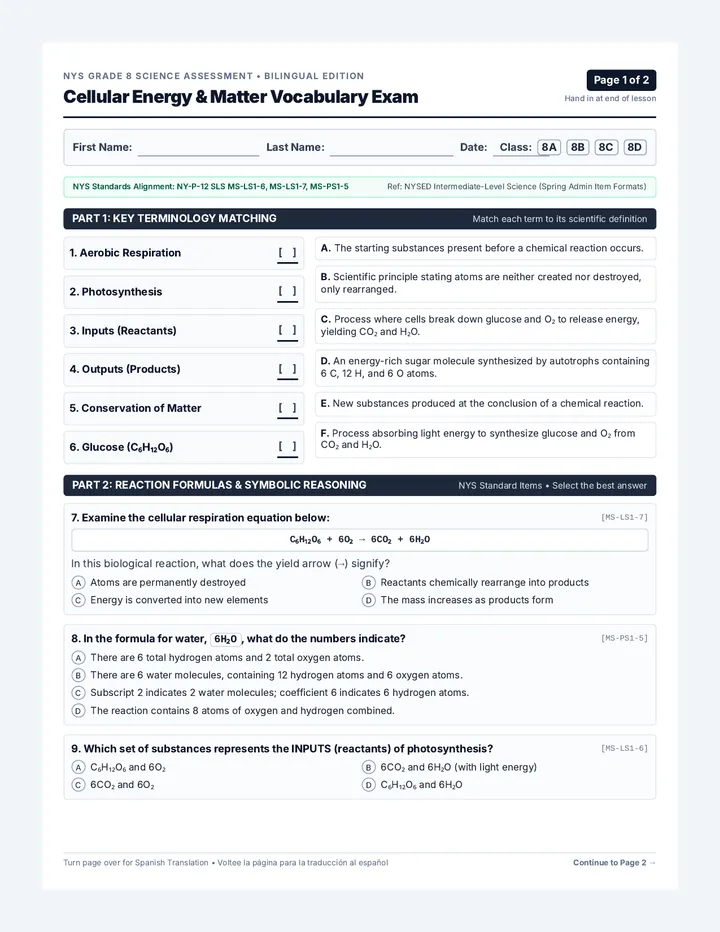
Time Allotted: 30 Minutes Page 1 of 2
PART 1: CELLULAR RESPIRATION & MATTER CONSERVATION
NYS Intermediate-Level Science Standards • MS-LS1-7 & MS-PS1-5
First Name:
Last Name:
Date:
Class (circle): 8A 8B 8C 8D
Cellular Respiration Reaction Reactants → Products
Inputs (Reactants) C6H12O6 + 6O2
→ Yields
Outputs (Products) 6CO2 + 6H2O
1 Constructed Response: Atom Accounting Graphic Organizer Attribution: NYS Grade 8 ILS Exam — June 2014, Questions 68–69 Adapted
Tally the number of atoms for each element on the reactant side and product side to determine if atoms are conserved.
| Element | Inputs (Reactants Side) | Outputs (Products Side) | Equal? |
|---|
| Carbon (C) Atomic #6 | From C6H12O6: | | |
| From 6CO2: | | | |
|
|
| Hydrogen (H) Atomic #1 | From C6H12O6:
| From 6H2O:
|
|
| Oxygen (O) Atomic #8 | From C6H12O6 + 6O2:
| From 6CO2 + 6H2O:
|
|
2 Multiple Choice: Cellular Respiration Inputs Attribution: NYS Grade 8 ILS Exam — June 2018, Question 28
During the cellular respiration reaction, which two substances are taken in as inputs (reactants) by living cells?
(A) Carbon dioxide and water
(B) Glucose and oxygen
(C) Oxygen and carbon dioxide
(D) Glucose and water
3 Multiple Choice: Conservation of Matter Attribution: NYS Grade 8 ILS Exam — June 2015, Question 14
In any chemical reaction, the total mass of the reactants equals the total mass of the products because atoms are —
(A) created during the reaction
(B) destroyed during the reaction
(C) rearranged to form new substances
(D) converted into heavier elements
4 Constructed Response: Scientific Conclusion Attribution: NYS Grade 8 ILS Exam — June 2015, Question 65 Adapted
Complete the scientific statement below based on your atom tally in Question 1:
Total Carbon (), Hydrogen (), and Oxygen () atoms are ________________________ before and after the reaction. No atoms were ________________________! They were only ________________________ into new molecules.
Explain in one complete sentence why this reaction proves the Law of Conservation of Matter:
Hand in this Do Now - Exit Slip at the end of this lesson
Tiempo Asignado: 30 Minutos Página 1 de 2
PARTE 1: RESPIRACIÓN CELULAR Y CONSERVACIÓN DE LA MATERIA
Estándares de Ciencias de Nivel Intermedio de NYS • MS-LS1-7 y MS-PS1-5
Nombre:
Apellido:
Fecha:
Clase (encierre): 8A 8B 8C 8D
Reacción de la Respiración Celular Reactivos → Productos
Entradas (Reactivos) C6H12O6 + 6O2
→ Produce
Salidas (Productos) 6CO2 + 6H2O
1 Respuesta Construida: Contabilidad de Átomos Atribución: Examen de Ciencias NYS Grado 8 — Junio 2014, Preguntas 68–69 Adaptadas
Cuenta el total de átomos de cada elemento en el lado de los reactivos y productos para determinar si se conservan.
| Elemento | Entradas (Lado Reactivos) | Salidas (Lado Productos) | ¿Igual? |
|---|
| Carbono (C) # Atómico 6 | De C6H12O6: | | |
| De 6CO2: | | | |
|
|
| Hidrógeno (H) # Atómico 1 | De C6H12O6:
| De 6H2O:
|
|
| Oxígeno (O) # Atómico 8 | De C6H12O6 + 6O2:
| De 6CO2 + 6H2O:
|
|
2 Opción Múltiple: Entradas de la Respiración Celular Atribución: Examen de Ciencias NYS Grado 8 — Junio 2018, Pregunta 28
Durante la reacción de respiración celular, ¿cuáles dos sustancias toman las células vivas como entradas (reactivos)?
(A) Dióxido de carbono y agua
(B) Glucosa y oxígeno
(C) Oxígeno y dióxido de carbono
(D) Glucosa y agua
3 Opción Múltiple: Conservación de la Materia Atribución: Examen de Ciencias NYS Grado 8 — Junio 2015, Pregunta 14
En cualquier reacción química, la masa total de reactivos es igual a la masa total de productos porque los átomos:
(A) se crean durante la reacción
(B) se destruyen durante la reacción
(C) se reorganizan para formar nuevas sustancias
(D) se transforman en elementos más pesados
4 Respuesta Construida: Conclusión Científica Atribución: Examen de Ciencias NYS Grado 8 — Junio 2015, Pregunta 65 Adaptada
Completa el enunciado científico a continuación según tu conteo de átomos en la Pregunta 1:
Los átomos totales de Carbono (), Hidrógeno () y Oxígeno () son ________________________ antes y después de la reacción. ¡No se ________________________ ningún átomo! Solo fueron ________________________ en nuevas moléculas.
Explica en una oración completa por qué esta reacción demuestra la Ley de Conservación de la Materia:
Hand in this Do Now - Exit Slip at the end of this lesson
Time Allotted: 30 Minutes Page 2 of 2
PART 2: PHOTOSYNTHESIS & MATTER CYCLING
NYS Intermediate-Level Science Standards • MS-LS1-6 & MS-LS2-3
First Name:
Last Name:
Date:
Class (circle): 8A 8B 8C 8D
Photosynthesis Reaction Light Energy Absorbed
Inputs (Reactants) 6CO2 + 6H2O
→ Yields
Outputs (Products) C6H12O6 + 6O2
5 Multiple Choice: Photosynthesis Reaction Attribution: NYS Grade 8 ILS Exam — June 2019, Question 32
Which biological process in autotrophic plant cells uses carbon dioxide, water, and light energy to produce glucose and oxygen?
(A) Cellular respiration
(B) Digestion
(C) Photosynthesis
(D) Decomposition
6 Multiple Choice: Matter Cycling Between Reactions Attribution: NYS Grade 8 ILS Exam — June 2016, Question 39
Which statement best describes the biochemical relationship between photosynthesis and cellular respiration?
(A) The products of photosynthesis serve as the reactants of cellular respiration.
(B) Both processes release carbon dioxide gas into the atmosphere.
(C) Animals perform photosynthesis, while plants perform only cellular respiration.
(D) Neither reaction obeys the Law of Conservation of Matter.
7 Constructed Response: Photosynthesis Atom Accounting Attribution: NYS Grade 8 ILS Exam — June 2022, Question 48 Adapted
| Element | Inputs (6CO2 + 6H2O) | Outputs (C6H12O6 + 6O2) | Equal? |
|---|
| Carbon (C) | | | |
| | | |
|
|
| Hydrogen (H) |
|
|
|
| Oxygen (O) |
|
|
|
8 Constructed Response: Scientific Explanation Attribution: NYS Grade 8 ILS Exam — June 2021, Questions 64–65 Adapted
Write an explanation for the relationship between the inputs of cellular respiration (Page 1) with the outputs of photosynthesis (Page 2):
(Identify the molecules, state how living organisms obtain them, and describe how matter cycles on Earth.)
Hand in this Do Now - Exit Slip at the end of this lesson
Tiempo Asignado: 30 Minutos Página 2 de 2
PARTE 2: FOTOSÍNTESIS Y CICLAJE DE LA MATERIA
Estándares de Ciencias de Nivel Intermedio de NYS • MS-LS1-6 y MS-LS2-3
Nombre:
Apellido:
Fecha:
Clase (encierre): 8A 8B 8C 8D
Reacción de la Fotosíntesis Energía Luminosa Absorbida
Entradas (Reactivos) 6CO2 + 6H2O
→ Produce
Salidas (Productos) C6H12O6 + 6O2
5 Opción Múltiple: Reacción de Fotosíntesis Atribución: Examen de Ciencias NYS Grado 8 — Junio 2019, Pregunta 32
¿Qué proceso biológico en las células vegetales autótrofas utiliza dióxido de carbono, agua y luz para producir glucosa y oxígeno?
(A) Respiración celular
(B) Digestión
(C) Fotosíntesis
(D) Descomposición
6 Opción Múltiple: Ciclaje de Materia entre Reacciones Atribución: Examen de Ciencias NYS Grado 8 — Junio 2016, Pregunta 39
¿Qué afirmación describe mejor la relación bioquímica entre la fotosíntesis y la respiración celular?
(A) Los productos de la fotosíntesis sirven como reactivos para la respiración celular.
(B) Ambos procesos liberan gas dióxido de carbono a la atmósfera.
(C) Los animales hacen fotosíntesis, mientras que las plantas solo hacen respiración celular.
(D) Ninguna de las reacciones cumple con la Ley de Conservación de la Materia.
7 Respuesta Construida: Contabilidad de Átomos Atribución: Examen de Ciencias NYS Grado 8 — Junio 2022, Pregunta 48 Adaptada
| Elemento | Entradas (6CO2 + 6H2O) | Salidas (C6H12O6 + 6O2) | ¿Igual? |
|---|
| Carbono (C) | | | |
| | | |
|
|
| Hidrógeno (H) |
|
|
|
| Oxígeno (O) |
|
|
|
8 Respuesta Construida: Explicación Científica Atribución: Examen de Ciencias NYS Grado 8 — Junio 2021, Preguntas 64–65 Adaptadas
Escribe una explicación sobre la relación entre las entradas de la respiración celular (Página 1) con las salidas de la fotosíntesis (Página 2):
(Identifica las moléculas, explica cómo las obtienen los seres vivos y describe cómo se cicla la materia.)
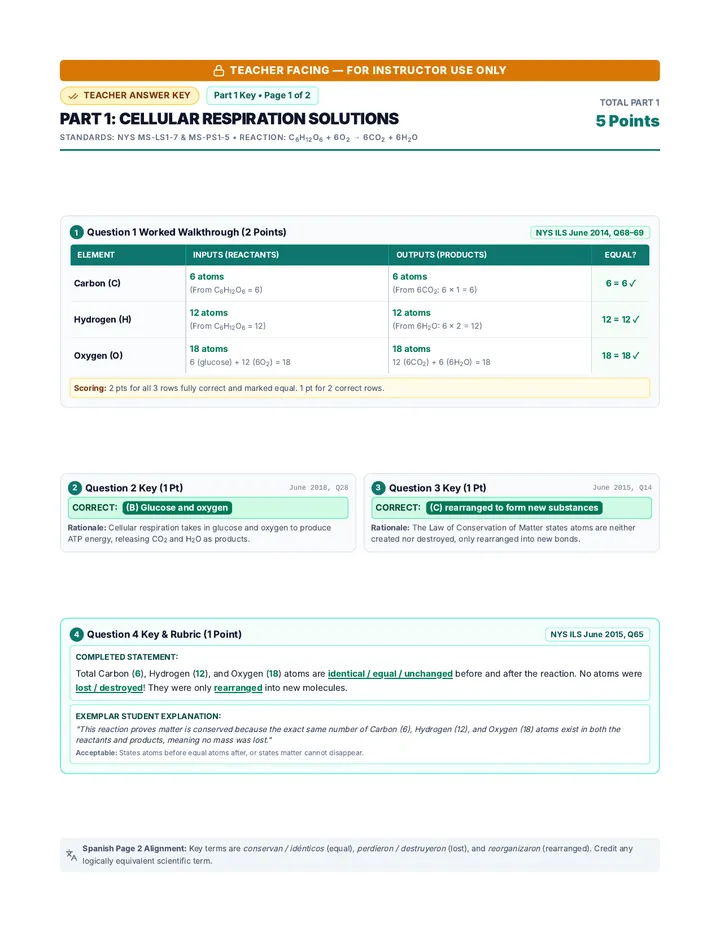
Cell Energy Answer Key
TEACHER FACING — FOR INSTRUCTOR USE ONLY
Teacher Answer Key Part 1 Key • Page 1 of 2
PART 1: CELLULAR RESPIRATION SOLUTIONS
Standards: NYS MS-LS1-7 & MS-PS1-5 • Reaction: C6H12O6 + 6O2 → 6CO2 + 6H2O
Total Part 1 5 Points
1 Question 1 Worked Walkthrough (2 Points) NYS ILS June 2014, Q68–69
| Element | Inputs (Reactants) | Outputs (Products) | Equal? |
|---|
| Carbon (C) | 6 atoms (From C6H12O6 = 6) | 6 atoms (From 6CO2: 6 × 1 = 6) | 6 = 6 ✓ |
| Hydrogen (H) | 12 atoms (From C6H12O6 = 12) | 12 atoms (From 6H2O: 6 × 2 = 12) | 12 = 12 ✓ |
| Oxygen (O) | 18 atoms 6 (glucose) + 12 (6O2) = 18 | 18 atoms 12 (6CO2) + 6 (6H2O) = 18 | 18 = 18 ✓ |
Scoring: 2 pts for all 3 rows fully correct and marked equal. 1 pt for 2 correct rows.
2 Question 2 Key (1 Pt) June 2018, Q28
CORRECT: (B) Glucose and oxygen
Rationale: Cellular respiration takes in glucose and oxygen to produce ATP energy, releasing CO2 and H2O as products.
3 Question 3 Key (1 Pt) June 2015, Q14
CORRECT: (C) rearranged to form new substances
Rationale: The Law of Conservation of Matter states atoms are neither created nor destroyed, only rearranged into new bonds.
4 Question 4 Key & Rubric (1 Point) NYS ILS June 2015, Q65
Completed Statement: Total Carbon (6), Hydrogen (12), and Oxygen (18) atoms are identical / equal / unchanged before and after the reaction. No atoms were lost / destroyed! They were only rearranged into new molecules.
Exemplar Student Explanation:
"This reaction proves matter is conserved because the exact same number of Carbon (6), Hydrogen (12), and Oxygen (18) atoms exist in both the reactants and products, meaning no mass was lost."
Acceptable: States atoms before equal atoms after, or states matter cannot disappear.
Spanish Page 2 Alignment: Key terms are conservan / idénticos (equal), perdieron / destruyeron (lost), and reorganizaron (rearranged). Credit any logically equivalent scientific term.
TEACHER FACING — FOR INSTRUCTOR USE ONLY
Teacher Answer Key Part 2 Key • Page 2 of 2
PART 2: PHOTOSYNTHESIS & MATTER CYCLING SOLUTIONS