Balance Point Slides Finding the Balance
Center of Mass in Irregular Polygons
The Balancing Act
Imagine a strange, flat wooden shape—not a square or a circle, but something jagged and irregular.
How can you find the exact point where it will balance perfectly on the tip of a pencil?
"The center of mass is the average position of all the parts of the system, weighted according to their masses."
Pencil Tip
Centroid vs. Center of Mass
The Centroid
The geometric center of a shape.
Based purely on the geometry and boundary.
Assuming uniform density, the centroid is the center of mass.
The Center of Mass (COM)
The point where gravity appears to act.
Depends on mass distribution .
If density is non-uniform, COM shifts away from the centroid.
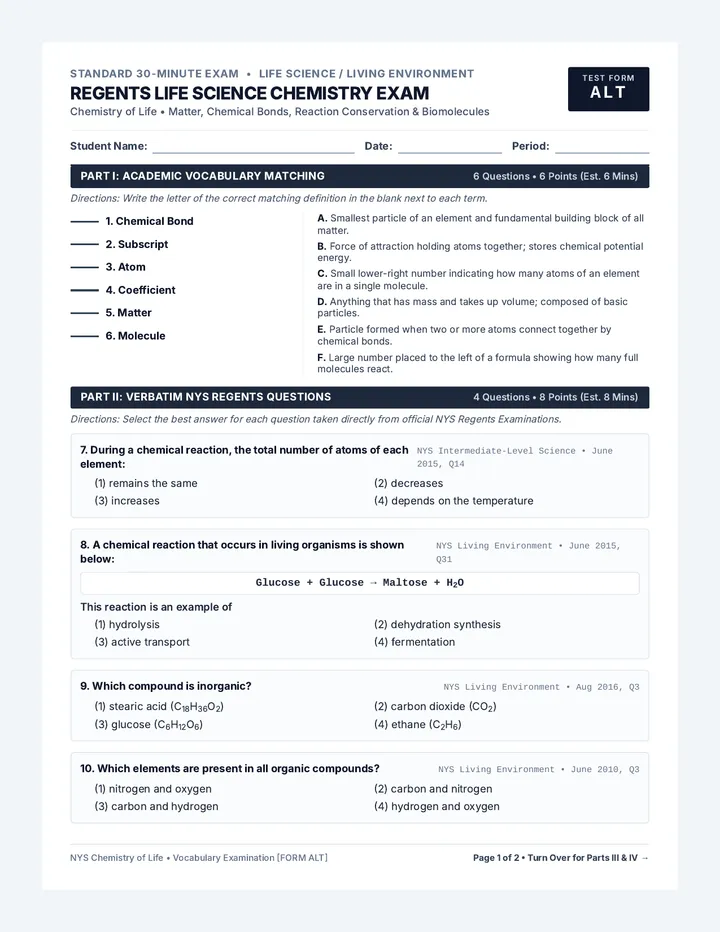
Geometric Decomposition
For complex shapes, we "break it down":
Split the shape into simple polygons (rectangles, triangles).
Find the centroid $(x_i, y_i)$ of each part.
Find the area $(A_i)$ of each part.
Calculate the weighted average:
\[ \bar{x} = \frac{\sum A_i x_i}{\sum A_i} \]
Experimental Tool: The Plumb Line
1
Suspend the shape from a single point so it hangs freely.
2
The COM must lie directly below the suspension point (vertical line).
3
Repeat from a different point. The intersection is the COM!
"Physics doesn't lie. Gravity always finds the center."
Centroid Hunt Worksheet Centroid Hunt Worksheet
Lesson 1: Center of Mass & Geometric Decomposition
Name:
Date:
Objective
Calculate the coordinates of the center of mass (centroid) for complex irregular polygons using the method of geometric decomposition.
X-Coordinate
\[ \bar{x} = \frac{\sum A_i x_i}{\sum A_i} \]
Y-Coordinate
\[ \bar{y} = \frac{\sum A_i y_i}{\sum A_i} \]
1 The L-Shape Bracket
10 cm
15 cm
6 cm wide
Thickness is uniform. Assume (0,0) at bottom-left.
Decompose the shape into two rectangles and fill the table below:
Part Area ($A_i$) Centroid $x_i$ Centroid $y_i$ $A_i x_i$ $A_i y_i$ 1 2 Total $\sum A =$ --- --- $\sum Ax =$ $\sum Ay =$
Final $\bar{x}$:
Final $\bar{y}$:
2 The "Keyhole" Plate
Calculate the centroid of a square metal plate (12cm x 12cm) with a circular hole of radius 3cm centered at (9cm, 9cm). Hint: Use a negative area for the hole.
12 cm
12 cm
Show your work below:
Final Centroid $(\bar{x}, \bar{y})$: ___________________________
Critical Thinking
If you were to balance the "Keyhole" plate on a finger, would the balance point be closer to the hole or further away from it than the geometric center of the square? Explain using the concept of mass distribution.
Finding Balance Teacher Guide Finding Balance
Teacher Facilitation Guide | Lesson 1
Duration
50-60 min
Lesson Overview
This lesson bridges the gap between abstract geometry and physical intuition. Students learn that for any rigid body, there exists a single point where the distribution of mass is perfectly balanced. This "center of mass" is critical for all future rotational physics topics, as it defines the point about which unconstrained rotation occurs.
Core Objectives
Define and locate the centroid of simple and composite 2D shapes.
Experimentally verify the center of mass using the plumb line method.
Mathematically derive COM coordinates via geometric decomposition.
Required Materials
Cardboard / Foam core
Scissors
String & small weights
Push pins & rulers
Scientific calculators
Pacing & Instruction
0-10 min
The Hook: Pencil Balance
Give each student an irregular cardboard shape. Challenge them to find the "magic point" where it balances on a finger. Introduce the term Center of Mass .
10-20 min
Theory: Centroids & Symmetry
Use the Balance Point Slides . Explain that for uniform materials, COM = Centroid. Discuss how symmetry axes instantly reveal the COM location.
20-40 min
Skill Build: Decomposition
Walk through the L-bracket example on the Centroid Hunt Worksheet . Emphasize that choosing a clever origin (0,0) makes the math much easier.
40-60 min
Lab: Plumb Line Verification
Students use strings and weights to find the COM of their irregular shapes experimentally. They mark the point and then check it against their calculated centroid.
Teacher Notes: Common Misconceptions
COM must be "inside" the material:
Show a ring or a donut. The center of mass is in the empty space in the middle. The "magic point" doesn't have to be on the physical object!
COM is always the geometric center:
This only holds for uniform density. Mention that a hammer's COM is very close to the head because that's where the mass is concentrated.
Worksheet Quick-Key
Problem 1 (L-Bracket)
$\bar{x} \approx 3.67 \text{ cm}$, $\bar{y} \approx 5.67 \text{ cm}$ (assuming 10x15 shape with 6cm segments)
Problem 2 (Keyhole Plate)
$\bar{x} = \bar{y} \approx 5.4 \text{ cm}$ (shifted away from the hole toward the origin)
Spinning Solids Slides Axis of Action
Rotational Symmetry and Stable Motion
Why the difference?
It's easy to spin a pencil along its long axis (between your palms).
But it's "harder" and more wobbly to spin it end-over-end .
What changed?
Long Axis
Transverse Axis
The Axis of Rotation
Central Axis
Passes through the Center of Mass (COM). Rotation is naturally stable.
Eccentric Axis
Offset from the COM. Causes "wobble" and requires centripetal force to keep the axis fixed.
Stable
Unstable
Geometric Symmetry
Symmetry axes are the "path of least resistance" for rotation.
Sphere
Infinite axes of symmetry through the center. Rotates the same way in any direction.
Cylinder
One longitudinal axis. Infinite transverse axes through the center.
Cube
Limited axes: Face-to-Face, Edge-to-Edge, or Corner-to-Corner.
The Math of Shifting
What if we rotate about a point other than the COM?
We use the Parallel Axis Theorem :
\[ I = I_{cm} + Md^2 \]
$I$ Total Inertia
$I_{cm}$ Inertia at Center
$M$ Total Mass
$d$ Distance shifted
Symmetry Cheat Sheet Symmetry & Spin
Student Reference Guide
Physics: Rigid Body Dynamics
Common Rotation Axes
Longitudinal Axis
An axis that runs lengthwise through the longest dimension of an object (e.g., down the center of a rod or cylinder).
Transverse Axis
An axis perpendicular to the longitudinal axis, passing through the Center of Mass.
Geometric Symmetry Elements
Shape Primary Symmetry Axis Rotational Properties Sphere Any diameter Perfectly isotropic. Inertia is identical for any axis through the center. Cylinder / Rod Central length axis Highest symmetry along length. Rotating transverse to length involves more mass far from the axis. Thin Hoop Normal to plane All mass is equidistant ($R$) from the central axis. Maximum possible inertia for its mass/radius. Cube Face-center-to-Face-center Discrete rotational symmetry (90°). Less stable than rounded objects for rolling.
Parallel Axis Theorem
Allows you to find the Moment of Inertia $(I)$ for an axis that is parallel to an axis through the center of mass, but shifted by a distance $(d)$.
\[ I = I_{cm} + Md^2 \]
$I$: Moment of Inertia for new axis
$I_{cm}$: Moment of Inertia for COM axis
$M$: Total mass of the object
$d$: Distance between the two axes
Stability Tip
Objects are most stable when rotating about their axis of maximum or minimum moment of inertia (Intermediate Axis Theorem). This is why a spinning football is stable along its long axis!
Radius of Gyration
The "effective radius" where the mass could be concentrated as a point mass to have the same inertia: $k = \sqrt{I/M}$.
Axes of Action Worksheet Axes of Action
Symmetry & Shift Worksheet
Name: ________________________
Date: ________________________
1. The Symmetry Hunt
For each geometric solid below, identify the number of unique axes of symmetry that pass through the Center of Mass (COM).
A. Uniform Sphere
B. Long Rod
C. Uniform Cube
2. Relative Inertia
Rank the following axes of rotation for a uniform cylinder from Lowest Inertia (1) to Highest Inertia (3) . Assume the mass and radius are the same for all scenarios.
___
Longitudinal axis through the center
Mass is distributed close to the axis (Radius $R$).
___
Transverse axis through the Center of Mass
Mass extends along the length $L$ away from the center.
___
Transverse axis through one end of the cylinder
Mass is shifted entirely to one side of the pivot.
3. The Shift Calculation
A thin rod has a mass of $M = 2.0\text{ kg}$ and a length of $L = 1.0\text{ m}$. The moment of inertia through its center is $I_{cm} = \frac{1}{12}ML^2$.
A. Calculate $I_{cm}$ for this rod:
B. Use the Parallel Axis Theorem ($I = I_{cm} + Md^2$) to find the inertia if rotated about its end (shift $d = L/2$):
Verify the result
The textbook formula for a rod rotated about its end is $I = \frac{1}{3}ML^2$. Does your calculation in part (B) match this? Show the algebraic proof.
Challenge
If you double the distance $d$ between the COM axis and the new axis, by what factor does the $Md^2$ term increase?
Hoop vs Disk Slides Mass Distribution Duel
The Geometry of Inertia: Hoop vs. Disk
The Identical Twin Paradox
Consider two objects:
Hoop (Ring): Mass $M$, Radius $R$
Disk (Coin): Mass $M$, Radius $R$
They have the exact same mass and the exact same size. If you race them down a ramp, will it be a tie?
Tie or No Tie?
Where is the Mass?
The Hoop
Every single atom in the hoop is at the maximum distance ($R$) from the center.
\( I_{hoop} = MR^2 \)
The Disk
The mass is spread out. Some atoms are at $R$, but many are much closer to the axis .
\( I_{disk} = \frac{1}{2}MR^2 \)
Inertia measures resistance to rotation.
The hoop is twice as "stubborn" as the disk!
Flywheels and Performance
Engineers use this geometry to their advantage:
Flywheels: Concentrating mass on the outer rim (hoop-like) stores the most energy.Racing Wheels: Lighter rims reduce rotational inertia, allowing for faster acceleration.
High Inertia Design
Who wins the ramp?
Resistance ($I$) vs. Acceleration ($a$)
"The harder an object is to spin, the more potential energy it wastes on rotation, leaving less for forward motion."
High Inertia = Slow Start
Low Inertia = Fast Start
Inertia Inquiry Lab Inertia Inquiry Lab
Lesson 3: The Geometry of Resistance
Name:
Section:
Thought Experiment
You have a hollow hoop and a solid disk . They have identical mass $(M)$ and identical radius $(R)$. If you apply the same torque to both for the same amount of time, which one will have a higher final angular velocity? Circle your choice and explain your reasoning.
Hollow Hoop Solid Disk
Reasoning:
I think... because...
Experimental Trials
Release both objects from the top of the ramp simultaneously. Record which object wins each heat.
Trial # Ramp Angle (°) Winner (Hoop/Disk) Notes/Observation 1 2 3
Analysis Q1
Based on your results, which object has a higher resistance to beginning rotation? How does its win/loss record reflect this?
Analysis Q2
Think about "Average Radius". In which object is the mass, on average, further from the center? Does this help or hurt acceleration?
The Mathematical Proof
The total energy of the object at the top of the ramp is Potential Energy ($U = mgh$). As it rolls, it splits this energy into Translational Kinetic Energy ($\frac{1}{2}mv^2$) and Rotational Kinetic Energy ($\frac{1}{2}I\omega^2$).
If $I$ is LARGE...
More energy is "stolen" by rotation.
Velocity $v$ will be: ___________
If $I$ is SMALL...
Less energy goes to rotation.
Velocity $v$ will be: ___________
Inertia Inquiry Answer Key Inertia Inquiry Key
Teacher Answer Key & Facilitation
Part 1 & 2: Predictions & Data
The Winner
The Solid Disk will always win.
Regardless of ramp angle, mass, or radius, the disk's smaller "shape factor" ensures it accelerates faster.
Common Observations
The disk pulls ahead immediately.
The gap between them increases over time.
Air resistance is negligible for these shapes.
Analysis Questions Key
Q1: Which object has higher resistance?
The Hoop . Because its "win record" is 0 wins / All losses, it clearly has a harder time converting potential energy into kinetic linear motion. It is "stubborn" because all its mass is at the maximum radius.
Q2: The "Average Radius" Concept
In the Hoop , the mass is on average further from the axis. Resistance (Inertia) depends on $r^2$. Mass that is further away "costs" more energy to spin up, which hurts linear acceleration.
Mathematical Conclusion
Hoop ($I = MR^2$)
Final speed formula:
\[ v = \sqrt{gh} \]
50% of energy goes to rotation.
Disk ($I = \frac{1}{2}MR^2$)
Final speed formula:
\[ v = \sqrt{\frac{4}{3}gh} \]
33% of energy goes to rotation.
Since $\sqrt{1.33} > \sqrt{1}$, the Disk is ~15% faster at the finish line.
Facilitation Tip
Ensure the ramp is wide enough for both to roll side-by-side. If the hoop wiggles, check for "wobble" (eccentric rotation) which adds friction. Emphasize that mass doesn't matter —a giant lead disk will tie with a tiny plastic disk!
Shape Factor Slides The Shape Constant
Calculating Shape Factors and Rolling Acceleration
The Magic Number: $k$
Most moment of inertia formulas for common solids follow a pattern:
\[ I = kMR^2 \]
The constant $k$ is the Shape Factor .
Common Shape Factors:
Hoop: k = 1.0
Hollow Sphere: k = 2/3 (0.67)
Solid Disk: k = 1/2 (0.50)
Solid Sphere: k = 2/5 (0.40)
The Master Formula
How fast an object accelerates down a ramp ($\theta$) depends only on its shape factor ($k$):
\[ a = \frac{g \sin \theta}{1 + k} \]
Notice what is missing: Mass ($M$) and Radius ($R$) cancel out!
Case Study: Spheres
Hollow Ball
$k = 0.67$
Acceleration: $0.6 \times g \sin \theta$
Solid Ball
$k = 0.40$
Acceleration: $0.71 \times g \sin \theta$
Solid wins by roughly 18%!
Predicting the Race
Tomorrow, we race. Your job today is to memorize the ranking of these "k" factors.
Fastest
Lowest $k$ (Solid Sphere)
Slowest
Highest $k$ (Hoop)
Remember: Lower Inertia = Faster Rolling Acceleration!
Rolling Resistance Problems Rolling Resistance
Lesson 4: Shape Factors & Acceleration
Name: ________________________
Score: _________ / 20
Inertia
\( I = kMR^2 \)
Acceleration
\( a = \frac{g \sin \theta}{1+k} \)
Final Speed
\( v = \sqrt{\frac{2gh}{1+k}} \)
1 The Identical Spheres
A solid sphere ($k = 0.4$) and a hollow sphere ($k = 0.67$) are released from the top of a ramp with an incline of $\theta = 20^\circ$.
A. Calculate the acceleration of the solid sphere:
B. Calculate the acceleration of the hollow sphere:
Analysis
By what percentage is the solid sphere faster than the hollow sphere in terms of acceleration? Show your calculation.
2 Energy Conservation Duel
A solid disk ($k=0.5$) rolls down a ramp of height $h = 2.0\text{ m}$.
A. What is its linear velocity at the bottom?
B. If you doubled the mass of the disk, how would the final velocity change? Explain.
Critical Check
Why does a sliding block (no rotation) always beat any rolling object down a frictionless ramp?
3 Mystery Object
An unknown rolling object accelerates at $0.45 \times (g \sin \theta)$. Use the acceleration formula to solve for its shape factor $k$.
Based on common shapes, what kind of object is this likely to be?
Shape Factor Teacher Guide Shape Factor Quick Guide
Teacher Resource | Lesson 4
Inertia Constants Table
Solid Shape Formula ($I_{cm}$) Shape Factor ($k$) Acceleration ($a$) Thin Hoop / Ring \( MR^2 \) 1.0 \( 0.50 \times g \sin \theta \) Hollow Cylinder \( \frac{1}{2}M(R_1^2 + R_2^2) \) ~0.7 - 0.9 Varies Hollow Sphere (Shell) \( \frac{2}{3}MR^2 \) 0.67 \( 0.60 \times g \sin \theta \) Solid Disk / Cylinder \( \frac{1}{2}MR^2 \) 0.50 \( 0.67 \times g \sin \theta \) Solid Sphere \( \frac{2}{5}MR^2 \) 0.40 \( 0.71 \times g \sin \theta \)
Worksheet Answer Key
Problem 1: The Identical Spheres
A. Solid: $a = \frac{9.8 \sin 20}{1.4} \approx 2.39 \text{ m/s}^2$
B. Hollow: $a = \frac{9.8 \sin 20}{1.67} \approx 2.01 \text{ m/s}^2$
Analysis: Solid is ~19% faster.
Problem 2: Energy Duel
A. $v = \sqrt{\frac{2(9.8)(2.0)}{1.5}} = \sqrt{26.13} \approx 5.11 \text{ m/s}$
B. No change. Mass cancels in the energy conservation equation for rolling.
Problem 3: Mystery Object
Equation: $0.45 = \frac{1}{1+k} \rightarrow 1+k = \frac{1}{0.45} \rightarrow 1+k = 2.22 \rightarrow \mathbf{k = 1.22}$
This object is more resistive than a hoop—likely a spool or an object with mass concentrated far beyond the pivot point.
Scaling Hint
Remind students that while $a$ depends on $k$, the actual time to reach the bottom also depends on the length of the ramp. Use $d = \frac{1}{2}at^2$ if you want them to calculate finishing times.
Pre-Race Tip
Students often confuse the hollow sphere (0.67) and hollow cylinder (1.0). Ensure they visualize that the cylinder has mass spread all along the sides, while the sphere curves back toward the axis at the poles.
Race Day Slides THE GREAT GEOMETRIC RACE
Final Challenge
The Starting Lineup
Solid Sphere
k = 0.40
Hollow Sphere
k = 0.67
Solid Disk
k = 0.50
Hollow Ring
k = 1.00
"Physics prediction: Finishing order is determined by k-factor alone!"
Experimental Setup
Rules of the Race:
Release simultaneously using a flat board.
Zero initial velocity.
Clean, smooth surface (minimize friction).
Use video analysis or stopwatches for timing.
FINISH LINE
Theory vs. Reality
What could go wrong? Why might our predictions fail?
Air Resistance
Affects low-mass, large-volume objects more significantly.
Sliding/Slipping
If the ramp is too steep, objects might slide instead of rolling purely.
Internal Friction
Deformation of soft materials (like a tennis ball) drains energy.
Ready to Race?
Finalize your predictions on the Lab Report.
Predict
Measure
Celebrate
Great Geometric Race Lab Report Geometric Race Report
Lesson 5: Experimental Validation
Team Name: _________________
Engineers: __________________
1. The Theoretical Bracket
Rank your contenders from 1st (Fastest) to 4th (Slowest) based on their k-factors .
1st Place
Predicted k: ______
2nd Place
Predicted k: ______
3rd Place
Predicted k: ______
4th Place
Predicted k: ______
2. Race Times
Contender Trial 1 (s) Trial 2 (s) Trial 3 (s) Average (s) Solid Sphere Hollow Sphere Solid Disk Hollow Ring
Statistical Accuracy
Did your actual finishing order match your theoretical bracket? If there was an upset (e.g., a disk beating a sphere), what experimental error caused it?
Geometry vs. Mass
Pick two objects with very different masses (e.g. a heavy marble vs a light foam sphere). Record their race result. Did mass influence the outcome? Why or why not?
Final Takeaway
In three sentences, explain how the geometric distribution of mass determines the "rolling winner." Use the terms inertia , energy , and linear velocity .
Race Setup Guide Race Setup Guide
Teacher Guide | Lesson 5
Overview
The Great Geometric Race is the capstone activity for the rotational inertia sequence. It is designed to demonstrate that mass distribution (the "k-factor") is the sole determinant of rolling acceleration, provided friction is minimized and the objects roll without slipping.
Theoretical Finishing Order
Solid Sphere ($k=0.40$) - ChampionSolid Disk ($k=0.50$)Hollow Sphere ($k=0.67$)Hollow Hoop ($k=1.00$) - Last
Required Gear
Wide plywood ramp
Meter sticks
Selection of spheres/disks
Stopwatches / Phones
Bubble level
Pro-Tips for Accuracy
The Release Board
Instead of using hands, use a ruler or flat piece of wood to hold all objects at the top. Lift the board quickly and vertically to ensure an identical start time for all contenders.
Ramp Angle
Keep the ramp angle low ($5^\circ$ to $10^\circ$). If the ramp is too steep, the objects will slide instead of rolling. If they slide, rotational inertia is bypassed and the results will be a tie (or determined by friction coefficients).
Object Variations
Avoid objects that are very light (like ping-pong balls) as air resistance becomes a significant factor. Use heavier marbles, billiard balls, and steel disks where possible.
Error Analysis
If the hollow sphere beats the solid disk (it shouldn't), have students inspect the disk for an uneven axis or the sphere for being "thicker" than a perfect shell.
Discussion & Debrief
Prompt 1: "If we performed this race on the Moon, would the finishing order change? Why?"
Prompt 2: "Which object stores the most energy at the bottom? The winner or the loser?"linear energy while the loser has more rotational energy.)
DOCUMENT: TG-L5-RACE-SETUP | REVISION: 2026.01
CONFIDENTIAL: TEACHER USE ONLY