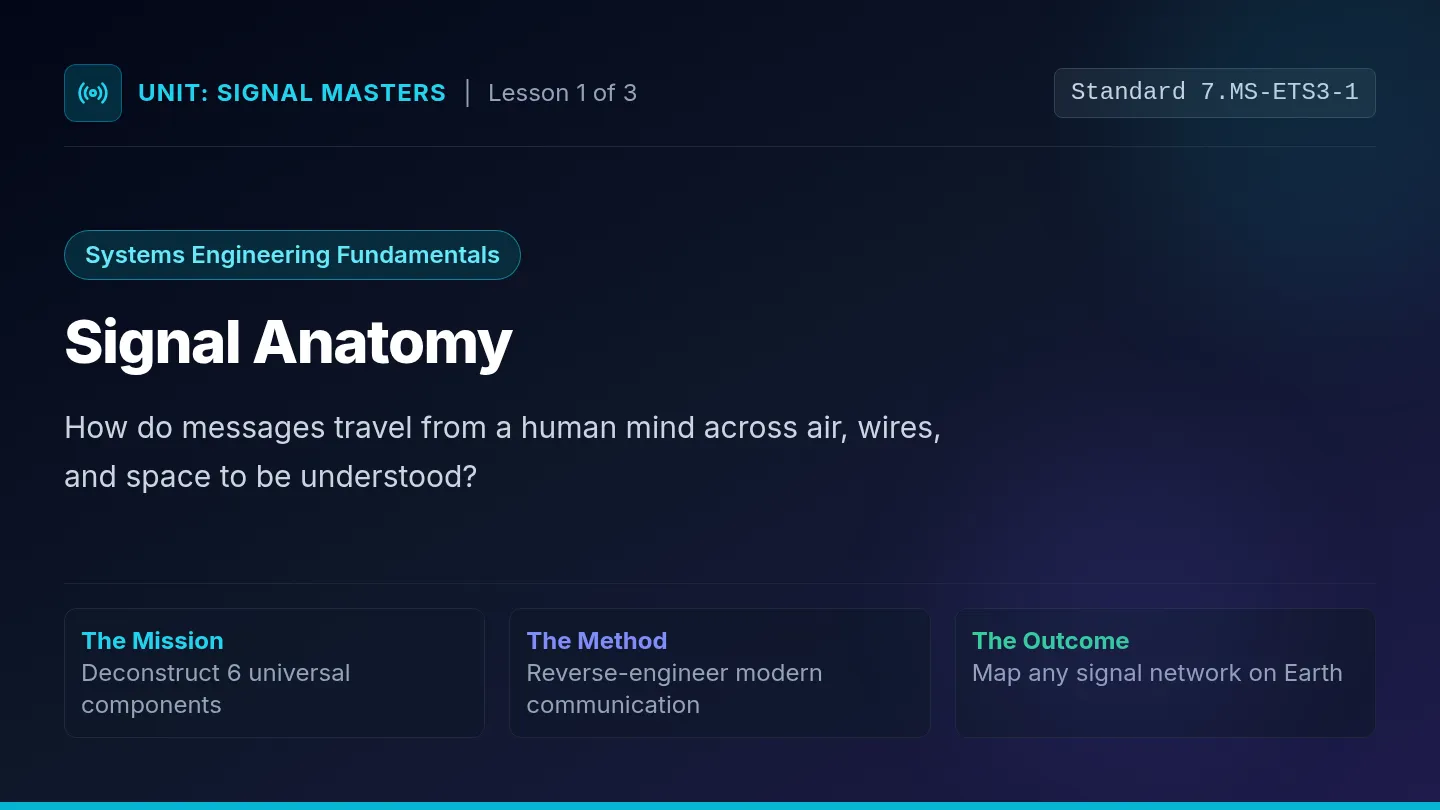
A two-day 7th grade physical science sequence aligned with McGraw Hill Inspire Science exploring how matter is composed of particles too small to see and how thermal energy dictates particle motion across states of matter.
Turn to your elbow partner: Sort each into Matter vs Non-Matter!
00:28 - 00:40 • Independent Practice 12 Minutes Focus
Evidence of the Unseen
Complete Part 3 of your Dossier: Analyze 3 observable phenomena that prove matter consists of individual moving particles.
Scenario A
Deflating Balloon
Why does a tied balloon shrink over 3 days even though there is no hole?
Scenario B
Sugar in Water
Why does sugar disappear from sight, but the water tastes sweet and gains mass?
Scenario C
Tea Diffusion
Why does tea color completely spread through still water without stirring?
Use CER (Claim, Evidence, Reasoning) in your written responses.
00:40 - 00:45 • Evaluate Exit Ticket (5 Min)
Day 1 Mastery Check
1
Define matter in your own words. Why is air considered matter while sunlight is not?
2
About how many atoms thick is a standard sheet of notebook paper?
3
Explain how a deflating balloon proves that air is made of tiny separate particles rather than a solid sheet of substance.
Turn in Part 4 before you leave today! Tomorrow: Particle Motion & Thermal Energy
Student Name: ___________________________
4 Independent Practice: Evidence of Invisible Particles (12 Min)
Elaborate
Scientists gather macro evidence to prove micro reality. Read each scenario and provide scientific reasoning using the particle model of matter.
Scenario A: The Deflating Party Balloon
A latex birthday balloon is tightly tied with zero holes. Over 3 days, it slowly shrinks and wilts. How does this prove that the air inside is made of tiny, discrete particles rather than a continuous solid?
Scenario B: Dissolving Sugar in Tea
When 10 grams of white sugar crystals are stirred into warm tea, the crystals disappear completely. Yet, the liquid tastes sweet and its total mass increases by exactly 10 grams. Where did the sugar go?
Scenario C: Macro Claim-Evidence-Reasoning (CER)
A classmate says, "Since we cannot see atoms with our bare eyes, we cannot be certain they are real." Write a brief 2-sentence counter-argument using one piece of scientific evidence from today.
Part 5: Exit Ticket • Mastery Check (5 Min)
Turn In to Teacher
1. Which statement best explains why air is classified as matter?
A) Air can be felt when wind blows B) Air has mass and takes up volume C) Air is transparent and odorless D) Air transfers light energy
2. Notebook paper is approximately 1,000,000 atoms thick. What does this scale tell us about atoms?
3. Why did the peppermint scent spread across the room even with zero air currents?
Atomic Architecture • Student Dossier Page 2 of 2
Scenario C (CER / Proof):On-Grade: Indirect proof (diffusion, mass conservation) + direct STM imagery. | 4th Grade: Completes starter: "STM [microscope] can map individual atoms."
5 Part 5: Exit Ticket Dual-Track Key
Q1 Answer: B
Matter has mass/weight and takes up volume/space. (Identical answer on both tracks).
Q2 Answer: Extreme Scale
On-Grade: 1M atoms thick proves extreme scale. Scaffolded: TRUE (All matter is made of atoms).
Q3 Answer: Particle Motion
Scent molecules moved/spread randomly through empty-looking space to reach the nose.
Teacher: Administer Exit Tickets. Both tiers measure whether students grasp that temperature reflects particle speed and affects spacing.
Tier 1: On Grade Level Track
Uses Standard Student Dossier. Focuses on kinetic molecular theory terminology, quantitative relationship between temperature and velocity, and explaining pressure changes via particle collision frequency.
Tier 2: 4th Grade Reading Level Track
Uses Scaffolded Science Guide. Provides everyday analogies (shivering particles, bumper cars), chunked cloze tasks with targeted word banks, paired visual models, and focused cause-and-effect sentence starters.
00:18 - 00:28 • Guided Practice State Modeling Drill
Analyze the Particle Models
Model Box A
24 spheres aligned in neat rows with tiny vibration brackets: ((•)) ((•))
Identify: Solid, Liquid, or Gas?
Model Box B
18 spheres touching at bottom of box with curved arrows sliding past each other
Identify: Solid, Liquid, or Gas?
Model Box C
6 widely spaced spheres with long straight arrows pointing in random directions
Identify: Solid, Liquid, or Gas?
Discussion Question: If we add thermal energy to Box B, what changes occur to the particle speed, spacing, and state?
Confirm your answers with your partner on Part 3 of your dossier.
00:28 - 00:40 • Independent Practice 12 Minutes Focus
Thermal Energy & Particle Scenarios
Complete Part 4 of your dossier: Connect submicroscopic particle behavior to macro observations.
Scenario 1
Car Tire Pressure
Why does a car's low tire pressure warning light turn on during the first freezing morning of winter?
Scenario 2
Flask & Balloon
When an uninflated balloon attached to an empty glass flask is placed in hot water, it inflates. Why?
Scenario 3
Cold Glass "Sweat"
Why do liquid water droplets form on the outside of an ice-cold lemonade glass on a warm summer day?
Always mention particle kinetic energy, speed, and collision rate in your reasoning.
00:40 - 00:45 • Evaluate Exit Ticket (5 Min)
Day 2 Mastery Check
1
What is the scientific definition of temperature in terms of particles?
2
Contrast particle movement in a solid versus a gas. How do their attractive forces compare?
3
Explain using kinetic theory why food coloring diffused much faster in hot water than in ice-cold water.
Turn in Part 5 before the bell rings! 2-Day Unit Complete: Particle Nature of Matter
Elaborate
Apply kinetic molecular theory to explain each real-world phenomenon. Be sure to reference particle velocity, spacing, and kinetic energy.
Scenario 1: Winter Morning Car Tire Pressure
On the first freezing morning in December (-5°C), a driver finds their tire pressure light on. No air has leaked out of the tire. Why did the pressure drop?
Scenario 2: The Flask & Balloon Demonstration
A rubber balloon is sealed over the opening of an empty glass bottle. When placed in a bowl of boiling water, the balloon stands up and inflates. Explain the submicroscopic cause.
Scenario 3: "Sweating" Iced Beverage Glass
Water droplets collect on the outside of a glass filled with ice water on a warm humid afternoon. Explain what happens to the energy and motion of gaseous water vapor particles in the air as they hit the cold glass surface.
Part 5: Exit Ticket • Mastery Check (5 Min)
Turn In to Teacher
1. When the temperature of a sample of liquid water increases, what happens to its particles?
A) Particles expand and grow bigger B) Particles move faster and push apart C) New particles are created by heat D) Attractive forces become stronger
2. How does the arrangement and motion of particles in a solid differ from those in a gas?
3. Using kinetic molecular theory, explain why food coloring dispersed faster in hot water than cold water.
Motion in Matter • Student Dossier Page 2 of 2
Q1 Answer: Move Faster
On-Grade: B (move faster and push apart). 4th Grade: A (they move faster). Heat = speed.
Q2 Answer: Gas State
On-Grade: Solid vibrates in grid; gas flies fast far apart. 4th Grade: C (Gas = bumper cars).
Q3 Answer: Collision Speed
Hot water particles move faster and bump the food dye particles outward with greater energy.
McGraw Hill Inspire Science • Grade 7 Physical Science Motion in Matter • Dual-Track Teacher Key
Words: slower / less
On a freezing cold morning, the tire pressure warning light turns on even though no air leaked out.
Sentence Starter: Because it is cold, air particles inside the tire move and push with force against the walls.
Story 2: Balloon on a Warm Bottle
Words: speed up / push
An empty balloon is put over an empty bottle. When the bottle is put into hot water, the balloon puffs up!
Sentence Starter: The heat causes the air particles inside to and outward against the balloon.
Story 3: "Sweaty" Ice Cup
Words: slow down / water drops
On a warm day, drops of water form on the outside of a cup of ice water.
Sentence Starter: Gas particles in the air hit the cold glass, , and turn into .
Exit Ticket: Check for Understanding (5 Min)
Hand In
1. When something gets hotter, what happens to its particles?
A) They move faster B) They freeze still
2. Which state of matter has particles that are spaced far apart and move like fast bumper cars?
A) Solid B) Liquid C) Gas
3. Finish the sentence: Hot water spread the food dye faster because hot water particles move .
Motion in Matter • Scaffolded Science Guide Page 2 of 2