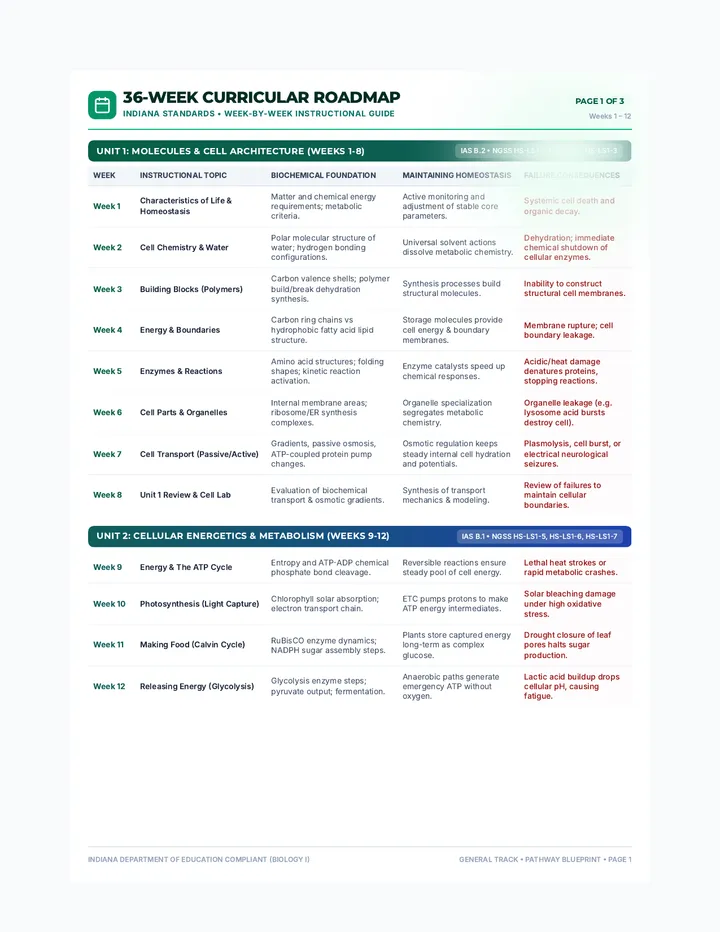
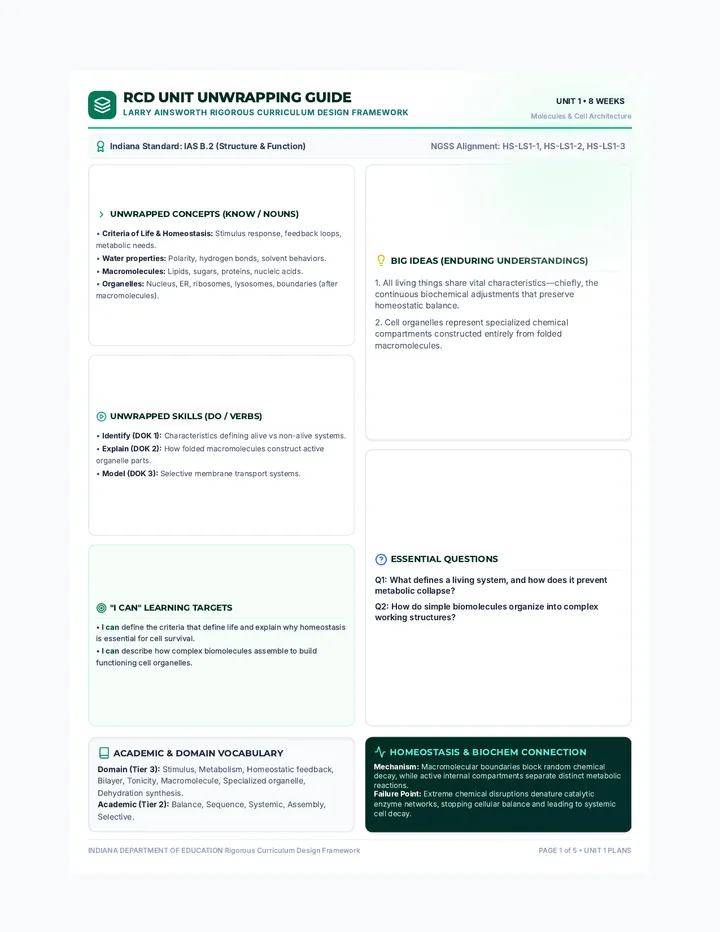
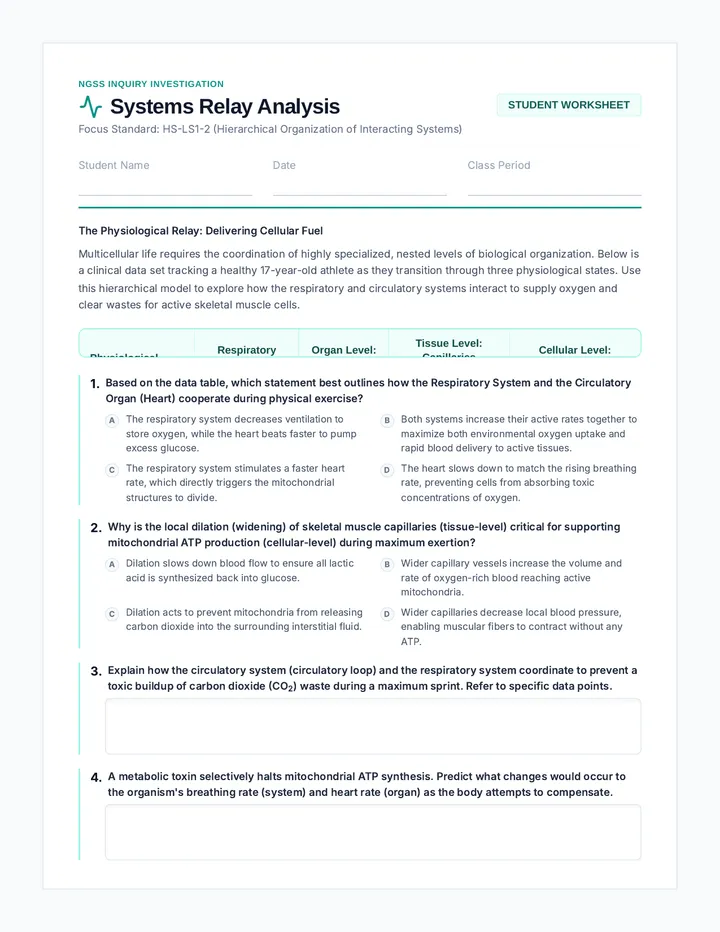
Precision Tools Lab Worksheet Precision Tools Lab
Lesson 1: Laboratory Glassware & Safety
NAME: ___________________________
DATE: ___________________________
The Hook: Is a Beaker Good Enough?
Today we investigate the difference between "rough" and "precise" measurements.
Objective
Compare the accuracy of a beaker, a graduated cylinder, and a volumetric flask by measuring the mass of 50.0 mL of distilled water.
Lab Setup
Analytical Balance
100 mL Beaker
50 mL Graduated Cylinder
50 mL Volumetric Flask
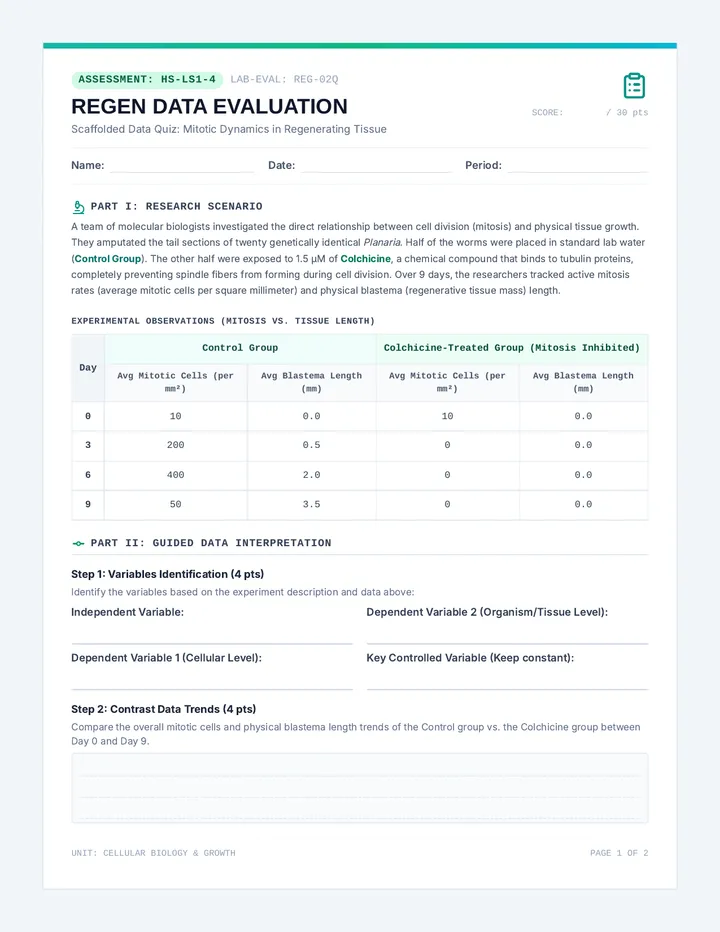
Experimental Data
Glassware Type Mass of Water (g) Density (g/mL) % Error 100 mL Beaker 50 mL Graduated Cylinder 50 mL Volumetric Flask
Analysis & Reflections
1. Which piece of glassware came closest to the expected density of water (\(1.00 \, \text{g/mL}\))? Why?
2. Based on your results, if you needed to prepare a solution with an exact concentration of \(0.100 \, \text{M}\), which glassware would you choose? Explain.
3. Describe the shape of the volumetric flask. How does this specific shape contribute to its high precision compared to a wide beaker?
Safety Check
Always wear safety goggles when handling glassware. Inspect glassware for cracks or "stars" before use. If any glass breaks, inform the teacher immediately and do not touch the shards.
Precision Tools Slides Mastering Precision
Laboratory Glassware and Safety Techniques for the Modern Chemist
Why Does it Matter?
In chemistry, concentration is everything. A 1% error in measurement can mean the difference between a successful experiment and a dangerous reaction.
Recall the Lab:
"Is a beaker precise enough to make a 0.100 M solution?"
[Visual: Beaker vs. Volumetric Flask comparison diagram]
Rough Measurement
Beakers & Erlenmeyers
Used for mixing, heating, and holding liquids.
NEVER used for precise volume measurements.
Tolerance: ±5% to ±10%
The Rule of Thumb:
If it has a pouring spout and no narrow neck, it's for holding , not measuring .
Precision Tools
Volumetric Flask
Designed to contain a single specific volume at a specific temperature (usually 20°C).
Calibration mark on a narrow neck.
Tolerance: as low as ±0.01 mL!
Graduated Cylinders
Good for general measuring, but not for "standard solutions."
TC vs TD:
TC: To Contain (Flasks)
TD: To Deliver (Pipettes/Cylinders)
Reading the Meniscus
The Golden Rule of Volume Measurement
Water molecules "climb" the glass walls, creating a curve.
👁️
Read at Eye Level
from the bottom of the curve.
Wait for the liquid to settle before making your final reading!
Safety First
Handling Acids
Always add acid to water (AA ). Doing the reverse can cause violent splattering due to heat.
Personal Protection
Goggles are mandatory. Closed-toe shoes and gloves required for concentrated stocks.
Glassware Care
Check for cracks. Never heat volumetric glassware—it ruins the calibration!
Precision Tools Answer Key ANSWER KEY
Precision Tools Lab
TEACHER RESOURCE
Expected Data & Calculations
Values will vary slightly based on temperature, but should follow these patterns:
Glassware Expected Mass (g) Density (g/mL) Typical % Error 100 mL Beaker ~45 - 55 g 0.90 - 1.10 5 - 10% Grad. Cylinder ~49.5 - 50.5 g 0.99 - 1.01 0.5 - 1% Vol. Flask ~49.9 - 50.1 g 0.998 - 1.002 < 0.1%
1. Glassware Accuracy
Key Point: The volumetric flask is the most accurate. Why: It is calibrated for a single, specific volume at its narrowest point (the neck). Any slight change in liquid level is highly visible on the narrow neck compared to the wide mouth of a beaker.
2. Selecting Glassware for Solutions
Key Point: Students must choose the Volumetric Flask . Why: To achieve "Standard Solution" status (3 significant figures or more), the highest precision glassware is required. A beaker is for holding/mixing, not for quantitative measurement.
3. Geometric Influence on Precision
Key Point: The cross-sectional area of the neck. Explanation: In a beaker, a 1 mL error might change the height of the liquid by only 1 mm (hard to see). In a volumetric flask neck, a 1 mL error would change the height by several centimeters, making it impossible to miss.
Teaching Tips
Watch for students using tap water (distilled is preferred for consistency).
Ensure they tare the balance with the empty glassware first.
Encourage students to look at the "±" tolerance markings printed on the glass.
Molar Math Worksheet Molar Math Master
Standard Solutions from Solids
Chemist Name
___________________________
The Toolkit
\[ Molarity (M) = \frac{moles \, of \, solute (n)}{volume \, of \, solution (V) \, in \, L} \]
\[ mass (g) = moles (n) \times molar \, mass (g/mol) \]
The Golden Rule:
Before you touch the balance, you must know your target. Standard solutions are prepared with high precision—your math must be perfect to 3 significant figures.
Preparation Calculations
LEVEL 1
1. How many grams of Sodium Chloride (NaCl) are needed to prepare \(250.0 \, \text{mL}\) of a \(0.500 \, \text{M}\) solution?
Show Calculations Here
Final Answer (with units):
LEVEL 2
2. A student needs to prepare \(100.0 \, \text{mL}\) of \(0.200 \, \text{M}\) Copper(II) Sulfate Pentahydrate (\(\text{CuSO}_4 \cdot 5\text{H}_2\text{O}\)). What mass of solute is required? (Molar Mass \(\approx 249.68 \, \text{g/mol}\))
Show Calculations Here
Final Answer (with units):
LEVEL 3
3. You have \(15.0 \, \text{g}\) of Glucose (\(\text{C}_6\text{H}_{12}\text{O}_6\)). If you dissolve this in enough water to make a \(500.0 \, \text{mL}\) solution, what is the final molarity?
Show Calculations Here
Final Answer (with units):
Quantitative Transfer Slides Creating the Standard
The Art and Science of Preparing Precision Solutions from Solids
What is a "Standard"?
A Standard Solution is a solution whose concentration is known with high accuracy and precision.
It serves as the "ruler" for chemical analysis.
Requirements:
Pure Solute (Solid)
Volumetric Glassware
Flawless Technique
Phase 1: Measure & Dissolve
Step 1
The Weigh-In
Use an analytical balance to weigh your solid solute. Record the mass to all decimal places provided by the balance.
Step 2
Pre-Dissolve
Add the solid to a clean beaker with half of your total target volume of distilled water. Stir until completely dissolved.
"The Secret Sauce"
Quantitative Transfer
1
Pour the dissolved solution into the volumetric flask using a clean funnel.
2
Rinse the Beaker!
Use a wash bottle to rinse the beaker walls 3 times. Pour every drop of rinse into the flask.
3
Rinse the funnel as well. Every molecule of solute must make it into that flask.
The Final Touch
Dilute to the Mark
Slowly add distilled water until the bottom of the meniscus touches the calibration line. Use a dropper for the last few drops!
Invert & Mix
Stopper the flask and invert it 10-15 times. Swirling is not enough for the narrow neck!
🧪
Success!
You have just prepared a Standard Solution .
Cool Blue Lab Activity Cool Blue Lab
Standard Solution Preparation
BENCH NO: _________
DATE: ______________
The Mission
Prepare exactly 100.0 mL of a 0.100 M solution of Copper(II) Sulfate Pentahydrate (\(\text{CuSO}_4 \cdot 5\text{H}_2\text{O}\)). Your grade depends on your technique and the precision of your final product's mass and color.
Phase 1: Pre-Lab Calculations
Calculate the required mass of \(\text{CuSO}_4 \cdot 5\text{H}_2\text{O}\) (\(\text{Molar Mass} = 249.68 \, \text{g/mol}\)).
Target Mass (g)
________ g
*Get teacher initials before proceeding to the balance.
Phase 2: Laboratory Procedure
1. Measure: Weigh the target mass into a clean weigh boat. Record the actual mass measured: __________ g.
2. Dissolve: Transfer the solid to a 100 mL beaker. Add approx. 50 mL of distilled water. Stir with a glass rod until all blue crystals disappear.
3. Quantitative Transfer: Pour the solution into a 100.0 mL volumetric flask using a funnel. Rinse the beaker and stirring rod 3 times with small amounts of distilled water, pouring each rinse into the flask.
4. Dilute: Fill the flask with distilled water until the bottom of the meniscus touches the 100 mL line. Use a dropper for the final few drops.
5. Mix: Stopper the flask. Firmly hold the stopper and invert the flask 15 times to ensure complete mixing.
Phase 3: Analysis
1. Compare your solution to the teacher's "Standard Blue" sample. Is the color identical? If not, is yours darker or lighter? Why might that be?
2. If you accidentally filled the flask slightly above the calibration mark, what effect would this have on your final molarity? (Greater, Less, or No Effect?)
Dilution Math Worksheet The Dilution Equation
Lesson 3: $M_1V_1 = M_2V_2$
Chemist Name
___________________________
Core Equation
\[ M_1V_1 = M_2V_2 \]
M1: Stock Molarity
V1: Stock Volume
M2: Final Molarity
V2: Final Volume
Solving Tip:
Always ensure your volume units match on both sides (both mL or both L). V2 is the total final volume , not the amount of water added.
BASIC DILUTION
1. You have a 12.0 M HCl stock solution. You need to prepare 500.0 mL of 0.100 M HCl. How much stock solution (V1) do you need?
SHOW YOUR WORK
Required Volume of Stock:
FINDING CONCENTRATION
2. A chemist takes 25.0 mL of a 2.00 M NaOH solution and dilutes it to a final volume of 1.00 L. What is the molarity of the new solution?
SHOW YOUR WORK
Final Molarity (M2):
SERIAL STEP
3. 10.0 mL of a 5.0 M stock is diluted to 100.0 mL. Then, 10.0 mL of that new solution is diluted to another 100.0 mL. What is the final concentration?
SHOW YOUR WORK
Final Molarity:
Serial Dilution Slides Dilution Dynamics
From Concentrated Stocks to Precision Samples using Serial Dilution
Moles Stay the Same
When we dilute, we add solvent (water), but we do not add more solute (moles).
The Analogy:
Adding a cup of water to a bowl of salty soup. The saltiness (concentration) goes down, but the amount of salt (moles) is still the same!
M₁V₁ = M₂V₂
The moles of solute in the portion we take (M₁V₁) must equal the moles of solute in the final mixture (M₂V₂).
Serial Dilution
A step-wise dilution of a substance in solution. The product of one dilution becomes the starting material for the next.
Step 1
10x Dilution
Step 2
100x Dilution
Step 3
1000x Dilution
Why do it?
To create extremely low concentrations that you couldn't weigh accurately on a balance.
The "Dilution Factor"
Math Breakdown:
Example:
1 mL solute + 9 mL solvent = 10 mL total
1:10 Ratio
In each step, the concentration is multiplied by the dilution factor (0.1).
1
Choose your dilution factor (e.g., 1:2, 1:5, 1:10).
2
Transfer exactly one unit of previous solution.
3
Mix thoroughly before the next transfer!
Precision Transfer
For dilutions, we use pipettes . They are designed to deliver small volumes with extreme accuracy.
Pro Tip:
Never blow out the last drop! Pipettes are calibrated "To Deliver" (TD) and account for that tiny residual volume.
Image: Diagram of Volumetric vs. Mohr Pipette
Rainbow Serial Dilution Lab Rainbow Dilution
Serial Dilution Mastery
Chemist Name
___________________________
Objective
Create a 5-step serial dilution using a colored stock solution. Demonstrate how concentrations decrease by a factor of 10 in each step while maintaining a visual gradient.
Materials Needed
Stock Dye Solution
Distilled Water
6 Test Tubes & Rack
10.0 mL Pipette
Stirring Rod
Step-by-Step Procedure
S
Label the first tube "Stock" . Fill it with 10.0 mL of the starting dye solution.
1
Label 5 tubes 1 through 5. Add exactly 9.0 mL of distilled water to each of these tubes.
2
Take 1.0 mL from the Stock and add it to Tube 1 . Mix thoroughly.
3
Take 1.0 mL from Tube 1 and add it to Tube 2 . Mix thoroughly.
4
Repeat this pattern until Tube 5 is finished. Always mix before transferring!
Concentration Gradient Table
Tube Dilution Factor Relative Conc. (%) Visual Color Observation Stock --- 100% Tube 1 1/10 10% Tube 2 1/100 1% Tube 3 1/1000 Tube 4 Tube 5
Post-Lab Reflection
1. At which tube does the color become nearly invisible? Does this mean there is no dye left in that tube? Explain using the concept of molecules.
2. Why is serial dilution better for creating a \(0.0001 \, \text{M}\) solution than trying to weigh a tiny speck of powder on a balance?
Virtual Lab Journal Virtual Lab Journal
Mastery & Error Analysis
Chemist Name
___________________________
The Digital Challenge
In this simulation, you will prepare solutions while purposely introducing or identifying errors. Analyze how small mistakes in measurement compound into massive inaccuracies in final concentration.
Trial Observations
Simulation Scenario Target Conc. (M) Actual Conc. (M) Identified Error Source Scenario A: The Spiller 0.500 M Scenario B: High Meniscus 1.000 M Scenario C: No Rinse 0.250 M
Percent Error Formula
\[ \% \, Error = \left| \frac{Actual - Theoretical}{Theoretical} \right| \times 100 \]
Calculate the % Error for Scenario B:
Mastery Reflection
1. Which error source had the greatest impact on the final concentration: spillage of the solid solute or overfilling the water? Why?
2. In a real lab, you can't "reset" the simulation. How do you decide when an error is significant enough to require throwing out the solution and starting over?
Error Detective Slides Error Detective
Cracking the Case of the Failing Concentration
Precision vs. Accuracy
Accuracy
How close your measurement is to the true/theoretical value .
Goal: High Accuracy
Precision
How consistent your measurements are with each other .
Goal: High Reproducibility
The Two Suspects
1. Systematic Error
Errors that are consistent and predictable . They push all results in one direction.
Example: A balance that always adds 0.05g to everything.
2. Random Error
Errors that are unpredictable and vary in both directions and magnitude.
Example: Parallax error—reading the meniscus from a different angle each time.
Crime Scene Investigation
💧
The Meniscus
Reading the top of the curve instead of the bottom. (Systematic)
🧊
Temperature
Liquids expand when warm. Volumetric glassware is calibrated for 20°C. (Systematic)
🌬️
The Balance
Air currents moving the balance pan during weighing. (Random)
How to be an Expert?
"Measurement is not just reading a number; it is understanding the uncertainty behind that number."
Check 1:
Is my glassware clean? Residue adds mass and changes volume.
Check 2:
Is the meniscus sitting exactly on the line at eye level?
Target Challenge Cards Performance Task
Target Solution Lab Orders
Master Chemist Challenge
Instructions for Students
You are the lead chemist in a pharmaceutical lab. An order has just come in. You must calculate, plan, and prepare the solution specified on your order card. Your work will be graded on accuracy (color and volume) and precision (technique).
ORDER #101
Lab Order
Target Solute:
Sodium Chloride (NaCl)
Target Conc.
0.250 M
Target Volume
100.0 mL
Calculated Mass Required:
ORDER #102
Lab Order
Target Solute:
Copper(II) Sulfate
Target Conc.
0.050 M
Target Volume
250.0 mL
Calculated Mass Required:
ORDER #103
Lab Order
Target Solute:
Glucose ($C_6H_{12}O_6$)
Target Conc.
0.125 M
Target Volume
50.0 mL
Calculated Mass Required:
ORDER #104
Lab Order
Target Solute:
Potassium Chloride (KCl)
Target Conc.
0.200 M
Target Volume
100.0 mL
Calculated Mass Required:
*Teacher Note: Cut these cards out and distribute to individual students or lab pairs for the assessment.
Master Chemist Rubric Master Chemist Rubric
Culminating Performance Assessment
Evaluation For:
___________________________
Criteria Master (4) Adept (3) Novice (2) Incomplete (1) Calculations Mass required is perfectly calculated with units and sig figs. Mass is correct; minor errors in sig figs or units. Calculation is set up correctly but math error occurred. Math is incorrect or missing logic. Glassware Use Uses volumetric flask correctly; reads meniscus at eye level perfectly. Uses volumetric flask; minor error in meniscus reading. Uses graduated cylinder instead of flask for final dilution. Uses beaker for final volume measurement. Quant. Transfer Beaker and funnel rinsed 3x; no visible spillage. Rinsed beaker/funnel 1-2x; minor transfer loss. Solid transferred but glassware was not rinsed. Visible spillage or solid left in original container. Mixing Inverted flask 15+ times; solution is completely uniform. Inverted flask 5-10 times; minor concentration gradient. Swirled only; did not invert properly. Solution is clearly not mixed (precipitate at bottom). Safety Goggles on 100% of the time; station left spotless. Minor safety reminder; station cleaned. Goggles removed while cleaning up; station messy. Major safety violation or station left uncleaned.
Technique Grade:
Total Score / 20
_____
Instructor Comments
Record observations of student technique here...