Inside the Atom Slides Inside the Atom
The Blueprint of Everything
Atomic Structure
Subatomic Particles
The Infinite Cut
Imagine you have a piece of pure 24k gold. You cut it in half. Then you cut that half in half.
How many times can you cut it before it's no longer gold?
Au
What is an Atom?
"The smallest unit of an element that maintains the chemical properties of that element."
Matter
Structure
Identity
The Subatomic Trio
Proton
Positive Charge (+)
Mass: ~1 amu
Location: Nucleus
0
Neutron
Neutral Charge (0)
Mass: ~1 amu
Location: Nucleus
-
Electron
Negative Charge (-)
Mass: ~0 amu
Location: Cloud
The Nucleus
The dense, massive center of the atom. It contains almost all of the atom's mass .
Think of it like the "sun" of a solar system.
Nucleus
The Electron Cloud
The region surrounding the nucleus where electrons move at incredible speeds. It takes up most of the atom's volume (space).
It's mostly empty space!
N
-
-
-
Electron Cloud
How small are we talking?
If an atom was the size of a football stadium ...
The nucleus would be the size of a marble sitting on the 50-yard line.
Everything else in that stadium? Empty space where electrons zoom around.
Blueprint Check-Up
Which subatomic particle determines the atom's identity?
Where is almost all the MASS of an atom located?
Which particle has essentially ZERO mass?
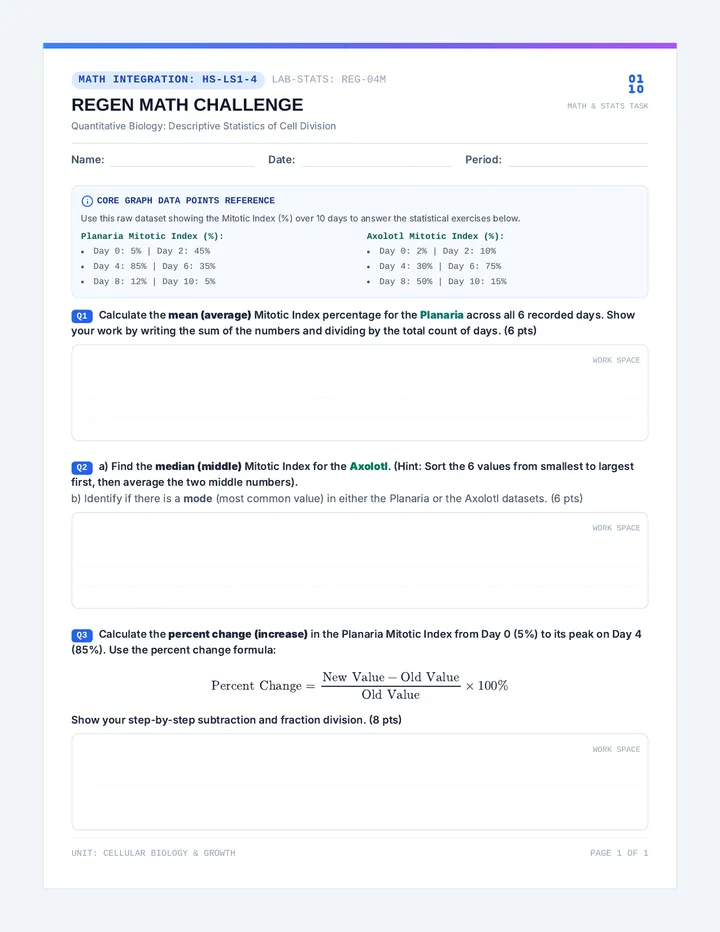
Atom Anatomy Worksheet Atom Anatomy
Lesson 1: Inside the Atom • Student Lab Sheet
Name:
Date:
1
The Subatomic Trio
Complete the table below using the information from our class discussion.
Particle Name Charge (+, -, or 0) Location in Atom Relative Mass Proton ~ 1 amu Neutron Electron ~ 0 amu
2
Sketching the Blueprint
A Carbon atom has 6 protons , 6 neutrons , and 6 electrons . Follow the steps below to draw its "blueprint":
Step 1: The Nucleus
Draw a tight cluster of 6 circles for protons and 6 circles for neutrons in the center square. Label the protons with a plus sign (+).
Step 2: The Electron Cloud
Draw 6 small dots representing electrons circling the nucleus. Remember: they move in the large empty space outside the center!
Step 3: Labeling
Use arrows to label the following:
Nucleus
Electron Cloud
Subatomic Particles
Center
3
Atomic Analysis
1. If you added one more proton to your Carbon atom, would it still be Carbon? Why or why not?
2. Explain why the nucleus contains almost all of the atom's mass, even though it is very tiny compared to the whole atom.
Decoding Atomic Identity Slides Lesson 02
Decoding Atomic Identity
Reading the Fingerprints of the Universe
"What makes an element who it is?"
The Power of One
8
Oxygen (O)
The gas you breathe to stay alive.
9
Fluorine (F)
A reactive, corrosive, poisonous gas.
The only difference? Just one single proton.
The ID Card
6
C
Carbon
12.011
Atomic Number
Symbol
Element Name
Atomic Mass
Every element has a square that contains its vital statistics.
We need to learn how to read this data to understand the atom's internal structure.
Atomic Number
Atomic Number = Number of Protons
This is the most important number. It determines the atom's IDENTITY. If you change the number of protons, you change the element!
Did you know?
In a neutral atom, the number of Protons is also equal to the number of Electrons.
P = E = Atomic #
Atomic Mass
Mass = Protons + Neutrons
The "weight" of the atom comes from the particles in the nucleus. We round this number to the nearest whole number for our calculations.
0 Neutrons
=
A Mass #
How to find Neutrons
The Magic Formula
Mass #
−
Atomic #
=
Neutrons
"Subtract the small number from the big number (rounded) to find the neutrons!"
2
He
Helium
4.003
Let's Decode:
Protons: 2
Electrons: 2
Mass (Rounded): 4
Neutrons: 4 − 2 = 2
Decoding Time
Grab your periodic table and your lab sheet. We are going to decode the blueprints for the first 10 elements!
Round the Mass
Small from Big
Neutrons Found!
Atomic Decoder Worksheet Atomic Decoder
Lesson 2: Decoding Atomic Identity
Name:
Date:
Identity
Atomic # = Protons
Balance
Protons = Electrons
The Secret
Mass (Rounded) - Atomic # = Neutrons
01 Guided Decoding
7
N
Nitrogen
14.007
Atomic Number
Atomic Mass (Rounded)
Protons
Electrons
Neutrons (Show your subtraction)
02 Independent Mastery
3
Li
Lithium
6.941
Protons:
Neutrons:
Electrons:
9
F
Fluorine
18.998
Protons:
Neutrons:
Electrons:
11
Na
Sodium
22.990
Protons:
Neutrons:
Electrons:
12
Mg
Magnesium
24.305
Protons:
Neutrons:
Electrons:
17
Cl
Chlorine
35.45
Protons:
Neutrons:
Electrons:
19
K
Potassium
39.098
Protons:
Neutrons:
Electrons:
03 The Identity Question
If an atom has 11 protons and 11 neutrons, what is its name and its mass number?
Why is it impossible to have an atom of Oxygen with only 7 protons?
Isotope Identity Crisis Slides Lesson 03
Isotope Identity
Crisis
Why is Atomic Mass a Decimal?
12
14
Same element, different weights.
The Decimal Mystery
Wait a minute... if protons and neutrons both weigh exactly 1 amu ...
1 + 1 = ?
Why is the mass of Carbon 12.011 ? Can you have 0.011 of a neutron?
12.011
The Bag of Marbles
Imagine a bag of 100 blue marbles. They look identical, but:
98 marbles weigh 10g
2 marbles weigh 12g
The "Average" marble will be slightly more than 10g.
What is an Isotope?
Atoms of the SAME element that have different numbers of NEUTRONS.
They Have:
Same Protons
Same Properties
But Differ In:
Neutron Count
Atomic Mass
Meet the Carbon Cousins
Carbon-12
99%
6 Protons
6 Neutrons
"The Common One"
Carbon-14
<1%
6 Protons
8 Neutrons
"The Radioactive One"
Weighted Average
The number on the table isn't just a simple average. It's weighted by how common each isotope is in nature.
12.011
Because Carbon-12 is so common (99%), the average is very close to 12!
Reading the Label
14 C 6
A
Mass Number (P + N)
Z
Atomic Number (P)
Average Atomic Lab
Today, we're going to use "isotopes" of common objects to calculate our own weighted averages.
Calculate
Count
Compare
Beanium Isotope Lab Worksheet Beanium Lab
Lesson 3: Isotope Identity Crisis
Name:
Date:
The Mission
In this lab, you have discovered a new element: Beanium (Bn) . Unlike other elements, Beanium atoms are large enough to see! Your goal is to calculate the average atomic mass of Beanium by investigating its different isotopes (Black Beans, Kidney Beans, and Pinto Beans).
Data Table
Isotope Number of Beans Total Mass (g) Avg. Mass of 1 Bean (g) Black Bean Kidney Bean Pinto Bean TOTAL N/A
The Atomic Calculations
1. Calculate Percentage Abundance:
(Number of Beans for isotope ÷ Total Number of Beans) × 100
Black Bean %
Kidney Bean %
Pinto Bean %
2. Calculate the Final Average Atomic Mass of Beanium:
Formula: [ (Avg. Mass 1 × % Abundance 1) + (Avg. Mass 2 × % Abundance 2) + (Avg. Mass 3 × % Abundance 3) ] ÷ 100
Final Result:
_______ g
Analysis Questions
Is your final average atomic mass the same as any of the individual bean masses? Why or why not?
Which isotope was the most common in your "element"? How did this affect the final average?
Explain why the periodic table uses decimal numbers for atomic mass instead of whole numbers.
Mendeleevs Masterpiece Slides Lesson 04
Mendeleev's
Masterpiece
Solving the Greatest Puzzle in Science
Organization
Prediction
Legacy
The Missing Piece
Imagine you are playing a game of cards. The deck is organized perfectly by suit and value.
If one card is missing, can you describe exactly what it looks like?
♥ 2
♥ 3
?
♥ 5
♥ 6
♥ 7
Dmitri Mendeleev 1834 – 1907
The Visionary
In 1869, Mendeleev wanted to organize the 63 known elements. He wrote their properties on cards and started playing "Chemical Solitaire."
The Rule:
Increasing Atomic Mass
The Twist:
Repeating Properties
The Pattern Emerges
Mendeleev noticed that when arranged by mass, certain properties (like reactivity) repeated at regular intervals.
Shiny
Dull
Soft
Explosive
Shiny
Dull
Soft
Explosive
This is why it's called the "PERIODIC" table—it has a repeating rhythm.
Leaving Gaps
Many scientists tried to force elements into a table. Mendeleev did something different. When the properties didn't match the next card, he left a blank space.
Si
?
Sn
"There is an element that belongs here. We just haven't found it yet."
Wait... we fixed it!
Mendeleev (1869)
Organized by Atomic Mass .
Problem: Some elements didn't fit the patterns perfectly when strictly sorted by weight.
Modern Table
Organized by Atomic Number (Protons).
This fixed all the weird outliers!
The Map's Layout
GROUPS
Columns (Up and Down). Elements in a group share similar properties .
PERIODS
Rows (Left to Right). Properties change across a period.
Pattern Detectives
You have a set of element cards with missing identities. Your job is to find the repeating rhythm and build your own Masterpiece.
Mendeleev Sorting Activity Chemical Solitaire
Lesson 4: Mendeleev's Masterpiece
Group Names:
Mendeleev's Rules
Arrange the cards in order of increasing Atomic Mass from left to right.
Start a new row (period) when properties begin to repeat .
If a card doesn't fit the properties of the group above it, leave a gap .
Card A Mass: 1.0
Properties
Invisible Gas
Highly Explosive
Card B Mass: 6.9
Properties
Soft Silver Metal
Reacts with Water
Card C Mass: 9.0
Properties
Grey Hard Metal
High Melting Point
Card D Mass: 10.8
Properties
Black Brittle Solid
Semi-conductor
Card E Mass: 23.0
Properties
Silver Metal
Violent with Water
Card F Mass: 24.3
Properties
Silver Hard Metal
Burns with White Light
Post-Puzzle Analysis
1. Which two cards ended up in the same vertical column (group)? What property did they share?
2. Did you have to leave any gaps? If so, what do you think that gap represents in the "real" world of science?
3. Predict the properties of an element with mass 25.0. What group would it likely belong to?
Mapping the Elements Slides Mapping the Elements
Navigating the Cheat Sheet of the Universe
Periods • Groups • Families
The Grand Map
The Periodic Table is more than just a list. It is a coded map . Once you know how to read the coordinates, you can predict how any form of matter will behave.
Location
Where it sits tells you what it is.
Families
Elements near each other act alike.
Trends
Sizes and reactivity change in patterns.
Groups
The vertical columns (1-18).
"Families that stick together..."
Elements in the same group have similar chemical properties and react in similar ways.
Vertical
Periods
The horizontal rows (1-7).
"Passing through stages..."
As you move across a period, properties change gradually. Atomic number increases by 1 each time.
Horizontal
The Three Kingdoms
Metals
Shiny, conductive, and malleable. They own most of the table (left & center).
Metalloids
The "staircase." They have properties of both metals and nonmetals.
Nonmetals
Dull, brittle, and poor conductors. Mostly gases (found on the right).
Legendary Families
Group 1: Alkali Metals
"The Explosive Cousins"
Super reactive, soft enough to cut with a knife. Never found alone in nature!
Group 18: Noble Gases
"The Loners"
Completely non-reactive. They are "too noble" to bond with any other elements.
Coordinate Practice
Period (Row)
2
Group (Column)
14
Who am I?
Carbon (C)
Table Treasure Hunt
Grab your map of the universe. We are going on a hunt for the ingredients of stars, oceans, and life itself.
Find Groups
Trace Periods
Claim Treasure
Table Treasure Hunt Worksheet Table Treasure Hunt
Lesson 5: Mapping the Elements
Name:
Date:
01 Finding the Coordinates
Use your Periodic Table map to find the element at each "address".
Period (Row) Group (Column) Element Name Symbol 4 1 2 18 5 11 3 13 6 2
02 Kingdom Classification
Determine if each element belongs to the Kingdom of Metals, Nonmetals, or Metalloids.
Iron (Fe)
Silicon (Si)
Neon (Ne)
Gold (Au)
Oxygen (O)
Arsenic (As)
03 Family Reunion
1. Name an element that acts like Lithium (Li) because it is in the same Group.
2. Which group number is known as the "Noble Gases"? Why are they called noble?
3. Describe the "staircase" on the periodic table. What does it separate?
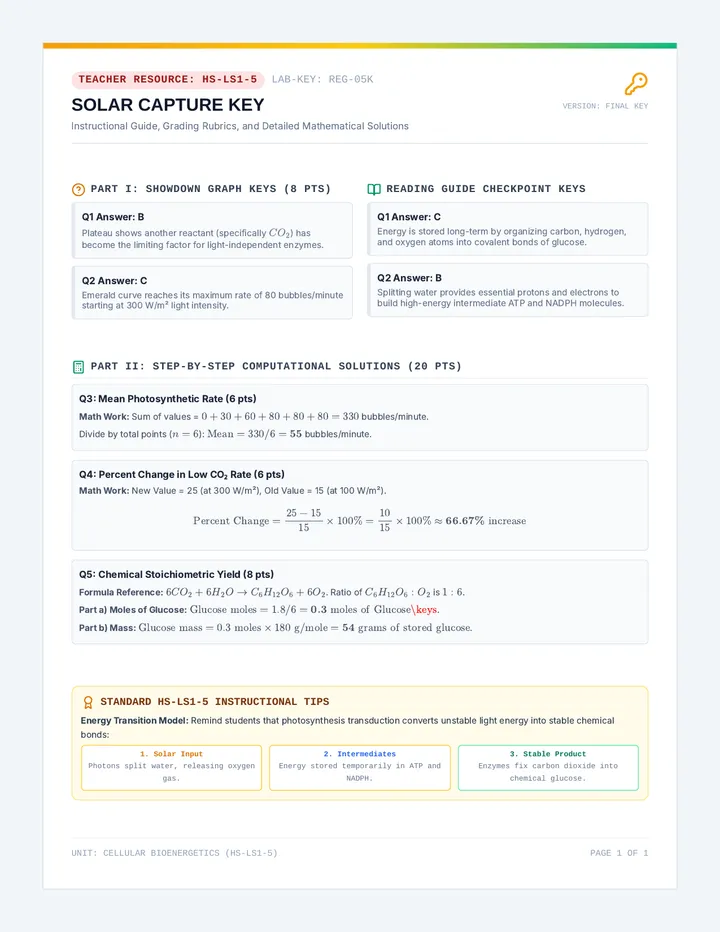
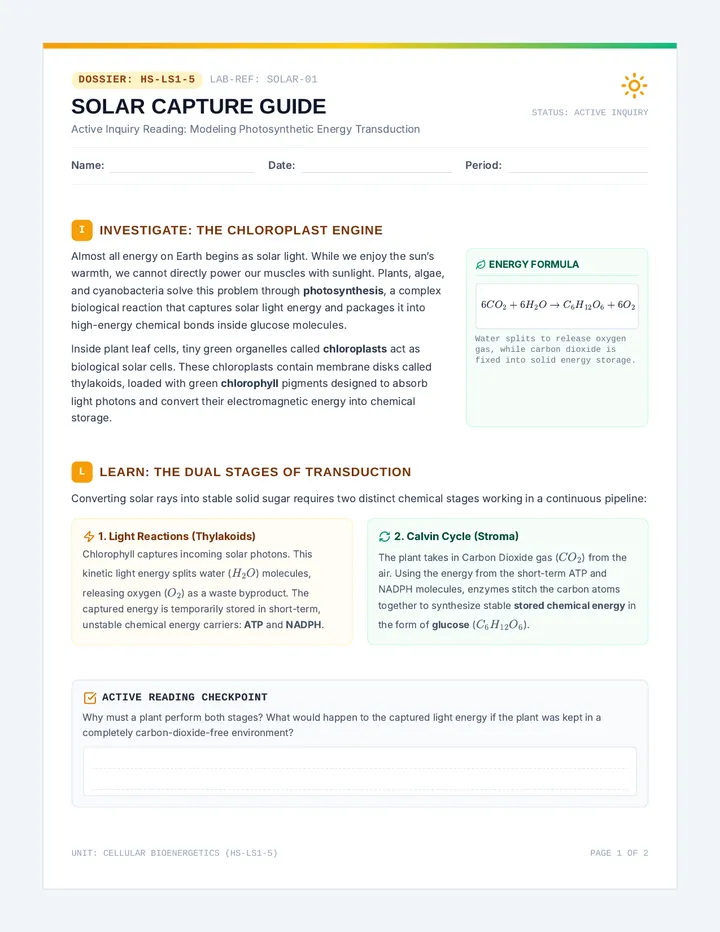
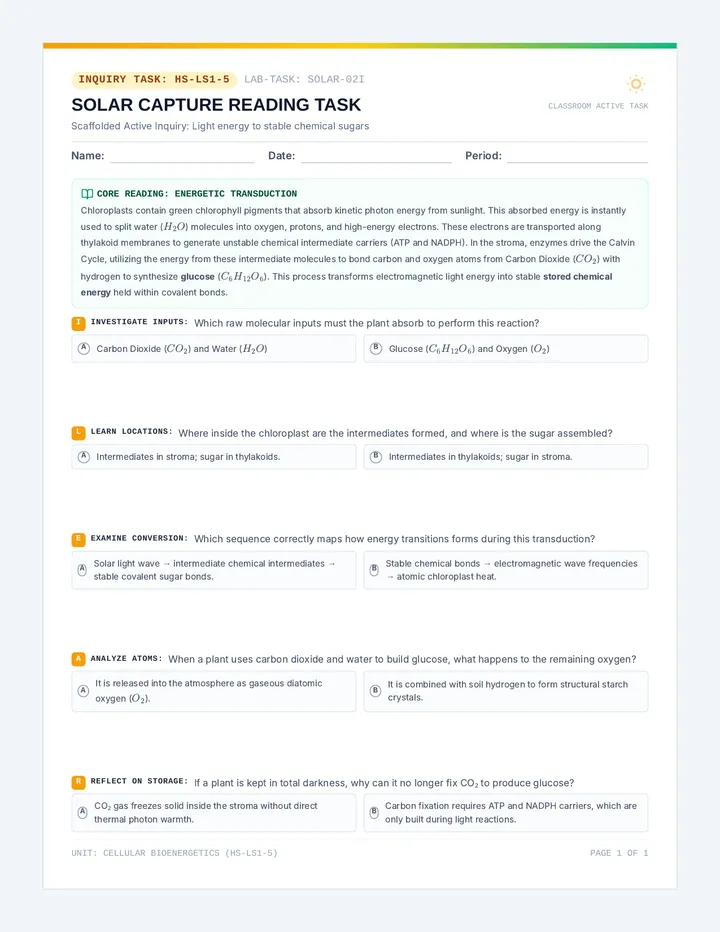
Atomic Blueprint Answer Key Master Answer Key
Sequence: Atomic Blueprint
Teacher Resource
Lesson 1: Atom Anatomy
Particle Table
Proton: (+) / Nucleus / 1 amu
Neutron: (0) / Nucleus / 1 amu
Electron: (-) / Cloud / 0 amu
Analysis
Adding a proton? No longer Carbon. Protons determine identity; adding one makes it Nitrogen.
Lesson 2: Atomic Decoder
Decoding Practice
Lithium: P: 3, N: 4, E: 3
Fluorine: P: 9, N: 10, E: 9
Sodium: P: 11, N: 12, E: 11
Chlorine: P: 17, N: 18, E: 17
Identity Check
11 P / 11 N: Sodium (Na). Mass Number 22.
7 P Oxygen? Impossible. Oxygen must have 8 protons by definition.
Lesson 5: Table Treasure Hunt
Coordinates
P4, G1: Potassium (K)
P2, G18: Neon (Ne)
P5, G11: Silver (Ag)
P3, G13: Aluminum (Al)
Classifications
Iron: Metal
Silicon: Metalloid
Neon: Nonmetal
Gold: Metal
Analysis
Acts like Li: Na, K, Rb, Cs, or Fr (same group).
Noble Gases: Group 18. "Noble" because they don't react/bond with others.
Staircase: Separates metals (left) from nonmetals (right).