Atomic Foundations Teacher Planner Atomic Foundations
5-Day Instructional Blueprint • IPC.7.A & IPC.7.B
Reference: IPC-UNIT-07
CHEMISTRY IPC
Component Day 1: Particle Power Day 2: Reactive Rebels Objective Model atomic structure and identify subatomic particles. Explain how atomic structure influences reactivity. Bellringer What is everything made of? Explain. (Sentence stems provided) Why do some substances react while others don’t? Lesson Opening Balloon static demo + Think-Pair-Share discussion. Reaction video (Na + water). Engage Phenomenon question: Why do objects attract? Predict what causes reactivity. Explore Lab: Build-an-Atom Model (clay/beads). Chunked steps for support. Lab: Valence Electron Investigation. Direct Instruction Mini-lesson on protons, neutrons, electrons with visuals. Valence electrons + stability rule (chunked explanation). Guided Practice Analyze Hydrogen, Carbon, Oxygen atoms together. Rank element reactivity activity. Independent Practice Worksheet: 5 atomic structure questions. Worksheet with 5 reactivity questions + stems. Stop & Jot Why is an atom neutral? Why do atoms form compounds? DOL Students build and explain atom model. Students explain reactivity using table evidence. Closing Exit Ticket: Atom vs Solar System comparison. Quick share-out. Assessment Formative observation + model accuracy. Teacher questioning + worksheet. Differentiation Sentence stems, visuals, partner support, proximity. Color-coded tables, guided notes. Monitoring Teacher circulates for misconceptions. Active monitoring during analysis.
Component Day 3: Trend Trackers Day 4: Bonding Bridges Objective Use periodic table patterns to predict properties. Relate element placement to bonding type. Bellringer What patterns do you see in the periodic table? Why do metals and nonmetals react strongly? Lesson Opening Highlight patterns on projected table. Reaction demonstration video. Engage Notice & Wonder activity. Predict bond type before explanation. Explore Pattern Hunt Investigation (groups). Lab: Bonding Simulation (cards). Direct Instruction Trends: size, metals, periods, groups. Ionic vs covalent bonds chart. Guided Practice Predict properties of unknown elements. Sort elements into bond categories. Independent Practice Prediction worksheet (5 questions). Bonding worksheet (5 questions). Stop & Jot Why do group elements behave similarly? Think-Pair-Share: How does table position predict bonding? DOL Students justify predictions verbally. Students classify bonds correctly. Closing Discussion: Why scientists rely on the periodic table. 1-minute summary writing. Assessment Accuracy of predictions. Bond classification accuracy. Differentiation Scaffolded trend chart + word bank. Structured organizer + peer tutor. Monitoring Teacher checks reasoning explanations. Immediate feedback during sorting.
Component Day 5: Element Experts Objective Apply atomic structure & periodic trends to analyze elements. Bellringer List 3 things atomic structure affects. Lesson Opening Review game warm-up. Engage Kahoot or class quiz game. Explore Review Stations (models, trends, bonding). Direct Instruction Student-led explanations (Distinguished practice). Guided Practice Station rotations with teacher feedback. Independent Practice Performance Task: Unknown Element Investigation. Sentence Stems Provided. Stop & Jot How does atomic structure control behavior? DOL Students justify element properties. Closing Reflection: How atomic structure controls behavior. Assessment Summative rubric performance task. Differentiation Choice stations + scaffold sheets. Monitoring Teacher conferences during task.
Instructional Design: Atomic Foundations Unit
Page 1 of 3
Particle Power Slides Lesson 1: Atomic Foundations
Particle Power
Identifying the building blocks of matter and the architecture of the atom.
Bellringer
"What is everything in the universe made of? Explain your thinking."
Sentence Stems:
"I believe everything is made of..."
"My reasoning for this is..."
The Phenomenon
Why do objects attract each other without touching?
Balloon Demo
Static Electricity
Atomic Architecture
Proton
Positive charge. Found in the nucleus. Identifies the element!
0
Neutron
Neutral charge. Found in the nucleus. Adds mass.
-
Electron
Negative charge. Found in the cloud. Determines reactivity.
Stop & Jot
If atoms contain charged particles, why are most atoms neutral (no charge)?
Think about the balance of protons and electrons!
Atomic Architecture Worksheet Arquitectura Atómica
Día 1: Modelado de la materia y partículas subatómicas
Nombre:
Fecha:
1
Laboratorio: El modelo atómico
Instrucciones:
Utilizando los materiales proporcionados (plastilina, cuentas o cereales), construye un modelo de un átomo de carbono . El carbono tiene 6 protones, 6 neutrones y 6 electrones. Dibuja tu modelo terminado abajo y etiqueta cada parte.
Espacio de trabajo para dibujo y etiquetado
2
Práctica independiente
1. ¿Qué partícula subatómica determina la identidad de un elemento? Si cambias el número de estas, obtienes un elemento completamente diferente.
Protón
Neutrón
Electrón
Núcleo
2. Si un átomo tiene 11 protones y 11 electrones, ¿cuál es la carga neta total del átomo? Explica por qué.
3. Describe dónde se concentra la masa de un átomo. ¿Qué dos partículas contribuyen más al peso?
4. Utiliza la siguiente tabla para comparar las tres partículas:
Partícula Ubicación Carga Protón Neutrón Electrón
5. ¿Por qué crees que los electrones se encuentran en una "nube" en lugar de en el centro del átomo?
Boleto de salida: Átomo vs. Sistema Solar
¿En qué se parece un átomo a nuestro sistema solar? ¿En qué se diferencia? (Piensa en el centro y las órbitas).
Reactive Rebels Slides Lección 2: Dinámica Química
Rebeldes Reactivos
¿Por qué algunos elementos se portan bien mientras otros explotan?
Actividad de Inicio
"Piensa en el agua y el sodio. El agua es segura para beber. El sodio es un metal blando. Cuando se tocan, explotan. ¿Por qué algunas sustancias reaccionan tan violentamente mientras que otras no reaccionan en absoluto?"
Comenta con un compañero durante 60 segundos.
La Regla de la Estabilidad
Electrones de Valencia
Los electrones que se encuentran en el nivel de energía más externo.
La Regla del Octeto
Los átomos son "felices" (estables) cuando tienen 8 electrones de valencia.
"¡La reactividad es solo el intento desesperado de un átomo por conseguir una capa externa completa!"
8e-
Neón (Estable)
7e-
Flúor (¡Reactivo!)
Uno de ellos está buscando pelea...
Comprobación Rápida
¿Por qué los átomos forman compuestos con otros átomos en lugar de quedarse solos?
Escribe tu respuesta en una frase en tus notas guiadas.
Reactivity Investigation Worksheet Rastreador de Reactividad
Día 2: Electrones de Valencia y Estabilidad
Nombre:
Fecha:
1
Laboratorio: Investigación de Valencia
Predice el número de electrones de valencia de cada elemento basándote en su número de grupo (columna vertical).
Elemento N.º de Grupo N.º de electrones de valencia Estabilidad (¿Estable o Reactivo?) Litio (Li) 1 Carbono (C) 14 Oxígeno (O) 16 Neón (Ne) 18
2
Clasificación de Reactividad
Basándote en la tabla anterior, clasifica los elementos desde el más reactivo al menos reactivo .
1. (MÁS)
4. (MENOS)
3
Síntesis y Enunciados
1. ¿Por qué se consideran los gases nobles (Grupo 18) como los elementos "menos reactivos"?
ENUNCIADO: "Los elementos del Grupo 18 son estables porque..."
2. Si un elemento tiene 7 electrones de valencia, ¿por qué es extremadamente reactivo?
ENUNCIADO: "Es reactivo porque solo necesita..."
3. Describe la relación entre el número de electrones de valencia y la estabilidad química.
Demostración de Aprendizaje
Utilizando la evidencia de tu investigación, explica por qué el Sodio (Grupo 1) reacciona violentamente con el agua, pero el Neón (Grupo 18) no lo hace.
Trend Trackers Slides Lesson 3: Patterns of Power
Trend Trackers
Cracking the code of the periodic table's hidden patterns.
Bellringer
"The Periodic Table isn't just a list; it's a map. What patterns do you notice when looking at the layout of the table?"
Colors/Groups
Increasing Numbers
Rows & Columns
Groups
Vertical columns. Elements in the same group have the SAME number of valence electrons.
"Think: Members of the same family act alike!"
Periods
Horizontal rows. Elements in the same period have the SAME number of energy levels (shells).
"Think: Each new row starts a new layer!"
The Pattern Tracker
Atomic Size
Increases as you go DOWN a group and decreases as you go RIGHT.
Metals
Most elements are metals. They are found on the LEFT and CENTER.
Reactivity
Metals are more reactive on the LEFT. Nonmetals are more reactive on the RIGHT.
Trend Hunt
If Element X is in Group 1 and Element Y is in Group 18, which one is more likely to react with water?
Be ready to justify your prediction using periodic trends!
Trend Trackers Worksheet Trend Hunter
Day 3: Predicting Properties via the Periodic Table
Name:
1
Pattern Hunt Investigation
Using your Periodic Table, find one element for each category below:
A Noble Gas (Stable)
A Highly Reactive Metal
An Element in Period 4
An Element with 3 Shells
2
Independent Prediction
1. Which element would have larger atoms: Lithium (Group 1) or Francium (Group 1)? Justify your answer using the "Group" trend.
2. Two elements, X and Y, are in the same group . What specific property do they likely share?
3. Magnesium is a metal. Sulfur is a nonmetal. Which one is found on the left side of the "staircase" and which is on the right?
4. Why does reactivity increase as you go down Group 1 (Alkali Metals)?
5. Predict the properties of an unknown element located in Group 17, Period 5. (Is it a metal? Reactive? How many valence electrons?)
Verbal Justification
Be ready to explain to the class why scientists rely on the periodic table to predict the behavior of elements they haven't even discovered yet!
Bonding Bridges Slides Lesson 4: Atomic Alliances
Bonding Bridges
How atoms stick together to build the world around us.
Bellringer
"Why do metals and nonmetals react so strongly with each other?"
Think about valence electrons. What does one have that the other needs?
Ionic vs. Covalent
Ionic Bonding
Transfer of electrons.
Metal + Nonmetal.
"Opposites attract! Like a magnet."
Covalent Bonding
Sharing of electrons.
Nonmetal + Nonmetal.
"Sharing is caring! Holding hands."
The Ultimate Trick
Where an element is on the periodic table tells you how it will bond!
Far Left + Far Right
Almost always IONIC.
Both on Right Side
Almost always COVALENT.
Bonding Prediction Worksheet Bonding Simulator
Day 4: Predicting Atomic Alliances
Name:
1
Lab: The Bonding Match
Look at the pairs of elements below. Use your periodic table to determine if they are Metals (M) or Nonmetals (NM) , then predict the bond type.
Element Pair Element 1 (M/NM) Element 2 (M/NM) Predicted Bond (Ionic/Covalent) Sodium (Na) + Chlorine (Cl) Oxygen (O) + Hydrogen (H) Carbon (C) + Oxygen (O) Calcium (Ca) + Fluorine (F)
2
Bonding Analysis
1. Describe the main difference between how electrons act in an ionic bond versus a covalent bond.
2. If you find two elements on the far right side of the periodic table, what type of bond will they most likely form? Explain why.
3. Magnesium is in Group 2 (Metal) and Sulfur is in Group 16 (Nonmetal). What type of bond will they form?
Think-Pair-Share
"If an atom is already stable (like Neon), why won't it form bonds with any other atoms?"
Element Experts Slides Lesson 5: Cumulative Mastery
Element Experts
Time to put your skills to the ultimate test.
Unit Review Stations
Station 1
The Model Shop
Build atomic models for neutral atoms and explain the roles of protons, neutrons, and electrons.
Station 2
Trend Tracking
Predict properties (size, reactivity, type) of elements based on their position on the table.
Station 3
Bonding Bridges
Analyze pairs of elements to determine if they will share or transfer electrons.
Final Mission
The Unknown Element Investigation
You will be given the properties and location of a "mystery element." Your job is to identify it and explain everything about its behavior.
Unknown Element Performance Task Performance Task
Day 5: Mystery Element Investigation
Expert Name:
1
The Evidence File
Subject: Mystery Element X
Clue 1: Located in Period 3 of the Periodic Table.
Clue 2: Has 7 valence electrons in its outer shell.
Clue 3: Reacts violently with metals in Group 1.
Clue 4: Is a nonmetal that forms covalent bonds with Hydrogen.
Identity Confirmation
The Mystery Element is:
Number of Protons:
Atomic Structure
Number of Energy Levels:
Reactivity Rating (1-10):
2
Expert Justification
How did you use the "Period" to narrow down your search?
STEM: "Because it is in Period 3, I knew it had..."
Explain why this element reacts so strongly with Group 1 metals.
STEM: "This element is highly reactive because it only needs..."
Prediction: If this element bonded with Sodium (Group 1 Metal), would the bond be ionic or covalent? Justify your answer.
Final Reflection
"How does the structure of an atom determine the behavior of the entire universe?"
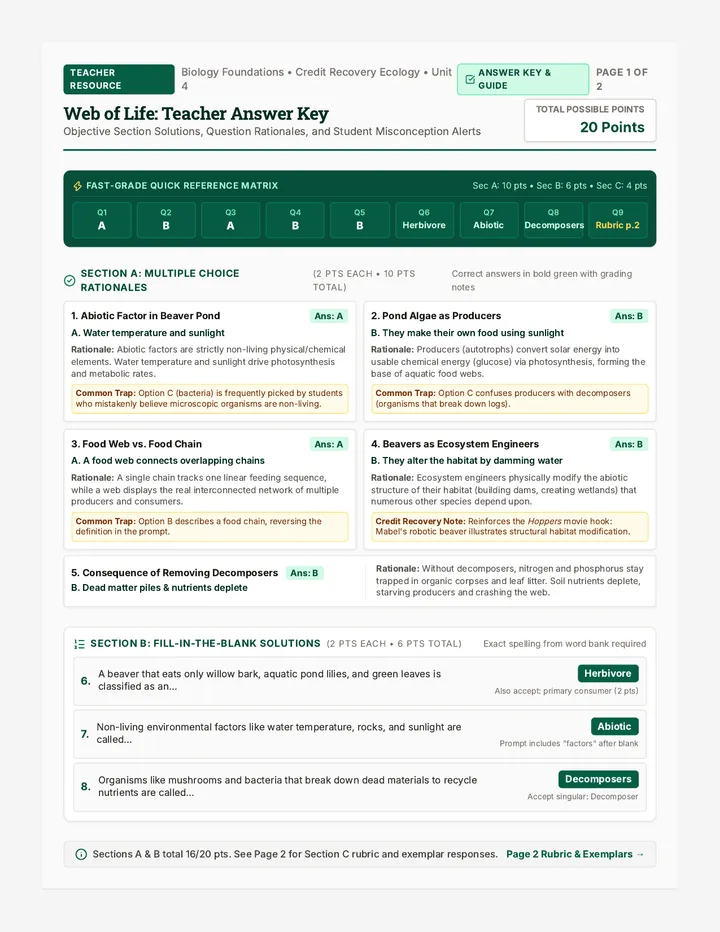
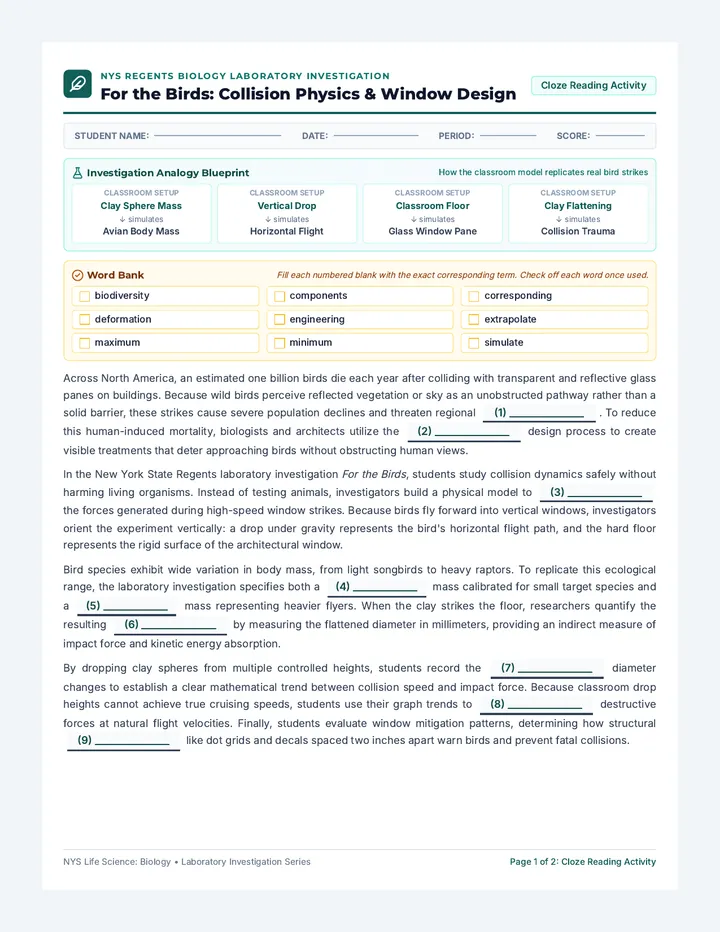
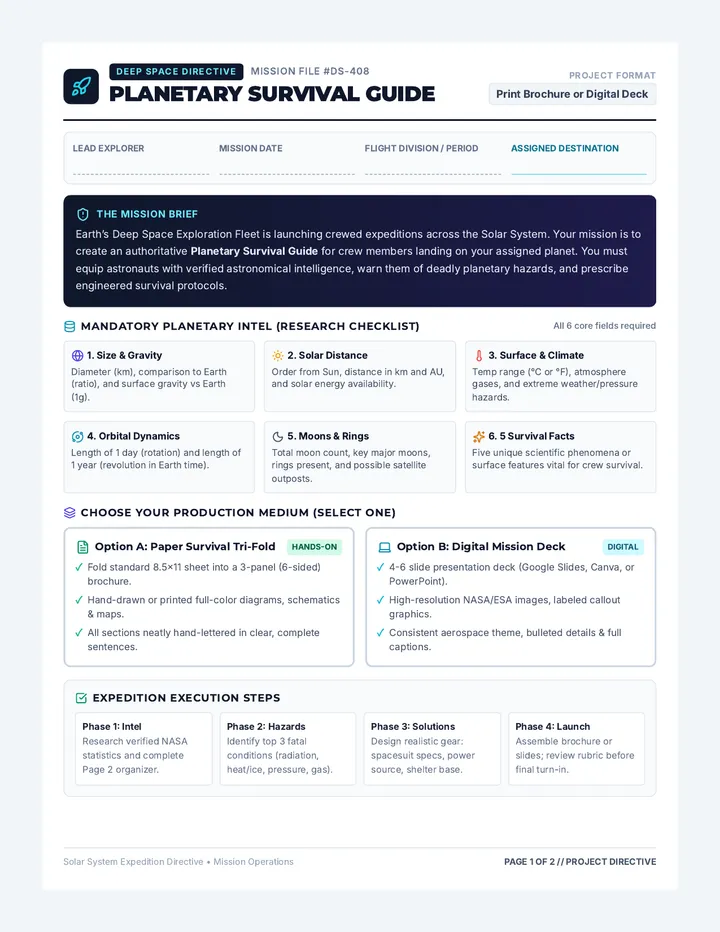
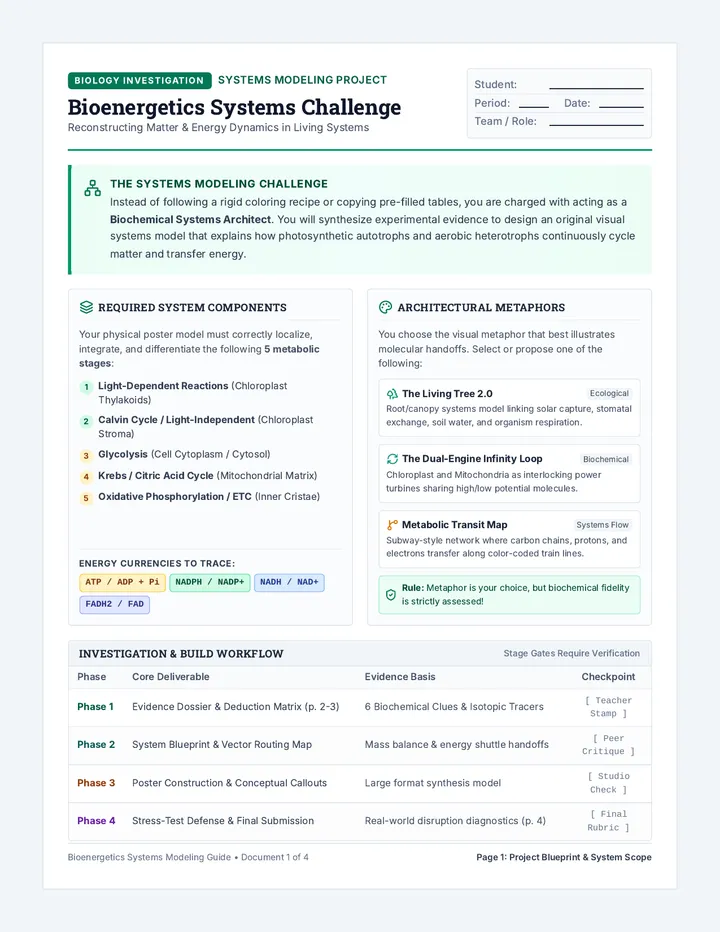
Biodiversity Blueprint Planner Biodiversity Blueprint
5-Day Instructional Planner • TEKS BIO.13D
Unit: Ecology & Human Impact
BIOLOGY STAAR ALIGNED
Component Day 1: Human Impact & Biodiversity Day 2: Activity & Stability Objective BIO.13D Focus
Define ecological footprint, atmospheric changes, and pollution effects. Identify characteristics shared by all animals. |
BIO.13D Focus
Analyze how human activities (land use, pollution, invasive species) affect stability and biodiversity. |
| Bellringer |
"What happens if one species disappears?"
Stop & Jot using provided stems. |
"Name one way humans change the land."
Recall and brief discussion. |
| Engage |
Phenomenon:
Invasive species video. Think-Pair-Share.
Demo:
Snowpack loss map (Colorado River example). |
Review:
Revise invasive species claim.
Phenomenon:
Coral bleaching video + Stop & Jot response. |
| Explore |
Lab: Predator Competition
Simulate food source competition using paper models. Record survival data for Species A & B. |
Data Analysis: Evidence in Ice
Examine simplified CO2 graph. Identify trends and correlate with industrial timeline. |
| Explain |
Direct Instruction:
Ecological footprint, CO2 increase, global warming, water toxicity. Animal traits: heterotrophic, no cell walls. |
Direct Instruction:
Land effects: Deforestation, urbanization. Population effects: Overhunting, habitat loss. Key idea: less biodiversity = less stability. |
| Practice |
Guided:
Sentence stems on human impact.
Independent:
5-Question worksheet (Importance of biodiversity). |
Guided:
Match Cause (Pollution) → Effect (Loss).
Independent:
Response on food chain disruption. |
| DOL | CER Statement: Claim, Evidence, and Reasoning for invasive species effects. | Mini Concept Map: Human Activity → Biodiversity → Ecosystem Stability. |
Component Day 3: Goods & Services Day 4: Stability Focus Day 5: Synthesis & Summative Objective Describe ecosystem goods/services and explain the survival necessity of biodiversity.
Human Impact Slides Biology Unit 13: Biodiversity
Human Impact
How environmental changes shape the variety of life on Earth.
Bellringer
"What happens if one single species disappears from an ecosystem?"
Stop & Jot Stems:
"I think..."
"One example could be..."
"This would affect..."
The Phenomenon
Invaders Among Us
Invasive species move into new territories and spread at an alarming rate.
Think-Pair-Share:
"Why do invasive species spread so fast in a new environment?"
Ecological Footprint
The total amount of resources (land, water, energy) a person or population uses to survive.
Water Usage
Energy Need
Waste Impact
Atmospheric Changes
CO₂
Carbon Rise
Burning fossil fuels increases greenhouse gases.
Global Warming
Trapped heat raises the Earth's average temperature.
Acid Rain
Pollutants mix with water vapor, lowering pH levels.
Kingdom Animalia
Regardless of impact, all animals share these four core traits:
1
Multicellular
Made of many specialized cells.
2
Heterotrophic
Must consume other organisms for food.
3
No Cell Walls
Cells are flexible, unlike plants or fungi.
4
Response
Quickly react to stimuli in the environment.
Impact & Identity Worksheet Impact & Identity
Day 1: Human Footprints & Animal Traits
Name:
Date:
1
Lab: Predator Competition
Procedure Summary:
Your group represents 2 predator species competing for 1 food source (tokens).
In each round, 50% of remaining tokens will be removed to simulate environmental change.
Record how many of each species survive.
Round Species A Population Species B Population Total Biodiversity 1 2 3
Analysis: Which species survived best?
Analysis: What caused the population decline?
2
Independent Practice
1. Define Biodiversity:
2. Why is biodiversity important?
3. Characterizing Animals:
Select all shared characteristics of animals:
Multicellular
Autotrophic
Heterotrophic
Prokaryotic
No Cell Walls
Respond to Environment
4. Explain how humans change the atmosphere through industrial activity:
3
Demonstration of Learning
CER Statement: Invasive Species
Claim
(Invasive species affect ecosystems because...)
Evidence
(From the lab or phenomenon discussion...)
Reasoning
(Explain how the evidence supports your claim...)
Exit Question
How can one single species change an entire ecosystem?