Matter Master Test
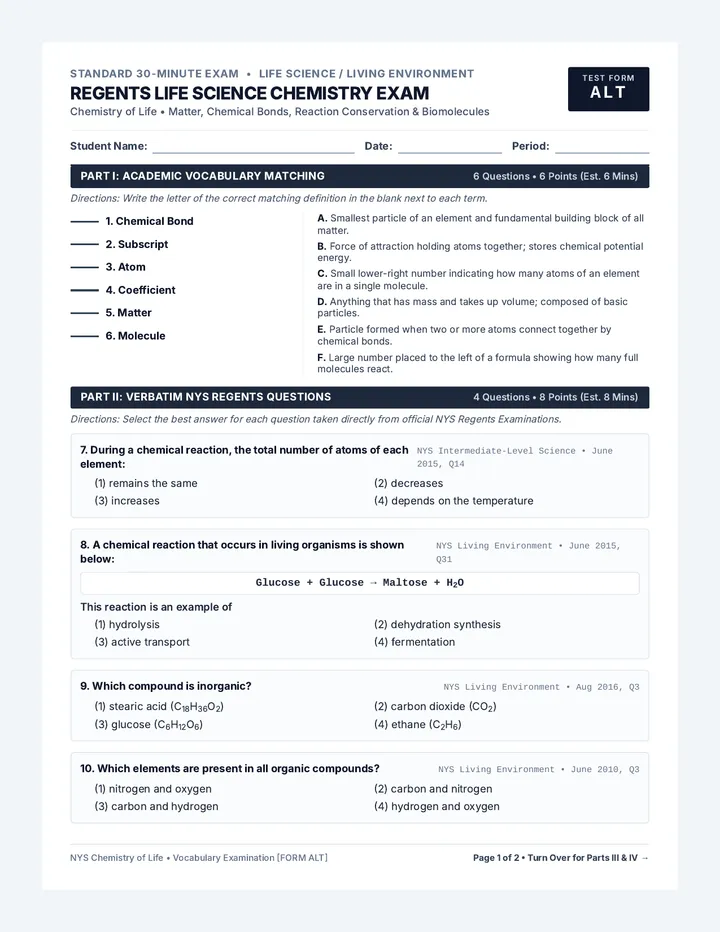
Matter Master
Unit 2: Properties & Changes
Name:
Date:
Part I: Vocabulary Match
Write the letter of the correct definition next to each term.
1. Matter
2. Atom
3. Density
4. Solubility
5. Viscosity
A. The mass per unit volume of a substance.
B. Anything that has mass and takes up space.
C. A liquid's resistance to flowing.
D. The smallest unit of an element that maintains its properties.
E. The ability of a substance to dissolve in another substance.
Part II: Knowledge Check
Circle the letter of the most accurate answer.
6. Which state of matter has a definite volume but takes the shape of its container?
A Solid
B Liquid
C Gas
D Plasma
7. Which of the following is an example of a chemical change?
A Ice melting
B Cutting hair
C Iron rusting
D Mixing sugar in tea
8. When a substance changes directly from a solid to a gas, it is called:
A Condensation
B Sublimation
C Evaporation
D Deposition
9. Which of these is a heterogeneous mixture?
A Saltwater
B Air
C Garden Salad
D Brass
10. What type of property is the boiling point of a substance?
A Physical
B Chemical
C Mechanical
D Biological
11. A solution is another name for a:
A Pure substance
B Heterogeneous mixture
C Homogeneous mixture
D Element
12. Particles in this state of matter vibrate in fixed positions and are tightly packed.
A Gas
B Plasma
C Liquid
D Solid
13. Which phase change occurs when energy is removed from a liquid?
A Evaporation
B Freezing
C Melting
D Sublimation
14. When baking soda and vinegar are mixed, bubbles form. This indicates:
A A change in state only
B A physical change
C A chemical change
D No change occurred
15. The Law of Conservation of Mass states that mass cannot be __________ during a chemical reaction.
A Measured
B Changed
C Created or Destroyed
D Weighed
Part III: Fill the Gaps
16. The amount of space an object takes up is called its .
17. In a saltwater solution, the salt is the and the water is the solvent.
18. The temperature at which a liquid turns into a solid is its point.
19. The ability of iron to react with oxygen to form rust is a property.
20. A substance made of two or more different elements that are chemically combined is a .
Part IV: Lab Classification
Classify each "Lab Sample" as an Element, Compound, Homogeneous Mixture, or Heterogeneous Mixture.
21. Pure Distilled Water (H₂O)
22. Gold Bar (Au)
23. Lucky Charms Cereal
24. Sweet Tea (without ice)
25. Aluminum Foil (Al)
Matter Master Answer Key
Answer Key
Matter Master Assessment
Teacher Reference
Part I: Vocabulary
-
- B (Matter)
-
- D (Atom)
-
- A (Density)
-
- E (Solubility)
-
- C (Viscosity)
Part II: Knowledge Check
Part III: Fill the Gaps
-
Volume
-
Solute
-
Freezing
-
Chemical
-
Compound
Part IV: Lab Classification
21. Pure Distilled Water (H₂O) Compound
22. Gold Bar (Au) Element
23. Lucky Charms Cereal Heterogeneous Mixture
24. Sweet Tea (without ice) Homogeneous Mixture (Solution)
25. Aluminum Foil (Al) Element
Grading Guide
Total Points: 25 (1 point per question).
Scale:
23-25: Mastery (A)
20-22: Proficient (B)
17-19: Basic (C)
Below 17: Below Basic (D/F)
Matter Master Review Slides
Matter Master
Unit Assessment Review
Prepare for the Challenge
The Big Change
Physical Change
- No new substance is formed
- Usually reversible
- Example: Melting ice, cutting paper
Chemical Change
- A new substance is created
- Hard to reverse
- Indicators: Bubbles, heat, color change
States of Matter
Solid
Fixed shape, fixed volume. Particles vibrate in place.
Liquid
Takes shape of container, fixed volume. Particles slide past.
Gas
No fixed shape or volume. Particles move fast and far apart.
Mixing it Up
Heterogeneous
You can see the different parts! They are not evenly mixed.
Example: Trail Mix, Pizza, Sand in Water
Homogeneous
(Solution)
Perfectly mixed! It looks the same throughout.
Example: Lemonade, Salt Water, Air
Key Terms to Know
Density How tightly packed matter is in a space. (Mass / Volume)
Solubility The ability of a solute to dissolve in a solvent.
Sublimation Changing directly from a solid to a gas.
Viscosity A liquid's resistance to flowing (think honey vs. water).
Good luck on the Assessment!