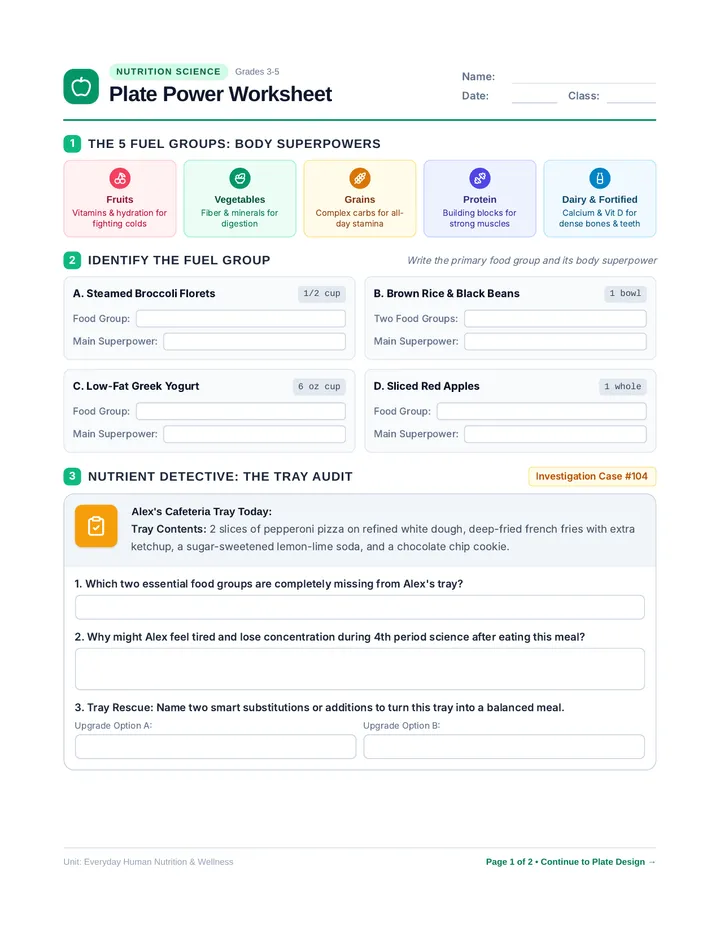
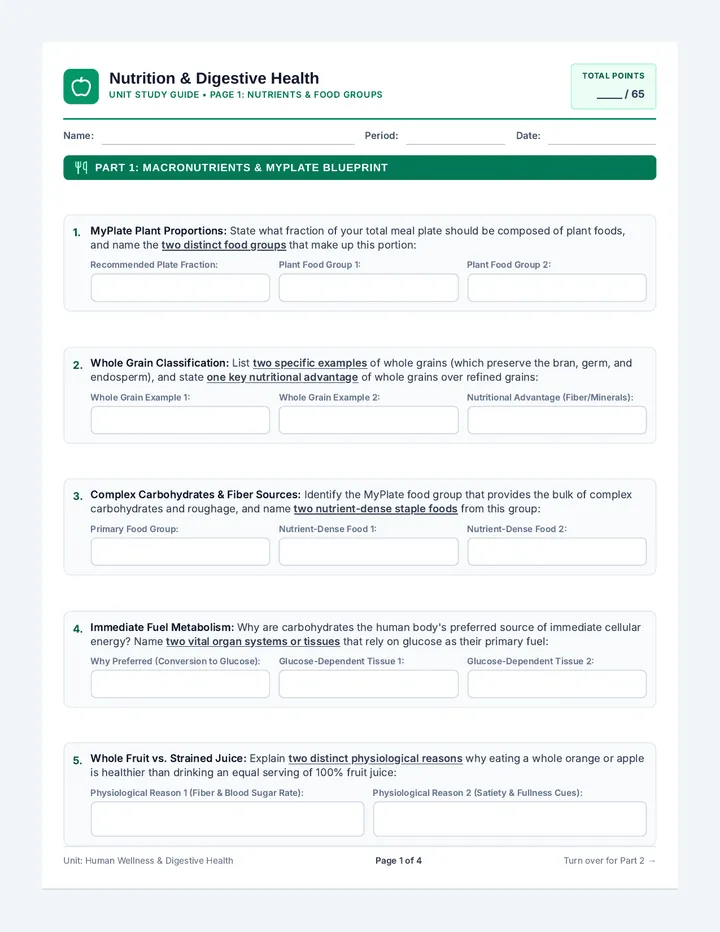
Essential food groups, nutrient functions, and balanced meal planning. Develops skills for interpreting nutrition labels and adopting lifelong healthy eating patterns.
An end-of-unit project kit where students act as nutritional biometrics analysts. They evaluate fictional teen profiles, diagnose the physiological and cognitive impacts of their eating patterns, and design optimized intervention plans.
The culminating challenge of the physical fitness unit where 6th-grade students calculate their target heart rate zones and apply their knowledge to engineer and playtest their own custom bodyweight exercise portals.
A comprehensive 90-minute biology-focused nutrition lesson for 9th graders. It covers the seven learning objectives and key terms through real-world scenarios, collaborative meal-planning, and debates on dietary trends. Includes teacher guides, a 15-slide presentation, and a guided notebook.
A 90-minute lesson plan package focusing on human nutrition, exploring macronutrients (carbs, proteins, fats), micronutrients (vitamins, minerals), and hydration through direct instruction and scaffolded food label analysis activities.
Students analyze the visual and psychological tactics used in marketing, from color theory to celebrity endorsements, and create a consumer awareness poster to educate others.
A 30-minute interactive lesson for 3rd graders on staying safe in the sun and heat, covering protection, hydration, and heat illness signs.
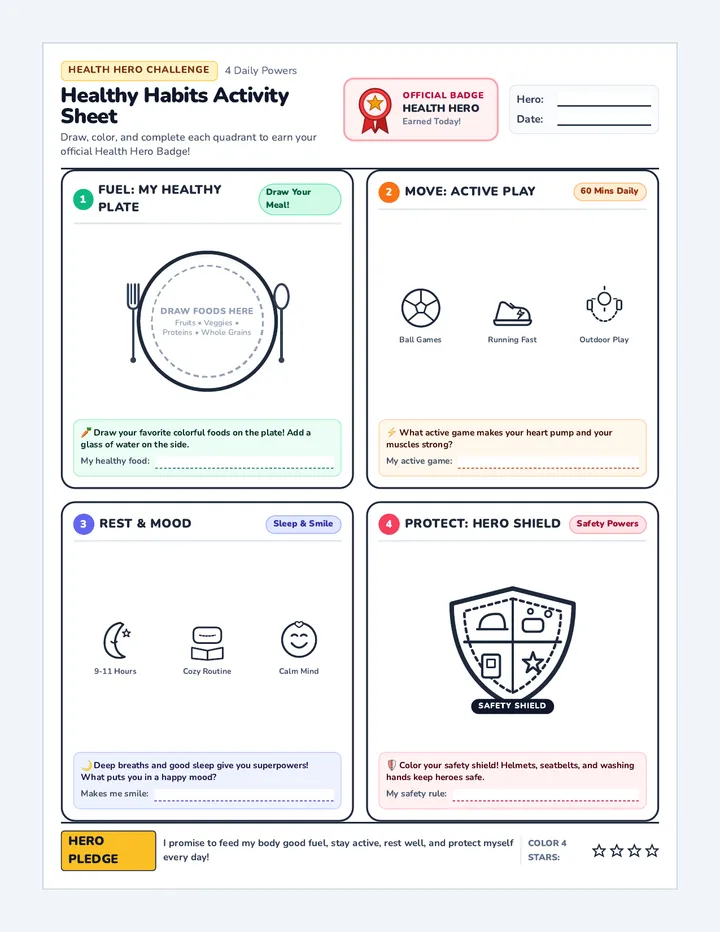
A foundational lesson where students learn the core pillars of health—nutrition, exercise, sleep, and hygiene—to build their own 'Hero's Habit' routine.
A 6th-grade health lesson exploring the science of physical fitness through a series of zero-equipment bodyweight exercise stations. Students learn about the components of fitness while rotating through high-energy 'Power Portals'.
A comprehensive study guide package covering key health topics for the Wisconsin Health Exam, including Nutrition, ATOD, Mental Health, and Safety.
Concludes the sequence by looking at the immune and circulatory systems. Focuses on long-term system health, rest protocols, and 'defense grid' maintenance.
Focuses on the skeletal and muscular systems. Uses mechanical metaphors for movement and explores physical stability as a foundation for emotional regulation.
Explores the body's energy conversion systems. Focuses on the lungs and digestive tract as 'Fuel Systems' and explores the link between nutrition/oxygen and mental clarity.
A 1-page printable daily logger and fitness tracker for summer campers to record their resting/active heart rate, color in water droplets for their hydration challenge, and draw their healthy athletic plate.
A comprehensive 6-page weekly program guide for camp counselors featuring a daily grid of active learning, STEM, art, outdoor play, and teamwork challenges. Includes fully differentiated pathways for younger (ages 5-7) and older campers (ages 8-10) styled in a vibrant athletic motif.
A comprehensive teacher facilitation guide containing the lesson plan, step-by-step pacing, high-impact talking points, discussion card answer keys, and weekly habit-tracking integration tips.
A student-facing printable booklet with a personal goal-setting sheet and a weekly superhero habit tracker calendar. Designed with clean, spacious, white-background writing areas suitable for 3rd-grade handwriting.
A printable set of 8 distinct scenario cards to spark group discussions about balanced eating, sleep boundaries, germ defense, and physical active play. Features beautiful comic-book styling and cut lines.
An engaging slide deck introducing the four pillars of healthy living: nutrition, physical activity, sleep hygiene, and germ defense. Features interactive class prompts and bold superhero themes.
A 1-page standards-based proficiency rubric on a 1-4 scale for the Fueling Decisions unit. It evaluates student performance on circumstance analysis, decision-making, nutrition, and reflection.
A 5-slide presentation to launch the 'Fueling Decisions' project. It introduces standard H2.N6.6, explores the factors that influence food choice decisions (time, budget, nutrition), outlines instructions for student completion, and references the 1-4 grading rubric.
A 2-page teacher-facing instructional resource and answer key to guide educators in delivering the 'Fueling Decisions' project. It provides lesson pacing, scaffolding suggestions, character analysis, and healthy eating discussion starters.
A 4-page end-of-unit student project packet for standard H2.N6.6. It provides a real-world scenario-based activity where students select a busy middle schooler, manage time and budgets, pick healthy meals, and reflect on decision-making influences.
A 1-page financial-health balance activity sheet for the Teen Fuel Lab. Students select healthy daily meals from a menu with prices to optimize performance while staying under a $15.00 budget.
A 1-page analytical grading rubric for the Teen Fuel Lab end-of-unit project. It details the evaluative criteria across four performance levels for easy scoring.
A 12-week introductory cooking curriculum for elementary students focusing on safety, nutrition, and the emotional connection to food.
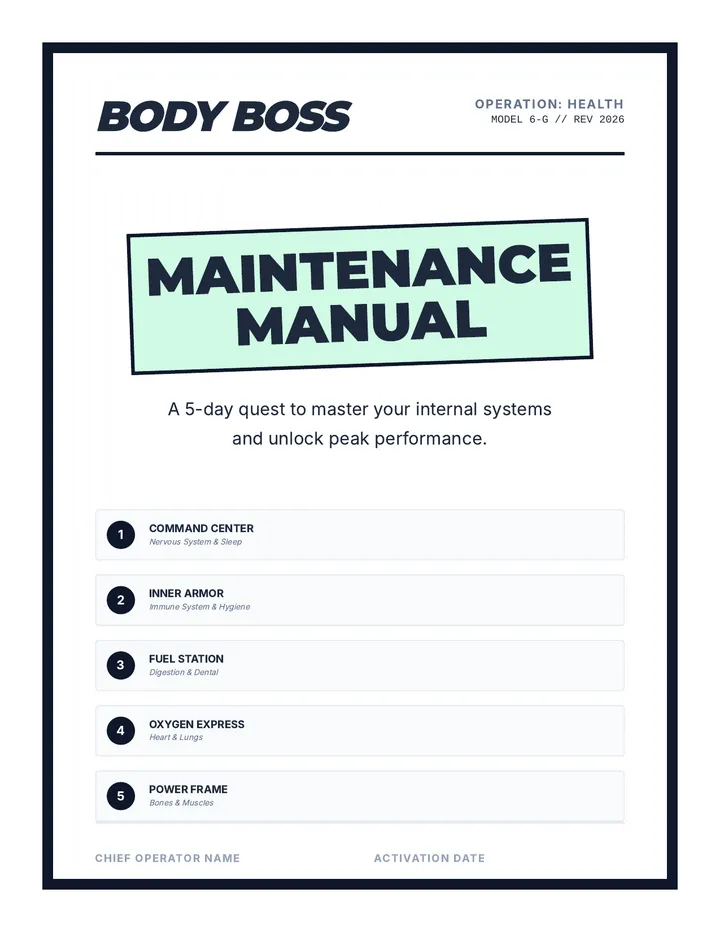
A 5-day health unit for 6th graders exploring body systems and hygiene through the lens of a 'Maintenance Manual' for their bodies. Designed for easy implementation by a substitute teacher.
A 2-day condensed unit for 10th-grade sports nutrition focused on identifying industry "Red Flags" and expert consensus for supplement safety. Students complete a digital Label Hunt and a final synthesis assessment to demonstrate mastery.
Unité complète sur le fonctionnement du corps humain, se concentrant sur la nutrition, la digestion et l'importance d'une alimentation saine pour la croissance et l'activité.
A comprehensive health and wellness unit focusing on nutrition, physical activity, and mental well-being to empower students to make informed lifestyle choices.
A functional biology curriculum designed for life skills students, focusing on practical knowledge of nutrition, personal hygiene, and environmental stewardship through hands-on activities and visual aids.
A comprehensive unit for 3rd graders to decode food labels, understand nutrition facts, and identify hidden ingredients. Students take on the role of 'Nutrition Detectives' to make evidence-based choices about the food they eat.
A comprehensive sequence designed for undergraduate students to master the art of balanced eating on a budget. Students transition from theoretical nutrition to practical application, focusing on cost-per-nutrient analysis, batch cooking, and navigating food environments.
An 8th-grade health sequence exploring the intersection of media marketing and stimulant use (nicotine and caffeine). Students analyze advertising tactics, investigate chemical realities, and create counter-marketing campaigns to expose industry manipulation.
A comprehensive investigation into caffeine consumption, marketing tactics, and physiological effects, designed to transform 7th-grade students into critical analysts of the energy drink industry.
A comprehensive 5-lesson project-based sequence for 5th graders examining caffeine stimulants, nutritional labels, and youth-targeted marketing tactics. Students investigate hidden ingredients and health impacts, culminating in a creative 'Truth in Advertising' label redesign project.
A positive-focused health sequence for 6th graders that teaches natural energy strategies—sleep, nutrition, movement, and stress management—as sustainable alternatives to chemical stimulants. Students develop a personal 'High Performance Plan' to optimize their energy and focus.
A 4-day end-of-semester review event where students compete in 'Olympic heats' covering child development from toddlers to middle childhood, safety protocols, and nutrition. Each day features competitive activities that reward accuracy and teamwork as teams aim for the gold medal.
A 2-day intensive exploration into the neurobiology of nutrition and the physiological feedback loops between gut health, movement, and mental well-being for middle schoolers.
A two-week wellness unit for middle schoolers focused on analyzing influences (media, tech, values) and mastering health-enhancing decision-making models. Students culminate their learning by creating a collaborative research poster on a chosen wellness topic.
A 3-part series for morning meetings focused on how breakfast, sugar intake, and hydration directly impact energy, mood stability, and concentration for 4th graders.
A comprehensive 7th-grade child development course focused on safety, basic caregiving, developmental milestones, and professional babysitting business skills. The curriculum is designed for 45-minute class periods and aligns with Urbandale CSD standards and proficiency scales.
A 4th-grade nutrition and wellness unit focusing on self-awareness, healthy habits, food influences, and cultural traditions. Students will learn how to make healthy choices for their bodies, minds, and feelings.
A comprehensive unit exploring human health, nutrition, and how our bodies use food for energy and growth.
A series of lessons focused on empowering students to take charge of their physical and mental well-being through sustainable habits.
A comprehensive session exploring the relationship between nutrition, mental health, and substance abuse recovery, focusing on carbohydrate timing and fiber's impact on mood and energy.
Une séquence complète sur les besoins nutritionnels humains, explorant l'équilibre alimentaire, l'influence des cultures mondiales sur l'alimentation et les modes de production durables.
A weekly lesson plan focused on physical activity, health, nutrition, and cooperative team play designed for summer school-age campers.
A high-energy, 30-minute interactive lesson for 4th graders to design balanced summer habits. Students learn to set achievable goals across three critical health pillars: physical activity/screen time, sleep routines, and hydration/nutrition.
A comprehensive health lesson for 3rd graders covering the four pillars of healthy living: balanced nutrition, sleep hygiene, germ defense, and physical activity. Through interactive slides, discussion cards, and habit-tracking logs, students learn to make mindful choices and build lasting healthy boundaries.
This lesson centers on standard H2.N6.6, helping students explore real-life circumstances like budget, schedule, and nutritional needs that influence food choices and eating behaviors. Through a hands-on project packet, students analyze middle school personas, budget their food, plan balanced meals, and reflect on decision-making influences.
A Tier 3 intensive coaching intervention designed to help 7th-grade students build self-confidence and sustainable habits around fitness, diet, and personal follow-through. The lesson features a structured clinical coach guide, an engaging student goal-setting and tracking workbook, and a collaborative progress contract.
A hands-on health lesson where students learn about the core components of a healthy life—nutrition, movement, hygiene, and rest—and design their own personalized healthy daily routine.