Power Plate Slides Power Plate
Fueling Your Body for Greatness
Why Do We Eat?
Energy (Fuel)
Think of your body like a car. Food is the gasoline that keeps you moving, thinking, and playing.
Growth & Repair
Your cells are constantly building and fixing themselves. Food provides the bricks and mortar.
Protection
Vitamins and minerals act like a shield, helping your immune system fight off germs.
Food isn't just calories.
The Big Five
The essential components of a Power Plate
Fruits
Nature's candy. Provides fiber and quick energy.
Vegetables
The nutrient powerhouse. Eat the rainbow!
Grains
The brain's primary fuel source. Choose whole grains.
Protein
Muscle builders. From beans, nuts, and meats.
Dairy
Strong bones and teeth. Calcium is key.
Building Your Plate
VEGGIES 1/2 of your plate
Fruits
Grains 1/4 of plate
Protein 1/4 of plate
Dairy
1
Make half your plate fruits and vegetables. Aim for variety!
2
Choose whole grains like brown rice or whole-wheat bread over refined options.
3
Vary your protein. Try fish, beans, and nuts along with poultry and lean meats.
Hydration Station
Your body is about 60% water. It helps transport nutrients, regulate temperature, and keep your brain sharp.
The Water Rule
Drink before you're thirsty! Water should always be your #1 drink choice over sugary sodas and juices.
Power Up or Power Down?
Scenario A
"Lunch today is a slice of pepperoni pizza, a side of fries, and a large orange soda."
Refined Grains Added Sugar Missing Veggies
Scenario B
"Lunch today is a turkey wrap with spinach on a whole-wheat tortilla, an apple, and water."
Lean Protein Whole Grain Hydrating
How would you transform Scenario A into a Power Plate?
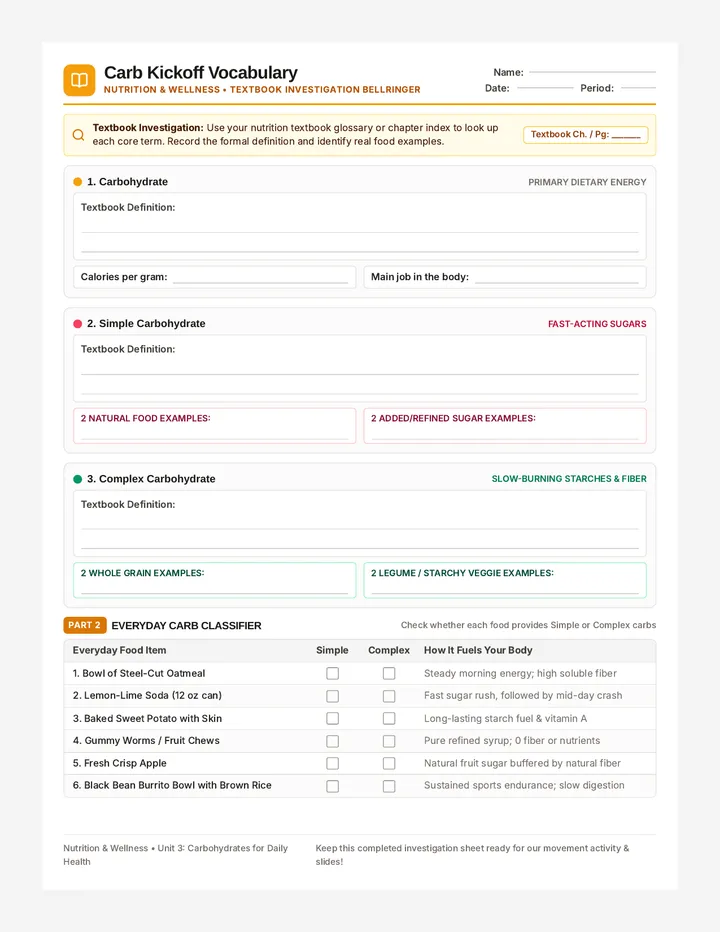
Daily Fuel Tracker Worksheet Daily Fuel Tracker
Investigate your current habits to build a stronger you.
Name:
Date:
Part 1: Yesterday's Intake
Think back to everything you ate and drank yesterday. List them below. Be as specific as possible (e.g., "whole wheat toast" instead of "bread").
Breakfast
Lunch
Dinner
Snacks
Hydration (Drinks)
Water Goal
Color in a droplet for every glass.
Part 2: Group Tally
Review your list from Part 1. Place a checkmark (✓) for each food item that fits into the groups below.
Food Group Tally / Items Daily Goal Fruits 1.5 - 2 cups Vegetables 2 - 3 cups Grains (Whole) 6 - 8 oz Protein 5 - 6.5 oz Dairy 3 cups
Part 3: Power Reflection
1. Which food group were you most successful at including yesterday? Why do you think that is?
2. Which food group was the hardest to include? How could you add it today?
3. One "Power Move" I will make tomorrow to improve my nutrition is:
Balanced Bite Reference Sheet The Balanced Bite
Your Quick Guide to Daily Power Plates
Vegetables
Fruits
Grains
Protein
Dairy
Golden Rules
Make half your plate fruits and vegetables.
Focus on whole fruits instead of juices.
Vary your veggie colors to get all vitamins.
Make at least half your grains whole grains.
Veggies & Fruits
Loaded with fiber, vitamins, and minerals. They keep your digestion smooth and skin healthy.
Spinach Broccoli Berries Oranges
Proteins
Building blocks for muscles, skin, and hormones. Essential for growth and tissue repair.
Chicken Lentils Fish Eggs
Grains
Primary energy source for your brain and muscles. Whole grains provide sustained energy.
Oats Quinoa Brown Rice Whole Wheat
Dairy
Key for calcium and vitamin D. Essential for building strong bones and teeth.
Greek Yogurt Milk Cheese Soy Milk
Don't Forget Water!
Aim for 8 glasses a day. Skip the sugary drinks.
H2O
Power Plate Teacher Guide Teacher Resource
Power Plate Facilitation Guide
Lesson 1: Introduction to Balanced Nutrition
Learning Objectives
Identify the five major food groups and their primary benefits to the body.
Explain the concept of a "Power Plate" (balanced meal portions).
Self-reflect on personal dietary habits and identify one actionable improvement.
Analyze common meal scenarios to determine nutritional balance.
Pacing & Activities
Hook (5-10 mins)
Display Slide 2 ("Why Do We Eat?"). Ask students to list their favorite foods and guess which "benefit category" they fall into.
Instruction (15-20 mins)
Use the Slide Deck to introduce the five food groups. Emphasize the 50/25/25 rule for fruits/veggies, grains, and protein.
Activity (15 mins)
Distribute the "Daily Fuel Tracker." Students work individually to reflect on yesterday's intake. Walk around to help categorize "complex" foods (e.g., sandwiches).
Debrief (10 mins)
Group discussion using Slide 6 scenarios. Focus on "transformation"—how to make a "bad" meal better rather than just labeling it "bad."
Key Misconceptions
"All fats are bad": Clarify that healthy fats (avocados, nuts) are essential for brain health."Juice = Fruit": Remind students that juice lacks fiber and is often high in added sugar."Potato = Veggie": While technically true, explain the difference between starchy and non-starchy veggies.
Discussion Prompts
"Why might someone find it hard to eat enough vegetables every day?"
"What are some snacks that hit two or more food groups at once?"
"How does what you eat for breakfast affect your afternoon performance?"
Differentiation & Extension
Support Strategies
For students struggling with categorization, provide the Balanced Bite Reference Sheet early. Use "visual sorting" cards for the food groups rather than writing lists.
Tip: Use the "Hand Method" for portions (Fist = Fruit/Veg, Palm = Protein, Cupped Hand = Grains).
Extension Ideas
Cultural Plate: Have students research a traditional meal from another culture and identify how it fits the Power Plate model.
School Lunch Critique: Analyze the school lunch menu for the week and suggest "Power Up" modifications for each day.
Rule Radar Story Rule Radar
Navigating Home and School
Expert:
My Two
Worlds
Every day, I spend time in two very important places: Home and School.
At Home, I am a family member.
At School, I am a student.
Both places have rules. Rules help keep me safe and happy!
Home Sweet
Home
At home, the rules are made by my family. These rules help our house run smoothly.
Home Rules might look like:
Taking off my shoes at the door.
Helping clear the table after dinner.
Asking before using my tablet or TV.
Home is a place where I can relax and be comfortable with the people who love me most.
School
Success
At school, the rules are made for everyone. These rules help us all learn together.
School Rules might look like:
Raising my hand to speak in class.
Walking quietly in the hallway.
Staying in my seat during work time.
School is a place where I learn new things and work as part of a big team.
Safety
First
The most important rules at school keep everyone safe.
No Fighting
I use my words, not my hands, to solve problems. This keeps our school a kind place.
Dangerous Items
Dangerous things, like guns or weapons, are never allowed at school. They stay far away from our learning space.
When we follow safety rules, we can all focus on learning and having fun together!
Why Are They
Different?
Home is for Resting
I can play loudly, sit on the floor, or eat a snack whenever I am hungry (if my family says yes!).
School is for Learning
I need to be quiet so others can hear the teacher. I have to wait for lunch time to eat.
Rules are different because the goals are different.
If I used home rules at school, it might be hard for my friends to learn. If I used school rules at home, it might feel too serious!
Switching
Gears
When I leave for school, I turn on my School Brain.
My School Gear:
I am ready to listen, follow group directions, and work hard!
When I come home, I can switch back to my Home Gear.
I am a Rule Expert!
Vibe Sort Worksheet Vibe Sort
Is this a Home Rule or a School Gear rule?
NAME:
Read each rule below. Decide if it is a rule you usually follow at Home, at School, or Both! Color in the matching circle.
1. Raise your hand to speak.
Home
School
Both
2. Keep hands and feet to yourself.
Home
School
Both
3. Walk quietly in the hallways.
Home
School
Both
4. Do not bring weapons to school.
Home
School
Both
5. Ask before using an iPad or TV.
Home
School
Both
Stay Safe!
Why is it important for everyone to leave dangerous items at home?
Safety helps us all learn together.
Rule Radar Story Car Theme Rule Radar
Navigating Home and School
Driver:
Two Different
Roads
Every day, I drive on two different roads: Home Road and School Highway.
At Home, I am in the Garage (The Pit Stop).
At School, I am on the Main Road.
Both roads have Signs. Rules are like traffic signs—they keep everyone safe!
The Home
Garage
In my home garage, the rules are made by my family. These rules help me "tune up" and rest.
Garage Rules:
Park my shoes in the right spot.
Fuel up with a healthy dinner.
Ask before starting the TV or tablet.
The garage is a place where I can relax, go slow, and spend time with my favorite people.
The School
Highway
On the school highway, the rules are for every driver. They help us all move forward together.
Highway Rules:
Signal (raise hand) before talking.
Slow down and walk in the hallways.
Stay in my lane (seat) during work time.
School is a big team of cars all learning new skills together.
Safety
Brakes
Some rules are like Brakes. They keep us from crashing.
No Fighting
I use my "Voice Horn" to say how I feel. I don't use my hands to push or hit other cars.
No Danger
Dangerous things, like guns or weapons, are never allowed at school. We leave those far away.
Safety rules are for EVERYONE. They keep the road clear for learning!
Shifting
Gears
When I pull into the school parking lot, I Shift Gears.
School Gear:
I am ready to follow the signs, watch for others, and go the right speed!
When I get home, I can shift into Park Gear and relax.
I am a Master Driver!