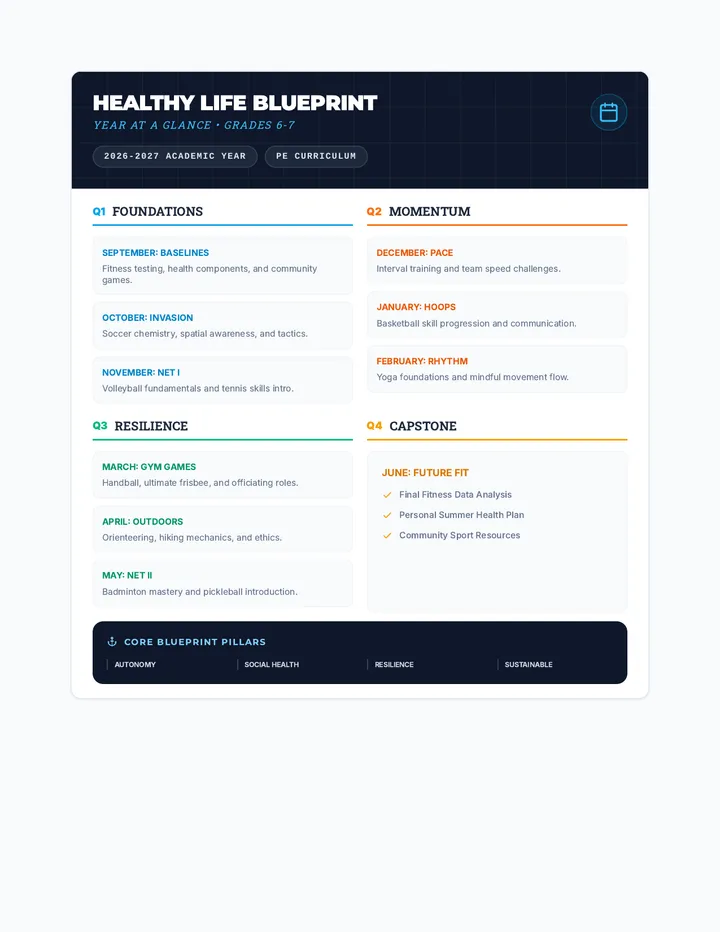
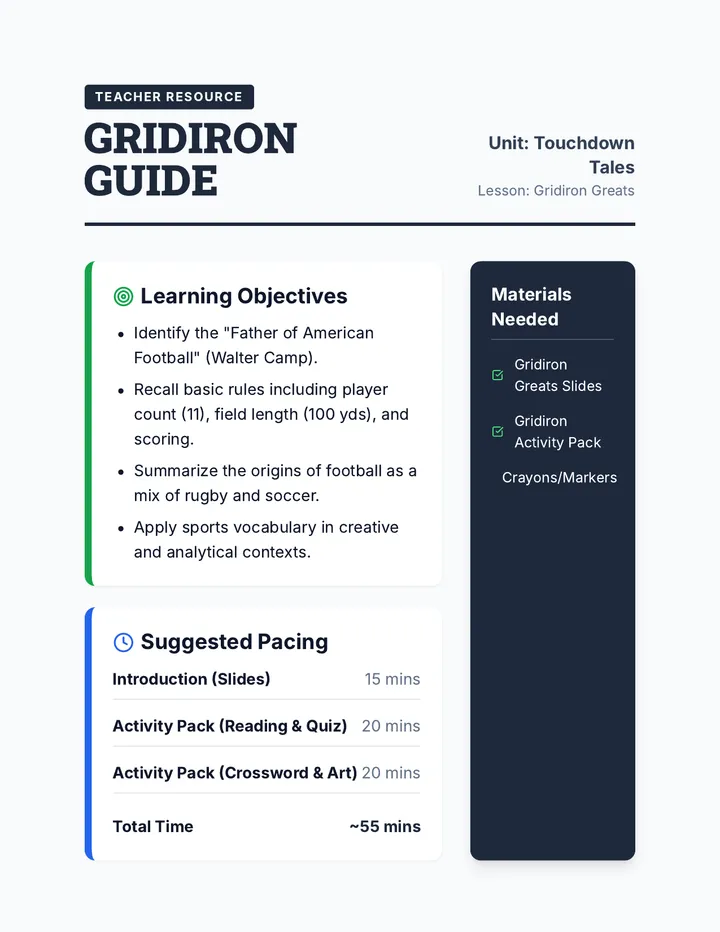
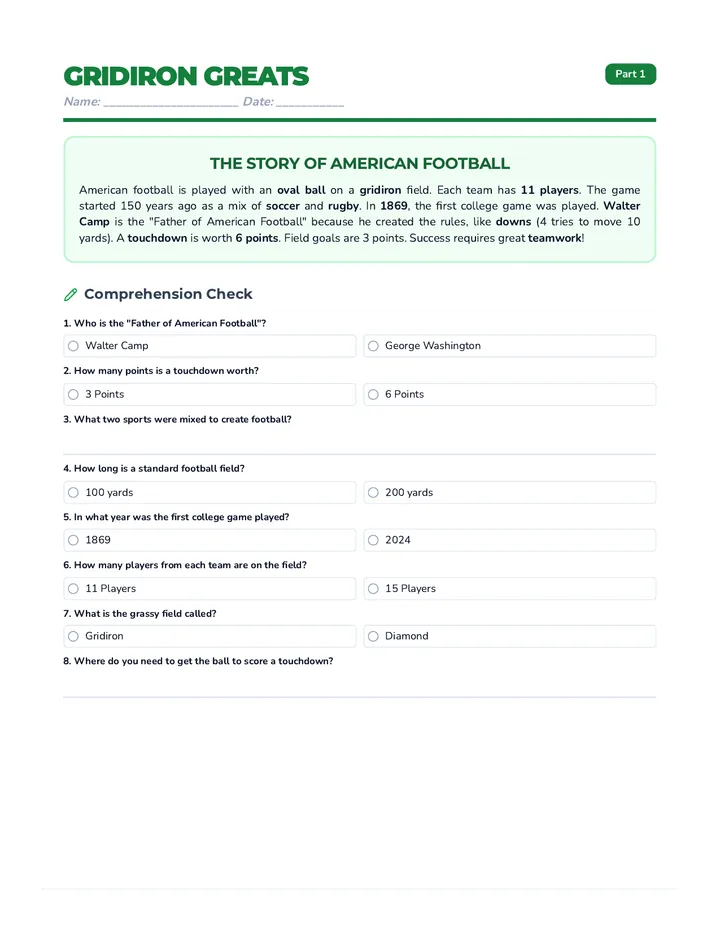
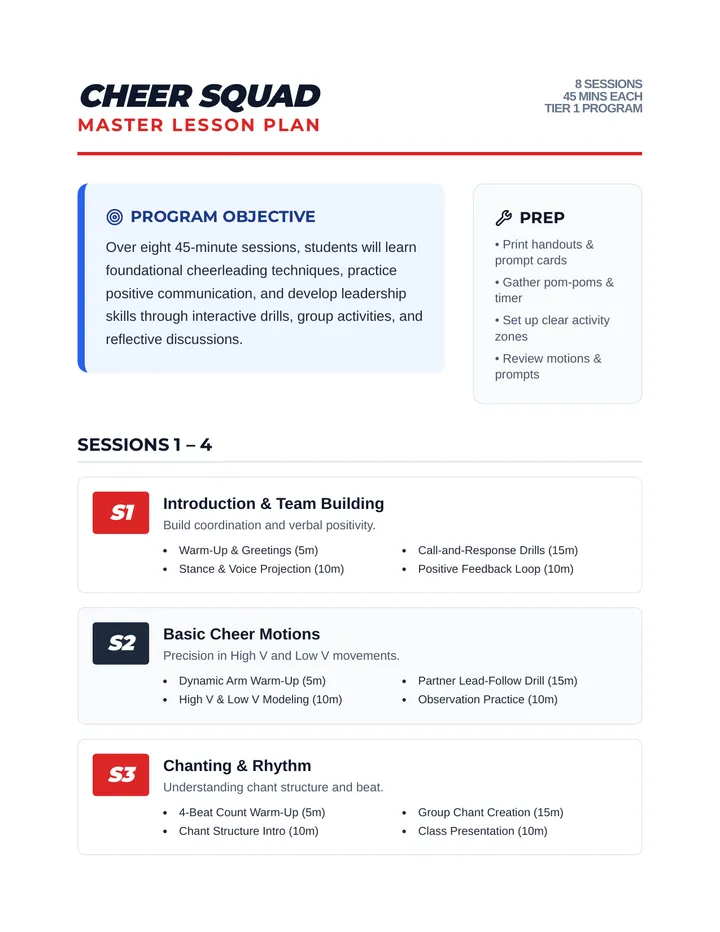
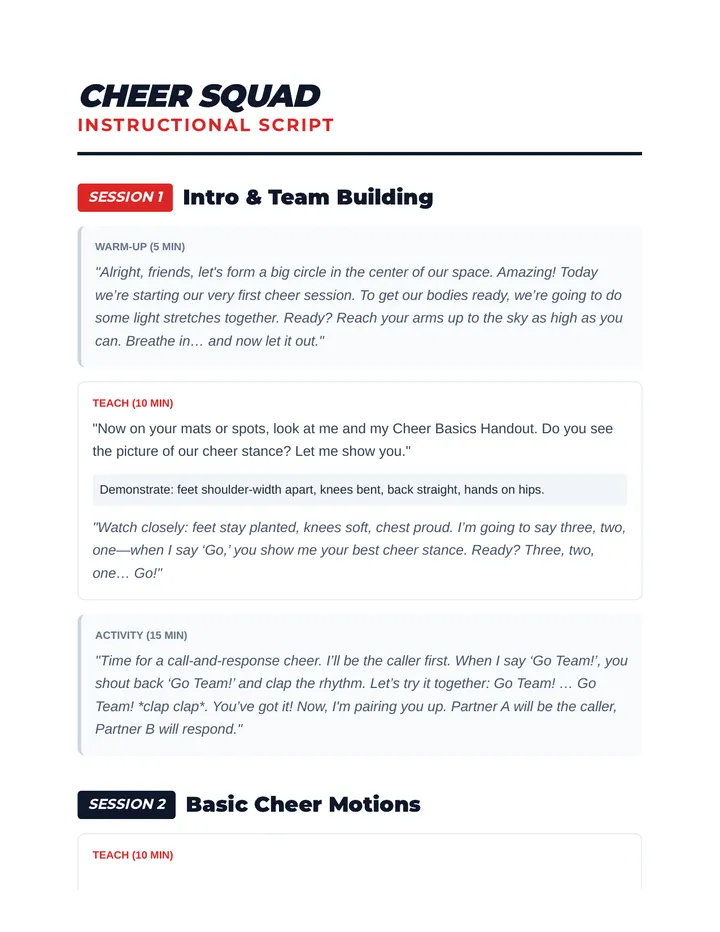
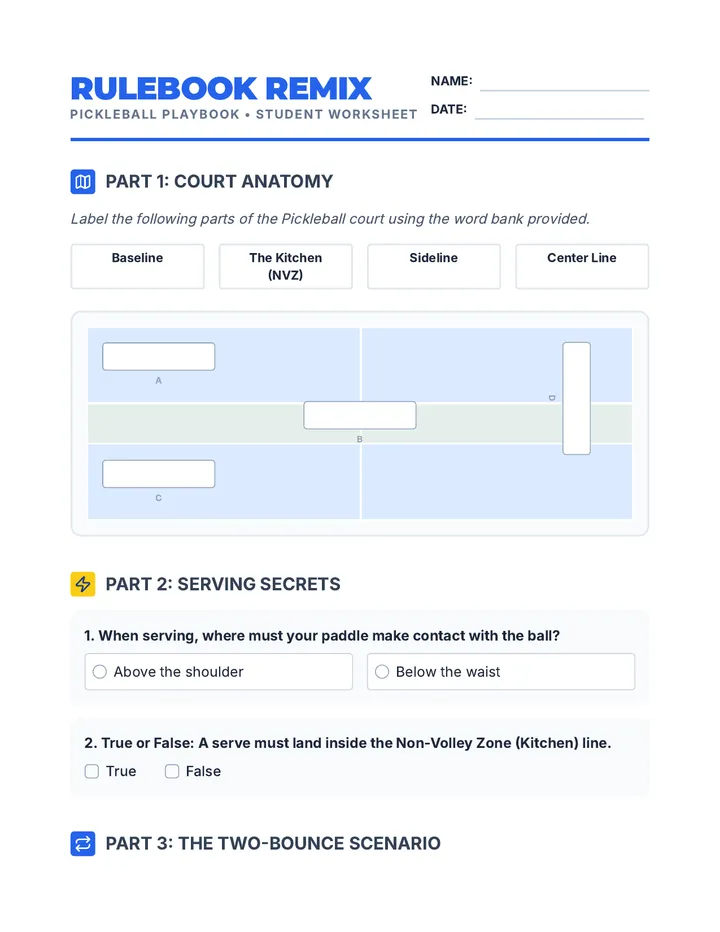
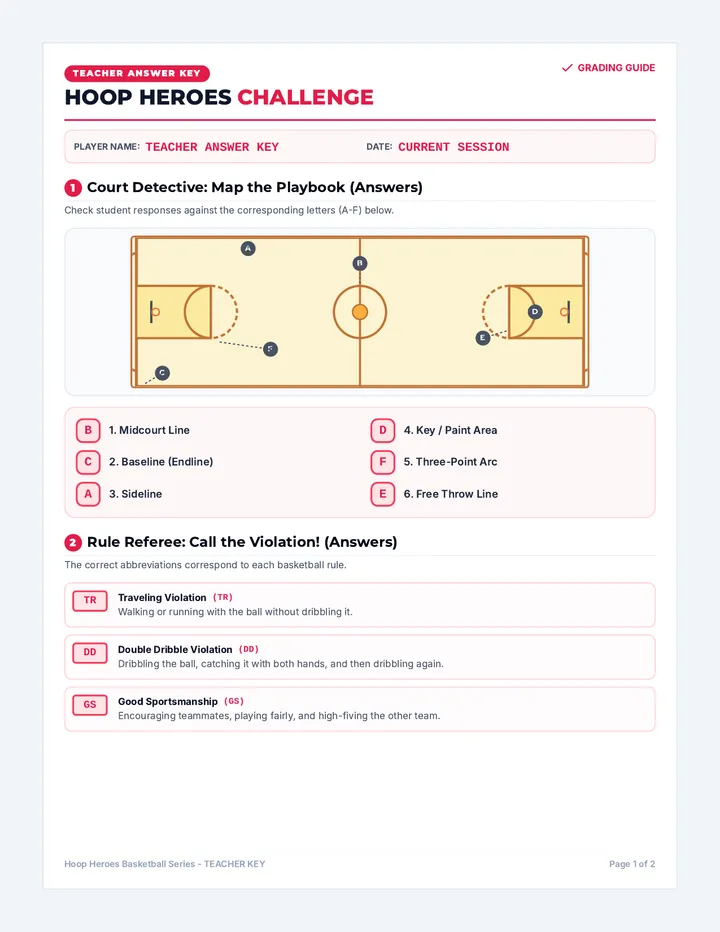
Fundamental techniques for soccer, volleyball, football, and basketball alongside strategic gameplay and communication skills. Emphasizes sportsmanship and collaborative tactics within a competitive team environment.
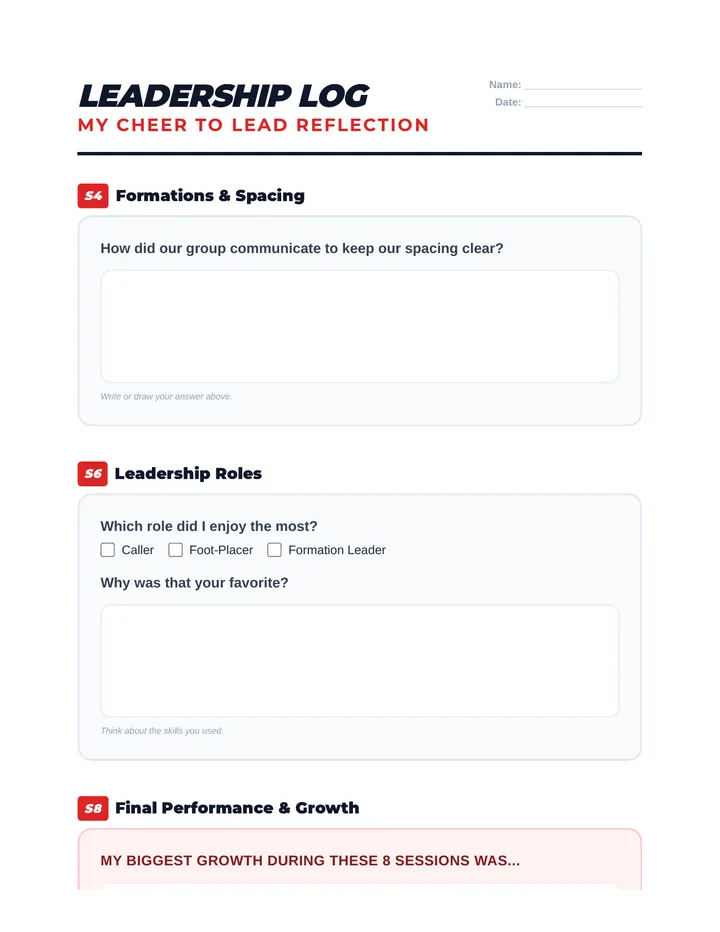
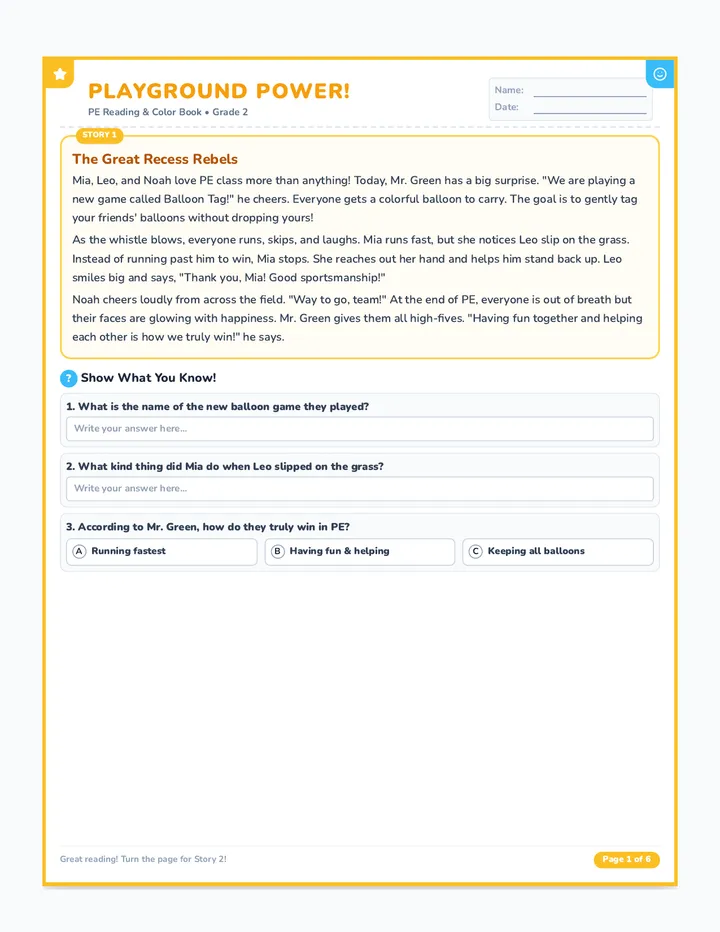
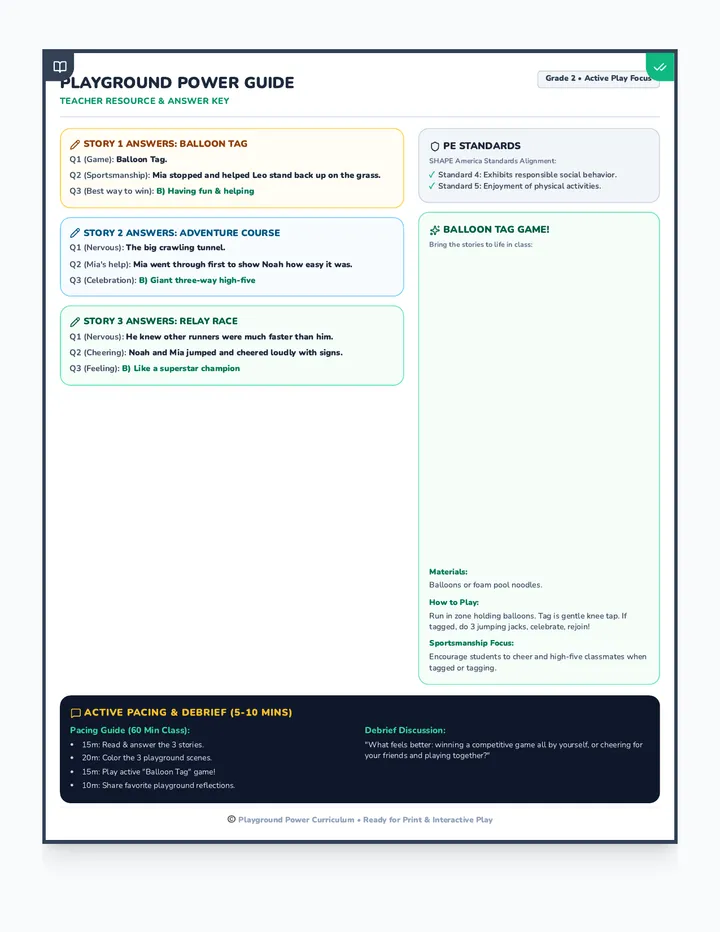
A Kindergarten Physical Education sequence focused on social-emotional skills through team building. Students learn to recognize emotions, offer encouragement, help peers in games, and celebrate together to build a supportive classroom culture.
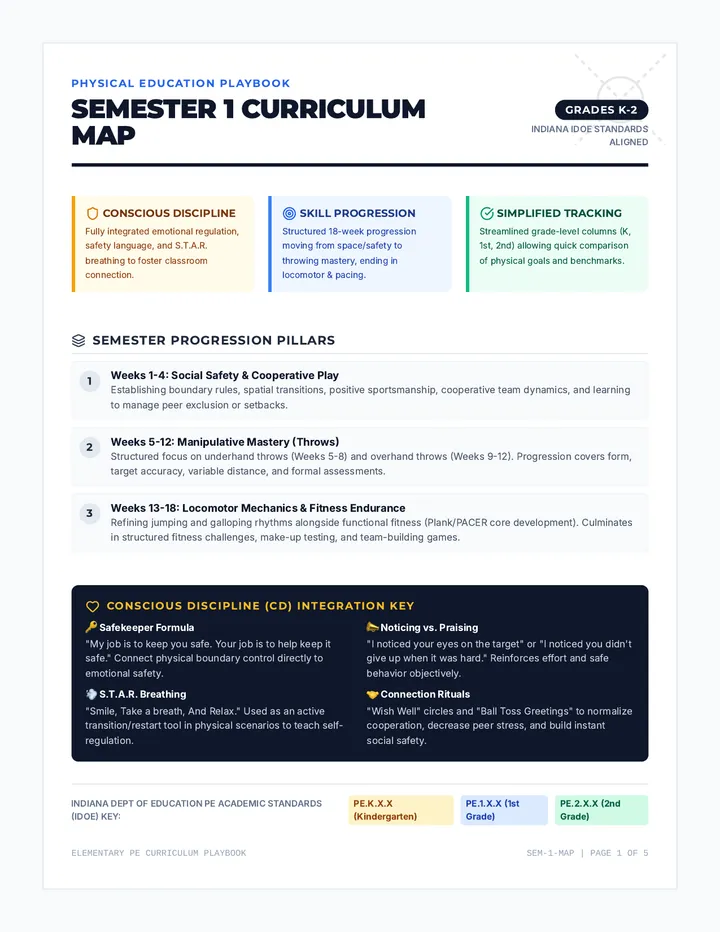
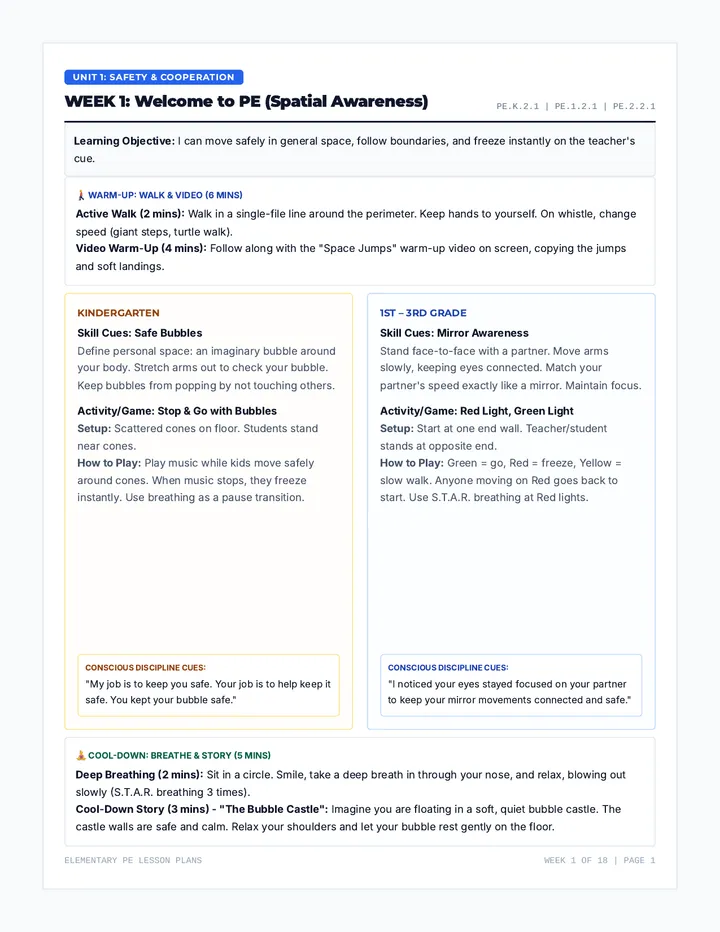
A Kindergarten sequence focused on developing spatial awareness through 'space bubbles' and progressing to complex group coordination activities like parachute play. Students learn to navigate their environment safely and move in harmony with peers.
A comprehensive 7th-grade unit on track and field mechanics, covering explosive starts, top-speed form, relay handoffs, and pacing strategies for middle-distance events. Students progress from technical skill acquisition to strategic application in timed trials.
A Kindergarten Physical Education sequence focused on verbal coordination, positive encouragement, and basic team strategy. Students learn to use their voices to connect with peers and improve group play.
A Kindergarten sequence focused on the basics of team communication through auditory signals, visual cues, and non-verbal cooperation. Students learn to use their eyes and ears to play safely and effectively as a team.
This sequence introduces first-grade students to verbal and non-verbal communication in physical activities. Students learn to use clear voices, interpret body language, practice active listening, and guide partners to build trust and teamwork.
A project-based Physical Education sequence where 9th-grade students analyze, design, and facilitate original cooperative games. The unit focuses on moving from competition to collaboration through inclusive design and instructional leadership.
This sequence focuses on the psychological and physical aspects of trust, safety, and support within a team environment. Students progress from basic weight-sharing activities to high-stakes simulated risks that require absolute reliance on peers, emphasizing safety protocols and collective responsibility.
A high-stakes cooperative game sequence for 12th graders focusing on leadership roles, resource management, and iterative strategy through complex physical challenges.
A Kindergarten physical education sequence focused on parachute play to develop group synchronization, listening skills, and cooperative movement. Students progress from basic safety and grips to complex group maneuvers like waves, domes, and object tracking.
A series of cooperative physical education lessons for Pre-K students focused on helping others, communicating, and solving problems together through narrative play.
This sequence challenges 11th-grade students to deconstruct the mechanics of effective teamwork through increasingly complex physical problem-solving initiatives. Moving beyond basic participation, students analyze group behavior, experiment with different leadership styles, and refine communication protocols under pressure.
A Kindergarten physical education sequence focused on teaching the foundational motor skills of soccer passing, trapping, and partner cooperation through engaging, game-based activities.
A Pre-K physical education sequence focused on soccer passing and teamwork. Students learn to communicate with partners, master the push-pass technique, and develop tactical awareness through cooperative games.
A 1st-grade physical education sequence focused on cooperative soccer skills, specifically the mechanics of passing with the inside of the foot and receiving (trapping) the ball. Students progress from static drills to moving targets and group play.
A 5-lesson sequence for 2nd graders focused on developing cooperative soccer skills, specifically the push pass, receiving with control, shooting accuracy, and basic team spacing. Students move from individual mechanics to small-sided 3v3 games emphasizing teamwork over individual play.
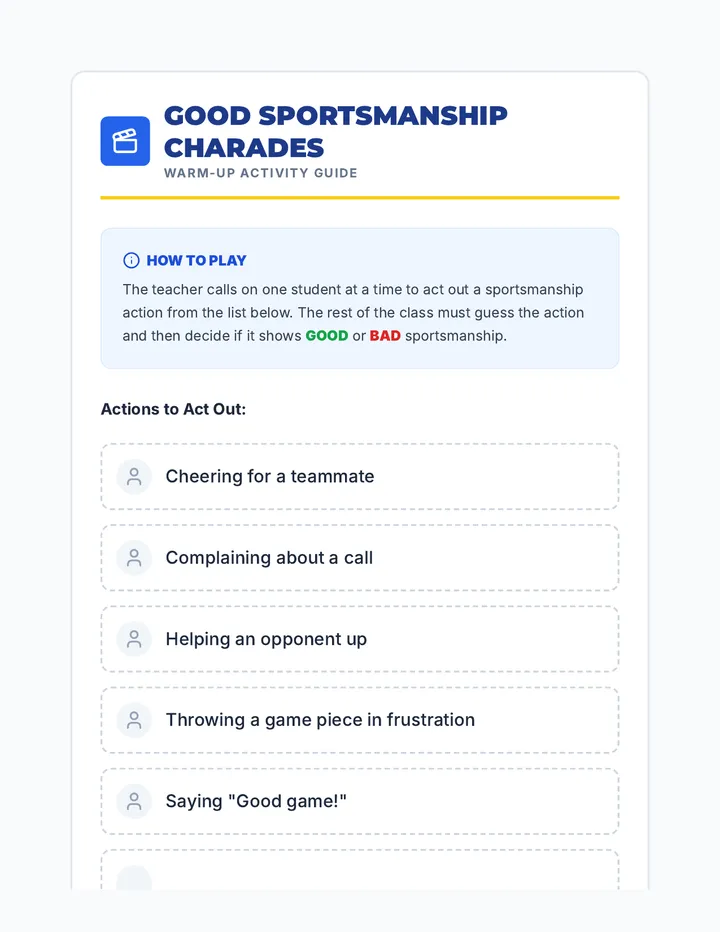
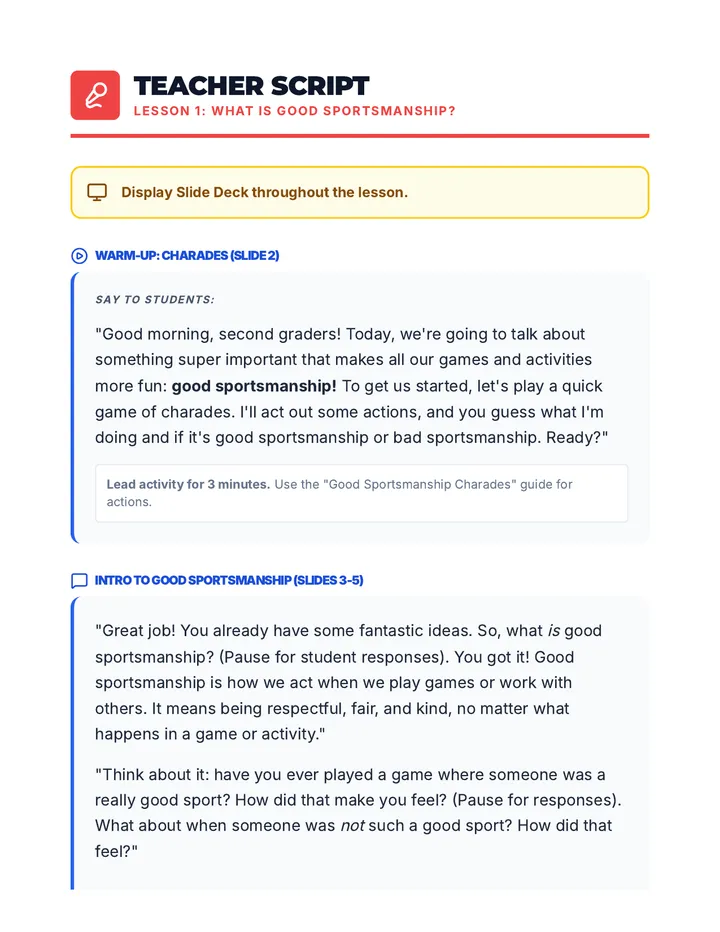
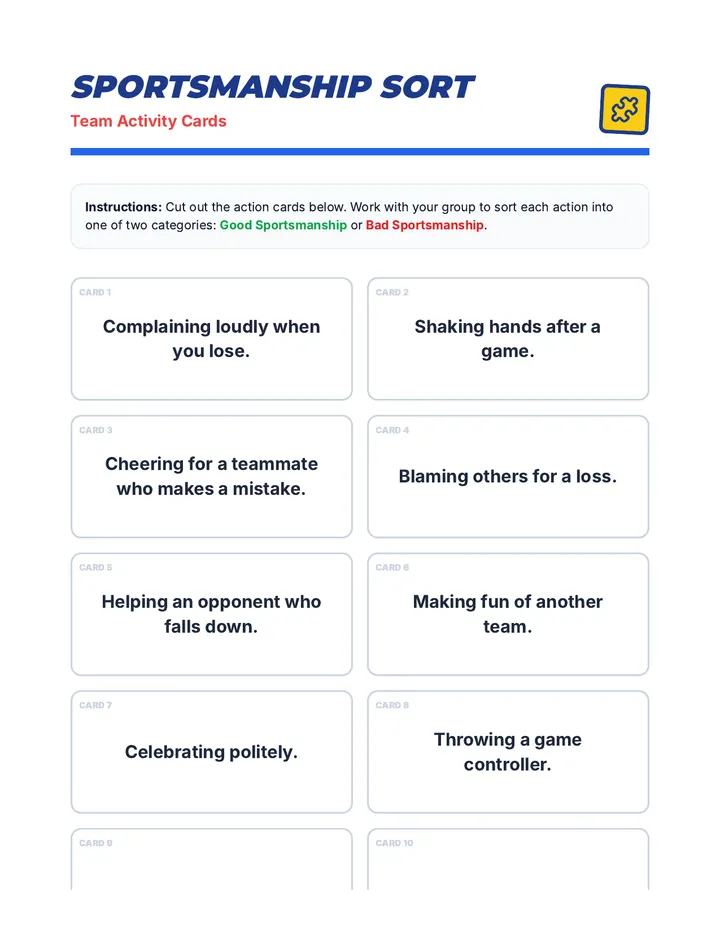
This sequence introduces Pre-K students to the concept of sportsmanship through teamwork, group cooperation, and positive encouragement. Students move from understanding what a teammate is to practicing collective goal-setting and verbal support.
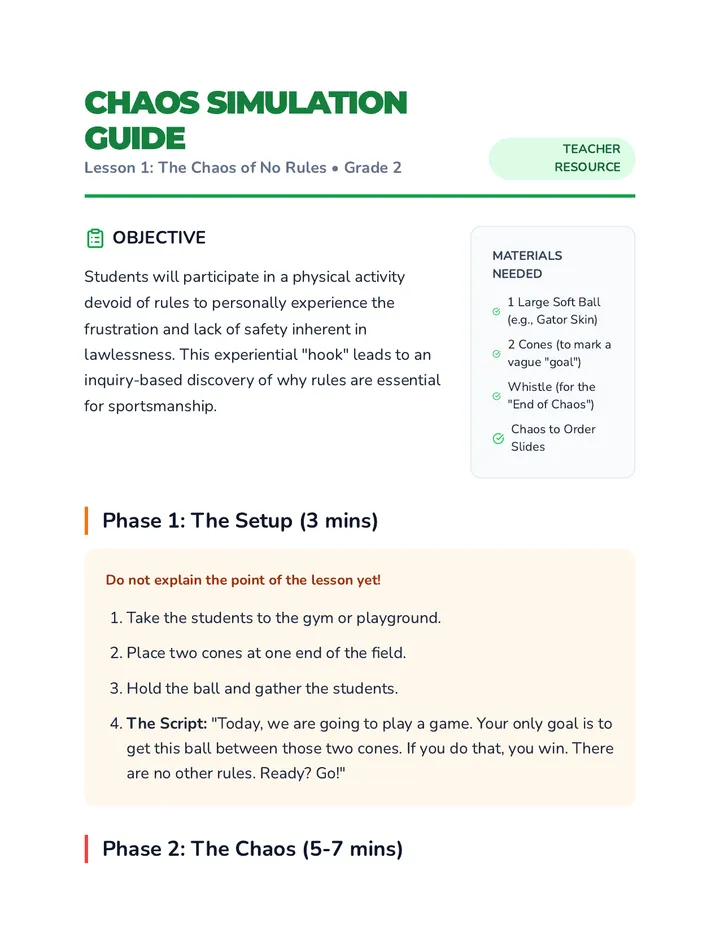
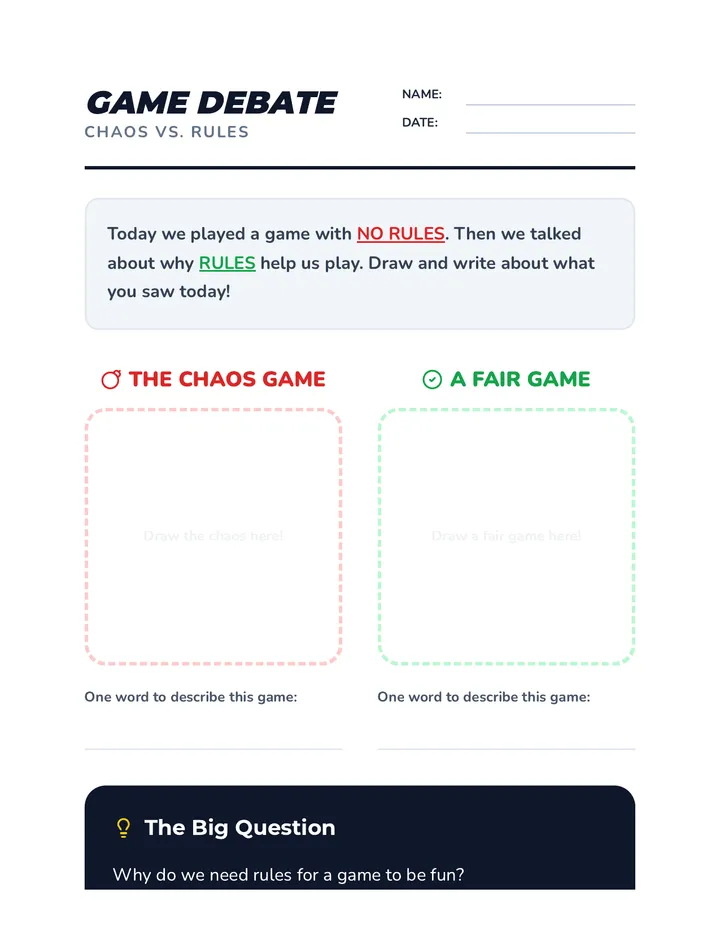
This sequence introduces Pre-K students to the core concepts of rules, fairness, and sportsmanship. Through games, storytelling, and hands-on activities, children learn the importance of turn-taking, respecting authority, and staying within boundaries.
A comprehensive 5-lesson unit for 4th Grade PE focusing on mastering long-handled implements. Students progress from basic safety and grip to complex dribbling, passing, and dynamic game play, emphasizing mechanics like weight transfer and follow-through.
This project-based sequence for 3rd graders explores how safety protocols, rules, and communication prevent injuries in physical activities. Students transition from analyzing existing rules to designing and teaching their own 'Safe Games,' emphasizing safety as a shared responsibility.
This kindergarten physical education sequence focuses on synthesizing soccer skills through small-sided games, moving from 1v1 duels to 3v3 scrimmages while emphasizing sportsmanship and decision-making.
A Kindergarten physical education sequence introducing soccer dribbling and ball control through imaginative play, emphasizing soft touches, stopping, and directional changes.
A 5-lesson sequence for Kindergarten students focusing on the mechanics and excitement of shooting in soccer, distinguishing it from passing through power, aim, and follow-through.
A comprehensive soccer skills sequence for Kindergarten focusing on rules, spatial awareness, and basic game mechanics. Students move from the 'beehive' mentality to understanding boundaries, 'no hands', and basic roles.
A foundational soccer sequence for Pre-K students focusing on basic gameplay, spatial awareness, and sportsmanship. Students learn about boundaries, directionality, defensive positioning, and the unique role of the goalkeeper through playful simulation and movement.
A soccer dribbling sequence for Pre-K students focusing on 'soft touches', using the inside of the foot, steering around obstacles, and controlling speed. Students move from stationary control to mobility through playful, game-based learning.
A fun, active sequence for Pre-K students focused on the fundamentals of kicking a soccer ball, from foot placement to target accuracy and sportsmanship.
This introductory sequence focuses on the absolute basics of ball manipulation using feet only for Pre-K students. Children explore balance and coordination while learning the fundamental rule of soccer: no hands allowed, progressing from stationary control to stopping a moving ball.
This sequence introduces 1st Grade students to the fundamental skills of soccer shooting and field spacing. Students progress from learning the 'laces' strike for power to understanding spatial awareness and basic attacking tactics in small-sided games.
A 1st Grade physical education sequence focusing on the foundations of soccer dribbling. Through imaginative play like 'soccer dogs' and 'asteroid navigation,' students learn ball control, speed regulation, and spatial awareness.
A comprehensive tactical soccer sequence for undergraduate students, focusing on spatial awareness, offensive systems, and strategic decision-making through game-based learning.
A comprehensive undergraduate sequence focused on the biomechanical principles of elite soccer skills, progressing from isolated technical refinement to high-pressure game application. Students analyze the physics of ball control, passing, dribbling, and finishing to develop both personal mastery and coaching proficiency.
A comprehensive 2nd-grade physical education unit focused on fundamental soccer skills, specifically ball control, dribbling surfaces, trapping, and spatial awareness through engaging, game-based activities.
A 5th-grade physical education sequence focusing on football (soccer) skills, positional roles, rules like offside, and the importance of sportsmanship and team strategy. students rotate through player and official roles to develop a holistic understanding of the game.
This unit focuses on the attacking phase of football, specifically shooting mechanics and scoring strategies. Students explore the physics of striking the ball for power versus placement and learn when to use each technique through a series of skill-building drills and game-like scenarios.
This sequence focuses on the technical foundations of football (soccer), including dribbling, passing, receiving, and tactical movement. Students progress from individual ball mastery to dynamic team-based possession drills.
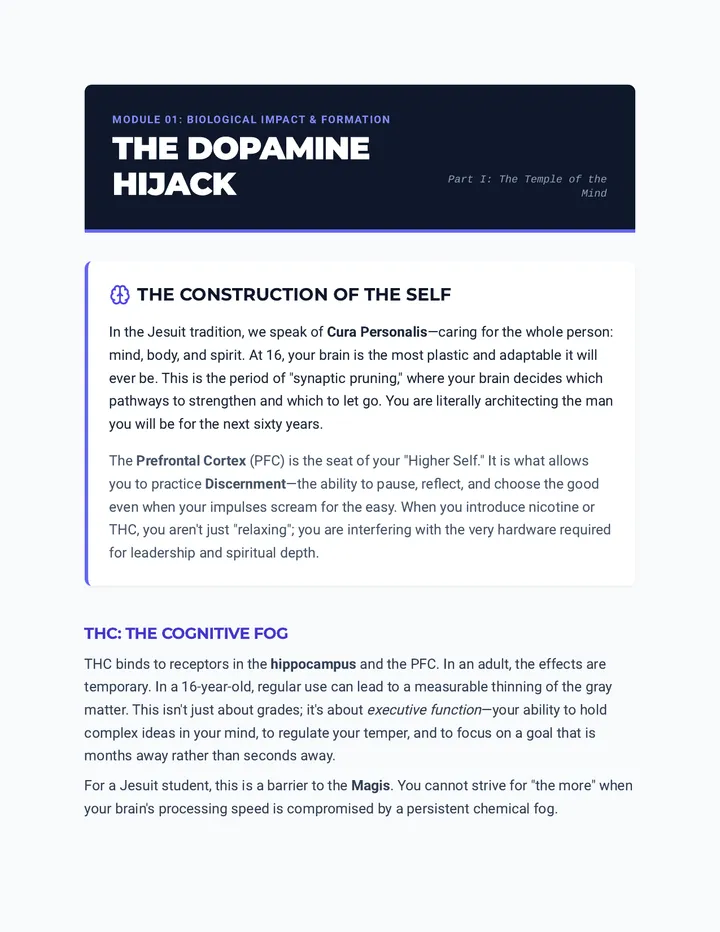
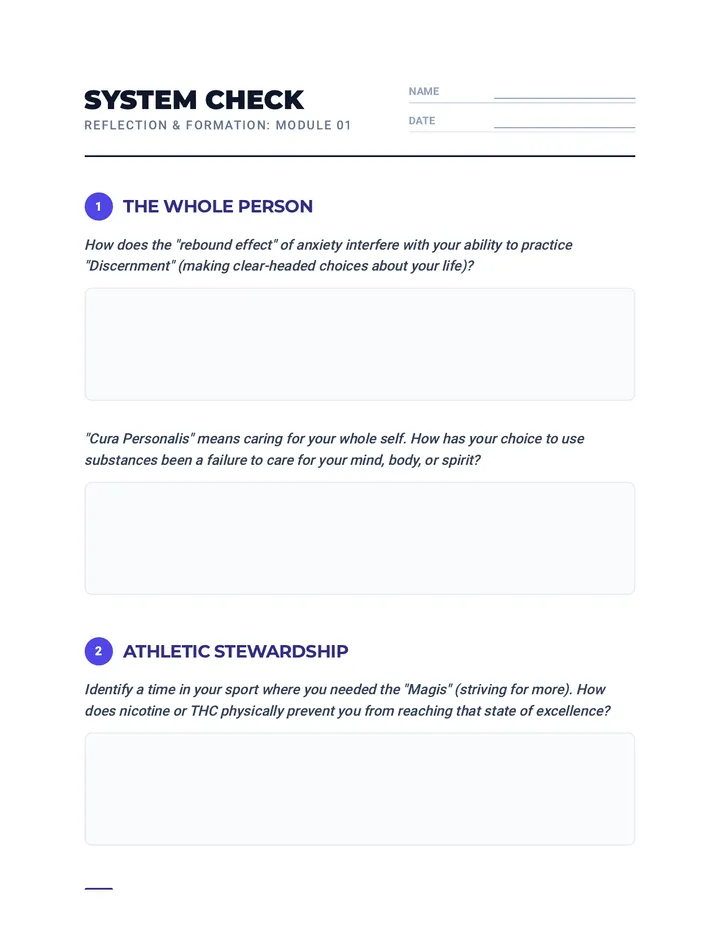
A restorative learning program designed for high school students to reflect on the impact of substance use and prepare for a positive return to their school community. The program balances scientific facts with deep personal reflection.
This sequence explores cardiovascular endurance and track meet operations for 5th-grade students. It covers pacing strategies, interval training through games, the mathematical geometry of track lanes, and culminates in a student-led class track meet where they apply both athletic and officiating skills.
A comprehensive 4th-grade physical education unit focused on the biomechanics of sprinting and the technical skills of relay racing. Students progress from individual running form to collaborative baton exchanges and team strategy.
This 8th-grade Physical Education sequence blends middle-distance endurance training with the logistics of track meet administration. Students develop pacing strategies and physiological awareness while taking on the roles of officials and managers, culminating in a student-led mini-meet.
This 5-lesson sequence for 6th grade PE focuses on the biomechanics of sprinting, pacing strategies for middle distance, relay coordination, and hurdle rhythm. Students progress from individual form to collaborative teamwork, culminating in performance analysis and goal setting.
A comprehensive 10th-grade track and field unit focusing on the biomechanics of sprinting, technical relay exchanges, and strategic pacing for middle-distance events. Students analyze acceleration angles, stride efficiency, and energy system usage through video review and data collection.
An advanced 11th-grade track and field sequence focusing on the biomechanics of sprinting, the precision of relays, and the physiological strategy of middle-distance running. Students transition from mechanical refinement to competitive application.
This 10th-grade gymnastics sequence guides students from performing isolated skills to composing fluid, artistic floor routines. It focuses on the choreography of transitions, spatial utilization, musicality, and peer feedback to enhance the aesthetic and athletic quality of gymnastics performances.
A Kindergarten sequence focused on teaching spatial awareness, turn-taking, verbal conflict resolution, and fair play strategies in team sports and physical education settings.
This graduate-level sequence examines the structural engineering of communication in elite athletic environments. Students will learn to design, audit, and implement sophisticated communication systems that enhance psychological safety, reduce cognitive load, and optimize tactical execution across diverse rosters.
A 1st-grade sequence focused on social-emotional skills in team sports, teaching students how to manage emotions, use I-statements, resolve disputes with Rock-Paper-Scissors, and use positive reinforcement.
A comprehensive 5th-grade PE sequence focusing on football (soccer) defensive tactics, moving from individual stance and jockeying to team-based pressure, cover, and zonal organization. Students develop spatial awareness and tactical communication to control the game without the ball.
A comprehensive sequence for 3rd graders focusing on defensive football (soccer) skills, including stance, tackling, anticipation, and ball protection. Students move from individual posture to live game-based scenarios.
A comprehensive 5-lesson sequence for 4th graders on football shooting mechanics, moving from basic power strikes to advanced 1-on-1 finishing and rebound anticipation. Students develop technical skills, safety awareness, and tactical composure in front of the goal.
This project-based sequence integrates all skills into a simulated tournament structure where students take ownership of team management. Teams draft lineups, design playbooks, and officiate matches, gaining a holistic understanding of the sport. The sequence focuses on applying technical skills and tactical knowledge in a competitive environment, with designated reflection periods to adjust strategies. Students learn that successful outcomes rely on preparation, adaptation, and fair play as much as athletic ability.
A comprehensive 10th-grade physical education unit focusing on defensive football tactics, moving from individual stance to complex full-field systems. Students master 'Pressure, Cover, Balance' and tactical transitions to neutralize opponents.
An advanced 11th-grade football unit transitioning from technical drills to dynamic, game-speed tactical application. Focuses on ball mastery, penetrative passing, clinical finishing, and cohesive defensive organization.
An inquiry-based exploration of striking mechanics for 2nd Grade. Students investigate how grip, stance, and swing plane affect the flight of objects using hands, paddles, and bats.
A comprehensive 8th-grade physical education unit focused on the tactical and technical aspects of defensive play in football (soccer). Students progress from individual containment and tackling skills to complex group tactics like pressure-cover-balance and defending set pieces.
An advanced physical education sequence for 11th-grade students focusing on technical ball mastery, possession tactics, and the biomechanics of football. Students move from individual touch mastery to high-pressure collective possession games.
A comprehensive 12th-grade unit that shifts the focus from physical execution to tactical leadership and coaching. Students analyze formations, design training sessions, master officiating, and manage in-game scenarios, culminating in a student-led tournament where they act as player-coaches.
A high-performance football unit for 12th graders focusing on the tactical and technical mastery of set pieces. Students move from technical skill-building to strategic choreography, culminating in a 'Dead Ball Playbook' used in a competitive derby.
This 12th-grade football sequence focuses on advanced defensive strategies, moving from individual jockeying mechanics to complex unit-based zonal tactics and full-field organization. Students develop both physical skills and tactical intelligence to control space and disrupt opposition attacks effectively.
An advanced 12th-grade physical education sequence focusing on the biomechanics, physics, and tactical application of football striking and finishing techniques. Students progress from technical breakdown to high-pressure game scenarios.
This 10th-grade Physical Education sequence focuses on the tactical and technical aspects of defensive play in football (soccer). Students progress from individual defending techniques to small-group coordination and full-unit tactical organization.
A comprehensive 5th-grade unit on defensive football skills, focusing on stance, timing, interception, and team coordination to regain possession cleanly and intelligently.
A comprehensive 9th Grade PE unit focusing on the biomechanics of football shooting. Students progress from stationary power shots to complex aerial volleys and finishing under pressure, combining physical practice with an understanding of the physics behind ball flight.
This 9th Grade PE sequence focuses on advanced ball control, shielding, and turning techniques in football. Students progress from individual dribbling mastery to high-pressure possession games, culminating in a Rondo-based assessment of their technical skills and decision-making.
A project-based volleyball unit for 11th-grade students that integrates high-level gameplay with statistical analysis. Students form teams, conduct skill assessments, track performance data during a tournament, and use that data to refine strategies for the championship finals.
This sequence guides 11th-grade students through the complexities of volleyball's offensive side, moving from individual mechanics to team-based tactical systems. Students will master setter decision-making, the 3-step hitting approach, varied attack shots, and transition coverage to build a cohesive scoring threat.
This sequence focuses on blocking, digging, and defensive alignments used to neutralize high-powered offenses in volleyball. Students learn to read hitter cues and implement perimeter and rotational defensive systems to coordinate the block and back-row defense.
An advanced 11th-grade volleyball sequence focusing on the biomechanics, physics, and strategy of serving and reception. Students transition from basic skills to high-performance execution through technical analysis and pressure-based simulations.
A high-stakes volleyball unit for 10th graders focusing on advanced gameplay, tournament organization, and the technical art of officiating. Students transition from players to league managers, mastering referee signals, strategic rotations, and the mental resilience required for competitive sports.
A comprehensive volleyball unit for 10th grade focusing on the 4-2 offensive system, rotational rules, and team communication. Students progress from theoretical court positioning to high-speed transition play and tactical scrimmages.
A comprehensive unit for 10th-grade students on advanced volleyball defensive tactics, focusing on individual mechanics, reading offensive cues, and team-based defensive systems. Students will progress from foundational blocking safety to complex rotational coverage.
This sequence focuses on refining the biomechanics of the forearm pass (bump) and the overhead pass (set) for 10th-grade students. It moves from static form analysis to dynamic movement, emphasizing platform stability, angle creation, and footwork efficiency for high-repetition accuracy.
A comprehensive 10th-grade volleyball sequence focusing on offensive mechanics, from the physics of the overhand serve to the timing and footwork of the three-step attacking approach. Students progress from baseline skills to complex offensive transitions.
A Sport Education-based volleyball sequence for 7th graders, focusing on officiating, coaching, and tournament play to build holistic sportsmanship and strategic understanding.
This sequence focuses on the critical role of communication in volleyball, moving from basic verbal call-outs to complex non-verbal cues and defensive systems. Students will develop teamwork, resilience, and tactical awareness through specialized drills and role-playing scenarios.
A comprehensive volleyball unit focusing on offensive tactics, including serving mechanics (underhand and overhand) and the attack progression (approach and spiking). Students develop technical consistency and strategic execution for competitive play.
A comprehensive sequence for 7th-grade students focusing on the structural mechanics of volleyball, including court zones, clockwise rotation, service receive formations, defensive transitions, and official scoring rules. Students progress from basic spatial awareness to coordinating complex team movements in game-like scenarios.
A comprehensive introduction to volleyball biomechanics, focusing on the forearm pass and overhead set. Students progress from basic athletic stance to dynamic partner play, emphasizing ball control, platform stability, and hand positioning.
This sequence for undergraduate students focuses on the interpersonal and psychological dimensions of volleyball, emphasizing verbal and non-verbal communication, leadership, and conflict resolution to build cohesive, high-performing defensive units.
A specialized course for undergraduate students focusing on the pedagogical side of volleyball. Students move from understanding motor learning theory to designing and leading their own game-like 'grills' and practice sessions.
A deep dive into the data-driven world of competitive volleyball for undergraduate students. This sequence bridges the gap between physical skill and tactical mastery, teaching students how to use statistical analysis, pattern recognition, and game theory to outmaneuver opponents.
This sequence transitions undergraduate students from individual volleyball skills to complex team systems, focusing on offensive rotations (5-1, 6-2) and defensive perimeters. Students will explore the logic behind overlapping zones, rotational faults, and transition plays through theoretical analysis and on-court simulation.
A biomechanical deep-dive into volleyball fundamentals for undergraduate students, focusing on the kinetic chain, torque generation, and geometric efficiency of elite-level execution.
A comprehensive 5-lesson sequence for 5th-grade students focused on the biomechanics of sprinting and the technical coordination of relay racing. Students progress from individual form analysis to complex team-based baton exchanges in a simulated competitive environment.
A comprehensive 8th-grade physical education unit focusing on the biomechanics of sprinting, hurdling, and relay coordination, emphasizing technical efficiency and explosive power.
This 9th-grade physical education sequence deconstructs the biomechanics of track and field, covering explosive sprint starts, maximum velocity mechanics, relay coordination, and pacing strategies for endurance. Students transition from raw power to strategic efficiency, culminating in a performance analysis and time trial assessment.
A comprehensive 2nd Grade PE unit on hand dribbling, focusing on finger pad control, level changes, peripheral vision, and locomotor movement. Students progress from stationary basics to dynamic tag games using a mastery-based approach.
A 5th-grade basketball sequence focused on offensive strategy, teaching students to move beyond 'swarm ball' through spacing, cutting, and screening. The unit culminates in student-designed plays and strategic scrimmages that reward movement over raw scoring.
A comprehensive 5th-grade basketball sequence focusing on the fundamentals of defensive play, including stance, lateral movement, positioning, closeouts, and rebounding. Students learn how to control the game through tactical positioning rather than just chasing the ball.
A comprehensive 5th-grade sequence focused on the biomechanics of basketball shooting, from foundational BEEF mechanics to high-pressure game situations. Students develop technical mastery through workshops, gamified practice, and self-reflection on shot selection.
This 5-lesson sequence for 5th graders develops foundational basketball ball-handling skills, moving from stationary fingertip control to dynamic movement and protective shielding. Students progress through mechanical mastery, ambidexterity, speed control, and defensive shielding, culminating in a complex obstacle course assessment.
A 5th-grade physical education unit focused on the mechanics and strategy of basketball passing. Students transition from stationary passing to dynamic movement, pivoting for angles, and long-range outlet passes, culminating in no-dribble games that emphasize teamwork and communication.
This 3rd-grade sequence focuses on offensive basketball strategy, teaching students the importance of floor spacing, cutting to the basket, the 'give and go' play, and basic screening. Students move from conceptual understanding of spatial awareness to practical application in modified 3-on-3 scrimmages.
A 3rd-grade basketball sequence focusing on defensive fundamentals, positioning, and teamwork. Students progress from individual stance and movement to complex team-based 'help' defense concepts.
This workshop-style sequence breaks down shooting a basketball for 3rd graders using the B.E.E.F. acronym (Balance, Eyes, Elbow, Follow-through). Students progress from stationary form shooting to dynamic layups, focusing on body alignment and consistent mechanics over shooting accuracy.
A 5-lesson sequence for 3rd Grade students focusing on basketball passing mechanics, strategic bounce passes, leading moving targets, triple-threat positioning, and collaborative team communication without dribbling.
A 5-lesson sequence for 3rd graders focused on mastering basketball dribbling, from stationary fundamentals to protecting the ball under defensive pressure. Students develop fingertip control, speed regulation, and bilateral coordination.
A comprehensive undergraduate-level sequence exploring the biomechanics, tactical systems, and strategic analysis of basketball defense. Students progress from individual mechanical mastery to complex team rotations and scouting-based game planning.
A comprehensive sequence for undergraduate students focusing on the pedagogical and management aspects of basketball coaching, moving from theoretical drill design to practical in-game leadership.
An advanced exploration of offensive basketball strategy for undergraduate students, focusing on spatial geometry, the physics of court spacing, and complex decision-making in real-time scenarios. Students progress from foundational spacing principles to sophisticated motion offenses and transition logic.
An advanced undergraduate-level sequence focusing on the biomechanics and motor learning principles of basketball skills, moving from analytical deconstruction to high-pressure performance.
A 4th-grade physical education unit focused on offensive basketball tactics, spacing, and 3v3 gameplay. This sequence moves from basic spatial awareness to complex team play and tournament-style competition.
A 5-lesson unit for 4th graders focusing on basketball defensive skills, including stance, positioning, man-to-man basics, help defense, and transition speed. Students will develop agility, spatial awareness, and sportsmanship through drills and simulations.
A comprehensive 5-lesson sequence for 4th graders focused on shooting mechanics using the BEEF principle, layup footwork on both sides, and rebounding techniques. This unit moves from static form to dynamic movement on the court.
A comprehensive basketball unit for 4th graders focusing on the mechanics of passing, pivoting, and team communication. Students progress from static passing form to dynamic movement and decision-making under pressure.