An advanced 11th-grade football unit transitioning from technical drills to dynamic, game-speed tactical application. Focuses on ball mastery, penetrative passing, clinical finishing, and cohesive defensive organization.
A series of health and wellness lessons for high school students focused on developing psychological resilience, critical media literacy, and a functional approach to self-perception.
A comprehensive unit focused on debunking mental health myths and establishing a scientific understanding of mental illness through the Bio-Psycho-Social model.
A high school health lesson analyzing the physiological effects of stimulants and depressants on the nervous system and the 'rebound effect' of using substances to cope with stress.
A high school health and psychology unit exploring neurodiversity, focusing on the diagnostic criteria, support needs, and lived experiences of individuals on the autism spectrum.
A high school health lesson focused on debunking common myths about psychosis, understanding its clinical definition and symptoms, and exploring the impact of social stigma on recovery.
A high school health lesson focused on the physiological effects of stress, specifically cortisol's impact on the brain, and practical laboratory testing of stress-reduction techniques. Students explore eustress versus distress and measure their own heart rate and stress levels during guided interventions.
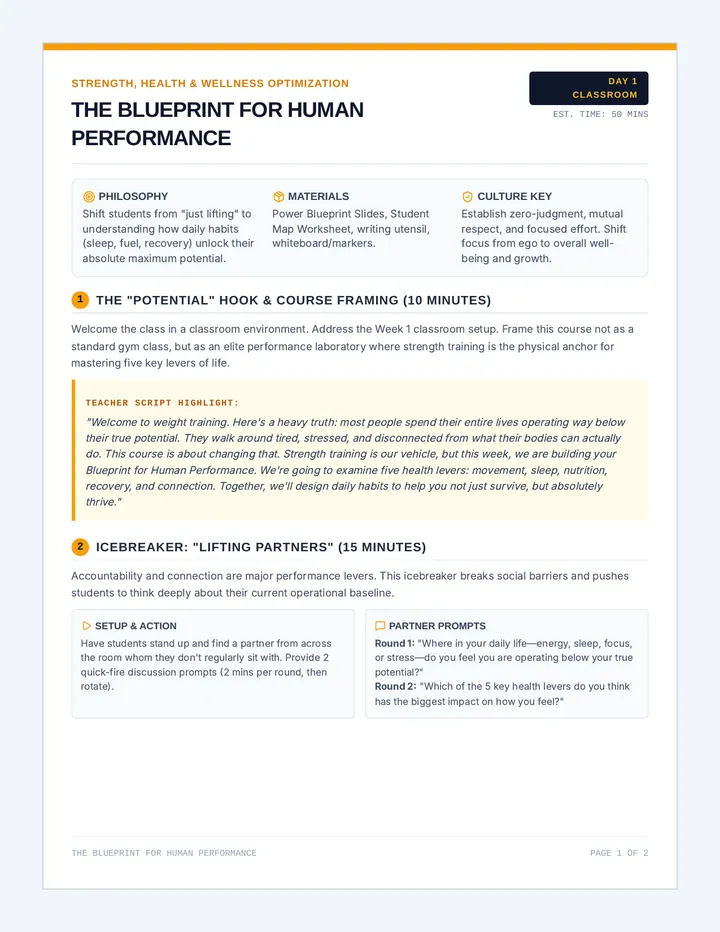
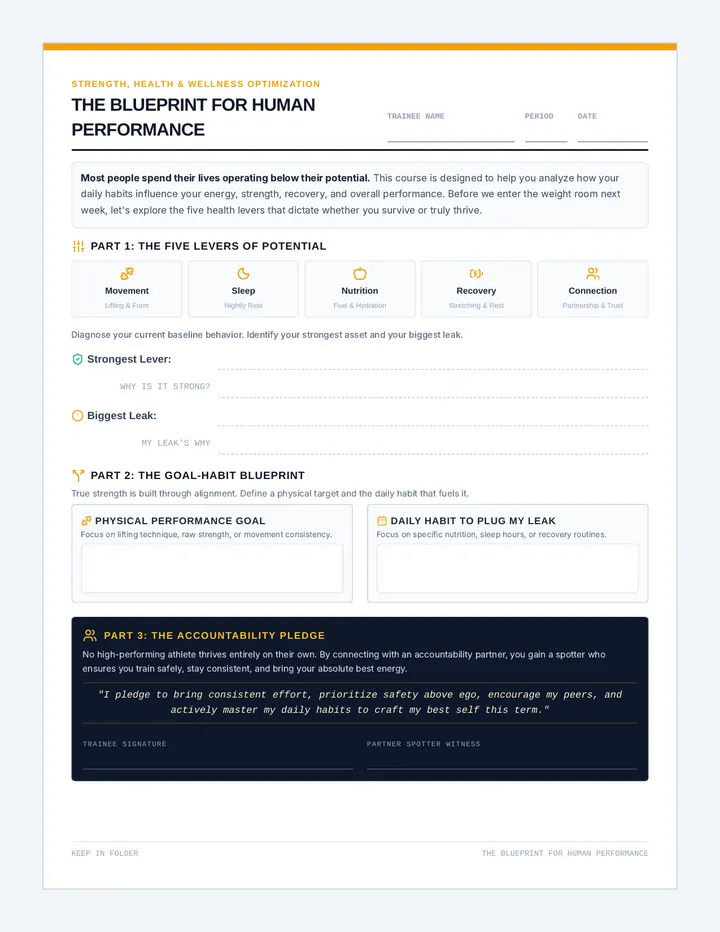
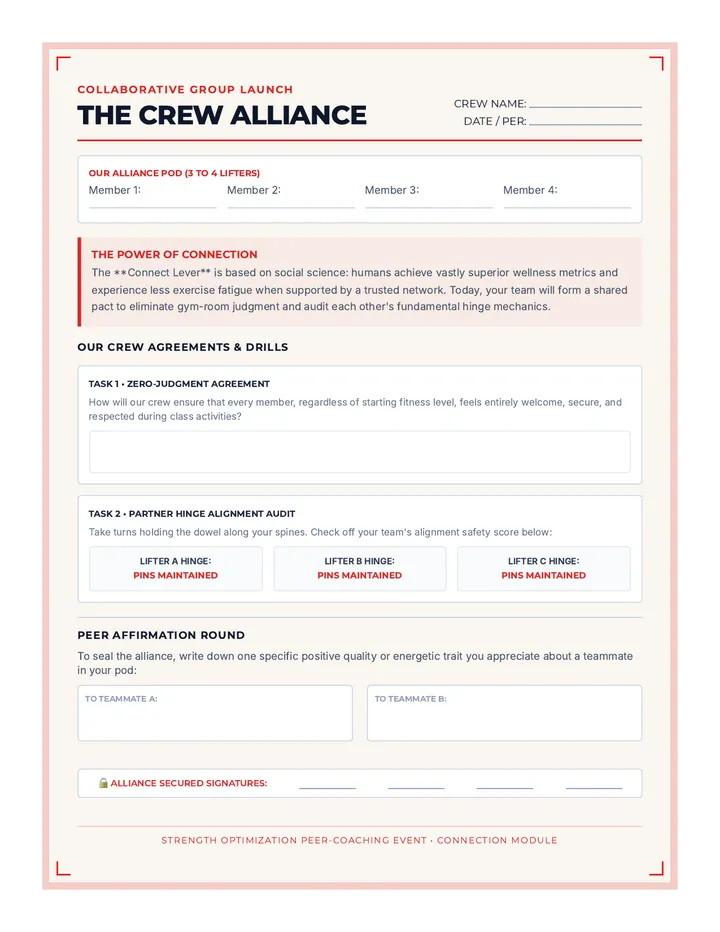
A comprehensive 16-week weight training curriculum divided into two parts: 'Part 1: The Human Engine' (Weeks 1-8) focusing on movement patterns, bodyweight mastery, and anatomy; and 'Part 2: The Iron Forge' (Weeks 9-16) focusing on advanced compound lifts, training science, and independent program design. Includes nutrition for performance and comprehensive classroom activities.
A comprehensive lesson sequence for High School Health/Psychology focused on understanding clinical depression, the biological basis of mental health, and strategies to overcome societal stigma.
A restorative learning program designed for high school students to reflect on the impact of substance use and prepare for a positive return to their school community. The program balances scientific facts with deep personal reflection.
A comprehensive health sequence for 11th-grade students focused on developing personalized fitness plans, understanding the science of physical activity, and debunking common fitness myths.
A 5-lesson health and counseling sequence for 11th graders focusing on the 'A' (Avoid Mood-Altering Substances) and 'E' (Exercise) components of the PLEASE skills. Students explore the neurobiology of substance use versus physical activity to build emotional resilience.
A research-focused sequence for 9th-grade students to map, evaluate, and access specialized crisis resources. Students learn to distinguish between general and specialized support, evaluate the credibility of services, and develop a personalized safety resource plan.
This sequence demystifies the process of accessing crisis support by breaking down the mechanics of hotlines and text lines. Students learn to distinguish between emergency services (911) and crisis hotlines (988), understand the experience of reaching out, and create personal resource tools for future use.
A comprehensive 9th-grade sequence on track and field events, focusing on the mechanics of horizontal jumps and throwing disciplines. Students explore the physics of force, momentum, and release angles through technical practice and a final simulated competition.
This 12th-grade sequence explores the technical mechanics of field events and the logistical complexities of track meet administration, preparing students for roles as athletes, coaches, and officials.
A high-performance track and field unit for 12th-grade students that integrates biomechanics and physiology. Students analyze acceleration physics, stride efficiency, energy systems, and relay coordination to optimize their athletic performance through data-driven training.
An advanced 11th-grade track and field sequence focusing on the biomechanics of sprinting, the precision of relays, and the physiological strategy of middle-distance running. Students transition from mechanical refinement to competitive application.
An intensive exploration of the physics and biomechanics behind field events, focusing on shot put, discus, long jump, and triple jump. Students apply scientific principles to athletic performance through peer coaching, video analysis, and technical drills.
A comprehensive introduction to grappling for 8th graders, focusing on leverage, balance, and positional control. Students learn to use their center of gravity and mechanical advantage to manage physical encounters safely and effectively.
This sequence shifts focus from physical combat to the mental and verbal aspects of self-defense, prioritizing conflict avoidance. Students learn threat assessment, assertive communication, and environmental scanning through Cooper's Color Code and role-playing scenarios.
A foundational unit for 7th-grade students focusing on the physical prerequisites of martial arts and self-defense: balance, stability, safe movement, and injury prevention through breakfalls. Students explore how controlling their center of gravity and core can enhance their physical safety and stability.
This sequence approaches gymnastics through the lens of athletic conditioning and applied anatomy. Students investigate specific strength and flexibility requirements needed to perform skills safely while acting as strength and conditioning coaches.
A project-based unit where 11th-grade students design and perform an artistic floor routine, focusing on flow, transitions, and spatial choreography in gymnastics.
A comprehensive 11th-grade gymnastics sequence focusing on balance beam precision and vaulting power. Students develop technical skills, psychological resilience, and critical safety spotting techniques across five intensive lessons.
This sequence integrates physics concepts with fundamental floor skills to help students understand the mechanics of tumbling. Students explore center of mass, rotational mechanics, leverage, and force absorption through hands-on practice and video analysis.
A comprehensive sequence for 9th Grade PE focused on the artistic and athletic composition of gymnastics floor routines, moving from individual skills to a cohesive performance.
This sequence focuses on the biomechanics and safety of gymnastics apparatus work, specifically the balance beam and vault. Students progress from foundational balance skills to complex vaulting mechanics, emphasizing center of gravity, explosive power, and peer spotting.
This sequence integrates gymnastics execution with biomechanical principles. Students explore center of mass, stability, leverage, and angular momentum through various tumbling skills, concluding with a video analysis project to critique their own form.
This sequence explores the physics of gymnastics, focusing on biomechanical principles like center of gravity, rotational inertia, and momentum transfer to improve tumbling performance. Students transition from static balance to dynamic rotation, culminating in a frame-by-frame video analysis of their own movement.
An advanced gymnastics sequence for 12th graders focusing on beam, vault, and the critical skill of spotting. Students transition from performers to 'safety coaches,' emphasizing risk management and technical proficiency.
A 12th-grade gymnastics unit focusing on the transition from individual skill mastery to artistic routine composition. Students learn to choreograph, refine, and perform a floor routine that emphasizes flow, spatial awareness, and aesthetic control.
This sequence equips 12th-grade students with actionable strategies for personal safety and bystander intervention regarding human trafficking. It covers recognizing indicators in peers, travel safety for independent living, the ethics of reporting, and mapping community resources.
This sequence equips 11th-grade students with practical skills to identify trafficking indicators, apply safety-first reporting protocols, and engage in ethical community advocacy. Students move from observation to action, learning the critical distinctions between 'saving' and 'supporting' while exploring the professional networks required for effective intervention.
A comprehensive 11th-grade health sequence focused on the intersection of personal safety and digital literacy. Students investigate how traffickers use digital footprints, social media scams, gaming platforms, and sextortion to exploit victims, culminating in the creation of personal digital defense plans.
This sequence explores the critical principles of water safety, from environmental risk assessment and buoyancy science to identifying distress and performing non-entry rescues. Students move from understanding physical risks to becoming advocates for safe practices in their communities.
This 9th-grade Health sequence investigates the systemic and individual factors that increase susceptibility to trafficking. Students explore vulnerability, high-risk populations, labor trafficking, substance abuse as control, and resilience building.
This project-based sequence shifts focus to community awareness, reporting protocols, and systemic understanding of human trafficking. Students investigate labor trafficking, recognize signs in peers, learn professional reporting protocols, and develop bystander intervention skills, culminating in a peer-led awareness campaign.
This sequence focuses on the psychological and physical aspects of trust, safety, and support within a team environment. Students progress from basic weight-sharing activities to high-stakes simulated risks that require absolute reliance on peers, emphasizing safety protocols and collective responsibility.
A high-stakes cooperative game sequence for 12th graders focusing on leadership roles, resource management, and iterative strategy through complex physical challenges.