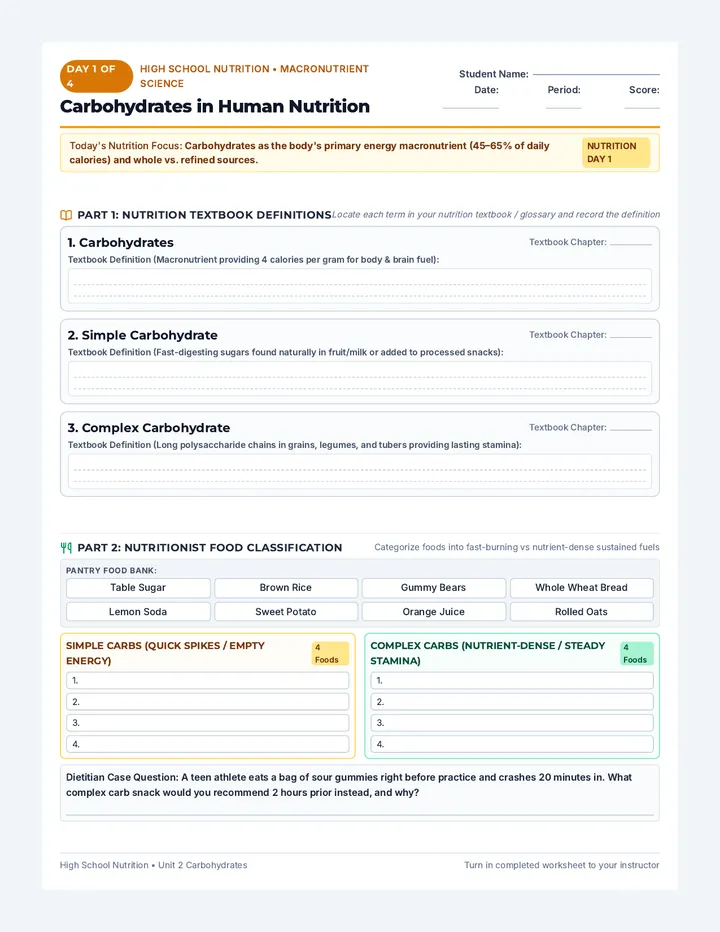
Cortisol Lab Report Worksheet
Lab Report: Cortisol Control
Subject: Health & Wellness | Unit: Mental Biology
Experimental File #204
Confidential Student Data
Lead Researcher (Student Name)
Observation Date
1
Phase I: The Stress Spectrum
Brainstorm common stressors. Categorize them based on their impact on your physiology.
Eustress (Short-term/Helpful)
Distress (Long-term/Harmful)
2
Phase II: Biological Mechanisms
Briefly define the role of these components as mentioned in the video:
HPA Axis
Cortisol
Amygdala
Hippocampus
3
Phase III: The Control Lab
| Intervention | Heart Rate (BPM) | Stress Level (1-10) | Observations |
|---|
| Initial Baseline | | 1 = Zen, 10 = Max Stress | |
| Post-Meditation (5 min) | | | |
| Post-Movement (5 min) | | | |
4
Phase IV: Analysis & Conclusion
1. Data Comparison: Which intervention had a more significant impact on your bio-markers? Why do you think that is?
2. Biological Reversal: How do meditation and exercise help "protect" or "regrow" the hippocampus?
Final Lab Conclusion
Synthesize your findings: How will you apply these "brain hacks" to your upcoming exam season or personal life?
Brain Hacks Lab Slides
Neuro-Wellness Series
BRAIN HACKS
The Cortisol Control Lab: Reversing the Effects of Chronic Stress
Warm-up: The Stress List
05:00
On your Lab Report, categorize common stressors into two groups:
Eustress
Short-term, helpful, motivating energy bursts.
Distress
Long-term, continuous, harmful pressure.
Think About...
- A championship game
- Arguing with parents every day
- Giving a presentation
- A huge workload at a part-time job
Video Study: Stress & Your Brain
Watch carefully for solutions!
Embedded media
0:48 — 1:15
Listen for: The HPA Axis and Cortisol release.
1:20 — 2:10
Watch for: Amygdala vs. Hippocampus changes.
3:28 — End
Note: The two "weapons" against cortisol.
Lab Phase A: Meditation
Lowering Cortisol via Parasympathetic Activation
05:00
The Procedure:
- 1 Record your baseline HR and Stress Level.
- 2 Eyes closed. Deep "box breathing" (4-4-4-4).
- 3 Focus purely on the sensation of air entering your lungs.
"Deep breathing sends a signal to your brain to turn down the HPA axis response."

Lab Phase B: Movement
Reversing Brain Shrinkage via Neuroplasticity
05:00

The Procedure:
- 1 Gentle standing stretches or light walking.
- 2 Increase blood flow without high intensity.
- 3 Record HR and Stress Level immediately after.
"Exercise is a powerful weapon that can increase the size of the hippocampus."
The Lab Report: Review
Compare Data
Which method worked better for you? Why are our results different across the class?
The Hippocampus
How do these habits protect your learning and memory centers from "shrinking"?
"Don't feel defeated by the pressures of daily life. Get in control of your stress before it takes control of you."
Stress Mastery Teacher Guide
Teacher Facilitation Guide
Unit: Mental Health Biology
Duration
45 Minutes
Target Grade
9th - 12th
Focus
HPA Axis / Cortisol
Materials
Lab Reports, HR Trackers
Lesson Pacing
00 - 05 min
Warm-up: Brainstorm stressors. Help students categorize "Giving a speech" (Eustress) vs. "Bullying" (Distress).
05 - 10 min
Video: Play "How stress affects your brain". Note: The epigenetic section (2:28) is often a "mind-blowing" moment for students.
10 - 35 min
The Lab: Conduct the meditation and movement activities. Ensure students take a *silent* 30-second heart rate count.
35 - 45 min
Synthesis: Data comparison. Key insight: Exercise increases BDNF (Brain-Derived Neurotrophic Factor) to help the hippocampus.
Intervention Scripts
Meditation (5 Min)
"Find a comfortable position. Close your eyes. We are performing 'Box Breathing.' Inhale for 4 seconds... hold for 4... exhale for 4... hold for 4. Imagine the 'bear attack' response of the HPA axis shutting off as your heart rate slows. Focus on the sensation of air in your nostrils."
Movement (5 Min)
"Stand up and push your chairs in. We will start with a reach to the sky—inhale. Reach for your toes—exhale. Now, light walking in a circle or stationary jogging. We aren't looking for a workout, just increased circulation to help the brain's neuroplasticity."
Content Key & Common Misconceptions
Key Definitions (from Video)
- HPA Axis: The interaction between the hypothalamus, pituitary, and adrenal glands that controls the stress response.
- Cortisol: The "stress hormone" that primes the body for action but can damage the brain in high, chronic doses.
- Amygdala: The brain's "fear center"; chronic stress *increases* neural connections here.
- Hippocampus: Associated with learning and memory; chronic stress *deteriorates* connections and shrinks its size.
Misconception Alert
Students often think that because exercise raises heart rate, it must increase stress. Explain the difference between acute physiological stress from exercise (which is healthy and builds resilience) vs. chronic mental stress (which breaks the body down). Highlight that exercise helps "wash out" excess cortisol and triggers the release of BDNF, which acts like "fertilizer" for the brain.
Epigenetics Note