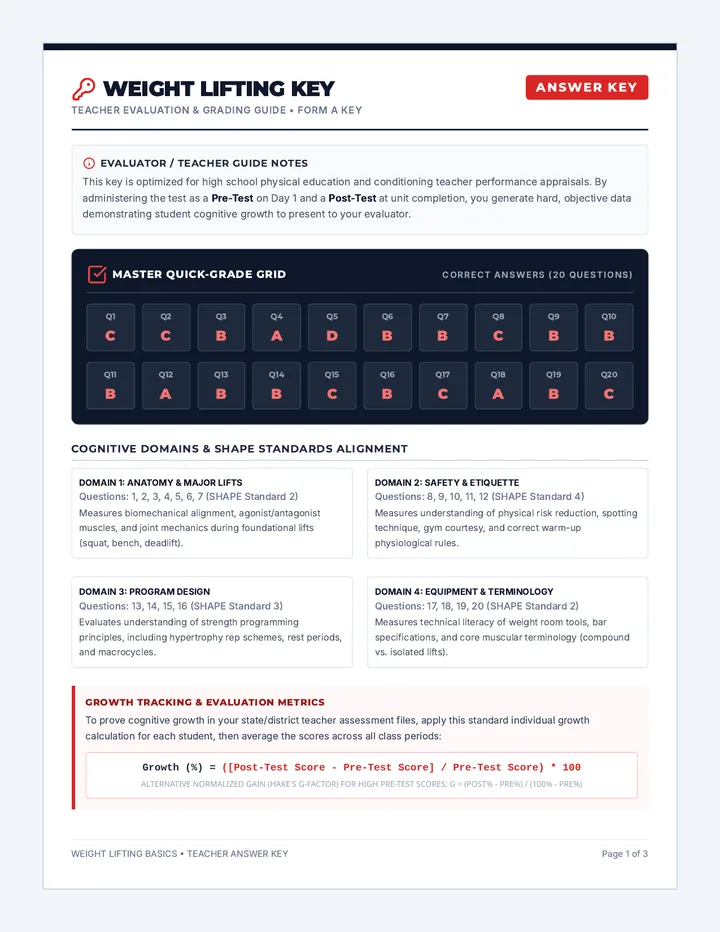
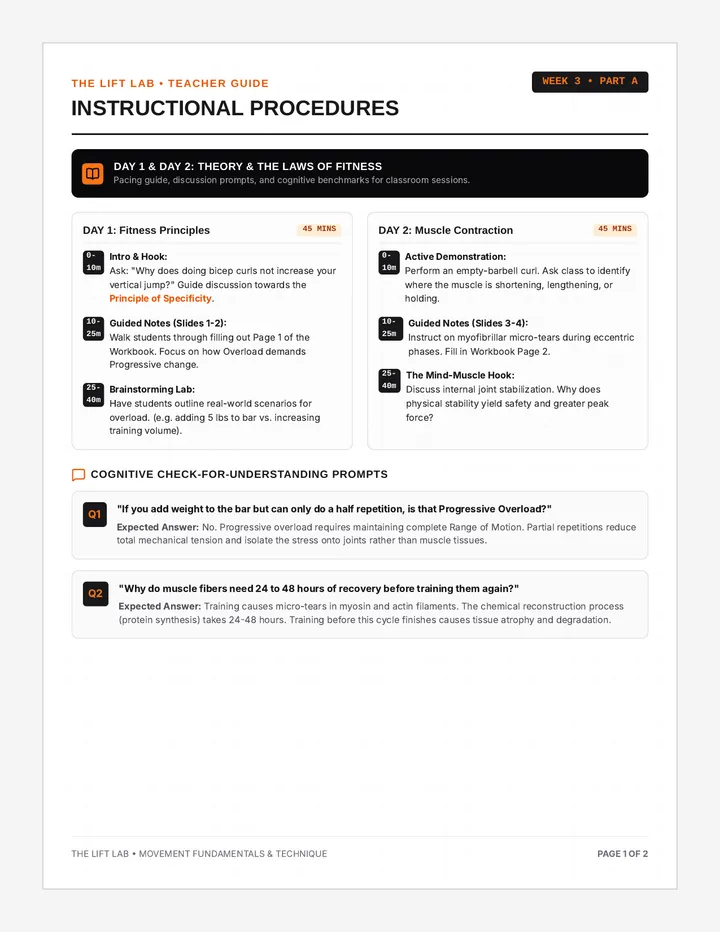
Iron Academy Master Outline Master Outline
Iron Academy: 16-Week Strength Curriculum
Part 1: The Human Engine
Weeks 1-8
01
Iron Rules
Safety, Etiquette, Spotting basics, and Gym Orientation.
02
Primal Patterns I
Squat & Hinge mechanics. Hip vs. Knee dominance (Bodyweight).
03
Primal Patterns II
Push, Pull, Lunge, Carry. Planes of motion and stability.
04
The Body Engine
Anatomy focus: Major muscles, origins, insertions, and contractions.
05
Performance Fuel
Macronutrients, Hydration, and the Performance Plate method.
06
Mobility & Stability
Dynamic warm-ups, joint health, and movement quality audits.
07
Intro to External Load
Barbell basics, PVC pipe drills, and unweighted form checks.
08
Part 1 Capstone
Technique assessment finals and Mid-semester reflection.
Part 2: The Iron Forge
Weeks 9-16
09
The Squat Foundation
Back Squat depth, ankle mobility, and heavy load cues.
10
The Bench Foundation
Bench Press mechanics, leg drive, and shoulder health.
11
The Deadlift Foundation
Pulling from the floor, neutral spine, and the Hinge standard.
12
Daily Undulating Periodization (DUP)
Theory: Varying intensity and volume within the week (Hypertrophy vs. Strength days).
13
Accessory Selection
Building a balanced body. Isolation exercises and weak point training.
14
The Blueprint Project
Students design their personal 4-week undulating training plan.
15
Implementation Phase
Live testing and tracking of undulating blueprints.
16
Peak & Reflection
Final strength testing (RPE 9-10) and course reflection paper.
The Undulating Week Template
Mon
Theory Classroom Day
Tue
Hypertrophy Moderate Weight
Wed
Stability Core / Mobility
Thu
Strength Heavy Weight
Fri
Power Speed Focus
Why Undulate?
By varying stimulus (Hypertrophy vs. Strength) within a single week, we prevent adaptation plateaus and ensure the student is exposed to different training intensities regularly, keeping engagement high and results consistent.
Iron Academy Philosophy
"Master the movement, then manipulate the variables."
Iron Academy Curriculum Roadmap Semester Version 2.2 // DUP Integrated
Spotter Guide Handout v2 Spotter's Guide
Iron Academy Safety Protocols
Candidate:
Date:
The Spotter's Creed
"I am the lifter's shadow. My focus is absolute. I am not a spectator; I am an active participant in every rep. I protect the lifter, I protect the gym, and I protect myself."
1. Communication
The Rep Goal: Always ask "How many are we looking for?" before the set begins.
The Lift-Off: Confirm if the lifter needs help moving the bar from the rack to the start position.
2. Readiness
No Distractions: Phones are put away. Eyes never leave the bar path.
Active Stance: Wide base, knees bent, hands following the bar (but not touching).
3. Intervention
Bar Speed: Only assist if the bar stops moving upward or begins to tilt.
Safety Pins: Always ensure safety arms are set to the correct height for the exercise.
4. Posture
Back Health: Lift with your legs, not your back, when assisting a heavy fail.
Wrist Spotting: On dumbbell presses, spot the wrists, never the elbows.
Practical Sign-Off
Demonstrate these skills to a peer or instructor to receive your safety clearance.
1. Proper Alternated Grip for Bench Press Lift-off
2. Correct Positioning for a Back Squat Spot
3. Wrist vs. Elbow Spotting demonstration
Iron Academy Safety Certificate Version 2.0 // Unit 01
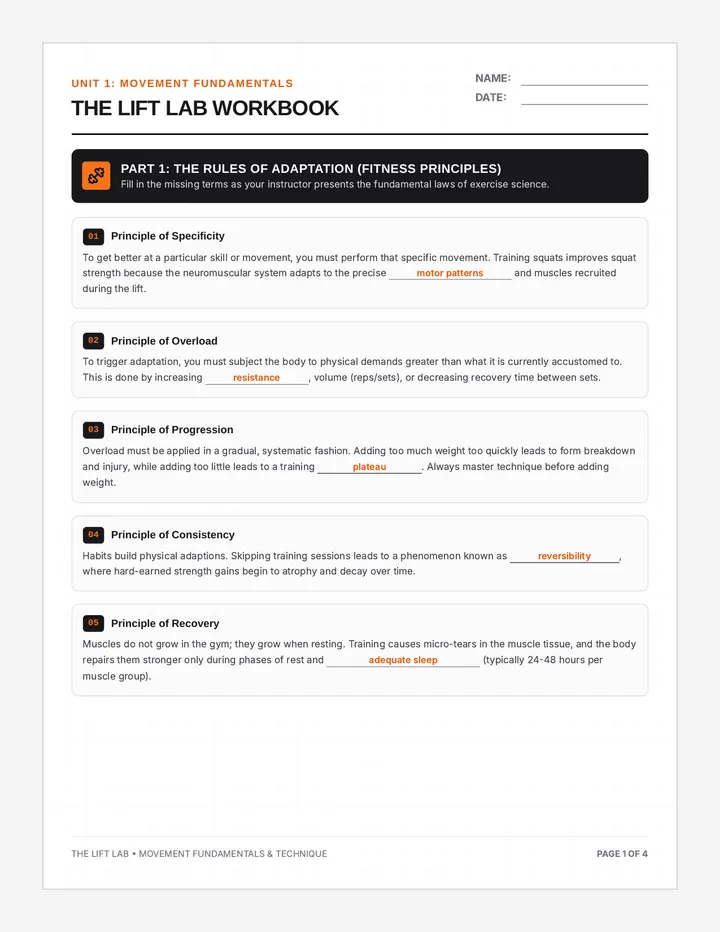
Iron Etiquette Worksheet刻 Iron Etiquette
Unit 1: Professional Weight Room Conduct
The Gym Culture Lab
Etiquette isn't just about being "nice"—it's about efficiency, safety, and mutual respect. Solve these common gym scenarios using professional Iron Rules.
Scenario: The Occupied Rack
You need to use the squat rack for your primary lift, but a peer is currently using it. They are resting between sets. What is the exact phrase or action you take?
Scenario: The Plate Graveyard
You walk up to a bench press station and find three 45lb plates left on the bar from the previous period. You only need to lift 95lbs. Explain the etiquette violation and the proper corrective action.
Scenario: The "Help" Signal
You are spotting a friend. On the 8th rep, the bar stops moving. They haven't asked for help yet, but they look like they are struggling. When do you touch the bar? When do you NOT touch the bar?
The Big Five Rules
1
Rack every weight, every time.
2
Wipe down benches after use.
3
No sitting on equipment during rest.
4
Always use collars/clips on barbells.
5
Earbuds out when instructor is talking.
Iron Academy Etiquette Lab Version 2.0 // Unit 01
Squat Hinge Mechanics Worksheet刻 The Great Divide
Unit 2: Squat vs. Hinge Mechanics
The Joint Primary
Every lower body movement is a spectrum. On one end is the Squat (Knee Primary), and on the other is the Hinge (Hip Primary). Understanding the difference is the key to safe loading.
Squat Pattern
Vertical displacement. Hips and knees move simultaneously. Targets the Quadriceps.
Hinge Pattern
Horizontal displacement. Hips move back, knees stay soft but stable. Targets the Posterior Chain.
Pattern Identification
Squat Figure
Cue 1: Does the bar path move vertically or horizontally?
Hinge Figure
Cue 2: Describe the "Hip Wall" technique used for hinges.
The Exercise Sort
Classify each of the following weighted exercises into the correct movement category.
Exercise Name SQUAT HINGE Primary Muscle Targeted Romanian Deadlift (RDL)
| |
| Goblet Squat |
|
| |
| Kettlebell Swing |
|
| |
| Leg Press |
|
| |
Why is a Deadlift often misidentified as a Squat by beginners? Explain the mechanical error they are usually making.
Iron Academy Mechanics Lab Version 2.0 // Unit 02
Lower Body Movement Lab刻 Lower Body Lab
Unit 2: Practical Movement Report
Trainee:
Observer:
Objective
To demonstrate mechanical proficiency in the unweighted Squat and Hinge patterns through peer-observed audits. Focus is on Quality of movement over speed or load.
Station 1: The Squat
Movement Standards
Feet shoulder-width, toes slightly out.
Chest remains upright throughout descent.
Knees track over the toes (no collapse).
Heels remain in contact with the floor.
Observer Notes
Identify any "butt wink" (pelvic tilt) or balance issues.
Station 2: The Hinge
Movement Standards
Initial move is hips traveling backwards.
Spine remains neutral (flat back).
Shins stay nearly vertical.
Full lockout (hips forward) at the top.
Observer Notes
Watch for excessive knee bending (turning it into a squat).
Critical Reflection
Which movement pattern felt more "natural" to you? Based on today's lab, what is one technical cue you need to focus on next session?
Iron Academy Practical Lab Report Version 2.0 // Unit 02
Upper Body Planes Worksheet刻 The Plane Map
Unit 3: Upper Body Planes of Motion
Horizontal vs. Vertical
Upper body movements are defined by their relationship to the torso. Training in multiple planes ensures shoulder longevity and balanced muscular development.
Key Principle "For every Push, there must be a Pull."
Pattern Matrix
Exercise Pattern Plane Mastery Target Bench Press PUSH Horizontal Shoulder blade retraction. Pull-up PULL Vertical Full range of motion. Overhead Press PUSH Vertical Core stability, no back arch. Seated Row PULL Horizontal Lead with the elbows.
The Shoulder Engine
Scapular Retraction: Squeezing the shoulder blades together. This is the "Seatbelt" for your shoulders during heavy presses.
Check-in Question:
Why do we pull our shoulder blades back before we bench press? What does it protect?
Horizontal Plane
The Balanced Session
Design a 4-exercise upper body "micro-routine" that includes one vertical push, one vertical pull, one horizontal push, and one horizontal pull.
Iron Academy Biomechanics Lab Version 2.0 // Unit 03
Functional Patterns Lab Report刻 Functional Lab
Unit 3: Lunge & Carry Stability Audit
Stability Objective
Lunges and Carries are unique because they challenge Lateral Stability and Anti-Rotation. This lab audits your ability to maintain posture under dynamic tension.
Station 1: The Lunge
Technique Standards
"90/90" position (both knees at 90 degrees).
Torso stays vertical (no leaning forward).
Knee stays in line with second toe.
Stable balance during the transition.
Peer Audit Notes
Watch for "knee valgus" (knee caving inward) or excessive wobbling.
Station 2: The Carry
Stability Standards
Shoulders level (no sagging to one side).
Short, controlled "marching" steps.
Grip remains neutral and firm.
Core braced (Anti-Lateral Flexion).
Observer Audit
Is the trainee resisting the weight or letting it pull them over?
Functional Logic
"How does mastering the Suitcase Carry (carrying a heavy weight in one hand) directly improve your performance in the Back Squat?"
Iron Academy Functional Lab Report Version 2.0 // Unit 03
Technical Anatomy Atlas刻 Technical Atlas
Unit 4: Muscle Origin & Insertion Guide
The Biological Pulley
Muscles are pulleys that exert tension on the skeletal system. They have two primary anchor points:
Origin (O):
The proximal anchor. The point that remains stable during contraction.
Insertion (I):
The distal anchor. The point that is pulled toward the origin.
Front Engine Map (Anterior)
FIGURE
Pectoralis Major
O: Sternum & Clavicle | I: Humerus
Function: Adducts and internally rotates the arm.
Quadriceps
O: Femur & Pelvis | I: Tibia (via Patella)
Function: Extends the knee joint.
Back Engine Map (Posterior)
Latissimus Dorsi
O: Lower Spine | I: Inside Humerus
Function: Pulls the arm down and back.
Hamstrings
O: Ischial Tuberosity | I: Tibia & Fibula
Function: Flexes the knee & extends the hip.
FIGURE
Mechanical Application
"I am performing a Barbell Bicep Curl. My shoulder is still, but my elbow is bending. Based on the rule of pulleys, where is the Origin of the Bicep likely located? Where is the Insertion?"
Iron Academy Anatomy Atlas Version 2.0 // Unit 04
Contraction Lab Worksheet刻 Contraction Lab
Unit 4: The Physics of Muscle Tension
Concentric
The "Up" phase. Muscle Shortens under tension.
Eccentric
The "Down" phase. Muscle Lengthens under tension.
Isometric
The "Hold" phase. Muscle length Stays same.
The Tension Timeline
Identify the type of contraction occurring in the PRIMARY MOVER for each phase of these lifts:
1. Back Squat
PHASE A: Lowering the hips to parallel.
PHASE B: Driving the weight back up.
2. Pull-up
PHASE A: Pulling chin over the bar.
PHASE B: Controlling the descent.
3. Planks
PHASE A: Holding the top of a push-up position.
Fiber Type Analysis
Type I: Slow Twitch
Aerobic fuel. High fatigue resistance. Small power output. (e.g., Postural muscles, long distance running).
Type II: Fast Twitch
Anaerobic fuel. Low fatigue resistance. HUGE power output. (e.g., Squatting a 1-rep max, 50m sprint).
Application Question:
"You are training for maximum strength (low reps, heavy weight). Which fiber type are you primarily trying to recruit and fatigue? Why?"
Iron Academy Biomechanics Lab Version 2.0 // Unit 04
Athlete Fueling Guide刻 Athlete's Fuel
Unit 5: The Performance Nutrition Guide
The 23:1 Rule
You spend 1 hour in the gym training. The other 23 hours determine if that 1 hour actually counts. Nutrition is the signal that tells your body to either Build or Break Down.
The Big Three Macros
Protein
"The Bricks." Repairs micro-tears in muscle tissue created during training.
Target: 0.8g - 1g per lb
Carbs
"The Gas." High-octane fuel for intensity. Spares protein for building.
Target: High on training days
Fats
"The Regulators." Supports hormone health and joint lubrication.
Target: Consistent baseline
The Kitchen Scavenger Hunt
Identify three WHOLE FOOD sources for each category that you would find in a high-performance kitchen.
Lean Proteins
Complex Carbs
Healthy Fats
The Hydration Formula
A dehydrated muscle loses up to 10% of its strength output. Use this formula to find your daily baseline intake.
Body Weight ÷ 2 = Daily Ounces
Your Weight
Target Oz
Iron Academy Performance Nutrition Version 2.0 // Unit 05
Performance Plate Worksheet刻 Timing & Plate
Unit 5: The Performance Plate Method
The Pre-Work Window
"Eat like an athlete 2-3 hours before you train."
Focus: Complex Carbs + Moderate Protein. Low fiber, low fat to prevent stomach distress.
The Post-Work Window
"The window of opportunity starts the moment you stop."
Focus: Fast Carbs + High Protein (20-40g). Signal the body to switch from 'Burn' to 'Build'.
The 1/4 - 1/4 - 1/2 Method
P
V
C
Veggies
Protein Choice (Post-Workout):
Carb Choice (High Intensity):
Vegetable / Color Choice:
Case Study: The Sleepy Athlete
"Student A often feels sluggish and weak during their Thursday strength session. Looking at their log, they have only drank 20oz of water and skipped breakfast."
Immediate Correction (Next 30 mins):
Long-term Fix (Habit Change):
Iron Academy Nutrition Lab Version 2.0 // Unit 05
Movement Audit Worksheet刻 Movement Audit
Unit 6: Range of Motion & Stability Check
Mobility
"The ability of a joint to move actively through a full range of motion."
Requirement: Supple muscles & flexible joint capsules.
Stability
"The ability to maintain control of joint position or movement."
Requirement: Neuromuscular control & core integrity.
The Joint-by-Joint Audit
Ankle Dorsiflexion (Mobility)
Required for: Deep Squats & Lunges. If ankles are tight, heels lift or back rounds.
Pass (4+ inches)
Fail (Tight)
Visual:
Hip Flexion & Rotation (Mobility)
Required for: Hinge & Squat. Tight hips lead to lower back pain and "butt wink".
Pass (Smooth)
Fail (Pinching)
Visual:
Scapular Control (Stability)
Required for: Bench & Overhead Press. Shoulders must remain retracted and depressed.
Pass (Solid)
Fail (Winging)
Visual:
The Maintenance Habit
"Choose ONE area from the audit above that needs work. Research or ask the coach for a daily 'corrective' exercise. List it below and track your compliance for 1 week."
Corrective Exercise Name:
Sets / Duration:
M
T
W
T
F
S
S
Iron Academy Pre-Hab Protocol Version 2.0 // Unit 06
Warm-Up Lab Worksheet刻 The Warm-Up Lab
Unit 6: Dynamic Priming vs. Static Recovery
Dynamic Priming
Static stretching (holding a stretch) BEFORE a heavy lift can actually decrease power output. We use Dynamic Warm-ups to increase core temperature and neurologically prime our movement patterns.
Step 1
Raise Core Temp
Step 2
Activate Patterns
Step 3
Prime CNS
The Primal Warm-Up
Select one dynamic exercise for each primal pattern to build your standard pre-lift routine.
Lower Body Pattern (Squat/Hinge)
Example: Leg Swings or Bodyweight Squats
Upper Body Pattern (Push/Pull)
Example: Arm Circles or Band Pull-aparts
Core / Stability Pattern
Example: Plank to Down-dog or Bird-Dogs
Speed / Power Primer
Example: Box Jumps or High Knees
Post-Work Recovery
Once the iron is racked, we switch to Static Stretching. This signals the Parasympathetic Nervous System to start the recovery process.
Why hold for 30+ seconds?
Research suggests it takes about 30 seconds for the "stretch reflex" (the muscle's safety tension) to relax, allowing for actual lengthening.
Key Rule
"Warm Up Dynamic. Cool Down Static."
Iron Academy Readiness Standards Version 2.0 // Unit 06
Barbell Checklist Worksheet刻 The Iron Standard
Unit 7: Barbell Handling & Safety Setup
Barbell Specifications
Standard Weight: 45 lbs (20 kg)
Knurling: The textured area for grip.
The Sleeve: The end where plates are loaded.
Collar/Clip: Mandatory safety device.
The Golden Rule
"Mechanics always dictate the load. Never let the weight dictate your mechanics."
The Secure Station
Before the bar ever leaves the hooks, you must verify the Secure Station Audit.
J-Hook Height
Hook should be at mid-sternum (Bench) or mid-chest (Squat). Never "tip-toe" the bar out.
Safety Pin Height
Pins set 1-2 inches below the bottom of your range of motion.
Plate Symmetry
Weight is identical on both sides. Clips are locked and flush against plates.
Clear Path
No bags, water bottles, or extra plates on the floor behind or beside the lifter.
Practical Activity: PVC Mirror Audit
With a partner and a PVC pipe, replicate a Back Squat and an Overhead Press. Observer must check for the following "Iron Leaks":
Check 1: Wrist Position
STRAIGHT BENT (LEAK)
Check 2: Elbow Path
VERTICAL FLARED (LEAK)
Partner Feedback Notes:
Iron Academy External Loading Version 2.0 // Unit 07
Part 1 Capstone Audit刻 Part 1 Audit
The Human Engine: Skills & Theory Clearance
Section A: The Growth Logic
1. Define "Primal Patterns" in your own words. Why do we train patterns instead of just muscles?
2. What is the "Rule of Pull" in anatomy? Reference Origin and Insertion in your answer.
The Performance Plate Quick-Check
List 2 food items for a high-intensity training day lunch:
PROTEIN:
CARB:
VEGGIE:
Section B: Practical Sign-Off
Instructor or Peer Lead must initial each movement once technical proficiency is demonstrated at RPE 5-6 (Light to Moderate Load).
Pattern / Exercise Critical Cue Observed Clearance (Initials) SQUAT (Goblet) Heels down, Knees tracking toes, Upright torso. HINGE (RDL) Hips back, Vertical shins, Neutral spine. HORIZONTAL PUSH (Bench) Scapular retraction, Bar path to mid-sternum. CARRY (Farmer's) Level shoulders, Controlled stride, Braced core.
Personal Momentum
What is the single most important lesson you've learned about your own body in the last 8 weeks? How will this change your training in Part 2?
Write your reflection here...
Iron Academy Part 1 Completion Semester Milestone // Unit 08
Advanced Squat Lab刻 The Forge: SQUAT
Unit 9: Advanced Barbell Back Squat
The Upper Body Shelf
"The squat starts with the upper body. A soft upper back means a collapsed squat."
Retract & Depress: Squeeze shoulder blades back and down before unracking.
Elbow Tucking: Pull elbows down toward your hips to engage the lats.
Bracing: 360-degree abdominal breath (Intra-Abdominal Pressure).
Mobility Requirements
Ankle Dorsiflexion Prevents heel lift
Thoracic Extension Prevents chest cave
The Depth Audit
"Parallel is the standard. Crease of the hip must be below the top of the knee."
The Walk-out Protocol:
1. Two-step walkout only.
2. Set feet (Shoulder width, toes 15-30 deg).
3. Big breath, brace, then descend.
Self-Check Checklist:
Chest Up
Heels Glued
Knees Out
Mechanical Analysis
If a lifter's hips rise faster than their shoulders during the ascent, what is the technical name for this error? Which muscle group is failing to contribute enough?
Answer here...
Iron Forge Technical Manual Version 2.0 // Unit 09
Advanced Bench Lab刻 The Forge: BENCH
Unit 10: Horizontal Press Mechanics
The Anchor System
"You don't bench with just your arms. You bench with your whole body anchored to the bench and the floor."
1
Left Foot
2
Right Foot
3
Glutes
4
Upper Back
5
Head
The Leg Drive Audit
Static Tension: Driving your heels into the floor creates tension up through the legs to the upper back, providing a stable platform for the press.
Check-in Question:
Why should your glutes never leave the bench during a heavy press? What does it change about your spine position?
The Path Checklist:
Bar lowers to mid-sternum.
Elbows at 45-degree angle (not 90).
Forearms vertical under the bar.
Identify the "Iron Leak":
"A trainee is pressing 135lbs. As they push the weight up, their feet start dancing and lifting off the floor."
Iron Forge Technical Manual Version 2.0 // Unit 10
Advanced Deadlift Lab刻 The Forge: DEADLIFT
Unit 11: Floor-to-Lockout Mechanics
The Setup Triangle
The Bar: Over mid-foot (1 inch from shins).
The Grip: Just outside the knees.
The Lats: "Protect your armpits." Squeeze back to engage the spine protector.
Pulling the Slack
"You must create tension against the bar before the weight leaves the floor. Listen for the 'click' of the bar hitting the top of the plate holes."
The Wedge Audit
Observe a partner's setup. They must achieve Zero Slack before they pull.
Technical Cues:
Hips high but back flat.
Shins touch the bar (after hips set).
"Push the floor away" (The Leg Press start).
Partner Feedback
Did you hear the bar "click" before the pull?
The Danger Zone
If a trainee's lower back rounds (lumbar flexion) during the first 2 inches of the lift, what is the safest immediate action to take as a coach or partner?
Iron Forge Technical Manual Version 2.0 // Unit 11
DUP Method Worksheet刻 The DUP Method
Unit 12: Daily Undulating Periodization
Varying the Signal
Linear progression (adding weight every time) eventually plateaus. DUP prevents this by varying the intensity and volume within a single week, targeting different physical qualities every session.
Hypertrophy
Growth Focused
Strength
Force Focused
Power/Speed
Velocity Focused
The Weekly Pulse
Design a 4-day undulating week for the Back Squat. Balance your high-intensity days with recovery or accessory-focused days.
Training Day Stimulus Type Intensity (% 1RM) Sets x Reps Tuesday HYPERTROPHY
| 70 - 75% | |
| Wednesday | Accessory / Core Focus | -- | |
| Thursday |
STRENGTH
| 85 - 90% | |
| Friday |
POWER/DELOAD
| 50 - 60% | |
The Accessory Map
"Accessories solve the weaknesses of the Big Three."
Scenario Analysis:
A lifter struggles with the lockout of their deadlift. Which accessory would you prescribe?
The 80/20 Rule
80% of your energy goes to the primary lift. 20% goes to the isolation accessories. Don't spend an hour on curls if you haven't squatted yet.
Iron Forge Training Science Version 2.0 // Unit 12
Accessory Atlas刻 Target Atlas
Unit 13: Accessory Exercise Selection
The Purpose of Isolation
"Accessories are not 'extra' work—they are the specific corrections that make your big lifts stronger."
The Accessory Map
Pattern: SQUAT Support
LEG PRESS
Target: Quad volume without spinal load.
SPLIT SQUATS
Target: Single leg stability & hip mobility.
Pattern: BENCH Support
DUMBBELL FLYES
Target: Pectoral stretch & hypertrophy.
TRICEP EXTENSIONS
Target: Lockout strength (arm power).
Pattern: DEADLIFT Support
FACE PULLS
Target: Rear delts & upper back posture.
GLUTE BRIDGES
Target: Hip extension power (Posterior Chain).
Pattern: CORE/STABILITY
PALOFF PRESS
Target: Anti-rotation stability.
FARMER'S CARRY
Target: Grip strength & total body integrity.
Prescription Lab
"Student B can squat 225lbs, but their knees always cave inward on the way up. Based on the map above, what is ONE accessory they should add to their program to fix this?"
Iron Forge Accessory Library Version 2.0 // Unit 13
The Iron Blueprint Project刻 The Iron Blueprint
Unit 14: Final Program Design Project
Coach:
Date:
Verification Pending
Phase 1: Mission Objectives
"A program without a goal is just a list of chores." Define your two S.M.A.R.T. objectives for this 4-week cycle.
Goal 01: Strength/Performance (Quantitative)
e.g. Increase Bench Press 3RM by 10lbs...
Goal 02: Technical/Mobility (Qualitative)
e.g. Master hip depth in squat without heel lift...
Iron Academy Capstone Project Architecture & Goals // Page 01
Phase 2: The Weekly Pulse
Apply Daily Undulating Periodization (DUP) to your primary lifts. Vary your intensity and volume throughout the week to maximize adaptation.
TUESDAY Growth
Main Lift Accessories (Pick 2) Sets x Reps 8-12 Reps
WEDNESDAY Base
Stability/Core Corrective Mobility Intensity Low/Moderate
THURSDAY Force
Main Lift Accessories (Pick 1) Sets x Reps 1-5 Reps
Scientific Justification
Why did you select the specific accessories on Wednesday for your main lifts?
Iron Academy Capstone Project The Undulating Week // Page 02
Phase 3: Growth Protocol
The Overload Plan
How will you increase difficulty each week? Describe your method (Weight, Reps, or Set volume).
WEEK 1
Baseline
WEEK 2
WEEK 3
WEEK 4 (PEAK)
Fueling the Forge
What is your primary "Pre-Workout" snack and "Post-Workout" meal for this program?
PRE:
POST:
Coach Review
Safety, Mechanics, and Growth Logic Clearance.
--
Iron Academy Capstone Project Final Blueprint Submission // Page 03