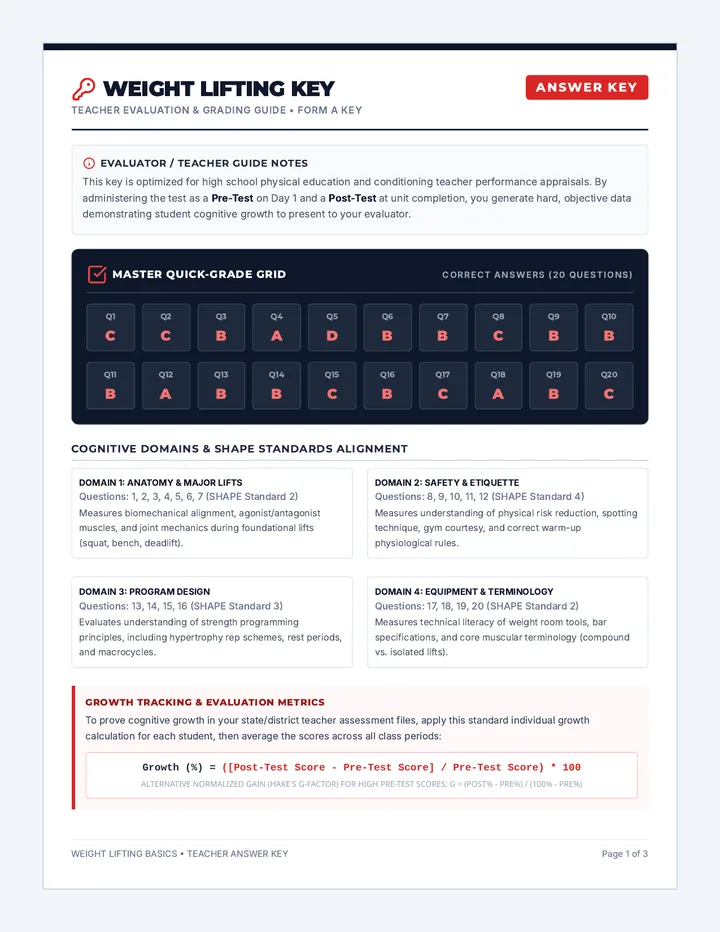
Alternative normalized gain (Hake's G-factor) for high pre-test scores: g = (Post% - Pre%) / (100% - Pre%)
WEIGHT LIFTING BASICS • TEACHER ANSWER KEY Page 1 of 3
WEIGHT LIFTING KEY & RATIONALES
FORM A EXPLANATIONS
SECTION A
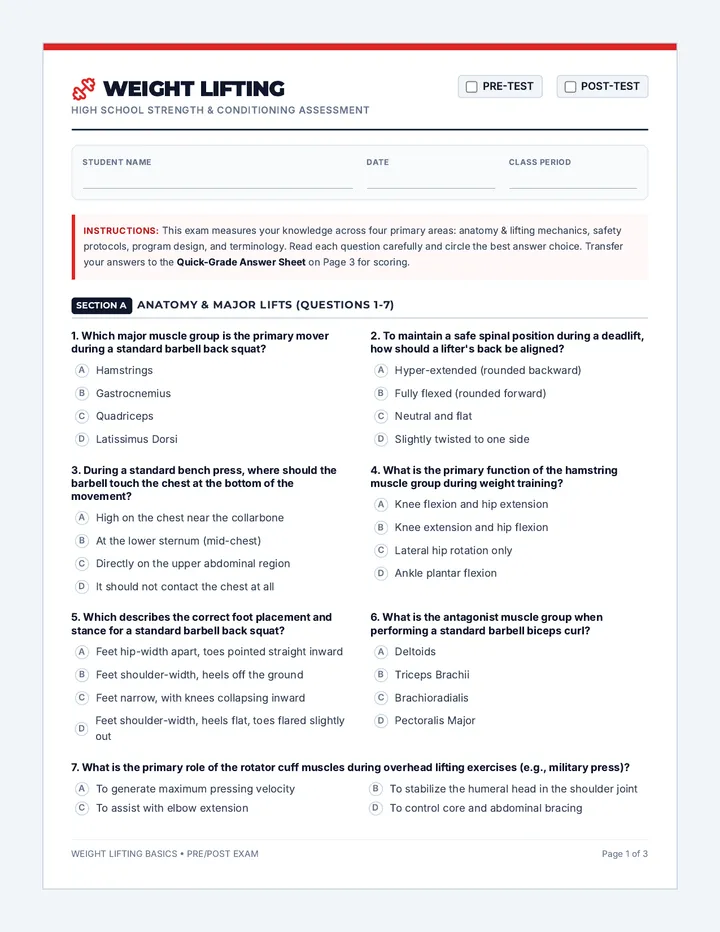
Question 1 Correct Choice: C (Quadriceps)
The barbell back squat requires significant knee extension and hip extension. The quadriceps femoris muscle group acts as the primary agonist (prime mover) during the extension phase, while the gluteus maximus is the primary hip extensor.
Question 2 Correct Choice: C (Neutral and flat)
A neutral, flat spine is critical during deadlifts to safely distribute shear forces across the spinal column and engage the spinal erectors effectively. Rounding (flexion) or hyper-extending (lordosis) under a heavy load can lead to disc herniation or acute muscle strain.
Question 3 Correct Choice: B (At the lower sternum / mid-chest)
In a safe bench press execution, the bar should touch the lower sternum (nipple line). This allows the elbows to naturally tuck at a 45-75 degree angle relative to the torso, protecting the shoulder joint (rotator cuff and labrum) from excessive stress.
Question 4 Correct Choice: A (Knee flexion and hip extension)
The hamstring group (biceps femoris, semitendinosus, semimembranosus) is a biarticular muscle group. It crosses two joints, actively flexing the knee and extending the hip joint (primary active functions during RDLs and running cycles).
Question 5 Correct Choice: D (Feet shoulder-width, heels flat, toes flared slightly out)
A solid squat foundation requires keeping the feet shoulder-width apart, heels pinned flat to maintain force distribution, and toes slightly flared (5-30 degrees) to allow natural outward tracking of the knees and pelvic depth without impingement.
Question 6 Correct Choice: B (Triceps Brachii)
An agonist-antagonist pair operates in opposition. When the biceps brachii concentrically contracts during elbow flexion (curls), the triceps brachii must relax and extend to allow the movement to occur smoothly.
Question 7 Correct Choice: B (To stabilize the humeral head in the shoulder joint)
The primary biomechanical function of the small rotator cuff muscle group (supraspinatus, infraspinatus, teres minor, subscapularis) is structural stability. They pull the head of the humerus tightly into the shallow glenoid fossa during heavy press motions.
SECTION B
Question 8 Correct Choice: C (Near the bar with an alternated grip, ready to assist)
An effective bench spotter keeps their hands near the bar utilizing an alternated (under-over) grip. This configuration prevents rotational slip if the lifter suffers sudden muscular failure and must be helped immediately.
Question 9 Correct Choice: B (Always use collar clamps/clips to secure weights)
Weight room safety mandates that collar clamps/clips are locked on barbells. Without clips, even a minor lateral tilt of the bar will cause plates to slip off, creating an immediate, dangerous weight imbalance that violently whips the bar in the opposite direction.
Question 10 Correct Choice: B (Returning all plates, bars, and dumbbells to storage)
"Racking weights" is a fundamental standard of physical respect and safety. Unracked weights create major tripping hazards, overload commercial/school bar sleeves causing bend damage, and limit accessibility for subsequent students.
WEIGHT LIFTING BASICS • TEACHER ANSWER KEY Page 2 of 3
WEIGHT LIFTING KEY & RATIONALES
FORM A EXPLANATIONS CONTINUED
SECTION B & C CONTINUED
Question 11 Correct Choice: B (The spotter must take the load or help bail safely)
If mechanical failure occurs, the spotting team must intervene to prevent acute injury. For back squats, spotters must be trained to help stand the weight up vertically rather than allowing the barbell to fall backwards onto spine/necks.
Question 12 Correct Choice: A (Increases core temp & blood flow without reducing muscle power)
Sports science proves dynamic warm-ups prepare muscle fibers for rapid, heavy contractions. Conversely, prolonged static stretching (holding stretches >45 seconds) temporarily decreases motor unit excitability and overall muscle force output.
Question 13 Correct Choice: B (Gradually increase weight, reps, or volume over time)
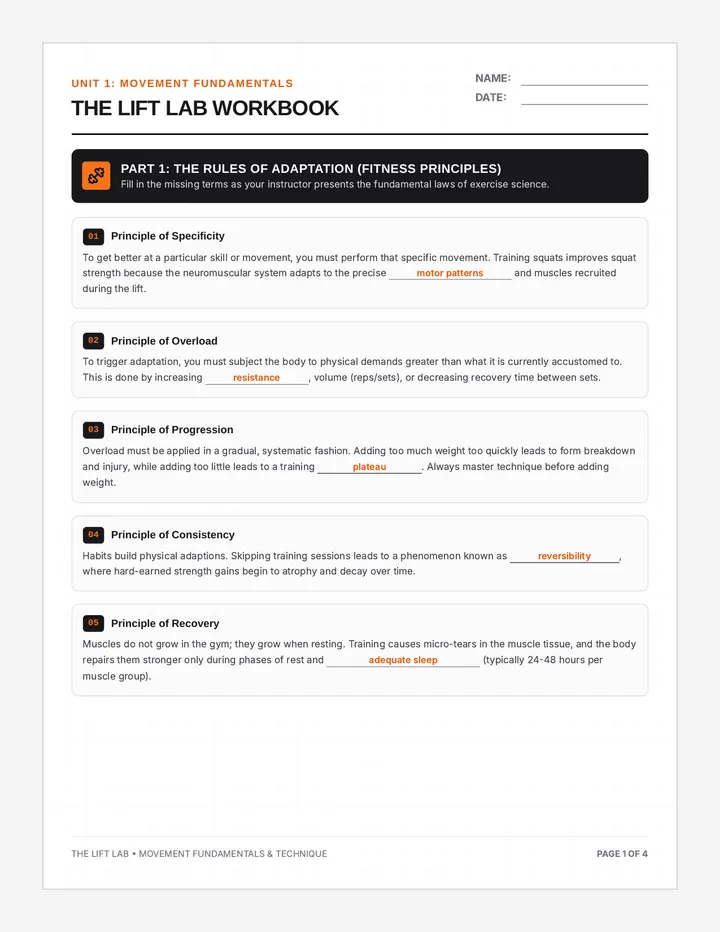
The physiological foundation of progressive overload dictates that a muscle must be subjected to an incremental demand that exceeds its current habitual capacity to stimulate structural adaptation and myofibrillar growth.
Question 14 Correct Choice: B (6 - 12 reps per set)
While strength adaptions occur below 6 reps (high load/low volume) and endurance develops above 15 reps, the 6-12 repetition range (65-80% of 1RM) represents the ideal physiological intersection of mechanical tension and metabolic stress for hypertrophy.
Question 15 Correct Choice: C (2 to 5 minutes)
Heavy lifting (at or above 85% of 1RM) relies heavily on the phosphagen (ATP-CP) energy system. It takes approximately 2-5 minutes of absolute rest for muscles to resynthesize 95-100% of their cellular ATP and creatine phosphate stores.
Question 16 Correct Choice: B (Mesocycle)
Periodization categorizes periods of time: a Microcycle is typically 1 week; a Mesocycle is a medium block of training focused on a singular target (hypertrophy, strength, power) lasting 2-6 weeks; a Macrocycle covers 1 full year.
SECTION D
Question 17 Correct Choice: C (45 pounds / 20.4 kg)
A standard men's Olympic barbell weighs 45 lbs (20.4 kg). Women's standard Olympic barbells weigh 35 lbs (15.8 kg). Knowing the absolute bar weight is mandatory for students to perform accurate load calculation logs.
Question 18 Correct Choice: A (Barbell Overhead Press)
A compound exercise requires movement across multiple joints and engages several muscle groups. The Overhead Press is a multi-joint movement (shoulders, elbows, core bracing), whereas calf raises and triceps kickbacks are single-joint, isolation lifts.
Question 19 Correct Choice: B (A rep is a single complete movement; a set is a group of reps)
Terminology accuracy is fundamental for conditioning literacy. A repetition (rep) represents a single concentric, isometric, and eccentric contraction cycle. A set consists of a sequence of those repetitions completed without stopping.
Question 20 Correct Choice: C (Power Rack / Squat Cage)
A power rack features heavy steel uprights equipped with adjustable safety pins. If a lifter fails a squat, they can safely rest the bar onto the horizontal pins without risking lumbar or physical injury, eliminating the absolute requirement of a human spotter.
WEIGHT LIFTING BASICS • TEACHER ANSWER KEY Page 3 of 3