Lift Lab Student Workbook
Unit 1: Movement Fundamentals
THE LIFT LAB WORKBOOK
NAME:
DATE:
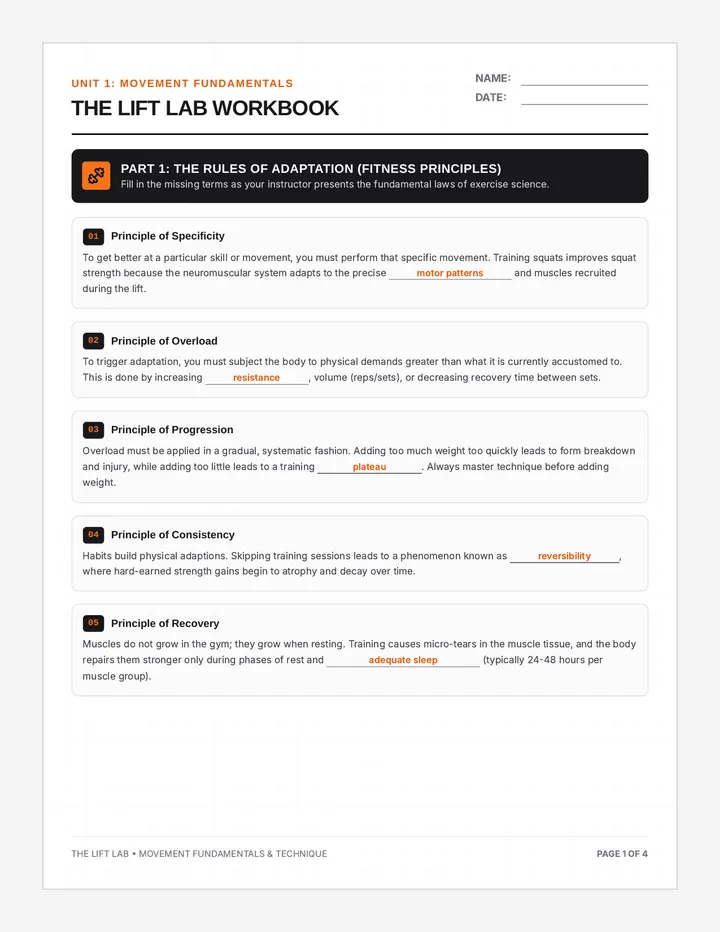
PART 1: THE RULES OF ADAPTATION (FITNESS PRINCIPLES)
Fill in the missing terms as your instructor presents the fundamental laws of exercise science.
01
Principle of Specificity
To get better at a particular skill or movement, you must perform that specific movement. Training squats improves squat strength because the neuromuscular system adapts to the precise motor patterns and muscles recruited during the lift.
02
Principle of Overload
To trigger adaptation, you must subject the body to physical demands greater than what it is currently accustomed to. This is done by increasing resistance, volume (reps/sets), or decreasing recovery time between sets.
03
Principle of Progression
Overload must be applied in a gradual, systematic fashion. Adding too much weight too quickly leads to form breakdown and injury, while adding too little leads to a training plateau. Always master technique before adding weight.
04
Principle of Consistency
Habits build physical adaptions. Skipping training sessions leads to a phenomenon known as reversibility, where hard-earned strength gains begin to atrophy and decay over time.
05
Principle of Recovery
Muscles do not grow in the gym; they grow when resting. Training causes micro-tears in the muscle tissue, and the body repairs them stronger only during phases of rest and adequate sleep (typically 24-48 hours per muscle group).
THE LIFT LAB • MOVEMENT FUNDAMENTALS & TECHNIQUE PAGE 1 OF 4
THE LIFT LAB WORKBOOK LAB SECTION 02
PART 2: MUSCLE BIOMECHANICS & CONTRACTIONS
Analyze how muscle fibers generate force, stabilize joints, and adapt to stimulus.
1. Types of Muscle Contractions
Concentric
The muscle actively shortens as it overcomes an external resistance.
Lab Cue: "Pushing / Pulling" up against gravity.
Eccentric
The muscle actively lengthens as it resists an external load.
Lab Cue: "Lowering" the load under control.
Isometric
The muscle develops tension without changing its physical length.
Lab Cue: "Holding" static position (Plank).
2. Movement Dynamics & Stabilization
The Law of Stabilization
For a prime mover to exert force safely, the surrounding joints must be anchored. What muscles or muscle actions serve as stabilizers?
Example: During a bench press, the Rotator Cuff / Upper Back acts as stabilizers to keep the shoulder joint aligned, and the Core stabilizes the torso.
Range of Motion (ROM) & Mobility
Explain why partial repetitions limit muscle tissue hypertrophy compared to complete, full range of motion lifts.
Completing exercises through full ROM recruits and stretches muscle fibers under load, triggering larger
micro-tears across the entire length of the muscle, maximizing growth and active mobility.
Technique vs. Load (The Safety Equation)
What occurs to structural safety when momentum or overloaded weight replaces precise physical biomechanics?
Force shifts from active muscular structures to passive connective tissues (tendons, ligaments, joints),
dramatically increasing the risk of acute tears or chronic wear injuries while decreasing exercise stimulus.
THE LIFT LAB • MOVEMENT FUNDAMENTALS & TECHNIQUE PAGE 2 OF 4
THE LIFT LAB WORKBOOK LAB SECTION 03
PART 3: ANATOMY MAPPING — THE BIG LIFTS
Match the correct muscle groups to their functional role in the Squat and Bench Press.
Movement 1: The Squat
The squat is a multi-joint compound lift focusing primarily on the lower body posterior and anterior chains.
PRIMARY MOVER (Extension of Knee):
Quadriceps Femoris Front Thigh
PRIMARY MOVER (Extension of Hip):
Gluteus Maximus Hips/Glutes
ASSISTING SYNERGISTS (Hip/Knee Stabilizers):
Hamstrings Back Thigh
ISOMETRIC STABILIZER (Torso Rigidity):
Core & Erectors Abdominals/Lower Back
Movement 2: Bench Press
The bench press is the benchmark compound exercise for upper body horizontal pressing force.
PRIMARY MOVER (Shoulder Adduction):
Pectoralis Major Chest
PRIMARY MOVER (Elbow Extension):
Triceps Brachii Back Arm
ASSISTING SYNERGIST (Shoulder Flexion):
Anterior Deltoids Front Shoulder
ISOMETRIC STABILIZER (Shoulder Girdle):
Rotator Cuff & Lats Shoulder/Back
Critical Scientific Connection:
During a compound movement, why does a weak stabilizer muscle limit the strength of your primary movers?
The body operates under neural inhibition: if stabilizers cannot secure a joint, the nervous system actively
limits force output from the primary movers to prevent physical dislocation or structural injury.
THE LIFT LAB • MOVEMENT FUNDAMENTALS & TECHNIQUE PAGE 3 OF 4
THE LIFT LAB WORKBOOK LAB SECTION 04
PART 4: LAB REFLECTIONS & FITNESS BLUEPRINT
Synthesize your training logs, mechanical lessons, and long-term adaptation targets.
1. Analyzing The Adaptation Curve:
Based on the Principle of Progression, outline your personal plan to increase load or intensity safely on the barbell squat over the next 4 weeks. (Consider reps, sets, and bar velocity).
Week 1: Focus on mastering deep air squats and empty barbell technique (3 sets of 10)
Week 2: Add light resistance (dumbbells or 10lb plates), focusing on strict form and controlled concentric velocity
Week 3-4: Increase weight by small increments (~5-10 lbs total) only if all 10 reps are performed with perfect form
2. The Mind-Muscle Connection:
Describe how actively concentrating on the contraction of your pectorals and triceps during the bench press changes your mechanical setup and alignment compared to simply "trying to push the bar up."
Concentrating on contractions shifts the focus from simply moving an object from Point A to Point B to actively
engaging muscle tissue. This results in retraction of the shoulder blades, stabilizing the shoulder capsule,
and driving the elbows inward to isolate the pectoral muscle fibers rather than relying on joints or momentum.
My Weekly Commitment Blueprint
CONSISTENCY STRATEGY:
I will train 3 days per week (Mon/Wed/Fri) with at least 48 hours of recovery between major sessions.
RECOVERY & REST PLAN:
I will aim for 8 hours of sleep per night and high-quality protein nutrition to repair micro-tears.
THE LIFT LAB • MOVEMENT FUNDAMENTALS & TECHNIQUE PAGE 4 OF 4
Lift Lab Lecture Slides
THE LIFT LAB UNIT 1 • WEEKS 3-6
MOVEMENT FUNDAMENTALS & TECHNIQUE
Connecting biological adaptation with foundational weight training biomechanics. Master the science before mastering the iron.
Week 3: Core Fitness Principles & Biomechanics
01 / FITNESS PRINCIPLES
THE LAWS OF ADAPTATION
Overload & Progression
The body adapts to demands that exceed normal capabilities. Overload must be applied gradually to build strength without structural injury.
Recovery & Sleep
Micro-tears in muscle fibers undergo cellular repair during periods of deep rest. Growth occurs on rest days, not in the weight room.
Core Rule: Training triggers stress. Recovery builds adaptation. Consistent actions yield long-term gains.
02 / EXERCISE SCIENCE
WHAT HAPPENS TO MUSCLES?
The Hypertrophy Pathway
STAGE 01 Micro-Tears
Lifting causes structural damage to muscle filaments.
STAGE 02 Protein Synthesis
Body synthesizes amino acids to rebuild tissue.
STAGE 03 Myofibrillar Growth
Muscle fibers grow thicker and stronger than before.
Warning: Inadequate nutrition or sleep stops Stage 2 and blocks strength progression.
03 / CONTRACTION DYNAMICS
TYPES OF FORCE GENERATION
CONCENTRIC
Shortening
Muscle shortens as it overcomes resistance. e.g., Pushing the barbell away from your chest.
ECCENTRIC
Lengthening
Muscle lengthens while resisting force. Controlling the barbell down slowly to your chest.
ISOMETRIC
Static Hold
Muscle produces tension without changing joint angles. Pausing at the bottom of a squat.
Did you know? Eccentric contractions generate the highest levels of mechanical muscle tension.
04 / THE SQUAT
ANATOMICAL TARGETING
Lower Body Powerhouse
The squat is a multi-joint compound movement that recruits the largest metabolic structures of the human body simultaneously.
CRITICAL CUE:
"Drive knees outward and lead up with your chest."
Muscle Map Checklist
Quadriceps Femoris Primary Mover (Knee Extension)
Gluteus Maximus Primary Mover (Hip Extension)
Hamstrings & Calves Joint Stabilizers
Abdominals & Erector Spinae Torso Rigidity
Form Alert: Loss of core tension causes the lower back to round, shifting load to spinal disks.
Lift Lab Form Assessments
THE LIFT LAB • WEEKLY ASSESSMENT
BARBELL SQUAT FORM EVALUATION
LIFTER:
COACH:
DIAGNOSTIC TECHNIQUE RUBRIC
Score 1-3 based on observed anatomical checkpoints and lift mechanics.
MAX POINTS: 9
PHASE 1: THE SETUP & UNRACK CRITICAL POINT
Needs Focus (1 pt) Bar rests on neck; hands are too wide; feet are uneven; shoulders are relaxed with zero spinal brace.
Proficient (2 pts) Bar set on upper traps (high bar) or spine of scapula (low bar); moderate brace; straight wrists; clean unrack steps.
Mastery (3 pts) Bar shelf fully packed; elbow drive engages lats; wrists straight; abdominal vacuum brace; precise 2-step drop unrack.
PHASE 2: THE DESCENT & DEPTH PRIMARY MOVEMENT
Needs Focus (1 pt) Knees cave inward; heels rise off ground; hip crease stays high above knees; lower back arches excessively.
Proficient (2 pts) Knees track toes; weight centered on midfoot; hip crease reaches parallel with knee joints; minor chest lean.
Mastery (3 pts) Knees pushed out; hips hinge deep into parallel/below; flat back; spine stays neutral; vertical chest throughout.
PHASE 3: THE ASCENT & FINISH POWER GENERATION
Needs Focus (1 pt) Hips shoot up faster than shoulders ("Good Morning" squat); knees collapse inward; lifter loses balance or holds breath.
Proficient (2 pts) Hips and shoulders rise at same rate; concentric drive through midfoot; exhale at top; full extension of knees/hips.
Mastery (3 pts) Glute squeeze initiates ascent; explosive but stable drive; torso angle maintained; bar path perfectly vertical.
COACH'S ON-THE-SPOT CHECKLIST
Feet Anchored Big toe, pinky toe, and heel planted (the tripod foot).
Abdominal Brace Deep breath taken and core packed before starting eccentric phase.
Knees Outward No internal knee collapse during concentric drive phase.
Hip Parallel Depth Hip crease drops at or below level of top of patella.
COACH FEEDBACK & CORRECTIONS (WRITE DETAILED NOTES BELOW)
Focus on keeping chest upright during descent. Keep elbows tucked directly under the barbell shelf to activate the lat muscles and prevent forward torso lean.
FINAL SCORE: ___ / 9
SIGN-OFF:
THE LIFT LAB • MOVEMENT FUNDAMENTALS & TECHNIQUE PAGE 1 OF 2
THE LIFT LAB DIAGNOSTICS ASSESSMENT 02
THE LIFT LAB • WEEKLY ASSESSMENT
BENCH PRESS FORM EVALUATION
LIFTER:
COACH:
DIAGNOSTIC TECHNIQUE RUBRIC
Score 1-3 based on observed anatomical checkpoints and lift mechanics.
Lift Lab Teacher Guide
THE LIFT LAB • TEACHER GUIDE
INSTRUCTIONAL PROCEDURES
WEEK 3 • PART A
DAY 1 & DAY 2: THEORY & THE LAWS OF FITNESS
Pacing guide, discussion prompts, and cognitive benchmarks for classroom sessions.
DAY 1: Fitness Principles
45 MINS
0-10m
Intro & Hook: Ask: "Why does doing bicep curls not increase your vertical jump?" Guide discussion towards the Principle of Specificity.
10-25m
Guided Notes (Slides 1-2): Walk students through filling out Page 1 of the Workbook. Focus on how Overload demands Progressive change.
25-40m
Brainstorming Lab: Have students outline real-world scenarios for overload. (e.g. adding 5 lbs to bar vs. increasing training volume).
DAY 2: Muscle Contraction
45 MINS
0-10m
Active Demonstration: Perform an empty-barbell curl. Ask class to identify where the muscle is shortening, lengthening, or holding.
10-25m
Guided Notes (Slides 3-4): Instruct on myofibrillar micro-tears during eccentric phases. Fill in Workbook Page 2.
25-40m
The Mind-Muscle Hook: Discuss internal joint stabilization. Why does physical stability yield safety and greater peak force?
COGNITIVE CHECK-FOR-UNDERSTANDING PROMPTS
Q1
"If you add weight to the bar but can only do a half repetition, is that Progressive Overload?"
Expected Answer: No. Progressive overload requires maintaining complete Range of Motion. Partial repetitions reduce total mechanical tension and isolate the stress onto joints rather than muscle tissues.
Q2
"Why do muscle fibers need 24 to 48 hours of recovery before training them again?"
Expected Answer: Training causes micro-tears in myosin and actin filaments. The chemical reconstruction process (protein synthesis) takes 24-48 hours. Training before this cycle finishes causes tissue atrophy and degradation.
THE LIFT LAB • MOVEMENT FUNDAMENTALS & TECHNIQUE PAGE 1 OF 2
THE LIFT LAB INSTRUCTOR REFERENCE WEEK 3 • PART B
THE LIFT LAB • GYM INSTRUCTION
PRACTICAL LABS & TECHNIQUE CUES
DAY 3 & DAY 4: TECHNIQUE DIAGNOSTICS & CORRECTIONS
Explicit coaching actions, common structural faults, and their anatomical fixes.
BIOMECHANICAL FAULTS DATABASE