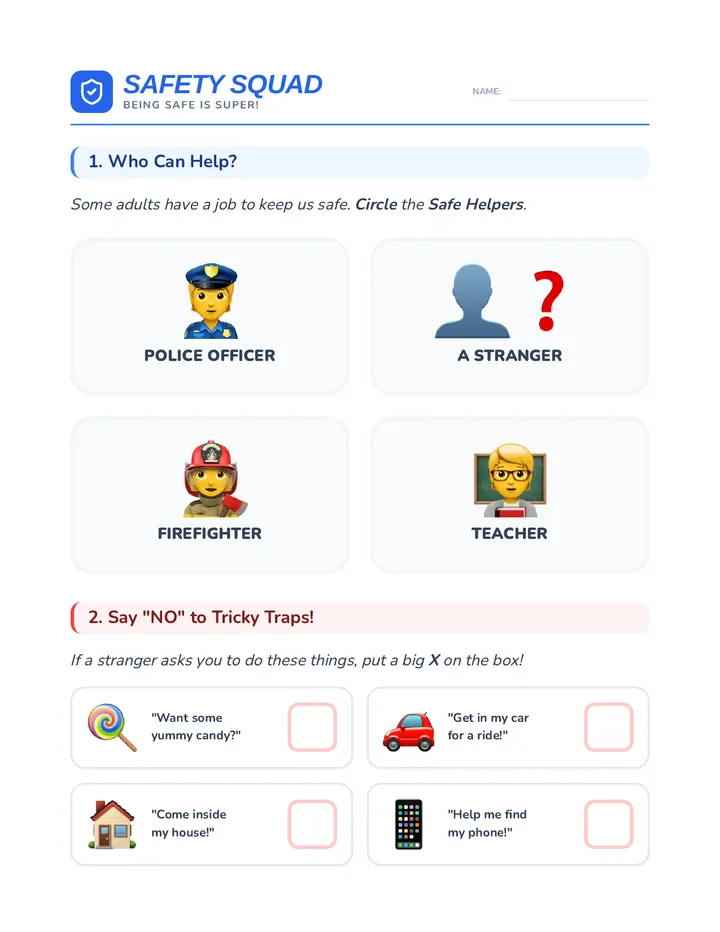
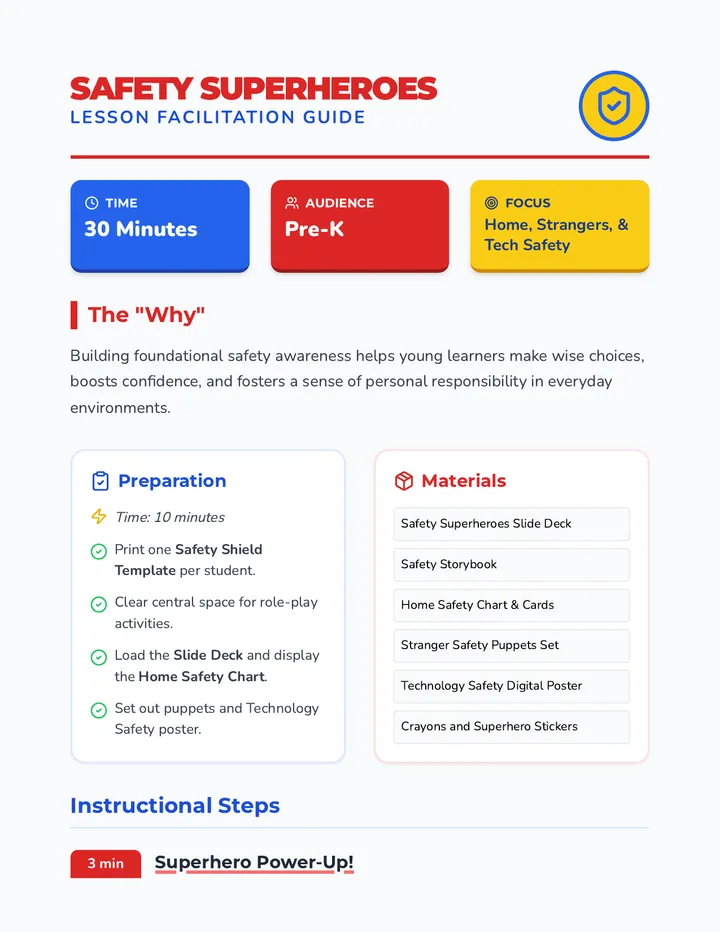
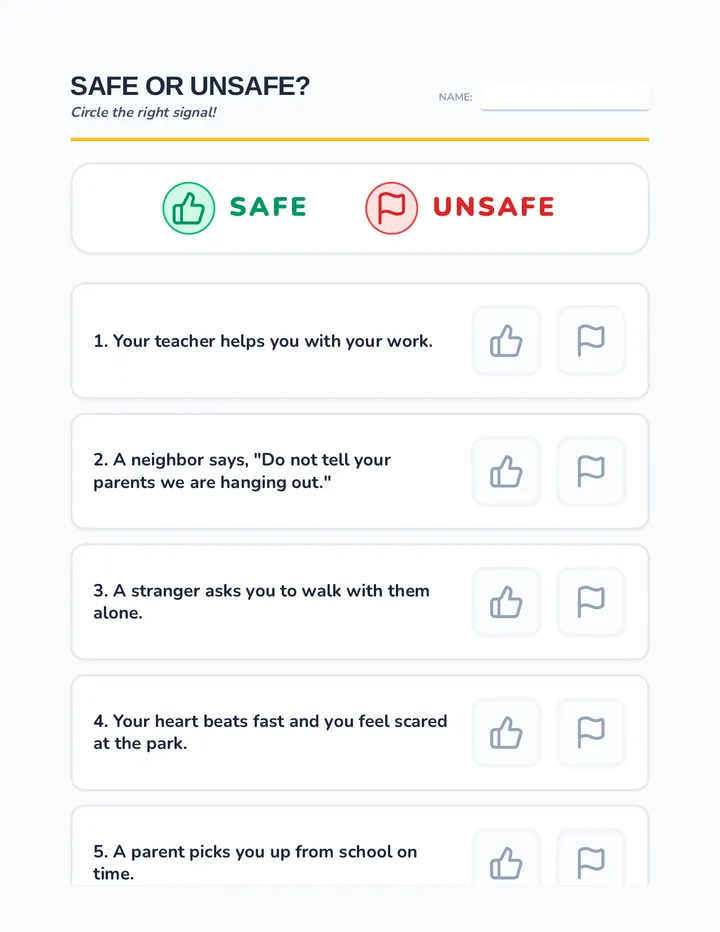
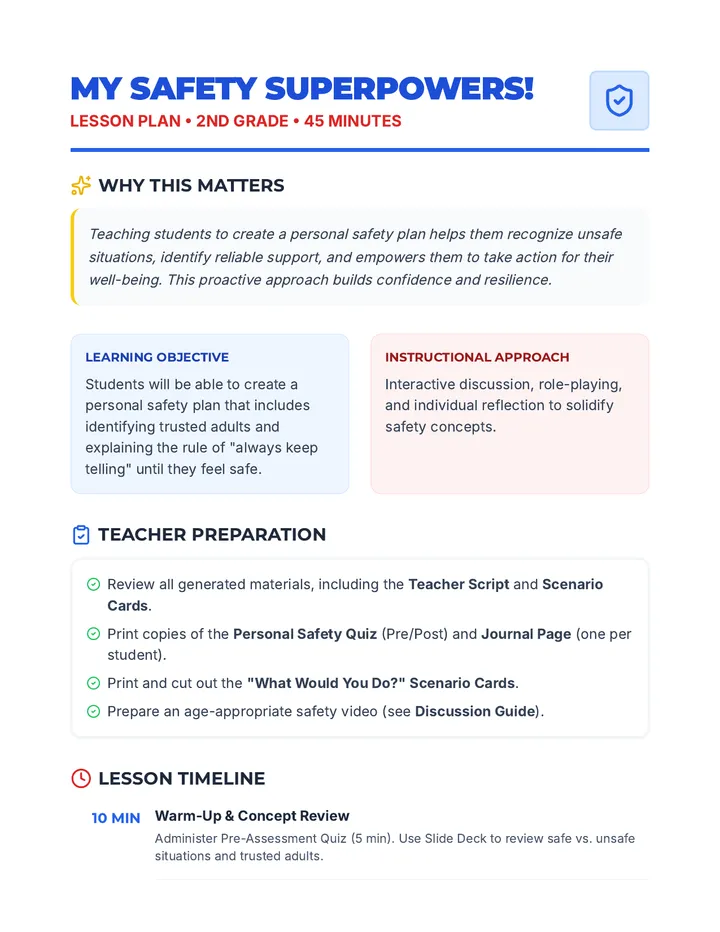
Distinguishes between safe adults and strangers through situational awareness and boundary setting. Equips students with communication protocols and emergency response actions for public spaces.
A multi-grade social-emotional learning unit focused on 'Summer Safety Heroes'. Lessons are tailored for different developmental levels, from 1st-grade foundations to 3rd-grade scientific mastery and risk management.
A comprehensive 7th-grade child development course focused on safety, basic caregiving, developmental milestones, and professional babysitting business skills. The curriculum is designed for 45-minute class periods and aligns with Urbandale CSD standards and proficiency scales.
A comprehensive sequence for 3rd grade students focusing on identifying emergencies, communicating with emergency services, and understanding community mental health resources. Students will develop situational awareness and learn the practical steps for seeking help in various crises.
This sequence shifts focus from physical combat to the mental and verbal aspects of self-defense, prioritizing conflict avoidance. Students learn threat assessment, assertive communication, and environmental scanning through Cooper's Color Code and role-playing scenarios.
A comprehensive 6th-grade PE sequence focusing on non-aggressive self-defense, situational awareness, and escape maneuvers. Students progress from mental preparedness and verbal boundaries to physical blocks, grab escapes, and safe falling techniques.
This sequence introduces 9th-grade students to personal safety, covering situational awareness, verbal de-escalation, defensive stances, striking mechanics, and escape techniques. It culminates in stress-based simulations to test decision-making and physical skills in a controlled environment.
A comprehensive 5-lesson sequence for 2nd graders to recognize online risks, understand the difference between real-life and online friends, and identify a network of trusted adults for support. Students learn to trust their instincts and use their 'brave voice' to seek help.
A project-based safety sequence where 2nd-grade students become 'Safety Inspectors.' They learn to identify household fire hazards, understand the danger of matches and lighters, interpret safety signage, and advocate for prevention through creative posters and a final safety pledge.
A comprehensive 11th-grade health sequence focused on the intersection of personal safety and digital literacy. Students investigate how traffickers use digital footprints, social media scams, gaming platforms, and sextortion to exploit victims, culminating in the creation of personal digital defense plans.
A 5-lesson sequence for 5th-grade students focused on identifying manipulative behaviors and recruitment tactics. Students learn to look past appearances, recognize the grooming cycle, understand the difference between gifts and bribes, and practice setting boundaries and exiting unsafe situations.
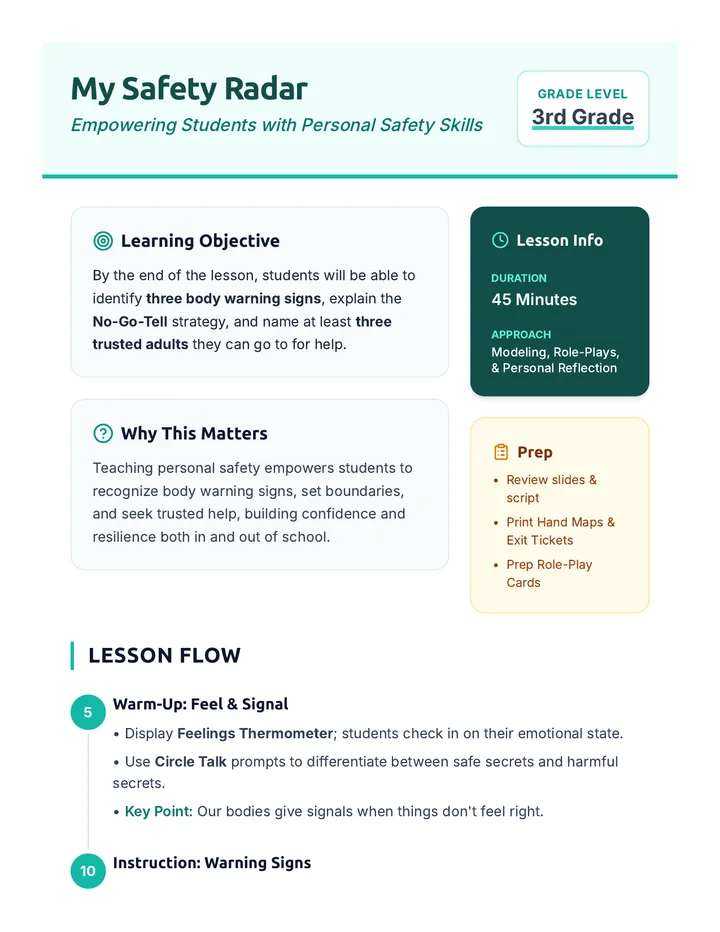
This sequence equips 5th-grade students with foundational safety skills, including defining personal boundaries, recognizing physiological 'Uh-Oh' feelings, distinguishing between secrets and surprises, and developing assertive refusal techniques. By identifying a network of trusted adults, students build the confidence to advocate for their own physical and emotional well-being.
A foundational sequence for 2nd graders to understand prescription drug safety, focusing on trusting adults, personal prescriptions, and safe storage rules.
A life-skills workshop for grades 2-5 teaching heat, water, and community safety through a collaborative 'Summer Navigator' framework. Includes an instructional lesson plan, interactive slides, collaborative scenario discussion cards, and a safety quest board game.
A comprehensive lesson on body safety and intuition, teaching students to recognize 'uh-oh' feelings and distinguish between safe surprises and harmful secrets.
A Spiderman-themed lesson focusing on personal safety, teaching kids to identify 'tricky people' and find 'safe adults' in their community.
A 20-minute kindergarten lesson focusing on respect (kind words and hands), school hallway safety, and community stranger safety through an interactive movement activity.
Students challenge the myth that dangerous people look scary, focusing instead on 'tricky' behaviors. They learn that a tricky person is an adult who asks a child for help or asks them to break safety rules.
An advanced summer safety lesson for 5th graders focused on leadership, environmental health, and complex risk management strategies. Students analyze scenarios and design comprehensive safety systems.
An advanced summer safety lesson for 3rd graders focused on scientific principles of protection, risk management strategies, and professional safety design.
A comprehensive social-emotional learning lesson for 1st graders focused on staying safe during summer activities. Students will learn about sun, water, bike, fire safety, and personal safety through interactive slides and creative art projects.
A lesson designed to teach children how to recognize common tricks used by strangers and how to respond safely.
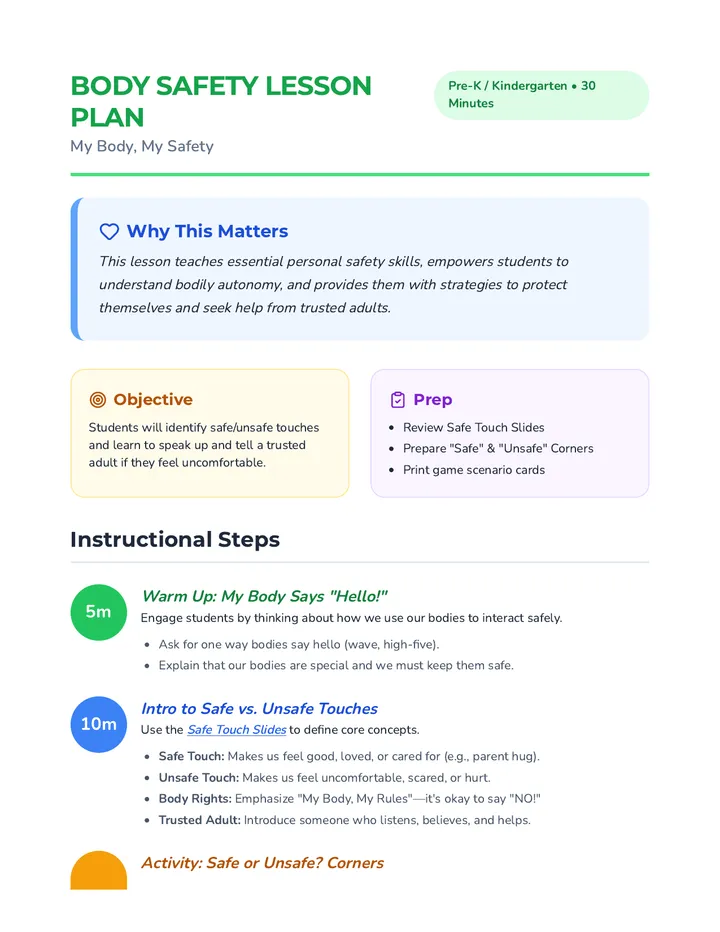
This lesson teaches kindergarteners how to identify trusted adults and respond safely to strangers through interactive discussion and a sorting activity. Students learn specific safety rules and who they can turn to when they need help.
A comprehensive lesson for kindergarten students on stranger safety, focusing on identifying safe adults, understanding the 'No, Go, Tell' rule, and distinguishing between safe and unsafe stranger interactions.
This lesson focuses on weather-related precautions and water safety strategies specifically for infant, toddler, and preschool environments, covering active supervision and emergency protocols.
A printable board game featuring a winding safety quest track, color-coded safety signal squares, hazard challenges, and victory objectives for small groups.
A set of 6 printable roleplay scenario cards representing heat, water, and community safety situations, paired with a student reflection response worksheet.
An engaging 5-slide visual presentation used to guide instruction, teach red, blue, and yellow safety signals, and establish core safety procedures.
A comprehensive teacher's guide and lesson plan outlining objectives, physical materials needed, precise pacing, and step-by-step instructions for running the Summer Navigator workshop.
A 2-page student journal for reflection and application of body safety concepts, including a body signals map, surprise vs. secret drawing area, and safety network identification.
Visual slide deck for Lesson 1 on intuition and body safety, featuring clear definitions, body signal mapping, and the difference between surprises and harmful secrets.
Updated teacher facilitation guide for Lesson 1 with visual emojis and icons for scenarios, improved formatting, and clear pacing guidelines for teaching body safety and intuition.
A quick post-lesson assessment where students draw their hero self and demonstrate basic understanding of safety protocol.
A comprehensive guide for teachers and parents with instructional scripts, key vocabulary, and discussion prompts to facilitate the Hero Safety Skills lesson.
An engaging visual presentation introducing the 'Spider-Sense' concept, tricky people behaviors, and identifying safe adults.
A printable maze-like activity where students navigate a city path, identifying 'tricky situations' and 'safe adults' to reach home safely.
A creative student worksheet where kindergarteners color their own "Safety Badge" and draw a picture of themselves practicing safety or respect. Revised to fix page breaks and work area space.