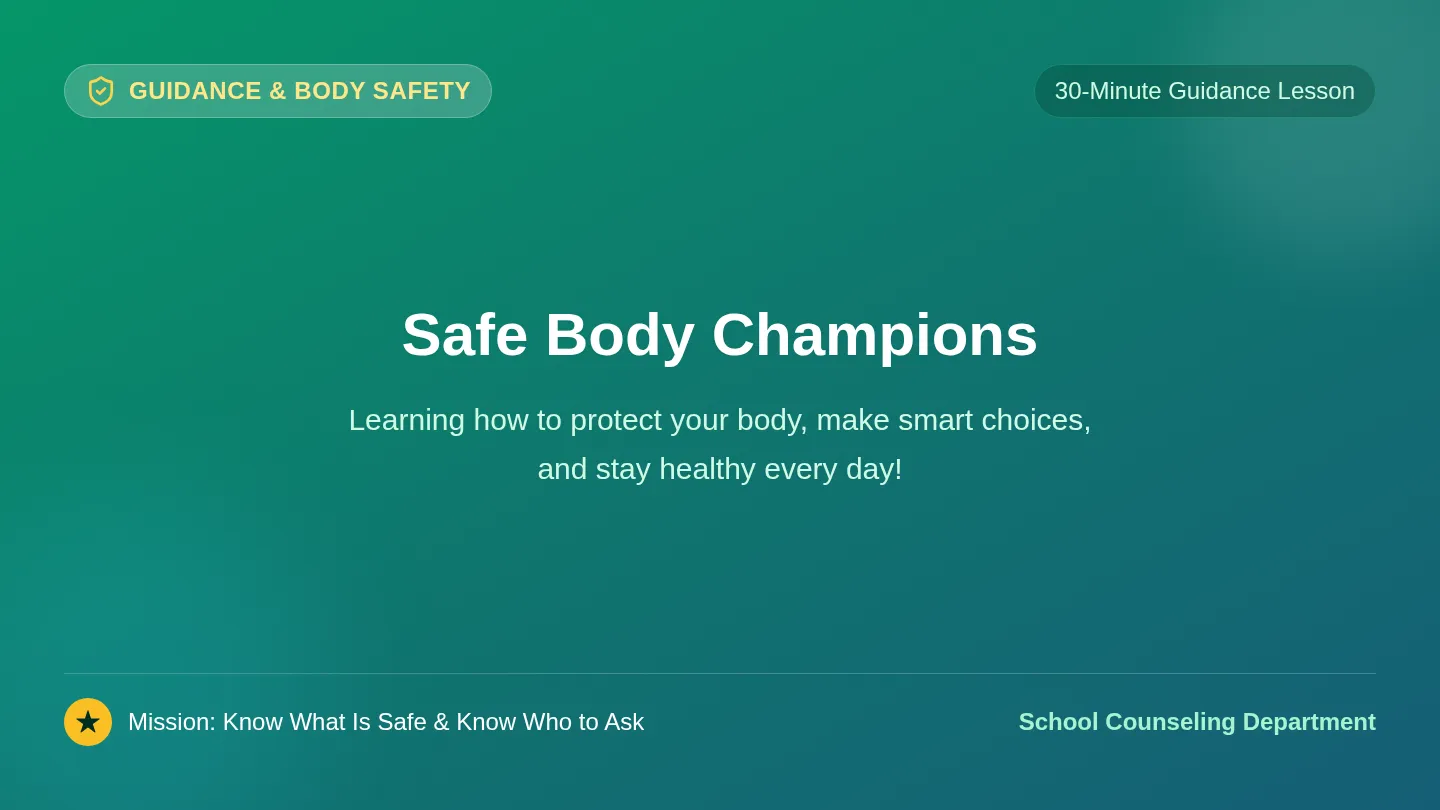
Safety Radar Teacher Guide My Safety Radar
Empowering Students with Personal Safety Skills
Grade Level 3rd Grade
Learning Objective
By the end of the lesson, students will be able to identify three body warning signs , explain the No-Go-Tell strategy, and name at least three trusted adults they can go to for help.
Why This Matters
Teaching personal safety empowers students to recognize body warning signs, set boundaries, and seek trusted help, building confidence and resilience both in and out of school.
Lesson Info
Duration
45 Minutes
Approach
Modeling, Role-Plays, & Personal Reflection
Prep
• Review slides & script
• Print Hand Maps & Exit Tickets
• Prep Role-Play Cards
Lesson Flow
5
Warm-Up: Feel & Signal
• Display Feelings Thermometer ; students check in on their emotional state.
• Use Circle Talk prompts to differentiate between safe secrets and harmful secrets.
• Key Point: Our bodies give signals when things don't feel right.
10
Instruction: Warning Signs
• Use Visual Slides to define safe vs. unsafe touch and identify 3 body warning signs.
• Introduce No-Go-Tell . Model steps using the Teacher Script .
• Volunteers repeat steps: No! → Go! → Tell!
10
Practice: Role-Play Scenarios
• Pair students with Role-Play Cards .
• Students act out scenarios, identify warning signs, and practice No-Go-Tell response.
• Teacher circulates to offer praise and guidance for clear, firm responses.
10
Independent: My Hand Map
• Distribute Trusted Adult Hand Map .
• Students trace their hand and name 3-5 trusted adults (family, teachers, neighbors).
• Quick partner share: Who is one person on your map and why?
10
Closure: Signal & Pledge
• 3-2-1 Exit Ticket : Assess understanding of signs, steps, and helpers.
• Safety Signal Charades : Fast-paced review game.
• Class recites I Can Get Help Pledge together.
Essential Student Materials
• Trusted Adult Hand Map Worksheet
• No Go Tell Role-Play Cards
• 3-2-1 Exit Ticket
• I Can Get Help Pledge Handout
Teaching Resources
• Safe or Not Visual Slides
• Sensitive Topics Teacher Script
• Feelings Thermometer & Circle Talk Prompts
• Safety Signal Charades Guide
Safe or Not Visual Slides Safe vs. Not Safe Touch
Understanding how touch can feel good or make us uncomfortable helps keep us safe.
Teacher Notes: Introduce the topic by explaining that our bodies help us know when a touch is safe or unsafe. Emphasize respect for personal space.
What Is a Safe Touch?
A hug from someone you trust (family, close friends)
A high-five or handshake
A pat on the back or “good job” tap
Helping someone with a gentle touch
Safe & Kind
What Is an Unsafe Touch?
Always Say No
Hitting, kicking, or rough play that hurts
Tickling if it feels scary or unwanted
Touching private parts (swimsuit areas)
Any touch that makes you feel nervous or "icky"
Body Warning Signs
Your body is like a radar! Watch for these signals:
Tummy ache or "butterflies"
Sweaty or shaky hands
Heart beating fast or feeling hot
Feeling scared, stuck, or "frozen"
Quick Practice
1. Your grandparent gives you a gentle hug.
SAFE
NOT SAFE
2. A stranger tries to pull you into their car.
SAFE
NOT SAFE
3. Your teacher helps you tie your shoe.
SAFE
NOT SAFE
4. Someone tickles you after you ask them to stop.
SAFE
NOT SAFE
Feelings Thermometer Check-In Feelings Thermometer Check-In
A quick emotional temperature check to start the lesson.
How to Lead
Display the Feelings Thermometer poster at the front of the room.
Ask each student to silently think about how they feel right now.
Have students point to or place a magnet/clip on the level that best matches their emotion.
Invite volunteers to share their chosen level and one word about why they feel that way.
Teacher Tip
Emphasize that all feelings are okay—whether they are "freezing" (sad/tired) or "boiling" (excited/mad). Noticing our emotions helps us stay safe and learn together.
Emotional Temperature
🔥
☀️
😊
😐
❄️
Boiling Excited Calm Tired Freezing
Time: 2–3 Minutes
Materials: Poster, Magnets/Clips
Good Secret Harmful Secret Circle Talk Good Secret vs. Harmful Secret
Circle Talk Discussion Guide
Setup & Guidelines
• Arrange students in a circle so everyone can see and hear.
• Review norms: Respectful listening, "I" statements, and right to pass.
• Important: Remind students they can talk to you privately if they feel upset.
Purpose
Help students understand the difference between secrets that keep us safe (surprises) and those that may be harmful or unsafe (requests to hide discomfort).
1. What is a secret?
“What does the word secret mean to you?”
Space for teacher notes on student definitions...
2. Defining the Types
Good Secret: A surprise party, a gift. Feels fun or exciting!
Harmful Secret: Someone asks you to keep quiet about something that makes you feel "icky" or scared.
3. Scenario Sorting
Read each aloud. Ask: "Good or Harmful? How does this make you feel?"
"Your friend is planning a surprise card for someone’s birthday and asks you not to tell yet."
"A neighbor tells you not to tell anyone if they give you candy and then wants a hug after you say no."
"A sibling hides a snack from you so they can eat it later."
"Someone says: 'If you tell anyone what I did, I won’t be your friend anymore.'"
Connection to No-Go-Tell
Harmful secrets often come with requests to stay quiet. If a secret makes you worry, use your radar!
Teacher Question: "Who is one trusted adult you can tell right away if a secret feels icky?"
Student Practice: "I need to No-Go-Tell. I felt _____ when you asked me to keep that secret."
Reflection
Invite students to share one thing they learned today about secrets and safety.
End of Warm-Up Discussion
Next Step: Body Warning Signs
No Go Tell Role Play Cards No Go Tell Role-Play Cards
Practice recognizing warning signs and taking action.
Cut along the dotted lines
Instructions for Students:
1 In pairs, take turns drawing a card. Read the scenario aloud.
2 Identify your body warning signs (radar signals!).
3 Practice the steps: NO! → GO away → TELL an adult .
Scenario 1
A neighbor offers you candy and then insists on tickling you even after you say "No, stop."
NO!GO!TELL!
Scenario 2
Your friend gives you a high-five and then tries to push you into a rough game when you feel your heart beating fast.
NO!GO!TELL!
Scenario 3
Your teacher bends down to hug you goodbye, but you feel "stuck" and your stomach feels fluttery.
NO!GO!TELL!
Scenario 4
A stranger asks you to get into their car so you can pet their puppy.
NO!GO!TELL!
Scenario 5
Your cousin picks you up and carries you over their shoulder, and you feel sweaty or shaky.
NO!GO!TELL!
Scenario 6
A classmate offers to help you by rubbing lotion on your arms even after you ask them to stop.
NO!GO!TELL!
Scenario 7
A coach pats you on the back, but then grabs your arm tightly and you feel "frozen."
NO!GO!TELL!
Scenario 8
Someone you don’t know well tries to hold your hand and walk you to the restroom at a park.
NO!GO!TELL!
Safe Radar Learning Kit
STAY SAFE
SPEAK UP
Trusted Adult Hand Map Worksheet Trusted Adult Hand Map
Name:
Date:
Instructions: Place your hand on the paper below and trace around it. On each finger, write the name of a trusted adult you can go to for help (like family, teachers, coaches, or neighbors).
Trace Your Hand Here
1
2
3
4
5
Label Your Fingers
Thumb:
Index:
Middle:
Ring:
Pinky:
Reflect
Choose one adult from your map:
Name:
Why I trust them (Reason 1):
Why I trust them (Reason 2):
You are never alone — Help is always there.
MY SAFETY RADAR | STUDENT HANDOUT
Safety Signal Charades Guide Safety Signal Charades
Reinforce body warning signs and No-Go-Tell steps through movement and teamwork.
How to Play
Divide the class into two teams or small groups.Shuffle the prompt cards and place them face-down.Act: One student draws a card and acts it out silently (no talking or sounds!).Guess: The team has 30 seconds to guess the body signal or step.Score: Correct guesses earn 1 point. Switch teams and repeat!
Reflection Questions
Which warning sign was the easiest to guess? Why?
Which step of No-Go-Tell felt the hardest to act out?
How can remembering these signals help us stay safe in real life?
Charade Prompts
Sign: Tummy ache (butterflies)
Sign: Sweaty or shaky hands
Sign: Heart beating fast
Sign: Feeling "frozen" or stuck
Step: Saying "NO!" loudly
Step: Moving away / stepping back
Step: Telling a trusted adult
30s Rounds
No Talking
Safety Signal Charades | Teacher Guide
Sensitive Topics Teacher Script Sensitive Topics Teacher Script
Modeling No-Go-Tell with clarity and confidence.
Purpose
This script provides age-appropriate language to model the No-Go-Tell response. Use a calm, serious but supportive tone. Remind students that they are the boss of their own bodies.
1. Introduction to No-Go-Tell
Teacher: “Class, today we’re going to learn three powerful words and actions that help keep your body safe. We call this No-Go-Tell . Can you say that with me?”
Students (choral): “No-Go-Tell!”
Teacher: “Great! The first part is No —saying a strong, loud ‘NO!’ when someone does something that makes you feel icky or scared. The second part is Go —moving away from the person or situation. And the third part is Tell —telling a trusted adult what happened. Let’s practice each step together.”
2. Modeling a Scenario
Setup
Model with a volunteer. Use Slide 4 (Warning Signs) for context. Ensure the "tickling" is purely pantomimed.
1
Step 1: NO!
Volunteer: “NO! Stop it!” (Strong & Loud)
Teacher: “Did you hear? A strong ‘No!’ is the first step. Class, why do we use a loud ‘No!’?”
2
Step 2: GO!
Volunteer: (Takes two giant steps away) “Please don’t touch me!”
Teacher: “Alex moved away right away—that’s the ‘Go’ step. Class, what did Alex do when they felt uncomfortable?”
3
Step 3: TELL!
Volunteer: “Ms. Lee, I need to tell you something. When someone tried to tickle me after I asked them to stop, I felt scared and my tummy felt funny.”
Teacher: “Perfect! Alex used all three steps: ‘No!’ ‘Go!’ ‘Tell!’ Let’s say them one more time together.”
3. Check for Understanding
QUESTION 1
“Who can tell me the first step of No-Go-Tell?”
QUESTION 2
“What does ‘Go’ look like in real life?”
QUESTION 3
“Why is it important to tell a trusted adult, even if the person tells you to keep it a secret?”
Transition to Practice
“Fantastic job! Remember: No! Go! Tell! Now, let's practice in pairs.”
Safety Radar Exit Ticket 3-2-1 Exit Ticket
Show what you know about staying safe!
Name:
Date:
3
List 3 body warning signs
Write down three signals your "radar" sends when something doesn't feel right.
2
Name 2 steps of No-Go-Tell
Besides saying "No," what are the other two steps you should take?
Step
Step
1
Name 1 trusted adult
Who is one person you can go to for help if you feel unsafe or uncomfortable?
Safe Radar Mastery
I Can Get Help Pledge Handout I Can Get Help Pledge
My Commitment to Personal Safety
Today we learned how our bodies send warning signs when something feels unsafe, and how we can use No!–Go!–Tell! to protect ourselves. Let’s make a promise to always speak up and get help when we need it.
I,
pledge to:
1
Listen to my body’s warning signs (like a fast heartbeat, butterflies in my tummy, or feeling ‘frozen’).
2
Use No! to say a strong, loud “NO!” when something doesn’t feel right.
3
Go! by moving away from the person or situation that makes me uncomfortable.
4
Tell! by telling a trusted adult as soon as possible.
5
Remember that I am never alone—help is always there when I ask for it.
Student Signature
Date
Teacher Note
Display this pledge poster in the classroom or have students keep a copy in their safety kit. Encourage students to read and sign their pledge at the end of the lesson and revisit it whenever they need a confidence boost.