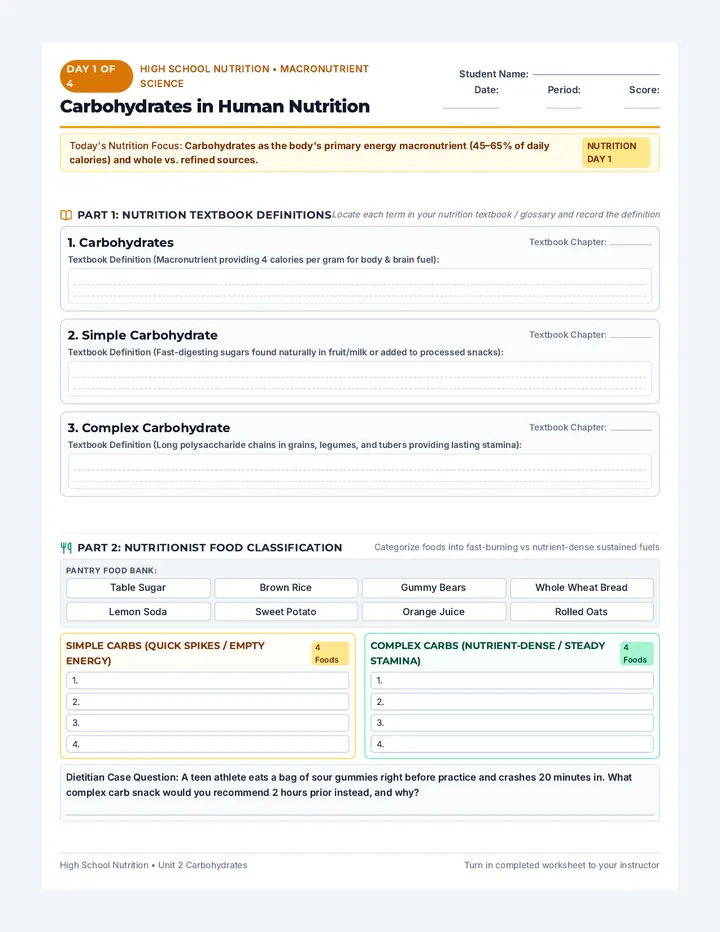
Carb Kickoff Vocabulary Worksheet Carb Kickoff Vocabulary
Nutrition & Wellness • Textbook Investigation Bellringer
Name:
Date: Period:
Textbook Investigation: Use your nutrition textbook glossary or chapter index to look up each core term. Record the formal definition and identify real food examples.
Textbook Ch. / Pg: _______
1. Carbohydrate Primary Dietary Energy
Textbook Definition:
Calories per gram:
Main job in the body:
2. Simple Carbohydrate Fast-Acting Sugars
Textbook Definition:
2 Natural Food Examples:
2 Added/Refined Sugar Examples:
3. Complex Carbohydrate Slow-Burning Starches & Fiber
Textbook Definition:
2 Whole Grain Examples:
2 Legume / Starchy Veggie Examples:
Part 2
Everyday Carb Classifier
Check whether each food provides Simple or Complex carbs
Everyday Food Item Simple Complex How It Fuels Your Body 1. Bowl of Steel-Cut Oatmeal
| Steady morning energy; high soluble fiber |
| 2. Lemon-Lime Soda (12 oz can) |
|
| Fast sugar rush, followed by mid-day crash |
| 3. Baked Sweet Potato with Skin |
|
| Long-lasting starch fuel & vitamin A |
| 4. Gummy Worms / Fruit Chews |
|
| Pure refined syrup; 0 fiber or nutrients |
| 5. Fresh Crisp Apple |
|
| Natural fruit sugar buffered by natural fiber |
| 6. Black Bean Burrito Bowl with Brown Rice |
|
| Sustained sports endurance; slow digestion |
Nutrition & Wellness • Unit 3: Carbohydrates for Daily Health Keep this completed investigation sheet ready for our movement activity & slides!
Carb Fuel Slides Nutrition & Wellness Class
Everyday Eating & Energy
Fueling Your Day & Performance
Simple vs. Complex Carbs
How everyday food choices power your workouts, mood, and daily stamina.
Unit 3: Eating for Real Life Energy Guided Notes: Page 1
Everyday Nutrition
Carbohydrates: Your Body's #1 Fuel
Primary Energy
Your muscles and brain prefer carbs over fats or proteins for quick, clean energy.
Provides 4 calories per gram
Brain Power
Your brain uses ~20% of your daily carbs to stay alert during exams and classes.
Fuel = Blood Glucose
Daily Balance
Nutrition guidelines recommend 45%–65% of your daily calories come from good carbs.
Quality is everything!
Nutrition Reality: Carbs are not the enemy! It is all about choosing the right type of fuel for your engine.
Fast Digestion
Simple Carbs: Fast-Acting Fuel
How They Work 15–30 Minutes
Quick Digestion
Made of tiny single or double sugar units. They require very little breakdown and rush straight into your bloodstream.
The Result: A fast surge of energy, but often followed by an energy slump.
Everyday Food Sources
Common Simple Carbs
Table Sugar & Honey: Coffee sweeteners, syrupsSweet Drinks: Sodas, sweet teas, sports drinksTreats: Candy bars, cookies, fruit snacksNatural Fruits & Milk: Apples, berries, yogurt
💡 Athlete Tip: Simple carbs are great immediately before or during a game for fast energy, but poor for sustained all-day focus.
Food Quality Detective
Natural Sugars vs. Added Sugars
Whole Fruit & Milk
Natural sugars come wrapped in water, vitamins, minerals, and dietary fiber .
Why it's better: Fiber acts like an energy speed bump, releasing fuel steadily.
Bonus: You feel full and nourished.
Soda, Candy & Syrups
Added sugars are stripped of fiber and nutrients, leaving only "empty calories."
Label Clue: Look for "Includes Added Sugars" on the Nutrition Facts panel!
Daily Limit: Under 25g–36g per day.
An orange gives you hydration, vitamin C, and fiber. An orange soda gives you 40 grams of liquid sugar!
Long-Lasting Energy
Complex Carbs: Slow-Burning Fuel
Whole Grains & Starches
Made of long, branched chains of energy. Your digestive system must work for 2 to 4 hours to break them down.
Everyday Examples:
Oatmeal, brown rice, whole wheat pasta, baked potatoes, corn.
Beans & Veggies
Nature's nutritional powerhouses packed with both complex starch and plant protein.
Everyday Examples:
Black beans, chickpeas, lentils, sweet potatoes, peas.
🌟 Why Complex Carbs Win: They provide steady blood sugar, prevent mood swings, and keep you full until lunch!
The Unsung Hero
The Power of Dietary Fiber
Slowing Digestion
Fiber traps sugar molecules, flattening your blood glucose curve and preventing crashes.
Gut Health
Feeds your beneficial gut bacteria, strengthening your immune system and mood.
Daily Goal
Teenagers need 25–38 grams of fiber daily, but most get less than 15 grams!
Rule of Thumb: When choosing bread, cereal, or snacks, pick foods with at least 3 grams of fiber per serving.
Kinesthetic Movement Lab
Movement Challenge: The Fuel Spectrum!
Stand Up! Choose From 2 Movement Options For Each Food:
Option 1 ⚡ Fast Burst
Do 3 Quick High Knees!
Represents Simple Carbohydrates : Rapid digestion, fast glucose surge, and quick-acting fuel.
Digestion speed: 15–30 Minutes
Option 2 🌿 Sustained Pace
Do 3 Slow Steady Marches!
Represents Complex Carbohydrates : Long-chain starch breakdown, steady stamina, and long-lasting energy.
Digestion speed: 2–4 Hours
Round 1: Gummy Candy
Round 2: Steel-Cut Oats
Round 3: Fresh Pear
Round 4: Black Bean Chili
How did your body move? Fast explosive burst vs. steady marathon pace!
Everyday Wellness
Smart Carb Swaps for School & Sports
Sugary Breakfast Cereal
⬇ SWAP FOR ⬇
Oatmeal with Berries
Keeps you focused all morning without a 10:00 AM stomach rumble.
Bag of Potato Chips
⬇ SWAP FOR ⬇
Air-Popped Popcorn
100% whole grain volume snack packed with natural plant fiber.
Canned Soda or Juice
⬇ SWAP FOR ⬇
Whole Fresh Fruit
Satisfies sweet cravings while giving your body hydration & vitamins.
Complete Section 4 & 5 of your Guided Notes now! Nutrition & Wellness Lab
Carb Quest Guided Notes Carb Quest Guided Notes
Nutrition & Wellness • Presentation Companion • Page 1
Name:
Date: Period:
Part 1
Carbohydrates in Everyday Life (Slides 1–2)
1. The Primary Role of Carbohydrates:
Why does the body prefer carbohydrates over fats and proteins for daily fuel?
Energy Density
Yields: cal/g
Daily Target
% calories
Brain Energy
Uses ~ % carbs
Part 2
Simple Carbs: Fast-Acting Fuel (Slides 3–4)
Digestion Timeline: Simple carbs digest in only minutes.
Why does this quick digestion cause a sudden energy spike followed by a slump?
🌿 Natural Sugars (Fruit & Milk)
How does natural fiber protect against a crash?
2 Healthy Examples:
🍬 Added Sugars (Sodas & Treats)
What line on the label warns you about these?
Teen Daily Limit & 2 Examples:
Real-Life Nutrition Application:
When would a student athlete actually benefit from consuming a fast-acting simple carb?
Part 3
Complex Carbs & The Power of Fiber (Slides 5–6)
• Digestion Speed: Takes hours. • Daily Fiber Goal: grams • Smart Label Rule: ≥ g/serving
Whole Grains & Starches (List 3 Foods):
Legumes & Starchy Veggies (List 3 Foods):
Nutrition & Wellness Class • Smart Carb Fuel Notes Turn to Page 2 for Carb Classifier, Movement Activity & Meal Swaps ➜
Carb Quest Guided Notes (Continued)
Page 2 of 2
Part 4
Everyday Carb Classifier
Check whether each food provides Simple or Complex carbs
Everyday Food Item Simple Complex How It Fuels Your Body 1. Bowl of Steel-Cut Oatmeal
| Steady morning energy; high soluble fiber |
| 2. Lemon-Lime Soda (12 oz can) |
|
| Fast sugar rush, followed by mid-day crash |
| 3. Baked Sweet Potato with Skin |
|
| Long-lasting starch fuel & vitamin A |
| 4. Gummy Worms / Fruit Chews |
|
| Pure refined syrup; 0 fiber or nutrients |
| 5. Fresh Crisp Apple |
Carb Mastery Teacher Guide Carb Mastery Teacher Guide
Lesson Plan, Movement Lab Guide & Student Worksheet Answer Keys
Teacher Resource • 50-Min Nutrition Class
1. Textbook Bellringer (10 min)
Students open nutrition textbooks to find definitions for Carbohydrate, Simple Carb, and Complex Carb, then classify foods.
2. Slides & Movement (25 min)
Present Carb Fuel Slides . Conduct the 2-option stand-up movement challenge (Slide 7) and complete guided notes.
3. Meal Swaps & Debrief (15 min)
Partners compare meal swaps and formulate a real-life response to fad no-carb diet myths.
Facilitating the Slide 7 Movement Challenge: 2-Option Fuel Spectrum
Option 1: Quick High Knees (Fast Burst) Represents Simple Carbohydrates : Fast enzymatic breakdown (15–30 min) sending quick glucose into the blood. Ideal for immediate short bursts, but causes an energy slump if not buffered.
Option 2: Slow Steady Marches (Endurance) Represents Complex Carbohydrates : Long-chain starches and fiber that digest gradually over 2–4 hours, providing steady stamina and preventing rapid spikes and crashes.
Answer Key
Carb Kickoff Worksheet Key (Textbook Investigation)
Part 1: Standard Textbook Definition Samples & Roles
• Carbohydrate: An essential macronutrient composed of sugars, starches, and fiber that serves as the body's primary energy source (4 kcal/gram). Main job: provide glucose fuel for muscular work and brain cognition.
• Simple Carbohydrate: Sugars made of single or double units (monosaccharides/disaccharides) that absorb rapidly. Natural examples: fruit (fructose), milk (lactose). Added/refined: corn syrup, white table sugar, candy, soda.
• Complex Carbohydrate: Long-chain starches and dietary fibers (polysaccharides) that break down gradually. Whole grains: brown rice, rolled oats, whole wheat. Legumes/veggies: black beans, sweet potatoes, peas.
Part 2: Food Classifier Key
1. Steel-Cut Oatmeal: Complex
2. Lemon-Lime Soda: Simple
3. Baked Sweet Potato: Complex
4. Gummy Worms: Simple
5. Fresh Crisp Apple: Simple (buffered with fiber)
6. Black Bean Burrito Bowl: Complex
Nutrition & Wellness • Unit 3: Smart Carb Fuel Turn to Page 2 for Guided Notes Master Key & Discussion Prompts ➜
Protein Power Slides Nutrition & Wellness Class
Everyday Eating & Energy • Day 2
The Body's Structural Master Builder
Protein: Power & Repair
How amino acids build muscles, repair cells, and power daily athletic recovery.
Day 2: Structural Nutrition & Synthesis Guided Notes: Page 1
Macronutrient Fundamentals
Protein: Your Body's Master Builder
Cellular Repair
Rebuilds muscle fibers after exercise, repairs skin, and constructs hair, nails, and bones.
Provides 4 calories per gram
Enzymes & Immunity
Produces antibodies to fight illness and makes enzymes that digest food and regulate hormones.
Protects Immune Health
Daily Balance
Dietary guidelines recommend 10%–35% of your total daily calories come from quality protein.
Promotes Fullness & Satiety
Nutrition Reality: While carbs are your body's preferred go-to fuel, protein is your body's essential building block!
Molecular Science
The Amino Acid Puzzle: 20 Blocks
The 9 Must-Haves Diet Essential
9 Essential Amino Acids
Your body cannot manufacture these 9 amino acids on its own. They must be consumed daily through the foods you eat!
The Key Rule: Missing even one stops protein synthesis and muscle recovery.
The 11 Internal Blocks Self-Made
11 Non-Essential Amino Acids
Given adequate total food energy, your liver can synthesize these 11 amino acids from other nutrients inside your body.
Biological Factory: 20 total amino acids link together to form thousands of unique human proteins.
💡 Analogy: Think of amino acids like alphabet letters: 20 letters combine to write every protein sentence in your body!
Food Classification
Complete vs. Incomplete Proteins
Complete Proteins (All 9)
Provide all 9 essential amino acids in optimal proportions in a single food source.
Animal Sources: Eggs, chicken breast, salmon, Greek yogurt, lean beef.
Plant Standouts: Soybeans (tofu/edamame) and quinoa!
Incomplete Proteins
Low or lacking in one or more essential amino acids (called the limiting amino acid).
Plant Sources: Beans, lentils, whole grains, nuts, seeds, peas.
Nutrition Solution: Combine plant foods to make complete protein!
Protein Power Guided Notes Protein Power Guided Notes
Nutrition & Wellness • Presentation Companion • Page 1
Name:
Date: Period:
Part 1
Protein in Everyday Life (Slides 1–2)
1. The Primary Role of Protein:
How does protein function differently from carbohydrates in your body?
Energy Density
Yields: cal/g
Daily Target Range
% calories
Key Cellular Role
& repair
Part 2
The Amino Acid Puzzle (Slide 3)
Building Blocks: There are total amino acids used by the human body.
Why are 9 of them classified as "essential" amino acids?
🌟 9 Essential Amino Acids
Where must they come from and why?
What happens if 1 is missing?
🌿 11 Non-Essential Amino Acids
How does the body produce them?
Internal Factory Organ:
Part 3
Complete vs. Incomplete Proteins (Slides 4–5)
• Complete Source: Contains all essentials. • Plant Standouts: & Quinoa • Athlete Intake: g/kg
Complete Protein Sources (List 3 Foods):
Complementary Plant Combinations (List 3 Pairs):
Nutrition & Wellness Class • Protein Power Builders Turn to Page 2 for Classifier Table, Movement Lab & Meal Swaps ➜
Protein Power Guided Notes (Continued)
Page 2 of 2
Part 4
Everyday Protein Classifier
Check Complete vs Incomplete and identify its protein advantage
Everyday Food Item Complete Incomplete Nutritional Role & Amino Acid Profile 1. Hard-Boiled Egg
| Gold standard protein; all 9 essential amino acids |
| 2. Bowl of Brown Rice |
|
| Plant starch with some protein; low in lysine |
| 3. Grilled Chicken Breast |
|
| Dense complete protein for muscle tissue repair |
| 4. Steamed Edamame (Soybeans) |
|
| Rare complete plant protein packed with fiber |
| 5. Handful of Roasted Almonds |
|
| Plant protein paired with heart-healthy fats |
| 6. Plain Greek Yogurt (0% or low fat) |
Protein Mastery Teacher Guide Protein Mastery Teacher Guide
Lesson Plan, Movement Lab Guide & Student Guided Notes Master Key
Teacher Resource • 50-Min Class • Day 2
1. Hook & Intro (10 min)
Distribute guided notes. Contrast yesterday's quick carb fuel with today's structural builder and cellular repair role.
2. Slides & Movement Lab (25 min)
Present Protein Power Slides . Run the Slide 7 Amino Acid Chain movement challenge and log data.
3. Meal Swaps & Debrief (15 min)
Complete classifier table, plan lean protein swaps, and address marketing myths regarding protein powders.
Facilitating the Slide 7 Movement Challenge: The Amino Acid Chain
Option 1: 3 Solid Power Squats (Solo Complete) Represents Complete Protein : Contains all 9 essential amino acids in one standalone package (e.g., eggs, poultry, Greek yogurt, edamame, quinoa). A single food provides complete structural power!
Option 2: Partner High-Five / Clapping Bridge Represents Complementary Plant Pairing : Two plant foods link together (e.g., grains lacking lysine + legumes lacking methionine) to form a complete amino acid profile across the meal.
Answer Key
Guided Notes Page 1 Master Key (Parts 1–3)
Part 1: Protein in Everyday Life
• Primary Role: Unlike carbohydrates (which serve as immediate energy), protein is the body's structural architect used for repairing muscle tears, cell membranes, skin, hair, and immune antibodies.
• Energy & Caloric Metrics: 4 calories per gram; recommended range is 10%–35% of total daily calories.
Parts 2 & 3: Amino Acid Science & Food Types
• Total Amino Acids: 20 total building blocks.9 Essential: Must come from daily food because the body cannot synthesize them.11 Non-Essential: Synthesized internally by the liver.
• Plant Complete Standouts: Soy (tofu, tempeh, edamame) and Quinoa.Teen Athlete Intake: 1.2–1.6 g/kg body weight.Complementary Pairs: Rice + beans, peanut butter + toast, hummus + pita.
Nutrition & Wellness Curriculum • Day 2: Protein Power Builders Turn to Page 2 for Classifier Key, Movement Log Key & Discussion Prompts ➜
Protein Power Guided Notes Master Key (Page 2)
Page 2 of 2
Part 4: Everyday Protein Classifier Key