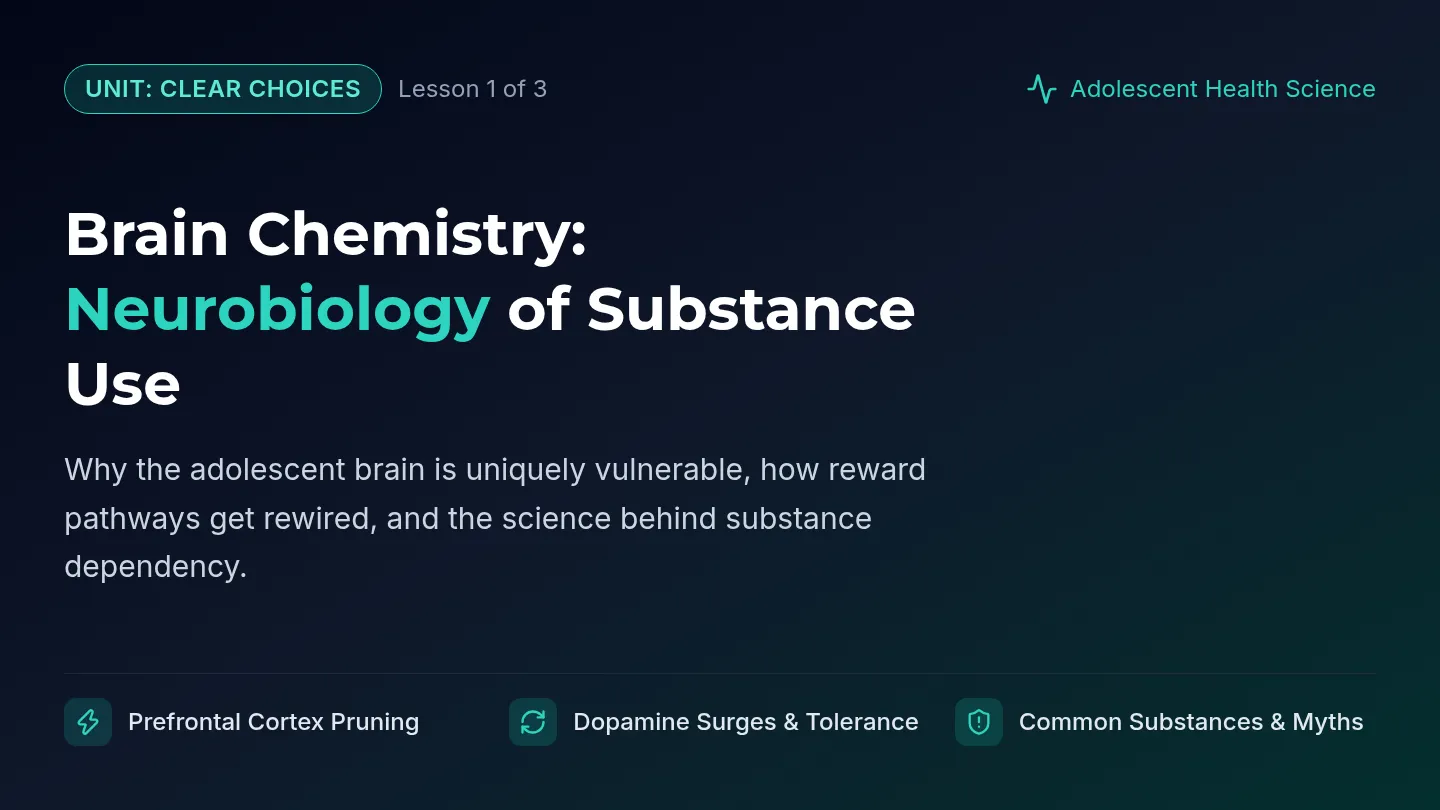
Borrowed Happiness Slides Chemical Equilibrium
Understanding the biology of 'A' and 'E' in the PLEASE skills.
Lesson 01
The PLEASE Skills
P
Physical Illness
L
Balanced Eating
A
Avoid Substances
S
Sleep
E
Exercise
Today we are looking at how Avoiding Mood-Altering Substances and Regular Exercise work together to stabilize your emotional baseline.
Borrowed vs. Invested Happiness
Artificial Regulation
Substances "borrow" neurochemicals (like Dopamine) from your tomorrow. You feel high now, but pay an "emotional debt" later.
REBOUND EFFECT
Natural Regulation
Exercise "invests" in your future baseline. It builds up your system's capacity to regulate stress and mood naturally.
SUSTAINED STABILITY
The Neurochemical ROI
STABLE BASELINE Substance "Rebound" Exercise "Lift"
Notice how substances take you below the baseline after the peak, while exercise gradually raises the baseline itself.
Avoid Mood-Altering Substances
Inaccuracy: Substances give your brain false data about your environment.Vulnerability: The "crash" makes you highly vulnerable to minor stressors.Dependency: Your brain stops producing its own "happy chemicals."
"If you borrow from tomorrow to pay for today, tomorrow will be empty."
ROI Happiness Worksheet The ROI of Happiness
Neurochemistry Comparison Worksheet
Name:
Date:
Phase 1: Defining Chemical Regulation
Artificial Regulation
Example: Alcohol, nicotine, caffeine, unprescribed drugs.
How does this method impact the brain's natural production of neurotransmitters over time?
Natural Regulation
Example: Aerobic exercise, strength training, movement.
How does this method influence the "baseline" of your emotional resilience?
Phase 2: Mapping Emotional Vulnerability
Sketch two lines on the graph below:
EUPHORIA
VULNERABILITY
Baseline
Start
Friday Night
Saturday AM
Sunday AM
Monday AM
Phase 3: The Argument
Why is the 'Avoid' (A) skill listed as a way to "reduce emotional vulnerability"? Connect your answer to the concept of the "Rebound Effect."
A friend says: "I use substances to relax so I don't feel stressed." Based on the biology we learned, what is the flaw in their logic regarding the next day?
Neurochemistry Teacher Guide Teacher Resource Chemical Equilibrium Sequence
Lesson 1: Facilitation Guide
Neurochemistry: Natural vs. Artificial Regulation
Learning Objectives
Define the 'A' and 'E' components of the PLEASE skills.
Explain the 'rebound effect' and 'emotional debt' caused by substances.
Contrast the long-term impact of exercise on emotional baseline vs. substance use.
Instructional Hook (10 mins)
The "Credit Card" Analogy: Ask students if they have ever used a credit card or borrowed money. Explain that substances are like a high-interest credit card for happiness. You get the "cash" (dopamine) now, but you have to pay it back with interest later (the rebound/crash). Exercise, however, is like a high-yield savings account—you put in the work now, and it pays out dividends later.
Quick Prep
"Borrowed Happiness" Slides
Copies of ROI Worksheet
Chart paper/Markers
TIMING
45-60 Minutes
Discussion Prompts & Key Points
Q: Why do we call substance use "borrowed happiness"?
A: Because the brain has a limited supply of neurotransmitters. When a substance forces a massive release, the brain is "empty" the next day while it tries to replenish. This emptiness manifests as anxiety, irritability, or depression.
Q: Does exercise give you an immediate "high"?
A: Sometimes (runner's high), but its primary benefit is the gradual increase in the brain's ability to handle stress hormones like cortisol. It's a "lift" rather than a "spike."
Differentiation Strategies
Support
Provide a pre-sketched graph on the worksheet for students to trace or annotate instead of creating from scratch.
Extension
Ask students to research "down-regulation" and how the brain removes receptors in response to substance use.
Rebound Case Studies Case Study Analysis
The Rebound Effect in Action
REF-ID: REB-2026-L2
Operational Definition: The Rebound Effect
When a mood-altering substance leaves the system, the body often experiences symptoms that are the exact opposite of the substance's initial effect. A relaxant (alcohol) rebounds into anxiety; a stimulant (nicotine) rebounds into fatigue and depression.
1
Jordan: The Sunday Scaries
Alcohol / Depressant
Jordan uses alcohol on Friday night to "turn off his brain" after a stressful school week. He feels social and relaxed until 1:00 AM. On Saturday, he sleeps late, but feels a strange sense of "doom" or low-level panic. By Saturday night, his anxiety is higher than it was on Friday before he started drinking. He feels he "needs" another drink just to get back to a normal state.
Initial Effect
Lowered inhibitions, relaxation, quieted mind.
The Rebound
Spike in glutamate (excitatory chemical) causing anxiety.
2
Maya: The All-Nighter
Caffeine / Stimulant
Maya has three energy drinks to finish a major project. She feels "on fire" and productive for 4 hours. The next morning, she is not just tired—she feels emotionally hollow, incredibly irritable, and unable to make simple decisions. She snaps at her parents and feels like crying over a forgotten homework folder.
Initial Effect
Hyper-focus, energy, perceived confidence.
The Rebound
Adenosine crash + Dopamine depletion = Emotional instability.
3
Sam: The Anxiety Buffer
Nicotine / Vaping
Sam vapes because he says it "calms his nerves" during social gatherings. He takes hits every 20 minutes. If he goes an hour without it, he becomes extremely agitated and hyper-focused on when he can next use. His friends notice he seems "edgy" and less fun to be around unless he's just used his vape.
Initial Effect
Brief release of dopamine, perceived "calm."
The Rebound
Immediate withdrawal-induced anxiety and irritability.
Rebound Analysis Worksheet Rebound Effect Analysis
Connecting the 'Avoid' Skill to Emotional Stability
Student Name:
Date:
Instructions
Using the Rebound Case Studies document, select two of the individuals and map out their "Vulnerability Cycle." Then, answer the synthesis questions at the bottom.
1
Case Study Selection:
The "Why"
What stressor were they trying to solve?
The Rebound
How did their emotions change 12-24 hours later?
The DBT 'Avoid' Skill
How would "Avoiding" this substance have kept their baseline stable?
2
Case Study Selection:
The "Why"
The Rebound
The DBT 'Avoid' Skill
Synthesis: The Biology of Vulnerability
1. Explain the "Flaw of Perceived Relief." Why does someone using a substance feel like they are solving a problem, even when they are creating a bigger one?
2. In your own words, define "Emotional Vulnerability" in the context of the day after substance use.
Rebound Role Play Cards Role: The "Helper"
The Truth-Teller
Your friend says: "I've been so stressed about the SATs. I'm just going to have a few drinks tonight so I can actually sleep and stop worrying for once."
Your Mission:
Challenge their logic using the "Rebound Effect." Explain what will happen to their anxiety levels on Sunday morning when they actually need to study.
Role: The "Helper"
The Focus Coach
Your teammate says: "I'm vaping to stay calm during the game. It just takes the edge off and helps me focus. I'm not addicted, I just use it when I'm nervous."
Your Mission:
Explain how the "calm" they feel is actually just the relief of stopping withdrawal. Point out that the substance is actually creating the "edge" they are trying to take off.
Role: The "Helper"
The Energy Expert
Your friend is on their 4th energy drink. "I'm finally feeling great! I feel like I can do anything. I don't know why you're so worried about my mood."
Your Mission:
Gently warn them about the "Emotional Debt." Describe what their mood baseline will look like in 6 hours when the crash hits. Suggest a natural alternative for sustained energy.
Role: The "Planner"
The Baseline Defender
"I'm thinking about stopping my 'Avoid' plan just for this party. It's one night. How much can it really hurt my emotional progress?"
Your Mission:
Explain why consistency in the 'Avoid' skill is crucial for building a "Buffer" against stressors. Use the "Investment" analogy from Lesson 1.
Reset Button Slides Reset Button
The Biology of the 'E' Skill: Metabolizing Stress through Movement.
What is Stress, Biologically?
When you are emotionally vulnerable, your body is flooded with Cortisol and Adrenaline .
"Emotional vulnerability isn't just a feeling; it's a chemical state. If you don't 'burn off' these chemicals, they stay in your system and keep you on edge."
Movement is Metabolism
Oxygenates
Forces deep breathing, which signals the nervous system to leave "Fight or Flight" mode.
Metabolizes
Literally "uses up" the extra glucose and cortisol released during stress.
Regulates
Triggers BDNF (brain-derived neurotrophic factor) which heals neurons damaged by chronic stress.
Changing the Goal Post
Exercise for Aesthetics
• Focus on looking a certain way
• Can lead to body judgment
• Often feels like a "chore"
• Results take weeks/months
Exercise for Reset
✓ Focus on feeling a certain way
✓ Non-judgmental movement
✓ Used as a "Rescue Tool"
✓ Results happen in 10 minutes
Today's Lab: We move to FEEL, not to look.
Reset Lab Log THE RESET LAB
Subject Tracking Log
Name:
Pulse:
Baseline (Pre-Movement)
Subjective Stress Rating (1-10):
RelaxedStressed
12345678910
Physical Sensation (Check all that apply):
Tight Chest
Clenched Jaw
Heavy Legs
Racing Thoughts
The Protocol
Perform 5 minutes of high-intensity movement (Jumping jacks, high knees, fast walking). Focus on breathing through your nose and noticing the heat generated in your body.
Teacher Note
"Movement metabolizes cortisol. You are literally clearing out the chemical smoke from your brain."
Post-Movement (The Reset)
New Stress Rating (1-10):
12345678910
Subjective Sensation Change:
Metabolic Reflection
1. How did the movement change your physical feeling of stress? Be specific (e.g., "my shoulders felt looser").
2. Why is this more effective for long-term emotional regulation than using a substance to "relax"? Think about what happened to the stress hormones in your body just now.
Movement Buffet Menu Movement Buffet
Finding your personal emotional anchors.
Movement Anchors are activities that require zero special equipment, take less than 5 minutes, and can be done anywhere. These are not "workouts"—they are emotional rescue tools.
The High-Intensity Reset
Best for: Intense anger, panic, or "high-energy" stress.
Jumping Jacks (60 seconds)
Wall Sits (until the burn starts)
Shadow Boxing the air
Stair Sprints (one flight)
The Grounding Stretch
Best for: Anxiety, racing thoughts, or feeling "scattered."
Forward Fold (hang like a ragdoll)
Shoulder Rolls (10 forward, 10 back)
Neck Tilts (slow and steady)
"Cat-Cow" while seated
The Rhythmic Shift
Best for: Low mood, "feeling stuck," or numbness.
Dancing to 1 upbeat song
Drumming on your lap
Pacing the room rhythmically
Shaking out your whole body
Micro-Movements
Best for: Classrooms, public spaces, or low-profile needs.
Toe Curls/Flexing (10 reps)
Isometric Squeezes (fists or glutes)
Hand Massage
Eye Palming (warm hands over eyes)
Which one felt "right" today?
Your anchor is the one that makes your brain feel 1% quieter after doing it.
Personal Anchor Plan Personal Anchor Plan
Developing Your Biology-Based Safety Net
STATUS: Ready to Deploy
1. Identifying the Need
What does your body feel like when you are most "emotionally vulnerable"? (e.g., heavy chest, buzzing skin, tight stomach)
In those moments, what is your most common "urge"? (e.g., to hide, to snap at someone, to reach for a substance, to doomscroll)
2. My Movement Anchors
The "High Energy" Anchor
For when I feel angry, hyper, or panicked:
The "Low Energy" Anchor
For when I feel sad, numb, or exhausted:
3. The 'Avoid' Commitment
"I recognize that substances borrow happiness from tomorrow. Instead of borrowing, I choose to invest."
List one specific substance (even if it's just caffeine or a phone) that you know makes your emotional rebound harder, and what you will do instead in a high-stress moment.
Avoid This:
Move Like This:
Plan Finalized
Signature:
Natural High Slides Final Synthesis Project
THE NATURAL HIGH
CAMPAIGN
Moving from "Just Say No" to "The Biology of Resilience." You are the advocate for your future self.
Advocacy
Biology
Resilience
The Project Brief
The Mission
Create a campaign (Poster, Video, or Manifesto) that explains why Avoiding Substances (A) and Regular Exercise (E) are the ultimate emotional regulation tools.
Key Requirements:
✓ Must explain the Rebound Effect .
✓ Must explain Stress Metabolism .
✓ Must use biology-based logic (ROI).
Focus on the "Investment"
Avoid the moralizing tone of old-school PSAs. Instead, treat it as a biological user manual for the human brain. Explain how to maintain high-performance neurochemistry.
A
Protect the Baseline
E
Raise the Baseline
Evolving the Message
"OLD WAY"
Moral / Fear-Based
• "Just say no because it's bad."
• "This is your brain on drugs (Frying pan)."
• Focus on punishment and shame.
• Goal: Compliance.
"NEW WAY"
Biological / Choice-Based
• "Avoid the emotional tax of the rebound."
• "Metabolize your stress naturally."
• Focus on agency and performance.
• Goal: Chemical Equilibrium.
Freedom Manifesto Template Advocacy Manifesto
My Biological
Freedom Manifesto
A commitment to Chemical Equilibrium
01
The Biology of My Decision
I choose to practice the 'Avoid' (A) skill because I recognize that my emotional baseline is an asset. When I use mood-altering substances, the following occurs in my system:
Conclusion: I refuse to pay the emotional debt of the rebound.
02
The Natural Regulation Strategy
I will use the 'Exercise' (E) skill not for aesthetics, but as a biological reset button. My primary "Metabolism Tool" is:
By doing this, I am literally clearing my system of:
Chemical 1: _______________
Chemical 2: _______________
03
The Future Baseline
To my future self, when the world feels loud and stressors are high, remember this campaign for equilibrium:
Signed & Committed