Shadowing Jockeying Slides Unit: Defensive Wall
The Art of Shadowing
"The best defenders don't always tackle the ball; they control where the attacker goes."
Session 1
The Defensive Mystery
Imagine you are facing the fastest player in the grade. They have the ball and are running right at you.
How can you stop them from scoring without ever trying to steal the ball?
Focus
Positioning
Patience
Jockeying
Jockeying is a defensive technique where you slow down the attacker and guide them toward the sidelines or a teammate.
Contain, don't dive in.
Direct them where YOU want.
Like a Shadow...
Stay close, but don't touch.
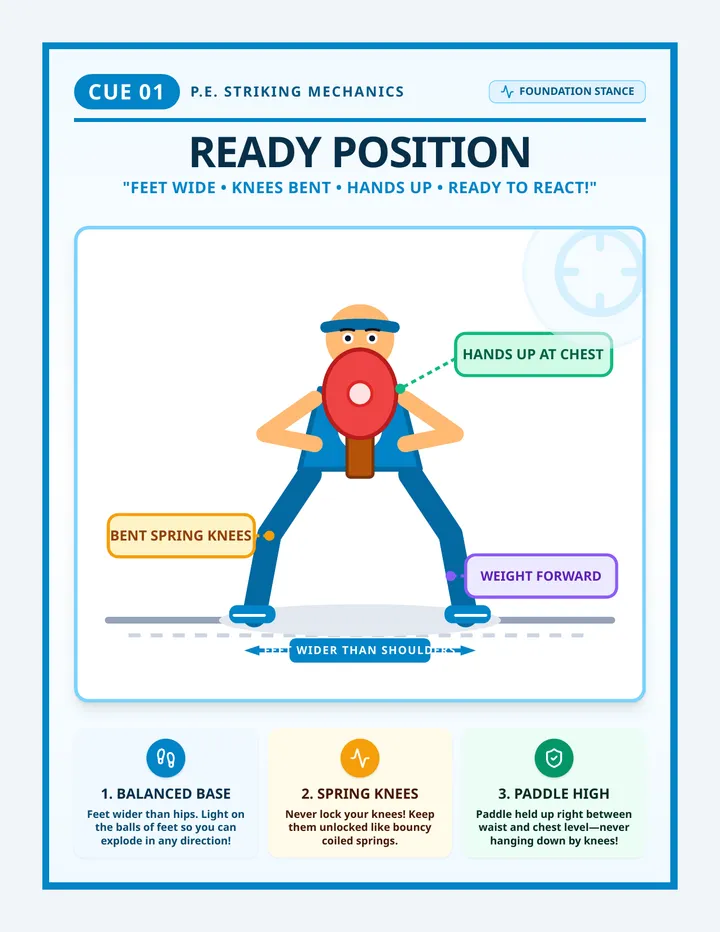
The Ultimate Defensive Stance
1
Low Center
Bend your knees! Stay on the balls of your feet to move quickly.
2
Side-On
Don't stand square. Turn one shoulder toward the sideline to guide the attacker.
3
Arm's Length
Keep about two steps away. Close enough to react, far enough not to be beaten by speed.
Your Mission: The Shadow Drill
Find a partner. One is the Attacker, one is the Shadow.
Attacker dribbles in a zigzag across a 10-meter space.
Shadow must keep their stance and mirror the movement.
Constraint: Shadows are NOT allowed to touch the ball!
Shadowing Teacher Guide The Art of Shadowing
Teacher Facilitation Guide | Lesson 1
Duration 45-60 min
Learning Objectives
Identify and demonstrate the side-on defensive stance.
Apply the concept of 'jockeying' to contain an attacker in a 1v1 scenario.
Explain why patience is a defensive strength.
Inquiry Questions
"If you dive in for the ball and miss, what happens to the space behind you?"
"How does your body angle tell the attacker where they are allowed to go?"
Equipment
1 ball per pair
4 cones per grid
Whistle
Instructional Flow
10
mins
The "Statue" Stance (Warm-up)
Students move randomly in a marked area. On the whistle, they must snap into a defensive stance. Check for: knees bent, weight on balls of feet, one foot slightly ahead of the other (side-on).
Coaching Cue: "Surf the field!" (Like standing on a surfboard).
20
mins
The Shadow Drill
1v1 in a 10x5m channel. Attacker tries to reach the other side. Defender (Shadow) must stay within an arm's length but CANNOT tackle. They just "shadow" the attacker.
Level 1
Slow walking pace. Focus on stance.
Level 2
Jogging pace. Attacker adds feints.
Level 3
Game speed. Guide to sidelines.
15
mins
Containment Challenge
Small-sided games (3v3). Rule: Before a team can tackle, they must "contain" the ball carrier for 3 seconds. If they tackle too early, it's a foul. This forces students to use their stance rather than lunging.
Common Misconceptions
"I have to take the ball to win."
Remind them: Winning is forcing a bad pass or making the attacker stop. Forcing an error is just as good as a tackle.
Standing Square
If feet are parallel, it's easy to get "nutmegged" or beaten on either side. Side-on positioning gives the defender a head start in one direction.
Shadowing Scouting Report Scouting Report: Individual Defense
Name:
Date:
"Good defense starts with the right foundation. How did you stand today?"
Stance Self-Check
Were your knees bent?
Yes
Was your body "side-on"?
Yes
Were you on the balls of your feet?
Yes
Did you stay an arm's length away?
Yes
Tactical Choice
When you were jockeying, which side did you try to force the attacker toward?
Toward the Sideline
Toward my teammates
I didn't think about it yet
Tip: Forcing them toward the sideline takes away half their options!
Game Log & Reflection
The Patience Test
What was the hardest part about *not* trying to take the ball right away?
The "A-HA!" Moment
Describe one time today when your positioning alone made the attacker lose control or turn back.
Dynamic Duos Slides Unit: Defensive Wall
Dynamic Duos
"Defense is a conversation between teammates."
Session 2
If your teammate goes to stop the ball, where is the most important place for YOU to be?
Option A
Right next to them, both tackling at once!
Option B
A few steps behind, covering the space!
The Defensive Roles
1
Pressure
Your job is to get close and Jockey the ball carrier. You are the wall.
"I've got ball!"
2
Cover
Your job is to stay behind and watch the space. If the 1st defender is beaten, you're there.
"I've got your back!"
Talk the Game
The Command
"PRESS!"
Tells your teammate to close down the ball.
The Command
"DROP!"
Tells your teammate to retreat and cover.
The Command
"STEP!"
Both move forward together to shrink space.
2v2 Gauntlet
Winning as a Pair:
Always have a 1st and 2nd defender.
Swap roles instantly when the ball moves.
No silent defenders! Verbalize roles.
Dynamic Duos Comms Sheet Comms Center: Partnership Plays
"Great teams talk. Silent teams lose."
Tactical Voice Commands
"I'VE GOT BALL!"
Role: 1st Defender. You are closing the gap.
"I'VE GOT COVER!"
Role: 2nd Defender. You are watching the space behind.
"SHUT THEM DOWN!"
Instruction to partner to apply more pressure.
"SHIFT RIGHT/LEFT!"
Move together to block a passing lane.
What Would You Say?
Scenario 1
The attacker passes the ball to a second player who is closer to your partner than to you.
What should you shout to your partner?
Scenario 2
Your partner gets beaten by the attacker and the attacker is running toward the goal.
What do you do? What do you say?
Scenario 3
The ball goes far back toward the other team's goalie.
Do you stay where you are or move? What's the command?
The Dynamic Duo Pledge
"I will communicate."
"I will cover your back."
"We defend as one."
Partner 1 Sign:
Partner 2 Sign:
Mastering the Steal Slides Unit: Defensive Wall
Mastering the Steal
"The best defenders don't wait for the ball—they meet it."
Session 3
Can you read minds?
We're going to learn how to "steal" the ball before it even reaches the attacker.
Read the Eyes
Read the Hips
Predict the Lane
The Power of the Interception
Tackling
Waiting for the attacker to have the ball, then trying to take it.
Risk: You might miss and commit a foul.
Interception
Predicting the pass and taking the ball mid-air or mid-roll.
Benefit: Immediate counter-attack!
Reading the Cues
Eyes
Most passers look exactly where they are about to kick.
Plant Foot
Where the non-kicking foot points is where the ball goes.
Timing
Wait for the moment they draw their leg back—that's your cue to SPRINT.
Steal the Show
Game: Interception Alley
Two teams pass the ball across a "No-Man's-Land." One defender stands in the middle.
Deflection = 1pt
Clean Catch/Steal = 5pts
Mastering the Steal Tracker Interception Tracker
Session 3: Reading the Game
Target Steals 5+
Deflections
You touched the ball but didn't keep possession.
1
2
3
4
5
Clean Steals
You intercepted and took control of the ball.
5
10
15
20
25
"Reading"
You predicted a pass correctly (even if you missed it).
Mastering the Cues
Which "Tell" was easiest to read today? Why?
The Passer's Eyes
The Passer's Body Angle
The Attacker's Movement
Explain your strategy for timing your "Steal":
"Anticipation is the difference between reacting and controlling."
The Great Retreat Slides Unit: Defensive Wall
The Great Retreat
"The fastest team isn't the one that runs forward—it's the one that runs back."
Session 4
The "Oh No!" Moment
The moment you lose possession is the most dangerous moment in the game.
Most goals are scored within 5-10 seconds of a turnover.
Switch Instantly!
Rule #1: Get Goal-Side
Wrong Spot
Chasing the attacker from behind. You are out of the play!
[Diagram: Attacker between you and your goal]
Goal-Side
Running back so YOU are between the ball and the goal.
[Diagram: You between attacker and your goal]
The Recovery Run
Straight Back
Sprint toward your own penalty box, not the ball carrier.
Ball Tracking
Look over your shoulder while running. Know where the danger is!
Re-Form Shape
Find your "home" position and get ready to defend as a unit.
Chaos Recovery Drill
The Drill:
Team A is attacking. Team B is defending.
On the whistle, Team A MUST drop the ball and sprint back to their goal.
Team B picks up the ball and counters immediately.
Can you re-form your defensive wall before they score?
Zone Guardians Field Map Field Map: Zone Guardians
"Defend the area, not just the player."
Mapping Your Zone
Zone A
Zone B
Zone C
Zone D
Zone E
Zone F
Our Goal
1. Assign your team to the zones above.
Zones D & F (Sidelines)
Zone E (Central / Goal-side)
Zones A, B, C (Midfield)
Unit Command: "The Baton Pass"
If an attacker moves from Zone D to Zone E, you don't chase them across the field. You pass them to your teammate in Zone E and stay to protect your own zone.
What's the verbal cue for "passing the baton"?
The Zone Guardian Goal
"If we all protect our squares, the attacker has no room to play."
Pressure
Cover
Balance
Zone Guardians Slides Unit: Defensive Wall
Zone Guardians
"Defending as a Unit: The Chess Match of Football."
Session 5: The Finale
The Field is a Chessboard
In zonal defense, you don't follow a person—you protect your square.
Stay in your designated zone.
Communicate when the ball enters your zone.
Support your neighbor's zone.
Organized. Efficient. Unbreakable.
The "Baton Pass"
Ball Moves
The attacker dribbles out of your zone and into your teammate's.
The Shout
"YOURS!"
Alert your teammate they are now the 1st Defender.
Reset
You instantly become the 2nd Defender (Cover).
Total Defense
What have we mastered?
1 Jockeying
2 Pressure & Cover
3 Interception
4 Transition
Final Battle: Zonal Scrimmage
The Objective:
Win the game not by scoring goals, but by neutralizing the attack. If the other team can't get past the midfield, YOU are the winners.
Protect the Goal!
Defensive Wall Skills Rubric Defensive Wall: Skills Rubric
5th Grade PE | Football Defensive Tactics Assessment
Student Name
Class Section
Final Grade
Criteria Developing (1-2) Proficient (3) Exemplary (4) Individual Stance & Jockeying Stands square to attacker; dives in/lunges for the ball frequently. Uses side-on stance and maintains distance; occasionally lunges. Consistently uses low, side-on stance; guides attacker toward sidelines with patience. Pressure & Cover (Partnership) Does not recognize roles; both players chase the ball simultaneously. Identifies 1st/2nd defender roles but slow to switch when ball moves. Seamlessly alternates roles with partner; provides perfect cover distance. Anticipation & Interception Reacts only after the ball is passed; focuses on the person, not the play. Watches the ball and attempts interceptions; reads basic passing lanes. Reads body language/eyes to predict passes; times interceptions to win possession cleanly. Transition (Recovery Run) Stops or walks when ball is lost; stays ball-side rather than goal-side. Runs back quickly but loses track of the attacker or ball location. Sprints to goal-side position immediately on turnover; checks shoulder for threats. Tactical Communication Defends in silence; relies on visual cues only. Uses basic commands ("Ball!", "Stay!") when prompted by teacher. Shouts clear, specific tactical cues ("Press!", "Drop!", "Baton Pass!") independently.
Coaching Feedback
Focus areas for next unit...
Strength
Teamwork
Vision