Healthy people do not just look strong; they make consistent choices. They eat balanced meals, move their bodies, and get enough sleep. Being healthy also includes managing stress and practicing gratitude.
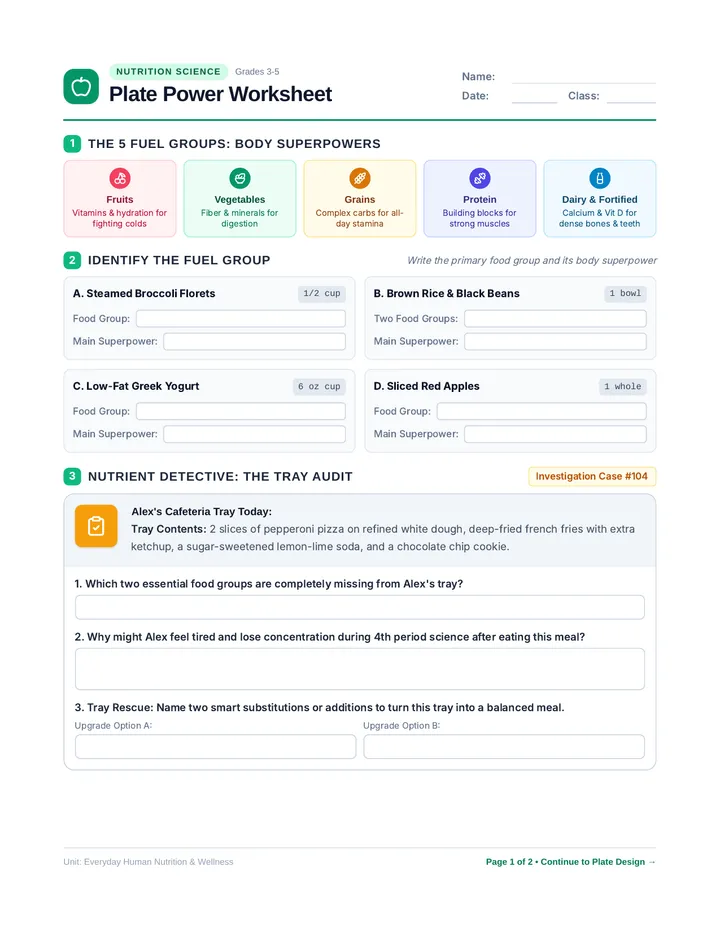
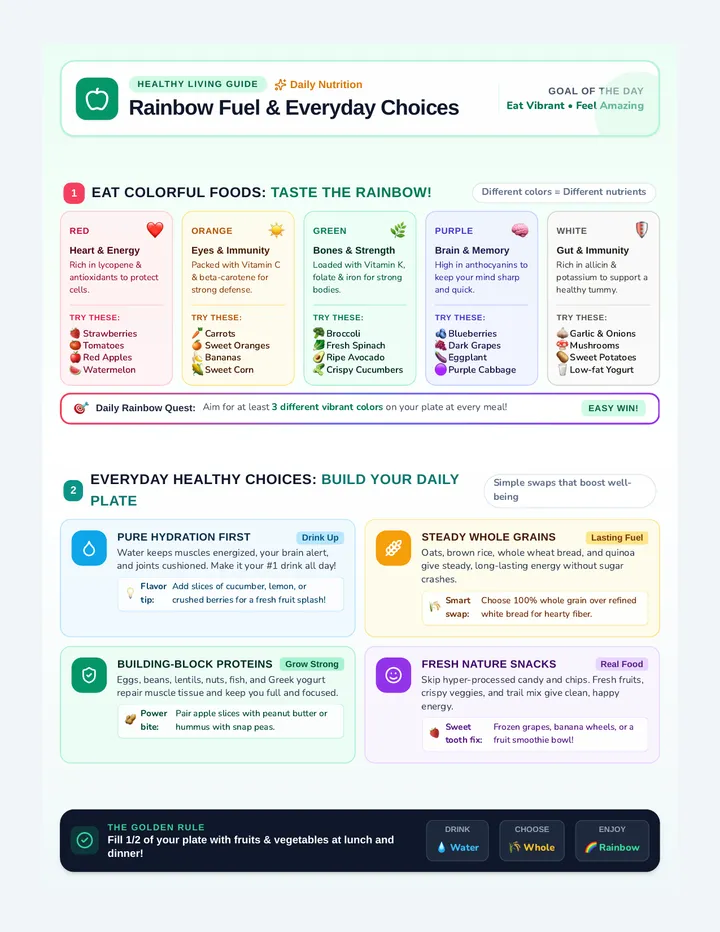
Nutrients are the substances in food that your body uses to build and repair itself. Think of them as your body's building blocks and fuel!
Body Builders
Help us grow and fix cuts.
Energy Givers
Power for our play and brain.
Health Guards
Keep us from getting sick.
I have lots of energy.
I have clear, bright eyes.
I focus easily in class.
My muscles feel strong.
One trait I want to work on is ________ because...
A "Power Food" I can eat to get this trait is ________.
Explorer Goal: I can name things that change what I eat.
We eat for many different reasons! Physical Needs like hunger tell us our body needs fuel. Social Needs mean we eat to spend time with friends or family. Emotional Needs happen when we eat because we feel happy, sad, or bored.
The foods your family eats and the traditions you follow, like "Pizza Friday."
How busy your day is! If you have soccer practice, you might eat a quick snack.
The foods available near your home or school, like grocery stores or restaurants.
How ads and TV make some foods look very exciting to try.
Tell Your Story
1. My Favorite Food Influence:
I really love to eat ________ because my family ________.
2. My Busy Day Choice:
When I am busy with ________, I usually eat ________.
3. My Neighborhood Choice:
I see ________ food near my school. This makes me want to eat it because...
Explorer Goal: I can spot tricks that ads use.
Food companies spend billions of dollars each year to get you to buy their food! They use bright packaging, famous stars, and fun music. Sometimes they even hide their food in your favorite video games or movies!
Bright Colors: Make the box look exciting.
Famous Stars: Make the food look trendy.
Happy Faces: Make you feel like you'll have fun.
Sneaky Spots: Putting items in shows or games.
1. Think of an ad you saw recently. What food was it for?
2. Which trick from the list above did the ad use?
The ad used ________ to get my attention.
3. How did the ad make you feel about the food?
The ad made me feel ________ because ________.
Explorer Goal: I can explain how food and feelings are connected.
Certain foods are linked to comfort and happy memories. The smell of baking cookies might make you feel warm and safe. When we eat these "comfort foods," our brain feels calm!
But sometimes we eat just because we feel sad, stressed, or bored. This is called emotional eating. It is important to have other ways to feel better, like talking to a friend or playing outside.
My Comfort Food:
Why it is special:
Write or draw your memory here!
When I feel sad or stressed, instead of snacks, I can try:
Talk to a trusted adult
Play outside in the sun
Read a fun book
Write in my journal
Sharing a Meal
How does sharing food with friends or family make you feel happy?
Sharing food makes me feel ________ because ________.
Explorer Goal: I can explore food habits and world cultures.
Everyone develops eating patterns over time. This includes how often you eat, how much you eat, and who you eat with. Knowing your habits is the first step to making healthy choices!
How many meals do I eat each day?
Where do I usually eat my dinner?
In some countries around the world, insects are considered a delicious treat! Grasshoppers are eaten in Japan. Grubs are popular in parts of Africa. Ants are used in special dishes in Mexico.
Culture teaches us what is "normal" and safe to eat. Insects are actually very nutritious and full of energy!
Would you ever try a healthy bug snack?
1. Culture
2. Nutrients
3. Tradition
4. Delicacy
A. A special or rare treat.
B. Habits shared by a group.
C. Healthy "power-ups" in food.
D. A long-time way of doing things.
1-____
2-____
3-____
4-____
Explorer Goal: I can summarize what I have learned.
You are a Healthy Me Explorer!
Go!
The most important thing I learned about my body or food is...
I will try to eat ________ because I know it helps my ________.
One way I can help my friends or family be healthy is...
Explorer Certification Signature
Sign Your Name Here!
Certified Healthy Hero
Healthy people make consistent choices. They eat balanced meals to get nutrients. Nutrients are substances in food that your body needs to:
When you eat well, you develop traits of a healthy person, like strong muscles, a happy attitude, and the ability to focus.
Strong bones and muscles
Stable and happy mood
Plenty of energy to play
Able to focus and think
A healthy trait I want to have is ________ because...
To get this trait, I will try to eat ________.
Learning Goal
I can analyze how family, lifestyle, and my home change what I eat.
Writing Goal
I can explain food influences with clear examples.
We eat for many reasons! Physical Needs like hunger tell us our body needs fuel. Social Needs mean we eat to spend time with friends. Emotional Needs mean we might eat because we are sad or bored.
Culture
Traditions and family routines like "Holiday Meals."
Lifestyle
How busy your day is—like eating a snack before practice.
Environment
The foods available near your home or school.
Knowledge
Learning what foods are healthy helps you choose better!
1. Lifestyle:
Because I am usually busy with ________, I often eat ________.
2. Culture & Family:
My family always eats ________ on special days. This makes me feel...
3. Environment:
There is a ________ near my house, so I often choose to eat ________.
Learning Goal
I can identify marketing tricks used to make me want food.
Writing Goal
I can describe marketing tactics in full sentences.
Food companies spend billions to influence what you buy! Marketing is the special plan they use to grab your attention. They use "tricks" like bright colors, catchy music, and cartoon characters to make their food look fun.
Eye-Catching
Loud colors and shiny boxes catch your eye on the shelf.
Famous Friends
Famous stars or characters make food look "cool."
Happy Feelings
Ads show people laughing to make you feel happy.
Placement
Hiding snacks in your favorite TV shows or games.
1. Think of a food ad you saw recently. What made you notice it?
The ad was for ________ and it used ________ to get my attention.
2. Was the food in the ad a healthy choice? Why or why not?
I think the food was ________ because ________.
3. How will you outsmart the ads next time you go shopping?
I will outsmart ads by ________ instead of just buying it.
Learning Goal
I can explain how food connects to my mood and memories.
Writing Goal
I can use descriptive words to talk about food feelings.
Certain foods are linked to comfort and positive memories. For example, the smell of baking cookies might make you feel safe and loved. These are called "comfort foods."
But sometimes we eat just because we feel sad, stressed, or bored. This is called emotional eating. Instead of eating when you feel this way, you can try non-food ways to manage stress, like:
My Comfort Food:
The Story:
Write or draw why this food is special!
When I feel sad or bored, I can try these instead of snacks:
Take 10 deep breaths
Drink a glass of water
Go outside and play
Learning Goal
I can identify my habits and learn about world food traditions.
Writing Goal
I can describe cultural traditions using full sentences.
Habits are patterns you follow over time. These include how often you eat and who you eat with. Complete your pattern check:
How many meals do I eat each day?
Who do I usually eat with?
My favorite food tradition is ________.
In some countries, insects are a delicious treat! Grasshoppers are eaten in Japan. In Mexico, some restaurants serve ant eggs. Culture teaches us what is "normal" to eat. Insects are actually very nutritious!
"Normal" is different everywhere!
Would you ever try a healthy bug snack?
I think ________ because ________.
1. Culture
2. Nutrients
3. Tradition
4. Delicacy
5. Sacred
A. A special or rare treat.
B. Beliefs and habits of a group.
C. Healthy "power-ups" in food.
D. A long-time way of doing.
E. Special or highly valued.
1-____
2-____
3-____
4-____
5-____
Learning Goal
I can summarize my learning and set healthy goals.
Writing Goal
I can write a reflection using full sentences.
Go!
Write one full paragraph about what you learned:
In this unit, I learned that food is ________. It helps me ________. I will try to ________ because...
How can you help your family make healthy choices?
I will help my family by ________ so that we can ________.
Explorer Certification Signature
Sign Your Name Here!
Certified Healthy Hero
Writing Goal
I can list specific nutrients and the jobs they do in my body.
Reading Passages
Healthy people make consistent choices. They eat balanced meals to get nutrients. Nutrients are substances in food that your body uses to build and repair tissues, regulate systems, and supply energy.
Body Builder
Power
Energy Giving
Power
Health Guard
Power
Trait Check-Off
Firm muscles & strong bones
Healthy, shiny hair & skin
Plenty of energy to focus
I can relax and unwind
1. A healthy trait I want to work on is ________ because...
2. To get this trait, I will try to eat foods that have ________.
Explorer Goal
I can analyze how family and habits change what I eat.
Writing Goal
I can give personal examples of food influences using full sentences.
We eat for many reasons! Physical Needs like hunger tell us our body needs fuel. Social Needs mean we eat to spend time with others. Emotional Needs happen when we eat because we are sad, happy, or bored.
Culture
Traditions like special holiday meals or recipes.
Lifestyle
How busy you are—like sports practice snacks!
My Food Story
1. Family Habits:
At my home, we usually eat ________ because it is our family ________.
2. Neighborhood Choice:
There is a ________ near my house, so I often eat ________.
3. Emotions:
When I am feeling ________, I usually choose to eat ________.
Explorer Goal
I can spot the tricks that ads use to sell food to kids.
Writing Goal
I can describe a food ad and how it tried to trick me.
Food companies spend billions to get your attention! Marketing is their plan to sell products. They use bright colors, famous stars, and "sneaky" tricks like hiding snacks in movies or games to make their food look fun.
Bright colors and patterns.
Famous stars and characters.
Showing people having "so much fun!"
Putting toys or gifts inside.
Detective Report
1. Can you think of an ad you saw recently? What made you want the food?
I saw an ad for ________ and it used ________ to get my attention.
2. Was that food actually a healthy choice? Why or why not?
I think it was ________ because ________.
Explorer Goal
I can explain how food connects to my mood and memories.
Writing Goal
I can use descriptive words to talk about my food memories.
Certain foods are linked to comfort and positive memories. For example, the smell of baking cookies might remind you of a happy time at home. These are called "comfort foods." When we eat them, our brain releases chemicals that make us feel calm!
But sometimes we eat just because we are sad, stressed, or bored. This is emotional eating. It is important to have "Heart Helpers" to feel better without snacking!
My Comfort Food:
The Story:
Write or draw why this food makes you happy!
Instead of snacking when I'm bored:
Take 5 deep breaths
Drink a tall glass of water
Go outside and play
Sharing is Caring
How can sharing a healthy meal with friends or family make you feel happy?
Sharing food makes me feel ________ because ________.
Explorer Goal
I can identify my eating habits and learn about world traditions.
Writing Goal
I can compare and describe culture using full sentences.
Everyone has patterns! Identifying your habits helps you choose what to keep and what to change.
How many meals do I eat each day?
Who do I usually eat my meals with?
One food my family loves is ________.
In many countries, insects are a delicious treat! Grasshoppers are eaten in Japan. In Mexico, people enjoy ant eggs. Culture teaches us what is "normal" to eat. Insects are actually very nutritious!
"Normal" is different for everyone!
Would you ever try a healthy bug snack?
I think ________ because ________.
1. Culture
2. Nutrients
3. Tradition
4. Delicacy
5. Sacred
A. A special or rare treat to eat.
B. Beliefs and habits shared by a group.
C. Healthy "power-ups" found in food.
D. A long-time way of doing things.
E. Something special or highly valued.
1-____
2-____
3-____
4-____
5-____
You are officially a Healthy Me Explorer!
Go!
Write one paragraph about how your choices help your body and mind:
In this unit, I learned that food is ________. I found out that my family's traditions ________. Now I will choose to ________ because...
How can you help your friends or family be healthy heroes?
I will help my friends by ________ so that we can both stay ________.
Certification Signature
Sign Here!
Certified Healthy Hero
Body Builders
Repair Cells
Energy Givers
Power Play
Health Guards
Stay Well
Firm muscles & strong bones
Happy attitude & stable mood
Plenty of energy to learn
Healthy teeth & skin
A healthy trait I want to work on is ________ because...
Explorer Goal
I can analyze how family and habits change what I eat.
Writing Goal
I can explain food influences using personal examples.
We eat for many reasons! Physical Needs like hunger tell us our body needs fuel. Social Needs mean we eat to spend time with friends or family. Emotional Needs happen when we eat because we feel happy or stressed.
Culture
Traditions like special family recipes or holiday treats.
Lifestyle
How busy your day is—like grabbing a snack before clubs!
1. Family Tradition:
My family always eats ________ on special days. This is important because...
2. Lifestyle Choice:
When I am very busy with ________, I often eat ________.
Explorer Goal
I can spot tricks that ads use to sell food to me.
Writing Goal
I can describe a food ad and how it tried to trick me.
Food companies spend billions to get your attention! Marketing is their strategy to sell products. They use "tricks" like bright colors, cartoon stars, and fun music. Sometimes they hide snacks in games or movies to make you want them!
Bright
Colors
Famous
Stars
Happy
Faces
Toy
Inside
Detective Report
1. Think of an ad you saw recently. What made you want the food?
I saw an ad for ________ and it used ________ to get my attention.
2. How can you outsmart an ad next time you shop?
I can outsmart the ad by ________ instead of just buying it.
Explorer Goal
I can explain how food connects to my mood and memories.
Writing Goal
I can use descriptive words to talk about my feelings.
Certain foods are linked to comfort and positive memories. The smell of baking cookies might make you feel warm and safe. These are called "comfort foods." When we eat them, our brain releases chemicals that make us feel calm!
But sometimes we eat just because we are sad, stressed, or bored. This is emotional eating. It is important to have other ways to feel better, like talking to a friend or playing outside!
My Comfort Food:
The Story:
Write or draw why this food makes you feel safe!
Instead of snacking when bored:
Take 10 deep breaths
Run around outside
Read a great book
Did you know your nose is connected to the part of your brain that holds memories? Certain smells can instantly make you think of a special person or a fun day!
Choose 2: Chocolate, Cinnamon, Popcorn, Cookies, Grilled Meat.
1. When I smell ________, I remember...
How did you feel? ________________
2. When I smell ________, I remember...
How did you feel? ________________
Explorer Goal
I can identify my own patterns of eating each day.
Writing Goal
I can evaluate my habits and find one thing to improve.
Everyone has eating patterns! These include how often you eat, who you eat with, and where you eat. Knowing your habits is not about judging yourself. It is about gathering info to make healthy choices!
1. How many meals do you eat each day?
2. How many snacks do you eat each day?
3. Where do you usually eat your dinner?
One thing I noticed about my habits is ________. I want to try to...
In many countries, insects are a delicious treat! Grasshoppers are eaten in Japan. In Mexico, people eat special ant eggs. Culture teaches us what is "normal" to eat. Insects are actually very nutritious! Learning about different food traditions helps us build respect for others and their identity.
1. Culture
2. Nutrients
3. Tradition
4. Delicacy
5. Sacred
A. A special or rare treat.
B. Beliefs and habits shared by a group.
C. Healthy "power-ups" in food.
D. A long-time way of doing things.
E. Something special or highly valued.
1-____
2-____
3-____
4-____
5-____
Describe a special meal your family eats for a holiday or celebration:
For ________ we always eat ________ because...
You are a Healthy Me Explorer!
Go!
Write a short paragraph about what you learned in this unit:
Sentence Starter: I learned that food is ________. It helps my body and mind stay ________. Now I will try to ________ because...
How can you help your friends or family stay healthy?
Certification Signature
Sign Here!
Certified Healthy Hero
Intellectual
Keeping your mind active and curious about the world.
Emotional
Understanding, expressing, and managing your feelings.
Activity 2.1
1. In your own words, define "wellness":
2. Use the reading passage to list 3 ways food affects your body:
1
2
3
3. Describe how food affects 3 different factors of wellness (like mood or friendships):
I think food affects ________ because ________.
Learning Goal
I can identify traits of healthy people and explain what nutrients do.
Writing Goal
I can describe healthy traits using complete sentences and appropriate vocabulary.
Healthy people do not just look strong; they make consistent choices. Common traits include eating balanced meals, staying active, and getting enough sleep. A diet is simply the total amount of foods and drinks a person consumes.
Nutrition is the study of nutrients and how the body uses them. Nutrients are essential for growth and energy production. Their key functions include:
Building Power
Creating new cells to help you grow.
Regulating Power
Helping your heart beat and lungs breathe.
Energy Power
Providing fuel for play and mental focus.
Activity 2.2: Trait Check
Check the traits of healthy people you believe you already have:
Strong muscles & bones
Clear, bright eyes & skin
Stable mood & happy feelings
Plenty of energy to play
Choose one trait to improve. Explain why and one step you can take:
I want to improve ________ because... To do this, I will ________.
Learning Goal
I can analyze how culture, family, and my home change what I eat.
Writing Goal
I can explain food influences using complete sentences and personal examples.
There are many things that change what you eat! Physical Needs like hunger tell us our body needs fuel. Social Needs mean we eat to spend time with others. Emotional Needs happen when we eat because we feel happy, sad, or bored.
Culture
Traditions and normal family routines like special holiday meals.
Lifestyle
How busy your day is—like eating a quick snack before practice.
Activity 2.3: Tell Your Story
1. Family Tradition:
Every holiday, my family always eats ________. This is special because...
2. Lifestyle (Your Schedule):
When I am busy with ________, I usually choose to eat ________.
Learning Goal
I can identify marketing tricks used to make me want different foods.
Writing Goal
I can describe a food ad and how it tried to trick me using full sentences.
Food companies spend billions of dollars each year to influence you! Food Marketing is the strategy companies use to sell their products. They want to grab your attention and make you want to buy their foods or drinks.
Common Ad Tricks:
Bright Colors: Eye-catching shiny boxes catch your eye.
Stars: Cartoon stars or famous people make food look "cool."
Happy Faces: Showing people laughing while eating the food.
Sneaky Spots: Hiding snacks in TV shows or video games.
Ad Detective Report
1. Think of an ad you saw recently. What did it make you want to buy?
I saw an ad for ________ and it used ________ to get my attention.
2. How can you outsmart an ad next time you go shopping?
I can outsmart the ad by ________ instead of just buying it.
Learning Goal
I can explain how food connects to my mood, memories, and stress.
Writing Goal
I can use descriptive words to talk about my food feelings and memories.
Certain foods are linked to comfort and positive memories. For example, the smell of baking cookies might remind you of a happy time at home. These are called "comfort foods." When we eat them, our brain releases chemicals that make us feel calm!
However, sometimes we eat just because we feel sad, stressed, or bored. This is called emotional eating. It is important to have "Heart Helpers" to manage your feelings without just reaching for a snack!
My Comfort Food:
The Story:
Write or draw why this food makes you feel safe!
When I feel bored or sad, I can try these instead of snacks:
Take 10 deep breaths
Run and play outside
Drink some cool water
Did you know your nose is connected to the part of your brain that holds memories? Certain smells can instantly make you think of a special person or a fun day! Pick 2 smells from the list below:
Chocolate • Cinnamon • Popcorn • Cookies • Grilled Meat
Activity 2.5 Part 2
1. When I smell ________, I remember...
How did you feel in this memory? ________________
2. When I smell ________, I remember...
How did you feel in this memory? ________________
Explorer Goal
I can identify my own patterns of eating each day.
Writing Goal
I can evaluate my habits and identify one area to improve.
Everyone has eating patterns! These include how often you eat, who you eat with, and where you eat. Knowing your habits is the first step toward improvement.
Identifying patterns does not mean judging yourself! It means gathering info to make healthy choices.
Habit Survey
1. How many meals do you eat each day?
2. How many snacks do you eat each day?
3. Where do you usually eat your dinner?
4. Who do you usually eat with?
One thing I noticed about my habits is ________. I want to try to...
In many countries, insects are a delicious treat! Grasshoppers are eaten in Japan. In Mexico, people eat special ant eggs. Culture teaches us what is "normal" and acceptable to eat. Insects are actually very nutritious!
Learning about different food traditions helps us build respect for others and their history.
Global Bite
Ounce for ounce, many insects have more nutrients than meat!
Vocabulary Match
1. Culture
2. Nutrients
3. Tradition
4. Delicacy
5. Sacred
A. A special or rare treat.
B. Beliefs and habits of a group.
C. Healthy "power-ups" in food.
D. A long-time way of doing things.
E. Something highly valued or special.
1-____
2-____
3-____
4-____
5-____
Describe a special food your family eats for a holiday or birthday:
For ________ we always eat ________ because...
You are officially a Healthy Me Explorer!
Go!
Write a paragraph about what you learned in this unit:
In this unit, I learned that food is ________. It helps my body stay ________. Now I will try to ________ because...
How can you help your friends or family stay healthy heroes?
Certification Signature
Sign Here!
Certified Healthy Hero