Vector Currents Worksheet
AP / Adv Physics Kinematics & Vector Mechanics
Vector Currents & Relative Velocity
Motion in Moving Reference Frames • Galilean Velocity Transformations
Name:
Date: Period:
Subscript Notation & Frame Transformation: For an object \(A\) moving relative to medium \(B\), observed from frame \(C\): \(\vec{v}_{A/C} = \vec{v}_{A/B} + \vec{v}_{B/C}\). In marine navigation: \(\vec{v}_{S/G}\) = Ship rel. to Ground (resultant course/track), \(\vec{v}_{S/W}\) = Ship rel. to Water (engine speed/heading), and \(\vec{v}_{W/G}\) = Water rel. to Ground (current vector).
1 Collinear Flow & Round-Trip Asymmetry (1D Reference Frames)
[6 Points]
A survey vessel operates on a river where the uniform current flows at speed \(v_c\). The ship maintains a constant engine hull speed \(v_s\) relative to the water, where \(v_s > v_c\). The vessel completes a round trip between port A and port B separated by distance \(D\) along the river.
a. Upstream & Downstream Durations:
Express downstream transit time \(t_{down}\), upstream transit time \(t_{up}\), and total time \(t_{tot}\) strictly in terms of \(D, v_s,\) and \(v_c\).
b. Comparison with Still Water:
Let \(t_0 = 2D/v_s\) be the still-water round trip time. Prove algebraically that \(t_{tot} > t_0\) for any non-zero current \(v_c > 0\).
Work & Algebraic Proof
2 Orthogonal River Crossing & The Crab Angle (2D Vector Addition)
[8 Points]
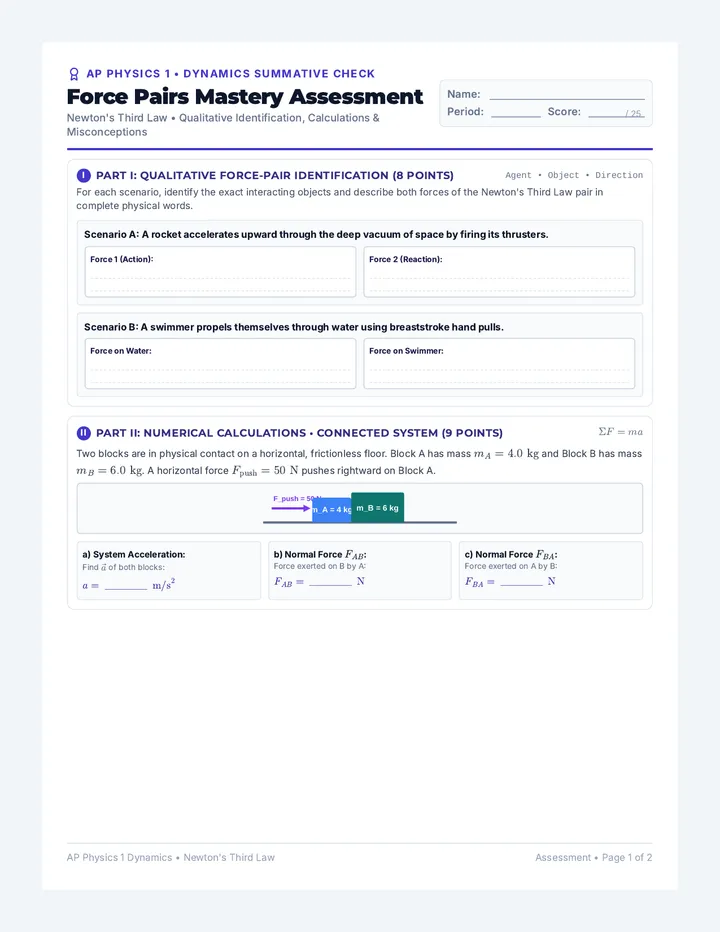
A straight river has a width of \(W = 960\text{ m}\) and flows due east at \(v_{W/G} = 3.60\text{ m/s}\). A research catamaran has a speed in calm water of \(v_{S/W} = 6.00\text{ m/s}\).
Case I — Heading Perpendicular to Bank: Bow points due North across the river. Determine the resultant velocity \(\vec{v}_{S/G}\) (magnitude and direction as an angle \(\alpha\) East of North), crossing time \(\Delta t_1\), and downstream drift distance \(\Delta x\).
Case I Calculations
Case II — Straight-Line Course ("Crabbing"): Navigator aims for a dock directly North across the river (zero downstream drift). Calculate steering angle \(\theta\) (West of North), effective ground speed \(v_{S/G}\), and crossing time \(\Delta t_2\).
Case II Calculations
Physics Mechanics • Relative Velocity • Reference Frames Page 1 of 2
Vector Currents | Advanced Navigation & Moving Reference Frames
Page 2 of 2
3 Open-Water Oblique Vectors: True Track & Ground Speed
[8 Points]
A container ship steers a heading of \(\theta_H = 30.0^\circ\) North of East with engine speed \(v_{S/W} = 16.0\text{ knots}\). An ocean current sets with velocity \(v_{W/G} = 5.00\text{ knots}\) directed at \(45.0^\circ\) South of East. Take \(+x\) as East and \(+y\) as North.
Decompose Components:
- • Ship rel. Water: \(v_{(S/W)x}\), \(v_{(S/W)y}\)
- • Current: \(v_{(W/G)x}\), \(v_{(W/G)y}\)
- • Sum for \(\vec{v}_{S/G} = v_x\hat{i} + v_y\hat{j}\)
Tasks:
Write \(\vec{v}_{S/G}\) in Cartesian unit-vector form \((\hat{i}, \hat{j})\), compute effective speed over ground \(|\vec{v}_{S/G}|\), and find the true course angle relative to East.
Vector Resolution & Resultant Track
4 Kinematic Optimization: Minimum Time vs. Minimum Drift
[8 Points]
A river of width \(W\) flows with velocity \(u\) in \(+x\). A boat has fixed speed \(v\) through water and steers at angle \(\theta\) from the downstream \(+x\) direction (\(0 \le \theta \le \pi\)).
a. Minimum Transit Time:
Derive \(T(\theta)\). Prove which angle \(\theta^*\) minimizes \(T\), and explain why current \(u\) has zero effect on the minimum crossing time.
b. Swift Current Limit (\(u > v\)):
When \(u > v\), zero drift is impossible. Determine the critical steering angle \(\theta_{opt}\) that minimizes downstream drift \(X\), showing \(\cos\theta_{opt} = -v/u\).
Optimization Derivations
5 Reference Frame Transformation: Intercepting a Drifting Beacon
[10 Points]
A cutter at \((0, 0)\) at \(t = 0\) targets a distress raft at \(\vec{r}_0 = (1200\hat{i} + 1600\hat{j})\text{ m}\). The raft drifts unpowered with tidal current \(\vec{v}_{W/G} = (3.0\hat{i} - 1.0\hat{j})\text{ m/s}\). The cutter maintains engine speed \(v_{C/W} = 10.0\text{ m/s}\) relative to water.
Transform to Water Frame \(S'\): In frame \(S'\), the raft is stationary at \(\vec{r}_0\). (a) In \(S'\), what path achieves minimum intercept time? (b) Calculate intercept duration \(\Delta t\). (c) Determine the cutter's ground velocity \(\vec{v}_{C/G}\) during transit.
Reference Frame Solution & Vector Synthesis
Physics Mechanics • Relative Velocity • Reference Frames Total: 40 Points