🩹 Self-Repair: How your skin and tissues heal after an injury
Greek root words: Bio (Life) + Logy (Study of).
💡 Characteristics of Life
6 Must-Have Traits
From single bacteria to trillions of cells in humans.
Ex: Bacteria multiplying
Eating food, absorbing nutrients, or photosynthesis.
Ex: Plants absorbing solar rays
Transforming from baby to adult, seed to giant tree.
Ex: Acorn growing into an oak
Reacting to light, sound, heat, danger, or touch.
Ex: Plant bending toward sunlight
Creating offspring sexually or asexually to continue life.
Ex: Cell division & seeds
Maintaining internal balance (temperature, hydration, pH).
Ex: Sweating when overheating
To be considered alive, an organism MUST have ALL six characteristics!
🔬 Cell Theory
Smallest Living Unit
1
Cell Membrane Outer barrier controlling what enters and exits
2
Cytoplasm Jelly-like fluid where chemical reactions happen
3
Genetic Material (DNA / RNA) Biological instructions for growth & function
Unicellular
One cell performs all life functions independently.
Examples: Bacteria, Amoeba, Yeast
Multicellular
Billions of specialized cells work together.
Examples: Trees, Humans, Animals, Fungi
Cells are the smallest structures capable of performing every function of life.
🧫 Cell Classification
Prokaryote vs. Eukaryote
Simple
No nucleus (DNA floats freely)
Simple, smaller internal structure
Almost always single-celled
Example: Bacteria & Archaea
Analogy: "Open studio floor plan"
Complex
Has a nucleus storing DNA
Many organelles (mitochondria, etc.)
Single or multicellular
Examples: Plants, animals, fungi
Analogy: "House with specialized rooms"
Memory trick: Pro = NO nucleus • Eu = DO have a nucleus!
🧬 Genetics
Blueprint of Life
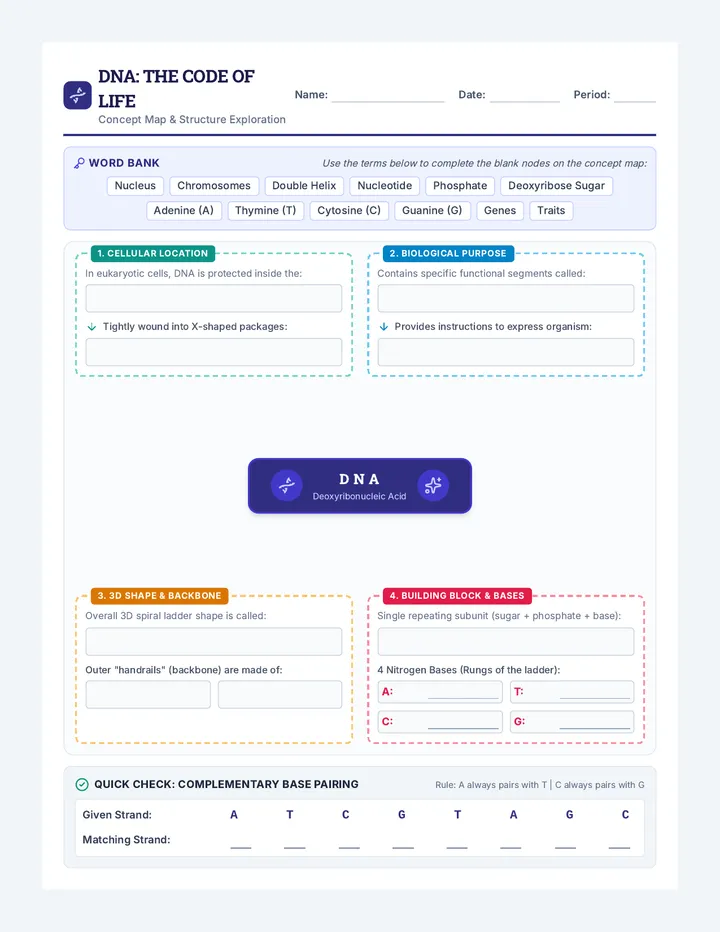
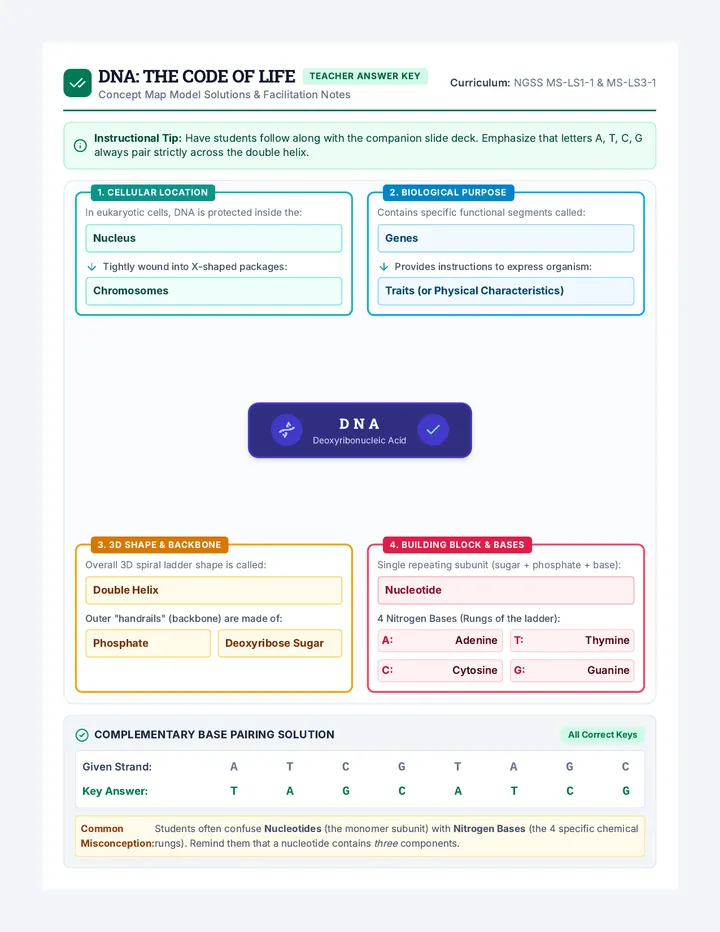
DNA (Deoxyribonucleic Acid) is the chemical molecule containing every instruction a cell needs to live.
Shaped like a Double Helix (twisted ladder)
Protected inside the Nucleus
Instructs cells when to divide and what tissues to create.
Codes for eye color, leaf shape, height, and biological functions.
Guides protein production and healing. Mutations introduce trait variations.
Genes are distinct sections of DNA that code for specific physical and cellular traits!
🧩 Biological Hierarchy
Life builds upward in scale from microscopic units to the entire planet:
1
Muscle cell
2
Muscle tissue
3
Heart
4
Circulatory
5
Human
6
Humans in city
7
Humans + wildlife
8
Living + nonliving
9
All Earth life
Example: Muscle cell → Muscle tissue → Heart → Circulatory system → Human → Ecosystem → Biosphere
🧠 Key Terminology
Study Cards
Biology
The scientific study of all living organisms.
Cell
The smallest fundamental unit capable of life.
Organism
Any individual living thing (plant, animal, microbe).
Homeostasis
Maintaining stable, balanced internal conditions.
DNA
Molecule that stores genetic code and blueprints.
Nucleus
Cell organelle that protects eukaryotic DNA.
Tissue
A group of similar cells working together.
Ecosystem
Community of living things interacting with environment.
Make sure these key terms and definitions are written in your notes!
🎯 Check for Understanding
Exit Ticket
Question 1
A) Uses energy
B) Made of cells
C) Has DNA / Genetic code
D) Made of metal
Question 2
In your own words, why is “made of metal” not a characteristic of life?
Guidance: Think about non-living objects (like cars or robots) vs. biological living cells and cellular processes.
Turn and discuss your answers with your shoulder partner! Lesson Complete
🚲 Rusting: Iron reacts with oxygen to form iron oxide
🎆 Fireworks: Different metal salts produce brilliant colors
Chemistry explains everything you touch, breathe, eat, and use every day!
🔸 The Physical World
Has Mass + Takes Up Space
Definite shape & volume
Particles are tightly packed and vibrate in place.
Examples: Ice, rocks, metal desk
Definite volume, takes shape
Particles slide and flow smoothly past each other.
Examples: Water, fruit juice, melted wax
No fixed shape or volume
Particles move freely at high speed to fill space.
Examples: Oxygen, steam, helium
Bonus State: Plasma (super-energized charged gas found in lightning, stars, and neon signs). Solids, Liquids, and Gases form the core 3 states!
⚛️ Atomic Structure
Subatomic Particles
Protons (Positive +) Located in the center nucleus; identifies element
0
Neutrons (Neutral 0) Located in the nucleus; adds stability & mass
–
Electrons (Negative –) Orbiting outer cloud; drives chemical bonding
Atoms link through shared electrons to build molecules, which join to form compounds.
Atoms = Letters (H, O, C)
Molecules = Words (H₂O, CO₂)
Compounds = Sentences (Salt, Sugar)
The number of protons in an atom’s nucleus determines which element it is!
🧪 Types of Substances
Pure vs. Blended Matter
Pure Substance
Made of only one type of atom. Cannot be broken down chemically.
Examples:
• Gold (Au) • Oxygen (O₂)
• Carbon (C) • Iron (Fe)
Chemically Bonded
Two or more elements bonded together with brand new properties.
Examples:
• Water (H₂O) • Salt (NaCl)
• Carbon Dioxide (CO₂)
Physically Blended
Substances mixed together without bonding. Can be separated physically.
Examples:
• Salad • Trail mix
• Air • Saltwater
Homogeneous mixtures (smooth, like juice) vs. Heterogeneous (uneven, like cereal in milk).
🔥 Transforming Matter
Recognizing Change Clues
Same Substance
Matter changes its shape, size, or physical state, but keeps its chemical identity!
Melting ice → still liquid water (H₂O)
Tearing paper → smaller pieces of paper
Dissolving sugar → sweet water mixture
Key Clues: Change in state (freeze/melt), size, or shape.
New Substance
Atoms rearrange bonds to create brand new substances with new properties!
Burning wood → ash, smoke & gases
Rusting metal → reddish iron oxide
Baking a cake → heat creates new food bonds
5 Clues: Color change • Gas bubbles • Temp change • New odor • Light
Ask yourself: "Can I easily undo this, or was a brand new substance formed?"
🧩 Chemical Map
118 Known Elements
6 C
Carbon 12.011
6 = Atomic Number (Protons in nucleus)
C = Chemical Symbol (Abbreviation)
Metals (~75% of table) Shiny, malleable, conduct electricity & heat
Iron, Gold, Copper
Nonmetals Gases or brittle solids, poor conductors
Oxygen, Carbon, Sulfur
Noble Gases (Group 18) Completely stable, unreactive gases
Helium, Neon, Argon
Reactive Alkali & Halogens Eager to bond rapidly with other elements
Sodium (Na) + Chlorine (Cl)
Elements are organized by increasing atomic number from left to right!
🧠 Core Terminology
Study Reference
Matter
Anything having mass and taking up volume space.
Atom
Smallest fundamental unit of a chemical element.
Element
Pure substance made of only one atom species.
Molecule
Two or more atoms bonded chemically.
Compound
Substance formed of two+ distinct elements.
Mixture
Physical blend of substances without bonding.
Chemical Reaction
Process where substances form new bonds.
Periodic Table
Organized chart of all 118 known elements.
Review these terms regularly to prepare for chemical equations!
🎯 Check for Understanding
Exit Ticket
Question 1
A) Melting ice into liquid water
B) Breaking a glass bottle
C) Burning a sheet of paper
D) Boiling water into steam
Explain Why
Burning paper creates completely new substances: ash, carbon smoke, and released gases that cannot be turned back into paper!
Remember the 5 Clues:
• Flame produced heat & light • Ash left behind (new color/substance) • Smoke & odor released!
Compare your answer and explanation with your table partner! Chemistry Deck Complete
Step 3: Geosphere
Rainwater soaks into rocks and ____________ to replenish aquifers.
Step 4: Biosphere
Plant ____________ absorb moisture from the soil to grow.
Describe how one volcanic event causes chain reactions across all four spheres:
Geosphere: Magma erupts through Earth's crust releasing lava and ________________.
Atmosphere: Ash and gases enter the air, blocking ____________ and cooling climate.
Hydrosphere: Ash falls into rivers and lakes, altering water ____________ and purity.
Biosphere: Forests are impacted, but volcanic ash later makes soil very ____________.
1. Natural Hazards: Helps us predict earthquakes, hurricanes, and ___________________.
2. Water Resources: Ensures clean drinking water and manages ____________________.
3. Protecting Earth: Guides conservation and sustainability for future _________________.
Exit Ticket Reflection: Local Sphere Interaction
Describe one example of an interaction between two different Earth spheres that you have seen near your school or neighborhood:
Earth Systems Explorer Guided Notes Page 2 of 2 • Completed Notes
• Complexity: Has organelles (mitochondria, etc.)
• Cellularity: Single or ___________________ (multi-celled)
• Examples: Plants, animals, ____________________
• Analogy: "House with specialized rooms"
• Shape: Twisted ladder called a ______________ ____________.
• Genes: Sections of DNA that code for ____________.
• Mutations: Changes in DNA code that create variation.
Fill in the missing organizational steps:
Cell → ____________ → Organ → Organ System → ____________
→ Population → ____________ → Ecosystem → Biosphere
Homeostasis: ____________________________________________
Organism: _______________________________________________
Tissue: _________________________________________________
Nucleus: ________________________________________________
Quick Check Exit Ticket
1. Which of the following is NOT a characteristic of life? (Circle one):
[ Uses energy ] [ Made of cells ] [ Made of metal ] [ Reproduces ]
2. In one sentence, explain why non-living metal objects are not considered alive:
Intro to Biology Guided Notes Page 2 of 2 • Completed Handout
Changes form, size, or state, but NOT identity!
Clues: Melting, freezing, cutting, dissolving.
Example: Melting ice → ____________________
Bonds break and rearrange to create a NEW substance!
5 Clues: Color change, Gas/bubbles, Temp, Odor, Light.
Example: Burning paper → ___________________
Atomic # (Protons): ______ C Carbon (Element Name)
Periodic Table Families:
• Metals: Shiny, malleable, and conduct ________________ and heat.
• Nonmetals: Dull solids or gases; poor conductors.
• Noble Gases: Highly stable and completely _________________.
Quick Check Exit Ticket
1. Circle the CHEMICAL change: [ Melting ice ] [ Breaking glass ] [ Burning paper ] [ Boiling water ]
2. Explain why your choice is a chemical change using at least two clues:
Intro to Chemistry Guided Notes Page 2 of 2 • Completed Handout
Winds cause clouds to condense / cool.
Step 2: Hydrosphere
Water falls as liquid precipitation / rain.
Step 3: Geosphere
Rain soaks into rocks and soil / sediment.
Step 4: Biosphere
Plant roots absorb moisture to grow.
Geosphere: Magma erupts through Earth's crust releasing lava and pulverized rock / ash.
Atmosphere: Ash and gases enter the air, blocking sunlight and temporarily cooling climate.
Hydrosphere: Ash falls into rivers and lakes, altering water acidity / chemistry.
Biosphere: Forests are impacted, but volcanic ash later makes soil very fertile / nutrient-rich.
1. Natural Hazards: Predict earthquakes, hurricanes, and floods/tsunamis.
2. Water Resources: Ensures clean water and manages droughts.
3. Protecting Earth: Guides sustainability for future generations.
Exemplar Exit Ticket Response & Rubric
Sample Student Answer (Full Credit):
"During heavy rains, water (hydrosphere) washes topsoil (geosphere) into our local creek, which makes the water murky and affects fish breathing (biosphere)."
Grading Criteria: Student correctly names 2 distinct spheres and describes a clear cause-and-effect relationship.
TEACHER ANSWER KEY • Earth Science Page 2 of 2
Complex
• Nucleus: HAS a nucleus (stores & protects DNA)
• Complexity: Organelles (mitochondria, vacuoles)
• Cellularity: Single or multicellular
• Examples: Plants, animals, fungi, protists
• Analogy: "House with specialized rooms"
• Shape: Double helix (twisted ladder)
• Genes: Code for inherited physical traits.
• Mutations: DNA changes producing trait variation.
Cell → Tissue → Organ → Organ System → Organism
→ Population → Community → Ecosystem → Biosphere
Homeostasis: Maintaining stable, balanced internal state
Organism: Any individual living thing
Tissue: A group of similar cells working together
Nucleus: Organelle that protects eukaryotic DNA
Exit Ticket Key & Rubric
1. Correct Answer: [ Made of metal ] is NOT a characteristic of life.
2. Sample Explanation (Full Credit):
"Metal objects are non-living materials because they are not made of biological cells, do not grow, reproduce, or maintain homeostasis."
TEACHER ANSWER KEY • Biology Page 2 of 2
Two+ elements chemically bonded.
Has brand new properties.
Ex: Water (H₂O), Salt (NaCl)
Mixture
Substances physically blended.
Can be separated physically.
Ex: Salad, Air, Trail mix
Changes state or shape, but retains chemical identity.
Ex: Melting ice → still liquid water (H₂O)
Bonds rearrange to produce brand new substances.
Ex: Burning paper → ash, smoke & released gases
Atomic # (Protons): 6 C Carbon (Element Name)
Periodic Table Families (Key Answers):
• Metals: Shiny, malleable, and conduct electricity and heat.
• Nonmetals: Dull solids or gases; poor conductors.
• Noble Gases: Highly stable and completely unreactive / inert.
Quick Check Solutions & Rubric
1. Correct Answer: [ Burning paper ] is a chemical change.
2. Sample Explanation (Full Credit):
"Burning paper is a chemical change because heat and combustion produce new substances (ash, smoke, carbon dioxide gas) and it cannot be reversed back into paper."
TEACHER ANSWER KEY • Chemistry Page 2 of 2