Evolution Assessment QuizMission Assessment Unit 01: Evolution & Selection Candidate: Section I: Critical Choice 1. Which of the following is the best definition of "Fitness" in an evolutionary sense? A. The physical strength and speed of an organism. B. The ability to survive and produce offspring. C. The amount of exercise an animal gets in the wild. D. The size of an organism's home range. 2. A bird wing and a bat wing have similar bone structures but different flight patterns. This is an example of: A. Analogous structures B. Homologous structures C. Vestigial structures D. Convergent evolution 3. Natural selection acts directly on which of the following? A. Genotypes B. Phenotypes C. DNA sequences D. Mutations Section II: Data Synthesis 4. Explain how a population of antibiotic-resistant bacteria develops over time when exposed to penicillin. 5. Why is Genetic Variation essential for the survival of a species in a changing environment? Section III: Evidence Analysis 6. How does Biogeography (the study of where species live) provide evidence for evolution? 7. If two species share 98% of their DNA, what can we conclude about their relationship? 8-9. Mechanism Breakdown Define Speciation and list two types of isolation that can lead to it. Definition: Types: 1. ________ 2. ________
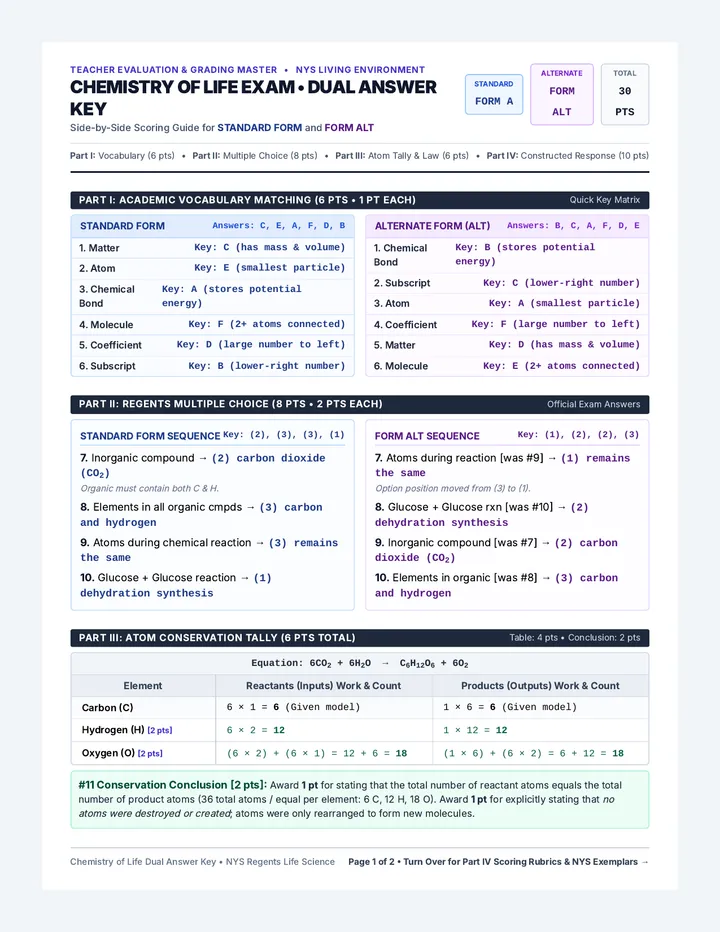
Biology Recovery Answer KeyAnswer Key Teacher Resource | Recovery Sprint 01: Evolution & Selection Vocab: 1-B, 2-D, 3-A, 4-C Anatomy: Q1=Shared common ancestor. Q2=Analogous have same function but different structure/ancestry. Quiz: 1-B, 2-B, 3-B, 4-Antibiotic resistance through selection, 5-Variation allows adaptation. Quiz Cont: 6-Shows how species are distributed, 7-Closely related, 8-Speciation: formation of new species, 9-Geographic/Behavioral isolation. 02: Systems Synergy Body Scenario: A=Respir/Circ, B=Digest/Circ, C=Nervous/Musc, D=Endo/Circ. Plants: Xylem=Water, Phloem=Sugar. Stamen=Male, Pistil=Female. Quiz: 1-B, 2-B, 3-B, 4-Sweat/vasodilation, 5-Prevent water loss. Quiz Cont: 6-Nutrients absorbed then transported, 7-Gravitropism (roots find water), 8-Human: Hormones trigger reproduction, 9-Plant: Phloem feeds seeds. 03: Defense Protocols Virus Table: Bac: Cellular, Virus: Host-req, Bac: Antibiotics, Virus: Vaccines. Immunity: 1st=Skin, 2nd=Inflammation, 3rd=Specific T/B cells. Quiz: 1-B, 2-C, 3-B, 4-Non-specific vs Specific, 5-Memory cells. Quiz Cont: 6-Surface marker match, 7-Destroy infected cells, 8-Helper T-cells coordinate immune response; HIV kills them. 04: Cellular Machinery Transport: Hypertonic=Shrink, Hypotonic=Swell. Active=ATP required. Genetics: Non-disjunction=failed separation. Substitution=Point, Deletion=Frameshift. Quiz: 1-B, 2-B, 3-B, 4-Size-based separation, 5-Cut DNA at specific sites. Quiz Cont: 6-Frameshift changes all codons after error, 7-Plasmids/Recombinant DNA, 8-Endo=In, Exo=Out (Active).
Evolution Evidence Lab SheetClues of the Past Recovery Mission 11: Evolutionary Evidence Name: Mission Brief: Fossil & Anatomy Files Scientists use multiple lines of evidence to reconstruct the history of life on Earth. Comparative Anatomy, Embryology, and the Fossil Record all provide clues about common ancestry and how species have adapted to their environments over millions of years. 1. Homologous vs. Analogous Bird Wing & Bat Wing Share a common bone structure from a common ancestor, but look different externally. Type: Homologous Bird Wing & Insect Wing Both used for flight, but have completely different internal structures and origins. Type: Analogous 2-4. Data Interpretation 02. Fossil Layers In an undisturbed rock sequence, the Law of Superposition states that the oldest fossils are found where? 03. Comparative Embryology Why do human embryos, fish embryos, and chicken embryos all have gill slits and tails early in development? 04. Vestigial Structures Whales have tiny, non-functional hip bones inside their bodies. What does this suggest about their land-dwelling ancestors? 5-9. Molecular Sequence Lab The table below shows a portion of the DNA sequence for a specific protein in four different species. SpeciesDNA SequenceDifferences from HumansHumanA-T-G-G-C-C-T-A-G-ChimpanzeeA-T-G-G-C-C-T-A-CMouseA-T-G-C-G-C-T-T-GFruit FlyA-G-T-C-G-T-T-T-G 05. Which species is most closely related to humans based on this DNA evidence? 06. Which species shared a common ancestor with humans the longest time ago? 07. Why is Molecular Evidence (DNA/Proteins) considered more reliable than Anatomical Evidence (physical traits)? 08-09. Define Convergence. How does it explain why a dolphin (mammal) and a shark (fish) have similar body shapes despite not being closely related?
Evolution Recovery GuideEvolution Recovery Mission 01: Change Over Time Name: Mission Brief: Natural Selection Evolution is the process by which populations change over time. The primary mechanism for evolution is Natural Selection, proposed by Charles Darwin. This process occurs because individuals with favorable adaptations—traits that increase fitness—are more likely to survive and reproduce. For natural selection to occur, four conditions must be met: 1) Overproduction of offspring, 2) Genetic variation within the population, 3) Struggle for survival (limited resources), and 4) Differential reproduction (some survive better than others). 1-2. Key Terminology Fitness Adaptation A. A trait that increases an organism's ability to survive and reproduce. B. The ability of an individual to survive and produce fertile offspring. 3. Natural Selection in Action Scenario: A population of dark and light moths lives in a forest. After a factory opens nearby, the trees become covered in dark soot. Dark moths are now harder for birds to see. What will happen to the moth population? Which trait is the adaptation? 4-6. Evidence of Evolution 04 How do Fossils provide evidence that species have changed over time? 05 Contrast Homologous and Analogous structures. Which one suggests a common ancestor? 06 Why is DNA/Molecular evidence considered the most reliable for determining relationships between species? 7-9. Population Change 07. Vestigial Structures that lost their function but remain (e.g., pelvic bone in whales). What do they reveal? 08. Speciation Define the process of creating a new species: 09. Gene Pool If a population's gene pool changes, has evolution occurred?
Plant Systems Recovery GuidePlant Power Recovery Mission 06: Botanical Systems Name: Mission Brief: Flora Function Plants are complex organisms with specialized tissues that handle transport, reproduction, and regulation. Like humans, they have systems that must interact to ensure survival. From the microscopic stomata in leaves to the long-range transport of the vascular system, every part plays a role in homeostasis. 1. The Plumbing System Xylem Transports water and minerals from the roots to the leaves. One-way flow. What would happen if xylem was blocked? Phloem Transports glucose (sugar) from leaves to the rest of the plant. Two-way flow. Where is the sugar produced? 2. Reproductive Strategy Flower Structure Describe the role of the Stamen (Male) and Pistil (Female) in plant reproduction. Stamen: Pistil: 3-5. Gas Exchange & Water Loss The Stomata are microscopic pores on the underside of leaves guarded by Guard Cells. 03. Gas Entry Which gas must enter for photosynthesis? 04. Transpiration Define the loss of water vapor from leaves: 05. Guarding Why would guard cells close stomata on a hot day? 6. Response to Stimuli Define each Tropism and explain how it helps the plant survive: Phototropism Gravitropism Thigmotropism 7-9. Systems Working Together 07. Transport & Reproduction How does the Vascular system (specifically phloem) support the Reproductive system (forming fruits/seeds)? 08. Regulation & Transport How do the Dermal system (stomata) and Vascular system (xylem) work together to maintain water balance? 09. Hormones & Response Plants use hormones like auxin to trigger growth responses. Which system transports these hormones to different parts of the plant?
Systems Assessment QuizMission Assessment Unit 02: Plant & Body Systems Candidate: Section I: System Interplay 1. Which two systems work together to transport oxygen from the atmosphere to the body's tissues? A. Digestive and Respiratory B. Respiratory and Circulatory C. Circulatory and Excretory D. Endocrine and Muscular 2. In plants, the vascular tissue responsible for transporting glucose (sugar) from leaves to roots is: A. Xylem B. Phloem C. Stomata D. Dermal 3. Which system is responsible for the production of hormones that regulate long-term processes like growth? A. Nervous B. Endocrine C. Immune D. Integumentary Section II: Homeostasis 4. Explain how the Nervous and Integumentary systems work together to cool the body down when it gets too hot. 5. Describe the function of Guard Cells in a plant and why they might close the stomata during a drought. Section III: Synergy Analysis Question 06 How do the Digestive and Circulatory systems interact to provide energy to your muscle cells? Question 07 Plants respond to gravity by growing roots downward. What is this response called, and how does it help the plant? Questions 08-9 Identify one way the Reproductive system in humans interacts with the Endocrine system, AND one way the Vascular system in plants interacts with the Reproductive system (flowers/fruits). Human Interaction: Plant Interaction:
Body Systems Recovery GuideBody Systems Recovery Mission 05: Human Harmony Name: Mission Brief: Integrated Systems Human body systems do not work in isolation. Every action, from running to digesting a meal, requires multiple systems to communicate and collaborate. Failure in one system often leads to a chain reaction affecting the entire organism. Homeostasis is the ultimate goal of these interactions. 1. Interaction Identification Identify the two primary systems working together in each scenario: A. Oxygen is taken into the lungs and transported to muscle cells. B. Nutrients are absorbed in the small intestine and moved to the liver. C. A reflex causes a hand to pull away from a hot stove instantly. D. Hormones are released to trigger the "fight or flight" response. 2. Homeostasis Control ProcessHow the Body RespondsSystems InvolvedBody temp risesBlood sugar drops 3. Feedback Loops Contrast Positive and Negative Feedback Loops. Provide one biological example for each. Negative Feedback Positive Feedback 4. Nutrient Transport & Waste Removal How do the Digestive, Circulatory, and Excretory systems collaborate to provide nutrients and remove metabolic waste? What would happen to the muscular system if the respiratory system failed to provide enough oxygen? Systems Pulse Check 05 Which system is responsible for producing red blood cells within the bone marrow? 06 How does the Integumentary system provide the first line of defense for the Immune system? 07 Describe the role of the Endocrine system in regulating long-term growth and development. 8-9. Critical Synthesis Case Study: A marathon runner is 20 miles into a race on a hot day. They are sweating heavily, breathing rapidly, and their heart rate is at its maximum. Question 08 Explain how the Circulatory and Respiratory systems are working together to keep the runner's muscles functioning. Question 09 How does the Nervous system detect the rise in body temperature and trigger the sweat response (Integumentary)?
Virus Recovery GuideViral Invasion Recovery Mission 07: Microscopic Malware Name: Mission Brief: The Non-Living Threat Viruses are not considered living organisms because they cannot reproduce on their own, do not grow, and do not process energy. They are essentially genetic material (DNA or RNA) wrapped in a protein coat. To survive, they must hijack a living host cell. 1. Anatomy of a Virus Label and define the two main parts of a virus: Capsid: Genome: 2. Virus vs. Cell Check the box if the characteristic applies to a Virus or a Bacterium. CharacteristicVirusBacteriumConsists of a single cell | | Contains genetic material (DNA/RNA) | | | | Treated with antibiotics | | | | Requires a host cell to reproduce | | | 3-5. Cycles of Infection Lytic Cycle "The Rapid Destroyer" 03. What is the immediate result of the lytic cycle? 04. Does the host cell survive? Lysogenic Cycle "The Stealthy Sleeper" 05. What happens to the viral DNA in this cycle? Bonus: What can trigger a lysogenic virus to enter the lytic cycle? 6. Target Acquisition Viruses use surface glycoproteins (spikes) to attach to host cells. Explain the "Lock and Key" mechanism between a virus and a host cell receptor. 7-9. Defense and Mutation 07. Retroviruses HIV is a retrovirus. What enzyme does it use to turn RNA into DNA? 08. Vaccines How do vaccines prevent viral infections? 09. Mutation Why must we get a new flu shot every year?
Immunity Recovery GuideImmune Defense Recovery Mission 08: Biological Shield Name: Mission Brief: Defense Layers The human immune system is a multi-layered defense network. It must distinguish between "self" and "non-self" (pathogens). From physical barriers to specialized cells that "remember" previous invaders, the system works 24/7 to maintain homeostasis and protect against infection. 1. The Defense Perimeter Complete the table for the body's three lines of defense: LevelDescriptionExample1st LineNon-specific physical & chemical barriers.2nd LineNon-specific internal responses (Inflammation).3rd LineSpecific immunity targeting unique pathogens. 2. Tag and Attack Antigen A protein marker on the surface of a pathogen that triggers an immune response. Sketch a simple antigen-antibody match: Antibody Y-shaped proteins produced by B-cells that bind to antigens to "tag" them for destruction. How do antibodies "remember" a virus? 3-5. The Cell Squad B 03. B-Lymphocytes (B-Cells) Role: Produce antibodies in the humoral response. T 04. Helper T-Cells Role: The "Generals" that coordinate the immune response. K 05. Killer T-Cells (Cytotoxic) Role: Directly destroy infected host cells. 6. Speed of Response When you are exposed to a pathogen for the second time, why is the immune response much faster and stronger? Think: Memory Cells "The first time we fight, we learn. The second time we fight, we win before the invader can settle." 7-9. Defense Strategy 07 How does the Circulatory system assist the Immune system during an infection? 08 What is the difference between Active Immunity (vaccines/getting sick) and Passive Immunity (breast milk/rabies shot)? 09 Why is it dangerous for a person with HIV to have a suppressed Helper T-cell count?
Defense Assessment QuizMission Assessment Unit 03: Virus & Immunity Candidate: Section I: Viral Dynamics 1. Which viral replication cycle results in the immediate destruction of the host cell? A. Lysogenic Cycle B. Lytic Cycle C. Mitotic Cycle D. Nitrogen Cycle 2. A virus is NOT considered living because it lacks which of the following? A. Genetic material B. A protein coat C. The ability to reproduce independently D. Chemical components 3. Antibodies are produced by which type of immune cell? A. Helper T-cells B. B-cells C. Red blood cells D. Platelets Section II: Immune Response 4. Contrast the first and second lines of defense in the human body. Provide one example for each. 5. Why do vaccines provide long-term protection against certain viral diseases like polio or measles? Section III: Strategic Defense Question 06 How does a virus use glycoproteins to enter a specific host cell? Question 07 Describe the role of Killer T-cells in the immune response. Questions 08-9 Explain how HIV disrupts the immune system by targeting Helper T-cells. Why does this make secondary infections so dangerous?
Karyotypes Recovery GuideGenetic Blueprints Recovery Mission 09: Karyotypes & Mutations Name: Mission Brief: Chromosome Decoding A karyotype is a visual map of all the chromosomes in a cell, arranged by size and number. This tool allows scientists to identify chromosomal disorders caused by non-disjunction (failure of chromosomes to separate properly). Additionally, small-scale mutations in the DNA sequence can lead to major changes in an organism's traits. 1. Karyotype Map Reading 1 2 3 4 5 21 XY Patient Sample B-22 A. Is this patient male or female? How do you know? B. Identify the abnormality at pair 21. What is this disorder called? 2. Meiotic Errors Explain the process of Non-Disjunction. How does it result in gametes with too many or too few chromosomes? "Chromosomes failed to separate" 3-5. DNA Level Mistakes 03. Substitution One base is swapped for another (e.g., A → G). Commonly called a point mutation. 04. Insertion An extra base is added to the sequence. Causes a frameshift. 05. Deletion A base is removed from the sequence. Causes a frameshift. 6. Impact Assessment Why are frameshift mutations (insertion/deletion) generally more harmful than point mutations? 7-9. Mutagens & Inheritance 07 List two environmental mutagens that can increase the rate of DNA damage. 08 For a mutation to be passed on to offspring, must it occur in somatic (body) cells or gametes (sex) cells? 09 Describe a "Silent Mutation." How can a DNA base change occur without changing the protein?
Cell Transport Recovery GuideCell Transport Recovery Mission 01 Name: Date: Guided Reading: The Gatekeepers Every living cell is encased in a cell membrane, a thin, flexible barrier that regulates what enters and exits the cell. This property is known as selective permeability. The membrane is primarily composed of a phospholipid bilayer, which consists of two layers of lipids with hydrophobic (water-fearing) tails and hydrophilic (water-loving) heads. Movement across the membrane occurs in two main ways: Passive Transport and Active Transport. Passive transport does not require energy (ATP) because molecules move from high concentration to low concentration—down the concentration gradient. Examples include diffusion (movement of small particles) and osmosis (movement of water). Active transport requires energy (ATP) because it pumps molecules against the concentration gradient (from low to high concentration). This is essential for maintaining specific internal conditions, such as the sodium-potassium balance in nerve cells. Vocabulary Check Homeostasis Hypertonic Hypotonic Isotonic A. Solution with higher solute concentration; causes cells to shrink. B. Maintaining a stable internal environment. C. Solution with lower solute concentration; causes cells to swell. D. Solution with equal solute concentration; cell size remains constant. Diagram: The Cell Membrane Label A Label B Identify Label A: Is this part hydrophilic or hydrophobic? Identify Label B: Is this part hydrophilic or hydrophobic? Analysis Questions 1. Explain why a cell might need to use active transport instead of passive transport. 2. A freshwater plant is placed in a saltwater tank. Using the concept of osmosis, predict what will happen to the plant's cells and why. 3. How does the cell membrane help maintain homeostasis?
Biotech Recovery GuideBiotechnology Recovery Mission 10: Genetic Engineering Name: Mission Brief: Engineering Life Biotechnology involves the manipulation of living organisms or their components to produce useful products. From using bacteria to produce human insulin to modifying crops for pest resistance, genetic engineering allows us to solve complex problems in medicine and agriculture. 1. DNA Fingerprinting Analysis S123 Which suspect (1-3) matches the evidence (S)? What charge does DNA carry, and why does it move toward the positive electrode? 2. The Bacterial Factory Define a Plasmid and explain its role as a "vector" in genetic engineering. Circular DNA 3-5. Real-World Biotech 03. Insulin Production Explain how human insulin is produced using recombinant DNA technology. 04. Transgenic Organisms What defines an organism as "transgenic" (or a GMO)? 05. Stem Cell Potential Why are undifferentiated stem cells valuable for medical research? 6-7. The Molecular Scissors 06. What is the function of a Restriction Enzyme? 07. What are "sticky ends," and why are they important for joining DNA from different species? 8-9. Ethics & Impact 08. Medical Privacy Discuss one ethical concern related to DNA sequencing and genetic privacy. 09. Cloning What is the difference between reproductive cloning and therapeutic cloning?
Cellular Assessment QuizMission Assessment Unit 04: Cellular Machinery Candidate: Section I: Membrane & Transport 1. Which type of transport requires ATP energy to move molecules against their concentration gradient? A. Passive Transport B. Active Transport C. Osmosis D. Diffusion 2. If a cell is placed in a salty (hypertonic) solution, what will happen to the cell? A. It will swell and burst B. It will shrink and lose water C. It will remain the same size D. It will divide into two cells 3. In a karyotype, an extra chromosome at pair 21 (Trisomy 21) is the result of: A. Substitution mutation B. Non-disjunction during meiosis C. DNA replication errors D. Frameshift mutation Section II: Biotech Applications 4. Explain the purpose of Gel Electrophoresis and how it separates DNA fragments. 5. Describe how Restriction Enzymes are used to create recombinant DNA. Section III: Genetic Impact Question 06 Why is a deletion mutation usually more harmful than a substitution mutation? Question 07 How can bacteria be used to produce human proteins like insulin? Questions 08-9 Compare Endocytosis and Exocytosis. Are they forms of passive or active transport? Explain your reasoning.
Mission Tracker ChecklistMission Tracker Recovery Sprint | Student Progress Name: Recovery Status Complete all missions to achieve full credit recovery. 01 Evolution & Selection Evidence of evolution, Natural Selection, Adaptations. Recovery Guide Unit Assessment Grade / Stamp 02 Systems Synergy Plant Systems, Human Body Interactions, Homeostasis. Body Guide Plant Guide Assessment Grade / Stamp 03 Defense Protocols Viral Structure, Replication Cycles, Immune Response. Virus Guide Immunity Guide Assessment Grade / Stamp 04 Cellular Machinery Transport, Karyotypes, Genetic Engineering. Transport Biotech Assessment Grade / Stamp Final Completion Instructor verification required for final sprint credit. Verification Signature