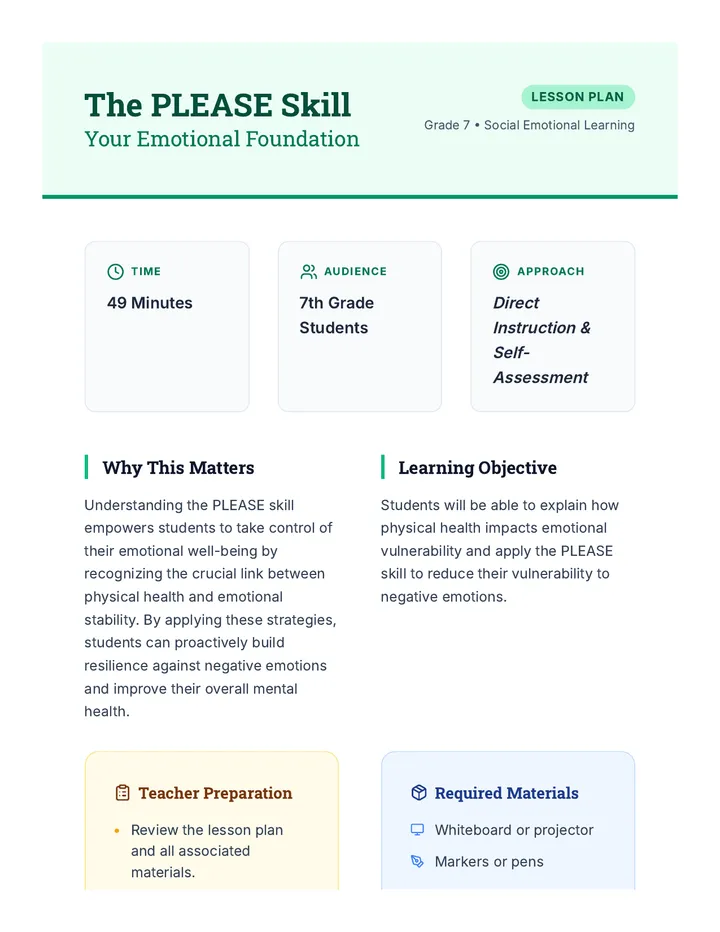
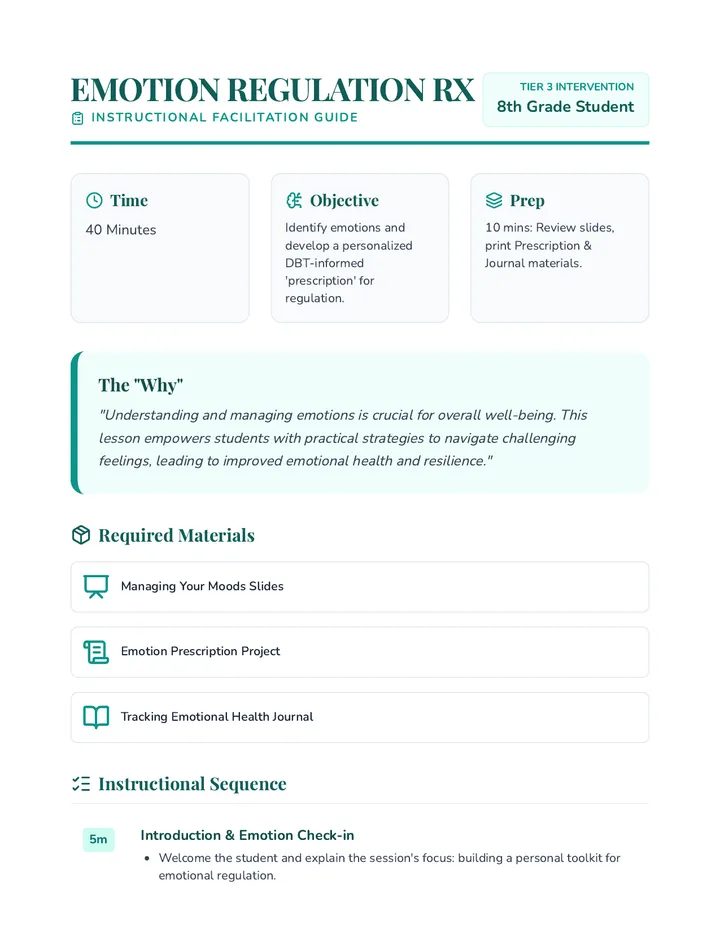
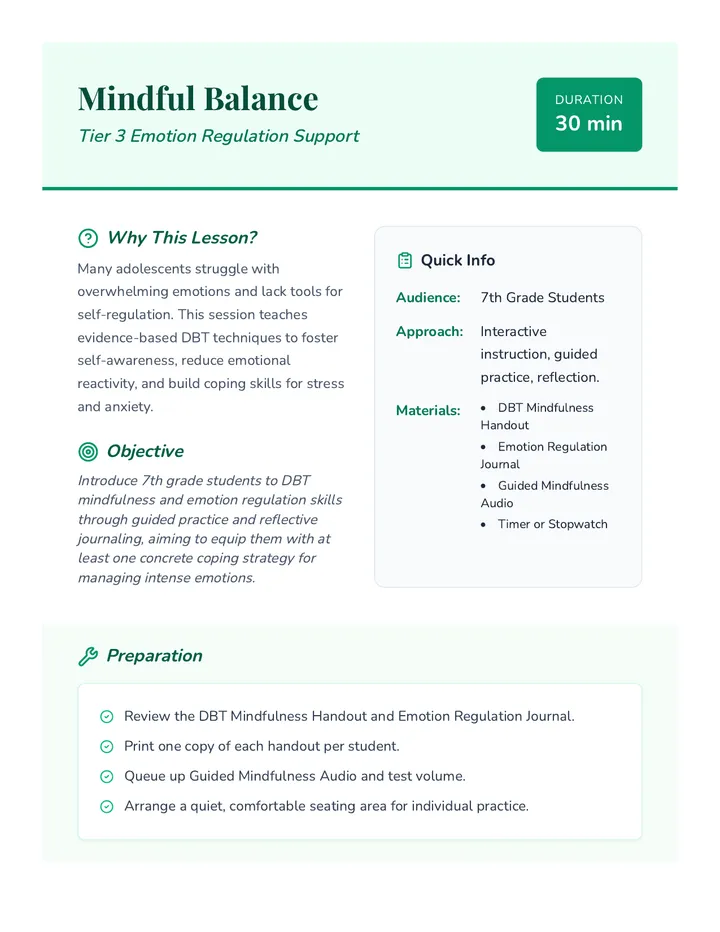
DBT-based strategies for managing physical health to decrease emotional sensitivity. Targets sleep hygiene, balanced nutrition, exercise, and physical illness management to build emotional resilience.
A comprehensive grading and feedback rubric for the final facilitation showcase, evaluating clinical stance, skill fidelity, engagement, and group management.
Final capstone worksheet for Lesson 5, where students map local community resources to each of the PLEASE skills and conduct an accessibility audit.
A standardized feedback and reflection form for students to use during the final facilitation showcase, focusing on clinical stance, clarity, and internal state.
Teacher guide for Lesson 5, including instructions for the 'Great Asset Scavenger Hunt' and final sequence reflection.
This slide deck prepares students for their final facilitation showcase, outlining the protocol, clinical presence requirements, and the etiquette for providing peer feedback.
The final capstone report for the Vulnerability Lab, requiring students to synthesize their tracking data into a personalized resilience manual and environmental design plan.
A reflective drafting worksheet for students to write a letter to their future selves, grounding their commitment to PLEASE skills in young adulthood.
Final slides for the sequence, focusing on community resource mapping and the counselor's role as a systems navigator.
A resource for instructors and students featuring pre-designed gamification ideas and engagement activities to spark creativity during the project phase.
A reflective journaling tool for graduate students to synthesize their personal experience with PLEASE skills and translate it into clinical empathy and professional ethics.
A comprehensive teacher's guide for leading the Lesson 5 workshop on medical adherence, behavioral shaping, and environmental modification.
Wallet-sized medical advocacy and self-care cards for students to complete and include in their Resilience Portfolios.
This sequence examines the PLEASE skills (Physical illness, Lunch/Eating, Avoid mood-altering substances, Sleep, Exercise) through a Social Determinants of Health lens. Undergraduate counseling students will learn to adapt these therapeutic interventions for clients facing systemic barriers such as food insecurity, housing instability, and physical disability.
This advanced sequence prepares undergraduate students to design and facilitate psychoeducational groups focused on the DBT PLEASE skills (Physical illness, Eating, Altering substances, Sleep, Exercise). Students will progress from understanding group structures to leading mock sessions, focusing on communication, engagement, and managing clinical dynamics.
A workshop-based sequence where undergraduate students apply the PLEASE skills to their own lives. Students act as both client and clinician, tracking sleep, nutrition, and exercise to understand the causal link between physical maintenance and emotional vulnerability.
This sequence explores the physiological foundations of the DBT 'PLEASE' skills. Students investigate the neurobiological mechanisms through which physical health impacts emotional regulation, focusing on sleep, nutrition, and exercise.
A specialized sequence for undergraduate counseling students focusing on the 'PL' (Treat Physical Illness) and 'A' (Avoid Mood-Altering Substances) components of the PLEASE skill. Students develop clinical assessment, motivational interviewing, and interdisciplinary collaboration skills to address medical and substance-related barriers to emotional regulation.
This graduate-level sequence explores the intersection of nutrition, movement, and emotional regulation within a clinical framework. It focuses on implementing the 'PLEASE' skill from DBT through a weight-neutral, trauma-informed lens that avoids triggering disordered eating behaviors.
A graduate-level experiential sequence focusing on the personal application of DBT's PLEASE skills to prevent therapist burnout and enhance clinical empathy. Students track their own physiological data to understand the link between physical health and emotional vulnerability.
A graduate-level exploration of the neurobiological underpinnings of the DBT PLEASE skills, focusing on how physiological states modulate emotional reactivity and the clinical application of lifestyle interventions.
This sequence provides graduate-level training on integrating behavioral medicine and DBT to reduce emotional vulnerability. It covers advanced sleep assessment, CBT-I adaptation, nightmare protocols, chronic pain management, and medical adherence strategies.
This graduate-level sequence focuses on the clinical application of PLEASE skills within DBT. Students will master the assessment, psychoeducation, and troubleshooting of physiological vulnerability factors, progressing from building client buy-in to designing complex, individualized protocols for diverse populations.
A comprehensive 5-lesson sequence for 11th-grade students focused on mastering the PLEASE skills (DBT therapeutic approach) to reduce emotional vulnerability. Students move from self-assessment to crisis planning, data analysis, and peer consultancy, culminating in a professional 'Resilience Portfolio' designed for their transition to young adulthood.
An 11th-grade sequence exploring the physiological foundations of emotional regulation, focusing on the Bio-Social Theory and the 'Treating Physical Illness' (PL) component of the PLEASE skills. Students investigate how physical health serves as the primary defense against emotional vulnerability.
Students finalize their comprehensive PLEASE Portfolio, which includes their crisis plans, daily routines, and medical advocacy cards. They reflect on how this foundation reduces emotional vulnerability.
Students work in consultancy groups to review each other's PLEASE plans. They offer feedback on feasibility and loopholes, practicing how to support peers in healthy behaviors.
In this culminating lesson, students design individualized PLEASE plans for complex client profiles. They must account for comorbidities, socioeconomic status, and physical ability levels.
This lesson navigates the complex 'A' skill, distinguishing between prescribed psychotropics and non-prescribed substances. Students discuss harm reduction frameworks and how to track the emotional half-life of various substances.
Students bring together all elements of the PLEASE protocol to create a scientific diagram and act as 'Brain Mechanics' to diagnose emotional vulnerability in fictional scenarios.
Examining the 'E' in PLEASE (Eat Balanced). Investigating how glycemic stability and the gut-brain axis influence neurotransmitter synthesis and anxiety levels.
Students address the 'PL' (Treat Physical Illness) component, exploring how to support clients who avoid medical care due to anxiety or financial/systemic barriers. The lesson includes navigating the healthcare system as an advocate.
Students interpret hypothetical or personal tracking data to see the lag time between behavior change and mood improvement. They learn to manage expectations regarding how quickly the PLEASE skills work.
Focus on the 'S' in PLEASE. Examining how REM sleep and circadian rhythms regulate the amygdala and prefrontal cortex functionality.
Students investigate the neurochemistry of exercise, specifically how movement releases endorphins and reduces cortisol. They test short bursts of activity to measure immediate changes in perceived stress levels.