Bootcamp Leader Guide
Mind Body Bootcamp
Facilitator's Field Manual • DBT Skills Group
Wise Mind
Objective
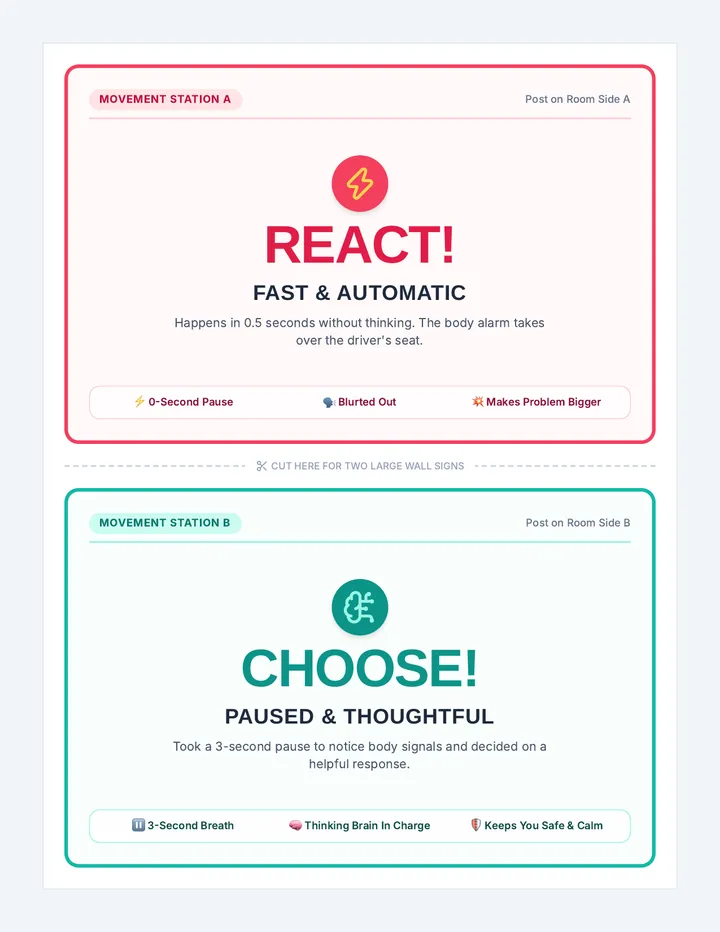
To use active movement to demonstrate the difference between the "Emotional Mind" (high energy, reactive) and "Reasonable Mind" (logic, calm) to find the "Wise Mind" (balance).
DBT Alignment
- Mindfulness: Wise Mind concept
- Distress Tolerance: TIPP (Intense Exercise)
- Regulation: Identifying body cues
Preparation
- Clear open space (gym or cleared classroom)
- Timer/Stopwatch
- Projector for Bootcamp Slides
- Student Skill Circuit Logs
Bootcamp Circuit Schedule
01
The Tense-ion Release (Warm-Up)
5 Mins
Action: Students stand with feet glued. On your signal, they must tense every muscle in their body (fists, face, toes) while staying perfectly still. Hold for 10 seconds, then "explode" into 30 seconds of loose, silly movement (shaking limbs).
Reflection: "Where did you feel the tension? How does your mind feel when your body is that tight versus when you're loose?"
02
The Red-Zone Sprint (Emotional Mind)
10 Mins
Action: 60 seconds of high-intensity movement (mountain climbers, jumping jacks, or high knees). Immediately after, students must stop and try to solve a simple math problem or riddle out loud.
Reflection: "Notice how hard it is to think clearly when your heart is racing. That's Emotional Mind. What physical signals (heartbeat, heat) are your early warning signs?"
03
The Balance Beam Breath (Wise Mind)
10 Mins
Action: Slow, controlled movement. Students walk heel-to-toe along a line (real or imaginary) while coordinating one slow breath per step. Then, they hold a challenging balance pose (Tree Pose) while naming one thing they are grateful for.
Reflection: "This is Wise Mind—using your breath to slow the body so the brain can lead. How did your focus change?"
Facilitator Pro-Tips
- Watch for "Over-Heating": If students get too dysregulated during the Red-Zone Sprint, use the "T" in TIPP (cold water on wrists) as a real-time intervention.
- Model Vulnerability: Share what your "Emotional Mind" signals are (e.g., "My ears get hot when I'm frustrated").
- Adaptive Movement: Allow students to choose their movement intensity based on their physical comfort, focusing on the *internal* experience rather than the external performance.
Bootcamp Slides
Mind Body
Bootcamp
Training for your Wise Mind
Mindfulness Regulation TIPP
The Inner Comm-Center
Reasonable Mind
Cool, calm, and logical. Just the facts. Like a computer processor.
Wise Mind
The balance. Where logic and feelings work together. The sweet spot.
Emotional Mind
Hot, reactive, and driven by feelings. Thinking is foggy.
Mission 01
The Red-Zone Sprint
60 SECONDS
1
Go full speed with High Knees or Mountain Climbers.
2
When the timer stops, FREEZE!
3
Check your pulse and notice your breath. This is Emotional Mind energy.
Scan Your Body:
- Heart thumping?
- Face feeling hot?
- Mind moving fast?
Mission 02
Balance Beam Breath
STABILITY
Walk a straight line, one slow step at a time.
Match your breath to your movement. Slow and steady.
This is Wise Mind taking control.
The Wise Mind Question:
"When things get fast or scary, what is one 'Wise Mind' anchor you can use?"
Hint: Breath, a word, or a body sensation.
STAY IN CONTROL!
S
Stop
Don't move a muscle. Freeze.
T
Take a Breath
Oxygenate your brain.
O
Observe
What are you feeling?
P
Proceed
Act from your Wise Mind.
Bootcamp Circuit Log
My Skill Circuit Log
Name:
Date:
Circuit 01: The Emotional Mind Sprint
Body Scan Check (Circle all that apply):
Racing Heart
Hot Face
Fast Thoughts
Heavy Breath
Reflect:
When I am in Emotional Mind, it feels like...
Circuit 02: The Wise Mind Anchor
What was your Wise Mind anchor during the balance activity?
My Anchor Word
My Focus Point
How did focusing on your breath change the way you felt?
My Wise Mind Toolbox
STOP
I will use the STOP skill when I notice...
TIPP
The movement that helps me most is...