Hit the Brakes Slides Module 1: Cognitive Inhibition Grade 6 Executive Function
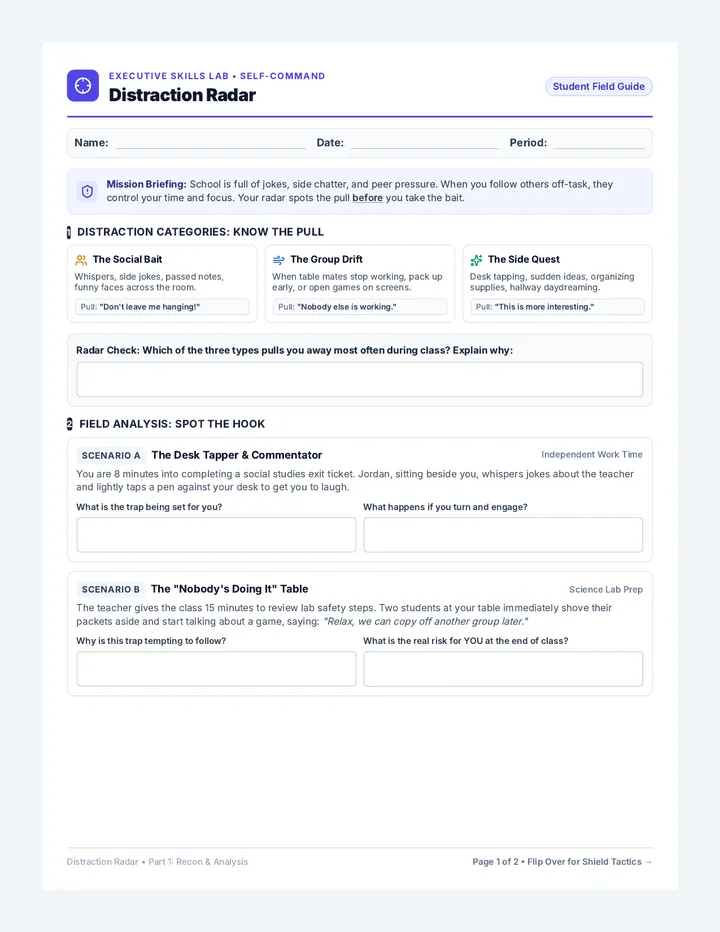
Mastering the Cognitive Brake
Why does your brain urge you to click, write, and rush before hearing the full directive? How top students install a deliberate delay to prevent costly mistakes.
Prefrontal Control
Impulse Invalidation
Strategic Execution
The Brain Engine vs. The Brake
Neuroscience of the Middle School Brain
The Reactive Reflex
Automated, impulsive rush triggered before processing instructions.
Opens browser tab / starts writing on the first word
Misses key formatting guidelines, rubrics, and point values
Cost: Reworking assignments, lost credit on overlooked criteria.
The Prefrontal Pilot
Intentional cognitive inhibition that locks attention until data is complete.
Keeps hands off devices/tools until prompt is fully delivered
Filters out deceptive traps and identifies core requirements
Advantage: Zero wasted effort, 100% precision on the first pass.
Key Insight: Inhibition is not hesitating—it is tactical processing.
The 3-Second Strategic Pause
Standard Operating Procedure when directions or prompts are issued
1
DISENGAGE
Release the mouse, set down the pen, hands off the keyboard. Break mechanical momentum.
2
ABSORB
Listen for the complete constraint: What are the deliverables? What is the release signal?
3
INITIATE
Begin execution only after receiving explicit release clearance from the instructor.
Protocol Check: Hands neutral, eyes locked, processing active.
Class Gauntlet: The Premature Action Test
Inhibition Trial
Live Directive Challenge
You will receive a multi-part classroom directive containing a high-temptation trigger. Can 100% of the room maintain zero physical movement until the official authorization code is spoken?
Success Metric: Zero pencil clicks, zero page turns, zero screen touches prior to authorization.
Target: Full Prefrontal Dominance Prepare Practice Diagnostic Sheet
Brain Brakes Practice Sheet COGNITIVE INHIBITION DIAGNOSTIC
Lesson 1: Prefrontal Pause & Strategic Delay
EXECUTIVE FUNCTION LAB
Grade 6 Academic Core
Student Name:
Date:
Period:
1
Academic Case Study: Reactive vs. Strategic Executive Action
Read each scenario. Identify the tactical difference between reactive impulse and prefrontal delay.
Scenario A: Science Investigation Lab Physical Momentum
Reactive Rush:
Grabbing graduated cylinders and measuring chemicals the instant the teacher names the lab topic, missing critical safety specs.
Strategic Pause:
Keeping hands off lab equipment until safety protocols, disposal instructions, and data table layouts are fully articulated.
Scenario B: Digital Assessment / Portal Assignment Digital Premature Action
Reactive Rush:
Clicking 'Open Document' and rapidly typing before reading the 3 required source citation constraints and rubric point breakdown.
Strategic Pause:
Hands neutral; reading prompt and rubric twice to mark constraints before entering a single keystroke.
2
Personal Trigger Audit
Which situations most frequently trigger your impulse to start prematurely? Check all that apply.
Peer Pacing Anxiety:
Seeing classmates type or pick up pencils makes me panic that I am falling behind.
Overconfidence Trap:
Assuming I already know the task and skipping fine-print directions.
Digital Quick-Click:
Instinctively clicking multiple tabs or buttons before instructions finish.
Finish-Line Rush:
Rushing to be done early rather than optimizing accuracy and completeness.
3
Tactical Response Protocol
Formulate your personal 3-second protocol when an instructor begins verbal or written directions.
State your exact physical and mental action when you feel the urge to start prematurely:
Inhibition Target Today:
100% Release Signal Compliance Zero Early Device Clicks
Wait for Signal Slides Module 2: Auditory Attention Grade 6 Executive Function
The Conditional Release Protocol
Why premature execution ruins academic performance: Training your auditory filter to withstand distractor words and hold action until full authorization.
Selective Filtering
Delay Tolerance
Zero False Starts
The "First-Word Launch" Dilemma
Why Jumping the Gun Costs Grades
The Premature Launch
Teacher: "Log into your student portal..."
→ Student immediately opens laptops & types!
Missed clause: "...but open only Assignment B, and do NOT click submit until peer-reviewed."
Consequence: Submitted wrong file, lost 15 points, forced redo.
The Cue-Conditioned Launch
Teacher: "When I say the release word 'SYNAPSE'..."
→ Pencils down, laptops closed, full auditory focus.
Hears all 3 constraints, criteria, and the official release word.
Outcome: Flawless execution, 100% rubrics met, autonomous flow.
Strategic Rule: Never initiate movement while a voice is delivering criteria.
The Three Rules of the Release Cue
Tactical protocol for high-density academic environments
1. Selective Filter
Screen out peripheral classroom noise and background chatter. Lock attention to the instructor's exact syntax.
2. Delay Tolerance
Ignore decoy trigger words and mid-sentence pauses. Hold physical posture in neutral until the true release cue.
3. Decisive Launch
The moment the cue sounds, transition directly into focused execution without hesitating or looking around.
Designated Release Cue Today: "SYNAPSE"
Live Trial: The Decoy Gauntlet
Class Trial
Conditional Auditory Directive
Listen for qualifying clauses and decoy triggers:
"Prepare to open your notebooks... but do NOT pick up a writing utensil yet..."
(Did anyone move? That was a decoy trap!)
"...and only when you hear SYNAPSE, turn to page 24 and solve item #1."
Did the room hold absolute discipline until the release word?
Standard: 100% Release Signal Discipline Transition to Mission Worksheet
Secret Signal Mission Worksheet CONDITIONAL RELEASE PROTOCOL LAB
Lesson 2: Auditory Attention & Delay Tolerance
EXECUTIVE FUNCTION LAB
Grade 6 Academic Core
Student Name:
Date:
Period:
Authorized Release Trigger
"SYNAPSE"
Mandatory Protocol: Hands off pens, keyboards, and paper. Listen past all decoy phrases until the instructor pronounces the trigger cue.
Live Auditory Trials: Execute Exclusively Upon Trigger Cue
Trial 01 Conditional Data Plotting
Wait for SYNAPSE , then calculate and write the value: \( (14 \times 3) - 12 \).
Signal Respected?
100% Early
Trial 02 Decoy Trigger Invalidation
Ignore decoys ("Start now", "Begin"). Wait strictly for SYNAPSE , then record your science lab table number.
Signal Respected?
100% Early
Trial 03 Syntax & Modifier Sequencing
Wait for SYNAPSE , then write the 3 states of matter in order of lowest to highest thermal energy.
Signal Respected?
100% Early
Trial 04 Contradictory Condition Gauntlet
Instructor will give an intentional paradox directive. Filter the noise; write the single verified conclusion upon SYNAPSE .
Signal Respected?
100% Early
Debrief: Analyzing Cognitive Resistance Under Pressure
When an instructor pauses mid-sentence or drops a decoy word, what internal self-talk prevents you from launching prematurely?
Composite Score:
4/4 Full Control 3/4 Minor Slip <3 Recalibrating
One Step Wonder Slides Module 3: Task Decomposition Grade 6 Executive Function
Algorithmic Task Staging
Why multi-step middle school prompts trigger cognitive overload: How high-performing students deconstruct complex rubrics into sequential, milestone-verified phases.
Cognitive Chunking
Milestone Verification
Sequential Execution
Cognitive Overload vs. Algorithmic Staging
Working Memory Management
Attentional Fragmentation
Attempting to juggle all 4 tiers of a rubric simultaneously:
"I'm finding quotes while formatting my header while worried about word count!"
Outcome: Overlooked criteria, chaotic reasoning, severe fatigue.
Milestone Staging
Treating assignments as an engineering assembly line:
Milestone 1: Isolate and satisfy Requirement 1 exclusively.
Audit Check: Verify completion before unlocking Milestone 2.
Outcome: 100% criteria compliance, calm precision, zero panic.
Core Principle: Never initiate Phase 2 until Phase 1 deliverables are verified.
The Three-Phase Staging Protocol
Universal method for multi-part middle school assignments
STAGE 1: DECONSTRUCT
Isolate the Prerequisite
Read the entire prompt, but immediately bracket Milestone 1. Ignore remaining tasks until Milestone 1 is built.
Focus: "One milestone at a time."
STAGE 2: EXECUTE
Deliverable Lockdown
Execute only the active milestone. Maintain strict boundaries against skipping ahead to the fun or easy sections.
Action: "Complete before branching."
STAGE 3: VERIFY
Audit & Advance
Pause tools. Check the milestone box. Take a 2-second breath, then unlock the next stage of criteria.
Verification: "Sign-off before next step."
Executive Tactic: Physically check off rubric criteria as you build.
Engineering Schematic Protocol
Blueprint Simulation
Autonomous Rover Schematic Assembly
Aerospace engineers cannot mount high-precision optical sensors to an uncalibrated chassis. Today, follow strict engineering milestones: chassis assembly, power grid, telemetry sensors, and payload verification.
Protocol: Pencil parked and milestone checked before advancing to the next tier!
Discipline equals engineering precision Open Blueprint Specifications Sheet
Robot Builder Direction Worksheet ROVER SCHEMATIC BLUEPRINT LAB
Lesson 3: Algorithmic Task Staging & Verification
EXECUTIVE FUNCTION LAB
Grade 6 Academic Core
Engineer Name:
Date:
Period:
!
STAGING PROTOCOL: Do not skip ahead. Complete each milestone in strict sequence. After drafting each component, audit criteria, check the milestone box, and park your pencil until the instructor confirms the next phase.
Phase 01: Core Chassis
Verified
Draft a central rectangular chassis in the grid center. Label internal battery core and main CPU compartment.
→ Audit criteria & park pencil
Phase 02: Suspension
Verified
Add 6 articulated rocker-bogie wheels (3 per side) with tread patterns and labeled pivot linkages.
→ Audit criteria & park pencil
Phase 03: Telemetry Mast
Verified
Mount a vertical remote-sensing mast on top. Add stereo navigation optics, laser sensor, and omni-antenna.
→ Audit criteria & park pencil
Phase 04: Robotic Arm
Verified
Extend a 3-joint robotic arm with sample core drill on front; add dual solar panel wings on rear deck.
→ Assembly Finalized
Technical Blueprint Grid [Scale 1:20] Await Phase Clearance
Drafting workspace for technical rover specifications & annotations
Milestone Integrity Check: Did you resist drawing Phase 3 or 4 elements while Phase 1 was active?
100% Staged Minor Skip Needed Reset
Whisper and Picture Slides Module 4: Working Memory Architecture Grade 6 Executive Function
Mental Simulation & Internal Rehearsal
Why instructions vanish within seconds of hearing them: How top students deploy the phonological loop and visuospatial simulation to lock multi-step plans into memory.
Subvocal Rehearsal
Mental Simulation
Dual-Coding Retention
The Working Memory Bottleneck
Cognitive Science Behind Forgetting
The Passive Listener Trap
Hearing a directive without active cognitive encoding:
Teacher delivers 3 precise research guidelines...
Result: Unrehearsed acoustic data decays within 4–6 seconds. Student raises hand: "Wait, what are we doing?"
The Dual-Coding Solution
Actively looping the verbal script while projecting mental actions:
1. Subvocal Loop: Whisper/re-voice key terms internally.
2. Visual Sketch: Picture physical navigation of tools & data.
Result: 200%+ increase in multi-step task retention without re-prompting.
Insight: Your inner voice and mind's eye are working memory amplifiers.
How to Run a Mental Simulation
The pre-execution protocol used by pilots, surgeons, and elite students
1. Sensory Pause
Soften gaze or close eyes for 3 seconds. Block out ambient classroom movement and visual noise.
2. Run the Play
Mentally visualize your hands opening the file, applying the rubric constraint, and checking the required deliverable.
3. Execute Plan
Open eyes and execute with high velocity because your neural circuitry has already run the sequence.
Trial Formula: Subvocalize the sequence twice → Simulate actions → Initiate.
Live Trial: The 3-Constraint Gauntlet
Zero Reminders Permitted
Complex Academic Directive:
1. Constraint A: Identify the independent variable in your data set.
2. Constraint B: Calculate the range between maximum and minimum values.
3. Constraint C: Frame your final response with units in brackets.
Stop! Rehearse the 3 constraints internally... Run the mental simulation... Now execute!
Did subvocal rehearsal prevent information decay? Advance to Cognitive Modeling Handout
Mental Movie Detective Handout MENTAL MODELING & REHEARSAL LAB
Lesson 4: Working Memory Optimization
EXECUTIVE FUNCTION LAB
Grade 6 Academic Core
Researcher Name:
Date:
Period:
Phonological Loop (Subvocal Script)
Silently rehearse key sequence verbs and constraints 2–3 times.
Visuospatial Sketchpad (Simulation)
Mentally project your hands executing each milestone before movement.
1
3-Stage Visuospatial Simulation Schema
Listen to the verbal multi-part scenario delivered once. Rehearse internally, then outline the mental simulation frames.
STAGE 1: SETUP & ISOLATE
Internal Script: "First, configure..."
STAGE 2: DATA & ANALYSIS
Internal Script: "Next, compute..."
STAGE 3: VERIFY & SUBMIT
Internal Script: "Finally, format & audit..."
2
Autonomous Execution Workspace (Zero Re-Prompting)
Instructor Directive: "Calculate the density of a mineral specimen with Mass = 144g and Volume = 18cm³, state the formula used, and identify whether it will sink or float in water (\(1.0 \text{ g/cm}^3\))."
Working Memory Audit:
Rehearsed formula internally
Simulated solution steps
Zero teacher re-prompts needed
Memory Fidelity Rating:
Autonomous (100% Retained) Partial Recall (Needed Peer Check) Decayed (Rehearsal Failed)
Mission Control Challenge Slides Module 5: Capstone Simulation Grade 6 Executive Function
Mission Control: Flight Gauntlet
Autonomous academic mastery: Synthesizing cognitive inhibition, auditory filtering, task decomposition, and mental simulation into real-world middle school performance.
1. Inhibition
2. Auditory Filter
3. Task Staging
4. Working Memory
The Executive Command Architecture
Full System Synthesis
Pillar 1: Cognitive Inhibition
Automatic 3-second pause. Resisting the impulse to click, write, or blur out before directives terminate.
Pillar 2: Auditory Attention
Screening decoy terms and false triggers. Maintaining neutral until the authorized release signal sounds.
Pillar 3: Task Decomposition
Deconstructing dense multi-part prompts into milestones. Completing and verifying Phase 1 before Phase 2.
Pillar 4: Mental Simulation
Subvocalizing directives and running internal simulations before physical initiation to guarantee zero memory drop.
Capstone Standard: Total autonomy without secondary prompts.
Live Gauntlet: Flight Simulation
Classwide Stress Test
Multi-Tier Academic Directive
Listen to all 3 protocol stages before any mechanical action:
Stage A (Deconstruction): Isolate your certificate sheet and confirm your homeroom code.
Stage B (Simulation): Internally rehearse your personal self-audit ratings across all 4 pillars.
Stage C (Release): Withhold pen contact until the authorized launch cue: "TRAJECTORY".
Hold neutral posture until the launch cue sounds!
Subvocal loop active? Mental simulation running? Awaiting launch authorization...
Executive Function Mastery Certification
Executive Autonomy Achieved
You have transitioned from reactive impulsivity to strategic cognitive control. You are equipped to master complex middle school classes, multi-tier projects, and independent study.
Complete your final metacognitive audit & credential signing now.
5 Modules of Cognitive Science Applied Official Credential Verification
Direction Master Badge Certificate Executive Function Institute • Grade 6 Academic Core
CERTIFICATE OF EXECUTIVE MASTERY
Certified Independent Academic Strategist
This formal credential is conferred upon:
Student Name
For demonstrating exemplary cognitive self-regulation, inhibitory control, selective auditory filtering, algorithmic task decomposition, and internal working memory simulation.
Four Core Executive Competencies Verified
1
COGNITIVE INHIBITION
Deploys 3-second strategic pause; suppresses premature clicking and hasty writing.
2
SELECTIVE AUDITORY FILTER
Maintains delay tolerance through decoy cues until authorized release signals sound.
3
TASK DECOMPOSITION
Stages multi-tiered rubrics into sequential milestones with verification gates.
4
WORKING MEMORY SIMULATION
Subvocalizes plans and mentally simulates workflows before executing independently.
Personal Executive Function Protocol Commitment:
Student Scholar Signature
VERIFIED SEAL
Instructor / Advisor Signature & Date