Self-advocacy strategies, visual supports, and functional language for identifying and expressing sensory preferences. Guides students in requesting environmental modifications and communicating internal states to caregivers or educators.
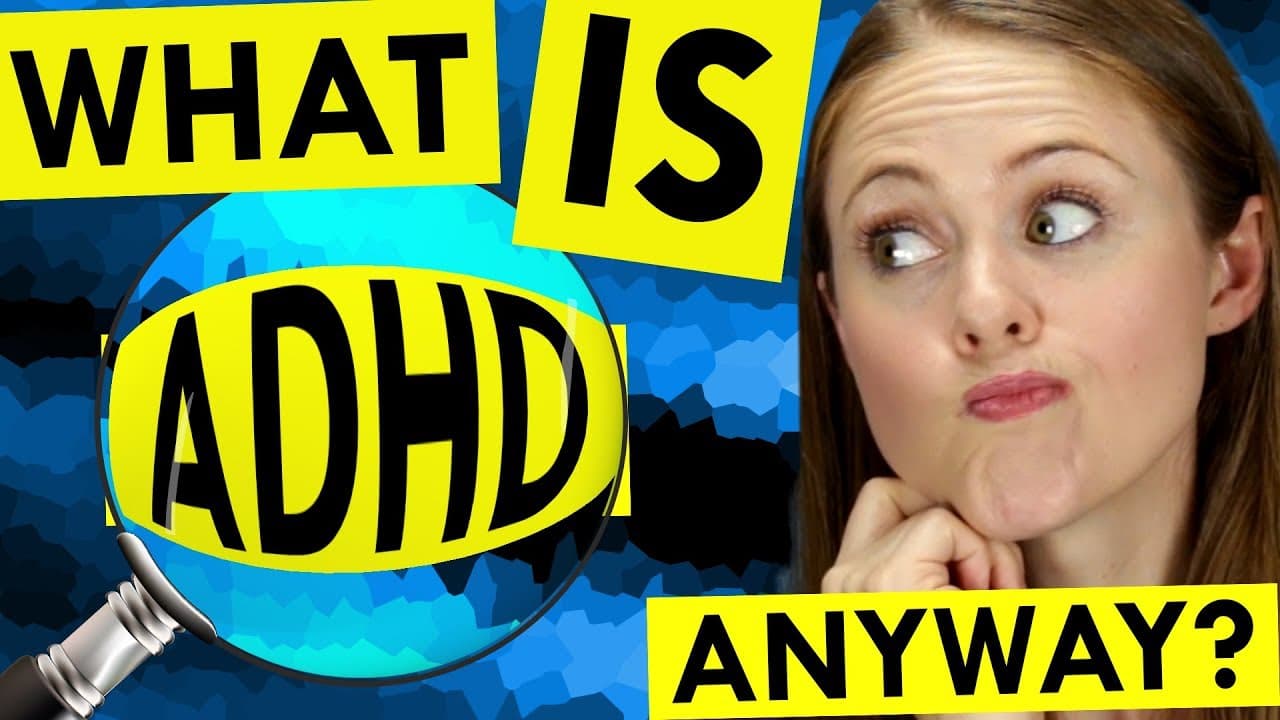
This educational video demystifies Attention Deficit Hyperactivity Disorder (ADHD) by exploring the internal experience of living with the condition. Hosted by Jessica McCabe, the video moves beyond clinical definitions to offer relatable, concrete metaphors that describe executive dysfunction, working memory challenges, and emotional dysregulation. It emphasizes that ADHD behaviors are not character flaws but rather neurological differences in how the brain regulates attention and emotion. The content breaks down complex neurological concepts into accessible analogies, such as comparing the brain to a CEO with a bad secretary, working memory to a whiteboard that constantly needs erasing, and emotional regulation to a severe sunburn. The video addresses key themes including the myth of "attention deficit" (versus attention regulation), the invisibility of the struggle, and the strengths that often accompany ADHD brains, such as creativity and out-of-the-box thinking. For educators, this resource is invaluable for fostering empathy and understanding in the classroom. It provides a shared language for teachers and students to discuss learning differences without stigma. By framing ADHD through mechanical and situational metaphors—like a race car with bicycle brakes—it offers students with ADHD a way to articulate their experiences and helps neurotypical peers understand why certain tasks are more challenging for their classmates.
7mins 39s
The ultimate compact version of the Adulting Celebration Chart with ultra-reduced line spacing and minimal vertical gaps. It utilizes tiny icons, condensed font sizes, and tight leading to provide a high-density workplace tracking experience that fits multiple players and comprehensive metrics in a single printable view. It moves metric descriptions inline to save vertical space.
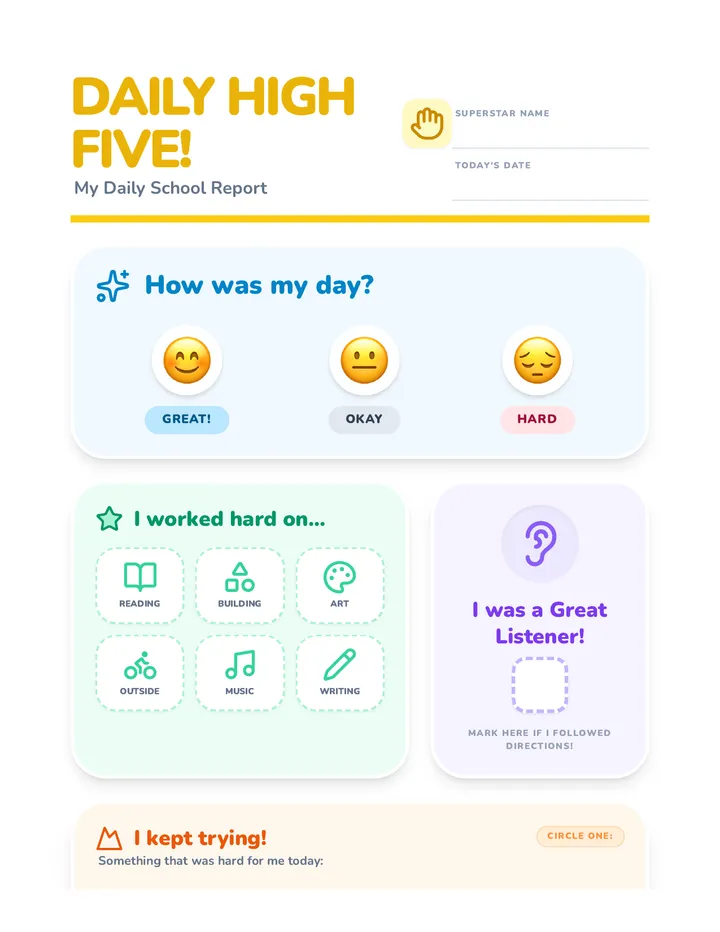
An updated daily communication log for non-readers featuring a "sticker-style" aesthetic. It includes a mood scale, activity icons for hard work, a listener check-box, and a dedicated challenging task section with circle-able icons for Math, Reading, Gym, OT, PT, and Speech, plus a drawing space.
A quick-reference validation guide for staff. Features two color-coded cards with specific empathetic phrases for general validation and reactive behavior responses. Optimized for landscape printing and lanyard use with clear visual cues.
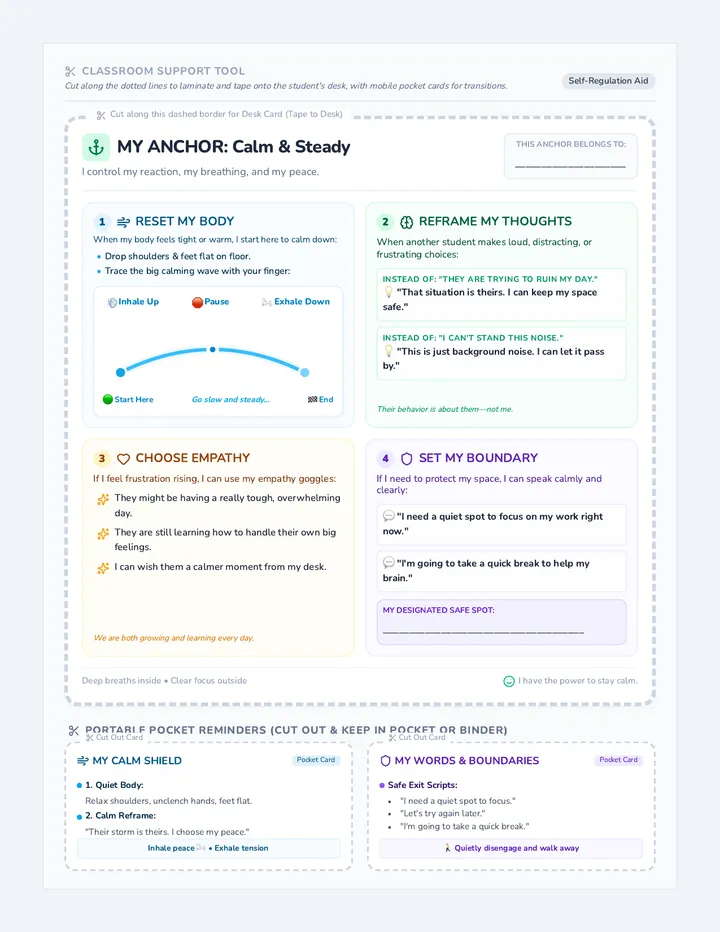
An updated desk-sized anchor chart featuring a much larger, visually prominent finger-tracing wave graphic for physical grounding, paired with neutral reframing scripts, empathy tools, and boundary phrases.
An expanded set of nine large-format printable desk strips with high-contrast visual reminders, including specific calming techniques and a "Safe Choices" strip for unwanted behaviors.
A single-page classroom anchor chart and desk poster formatted for perfect single-page printing. Features a clean 3x3 layout of color-coded school scenarios and 5 structured fill-in-the-blank sentence starters to support student voice and expression.
A comprehensive teacher resource guide outlining various neurodivergent support options categorized by environment, instruction, processing, and more, specifically tailored for a housing or independent living lesson.
An ultra-minimalist set of voice level cards featuring large numbers, bold icons, and single labels for instant recognition.
An updated retro-diner themed break choice board. It now includes a 'Today's Specials' section for three pre-selected options and an 'Order' spot for the student's final choice, plus an expanded set of 8 cut-out tokens.
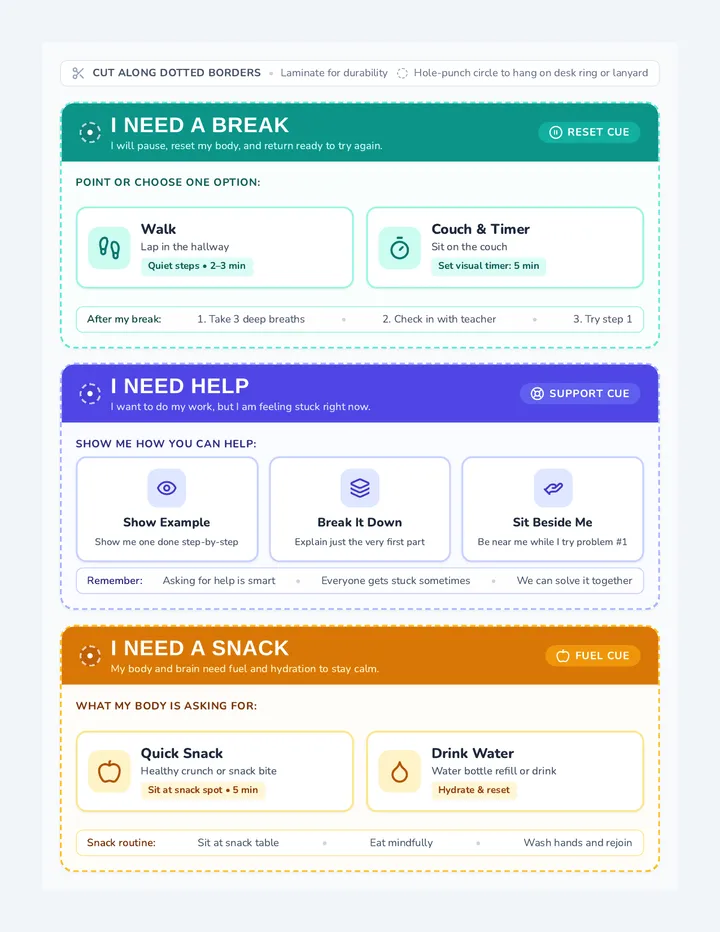
A friendly, highly visual double-sided desk card designed for students who struggle with verbal communication. One side features a soft, calm-down 'I Need a Break' card with cute emoji characters guiding simple calm-down actions, and the other side features a vibrant, high-contrast 'I Need Help' card with non-verbal pointing prompts for immediate teacher attention.
A refined one-page parent guide for toilet training autistic students. Now featuring the original emoji visual stories and initial instructional wording, alongside larger, bolder instructional sentences for parents.
A comprehensive IEP goal bank for emotional regulation, focusing on trigger identification, independent use of coping tools, and functional break requests. Each goal category includes specific objectives and measurement standards.
A 6-week social-emotional learning program for teenagers on the autism spectrum, delivered in focused 20-minute sessions. The program uses visual "blueprints" to teach energy management, body awareness, and Comic Strip Conversation techniques for emotional regulation and perspective taking.
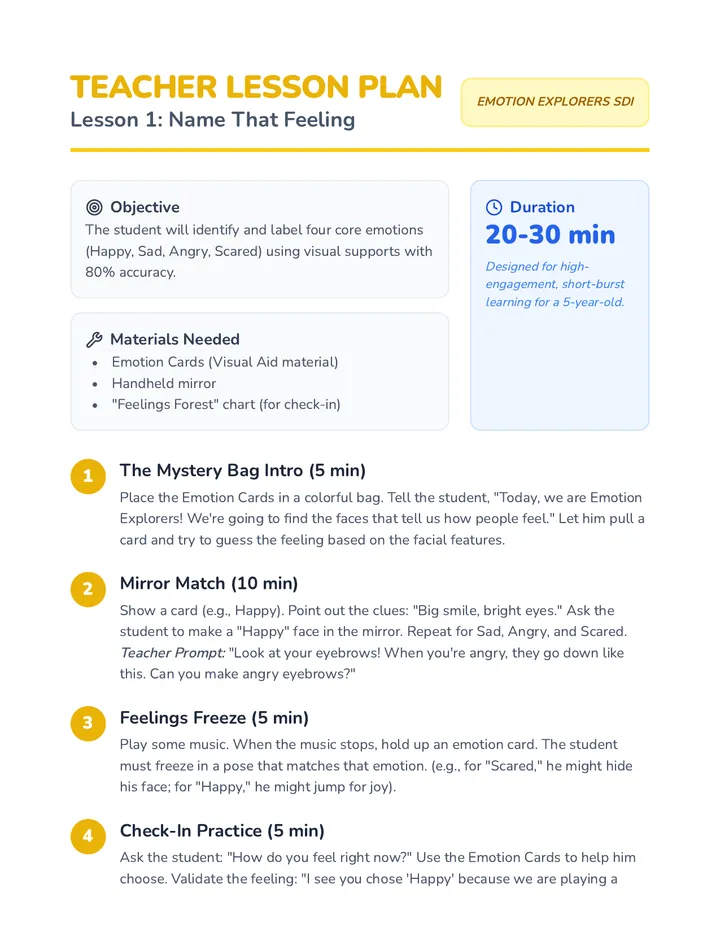
An 8-lesson SDI series designed for a 5-year-old student to develop emotional regulation skills, covering emotion identification, body awareness, and specific calming strategies like breathing and sensory tools.
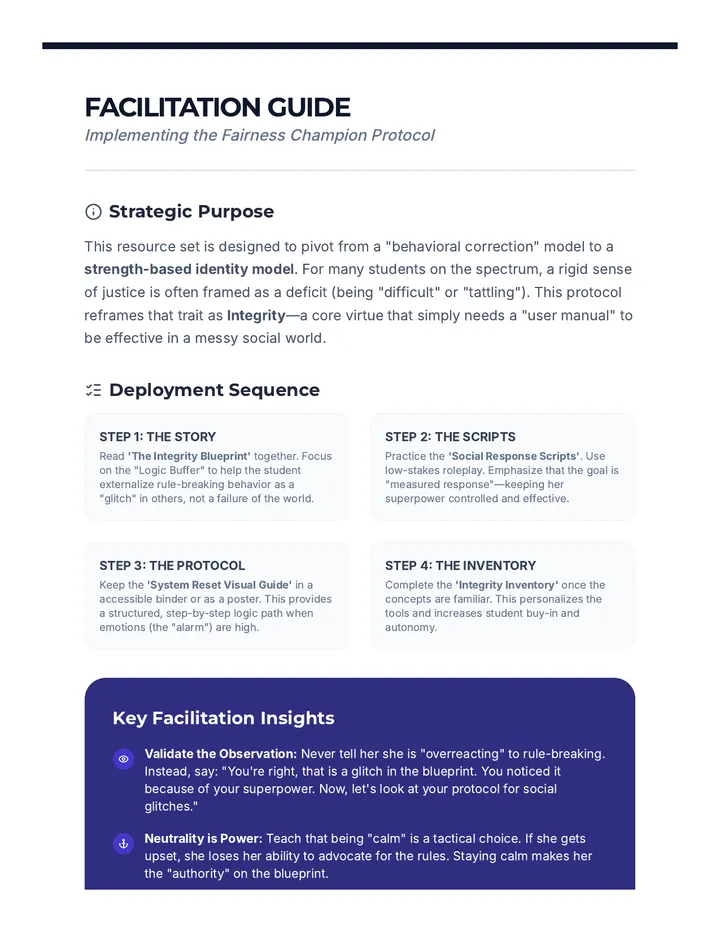
A 6-week social-emotional learning curriculum for a 13-year-old girl on the autism spectrum, focusing on managing specific triggers through a strength-based "Integrity Blueprint" lens.
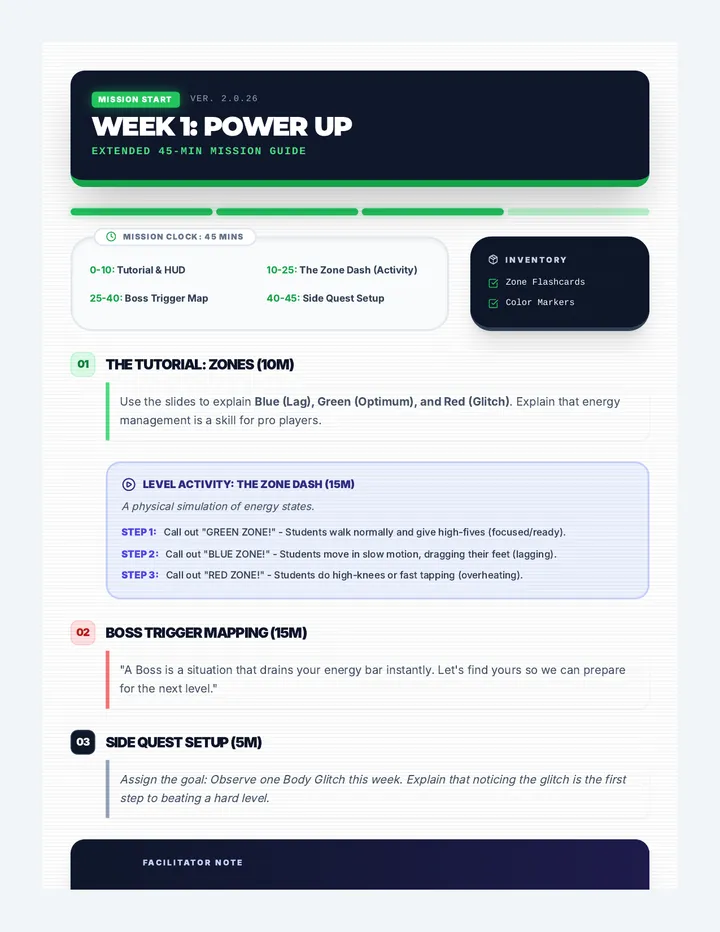
A 6-week social-emotional learning curriculum designed for 4th-grade students with ADHD, focusing on self-regulation, flexible thinking, and respectful communication through a high-engagement 'Level Up' video game theme.
A comprehensive 6-week social skills and problem-solving program designed specifically for 2nd-grade students with ASD. The sequence uses a 'Social Detective' theme to teach self-regulation, perspective taking, empathy, and social problem-solving through visual supports and concrete activities.
A 6-week individual behavior intervention sequence for 1st grade students struggling with emotional regulation, elopement, and attention-seeking behaviors. The sequence focuses on identifying feelings, sizing problems, and using functional communication to seek attention appropriately.
A sequence designed to help neurodivergent students navigate unexpected schedule changes with logic-based social stories and visual tools.
An intensive 8-session autonomic regulation and behavior protocol for 3rd-5th graders designed to replace dangerous flight or hiding behaviors (such as bolting or hiding under desks) with structured travel to a designated safe 'Reset Space' or 'Calm Down Station' equipped with comforting, quiet tools.
A comprehensive series of lessons for high school students focusing on the four Zones of Regulation. Students will learn to identify internal physical cues, external triggers, and specific coping strategies to manage low-energy (Blue), regulated (Green), elevated (Yellow), and extreme (Red) states.
A series of Tier 2 behavior intervention academies for elementary students based on the Urbandale Student Code of Conduct. Using the Skillstreaming model, these 15-20 minute mini-lessons target specific pro-social skills to replace behaviors related to Defiance, Disruption, Physical Aggression, and Abusive Language.
A Kindergarten sequence focused on building cognitive flexibility and emotional regulation when visual schedules change. Students learn to use specific visuals like 'Oops' cards, substitution icons, and 'Surprise' markers to navigate transitions and unexpected events calmly.
A 2nd-grade special education unit focused on executive function. Students learn to recognize the physical signs of being 'stuck' and categorize barriers into materials, comprehension, and environment.
A comprehensive self-advocacy curriculum designed for young adults to navigate school, home, community, and the workplace with confidence. Focuses on personal identity (pronouns), legal rights (ADA/IDEA), and practical communication strategies.
A professional development session for high school teachers focusing on restorative practices, emotional regulation, and the implementation of proactive care plans. This lesson equips educators with the tools to handle chronic emotional challenges and foster deep connection with students in grades 9-12.
A comprehensive set of tools for teachers and occupational therapists to identify, score, and support students with sensory processing needs. Includes a screening checklist, a simplified scoring guide, and a classroom strategies handout.
A 20-minute Tier 1 lesson for exceptional children introducing the concept of personal space bubbles to improve social comfort and reduce task avoidance.
A comprehensive lesson designed to help a 3rd-grade student recognize and shift from 'stuck thinking' to 'flexible thinking' during transitions and writing tasks. Includes a social story, role-playing, and tangible strategy cards.
A comprehensive social story and supporting tools designed for an academically advanced 2nd grader to manage non-preferred tasks, transitions, and big emotions using verbal communication and solution-seeking strategies instead of screaming or eloping.
A high-energy, superhero-themed lesson designed for students with autism to learn the 'superpower' of self-advocacy. This lesson covers standing up for oneself at home, school, and in the community through interactive slides, stories, and games.
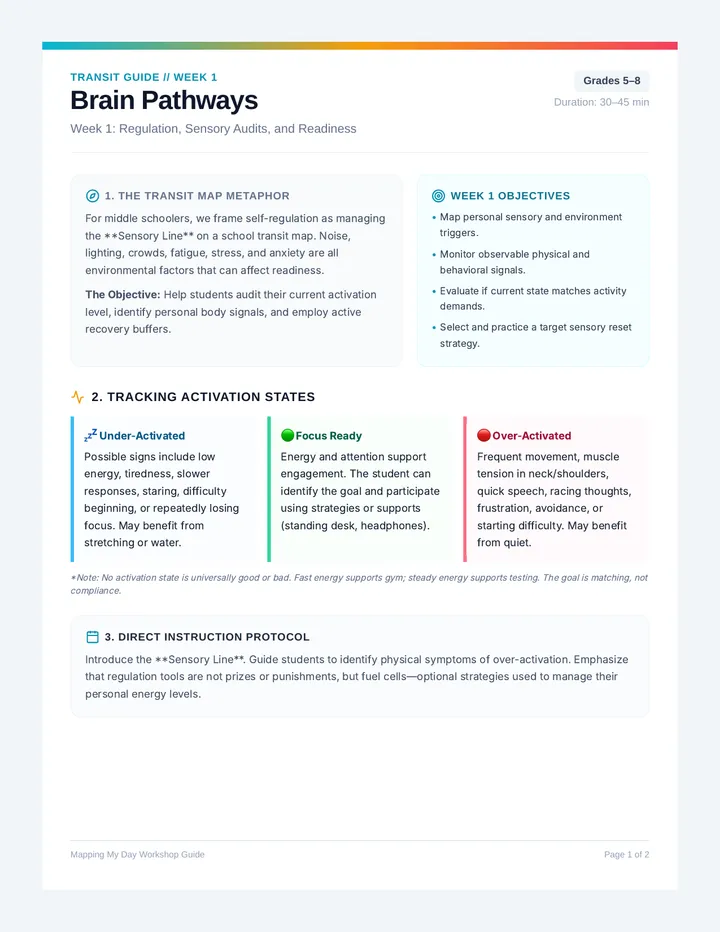
A comprehensive 1.5-hour professional learning session and toolkit package designed for 7-12 educators. It focuses on developmentally appropriate, low-prep, and discreet sensory regulation strategies that respect adolescent autonomy and support academic focus and executive functioning.
A lesson designed to support adults with cognitive decline in nursing home settings, focusing on the social and emotional skills needed to wait for staff assistance patiently.
A comprehensive preparation resource set for Field Day, designed for upper elementary and sensory-sensitive students. It includes a structured, coping-strategy-focused social story booklet and a beautifully organized, visual rotation schedule poster to support seamless transitions.
A lesson designed to help students in behavior support programs identify their current emotional state, recognize triggers, and select appropriate coping strategies for self-regulation.
A lesson for highly intelligent 1st grade students with autism focused on turn-taking and classroom flexibility using the metaphor of a 'Classroom Garden' to illustrate how every student's voice needs space to grow.