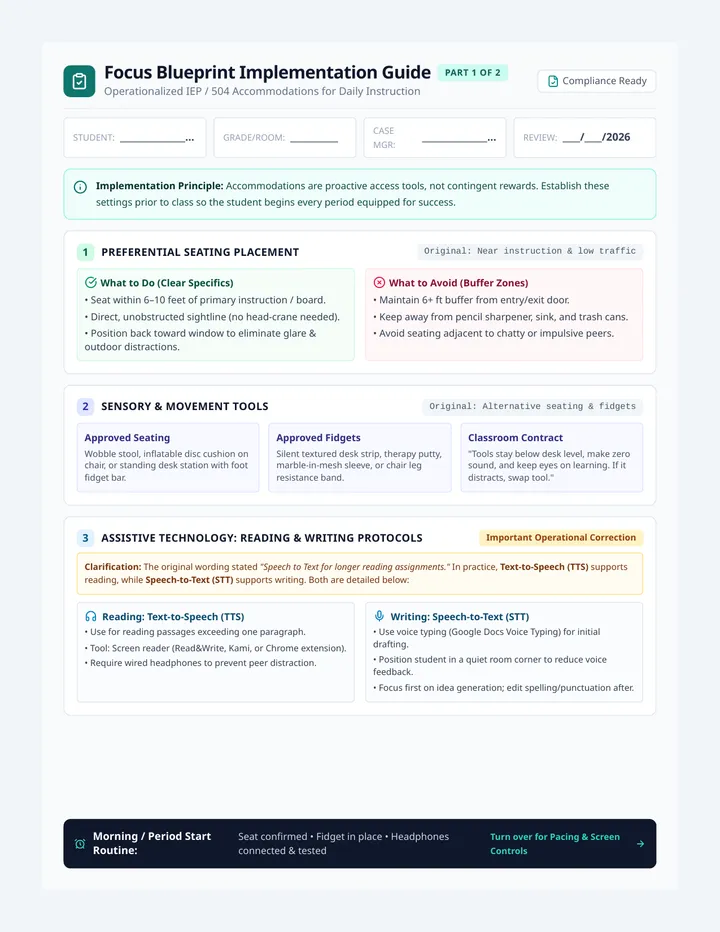
Implementation of AAC device navigation, symbol-word communication, and speech recognition for text editing. Builds proficiency in keyboard shortcuts, text-to-speech reading supports, and digital organization through productivity apps and calendars.
A comprehensive 15-session self-advocacy series designed for high school students with learning disabilities and ADHD, focusing on identifying challenges and requesting supports.
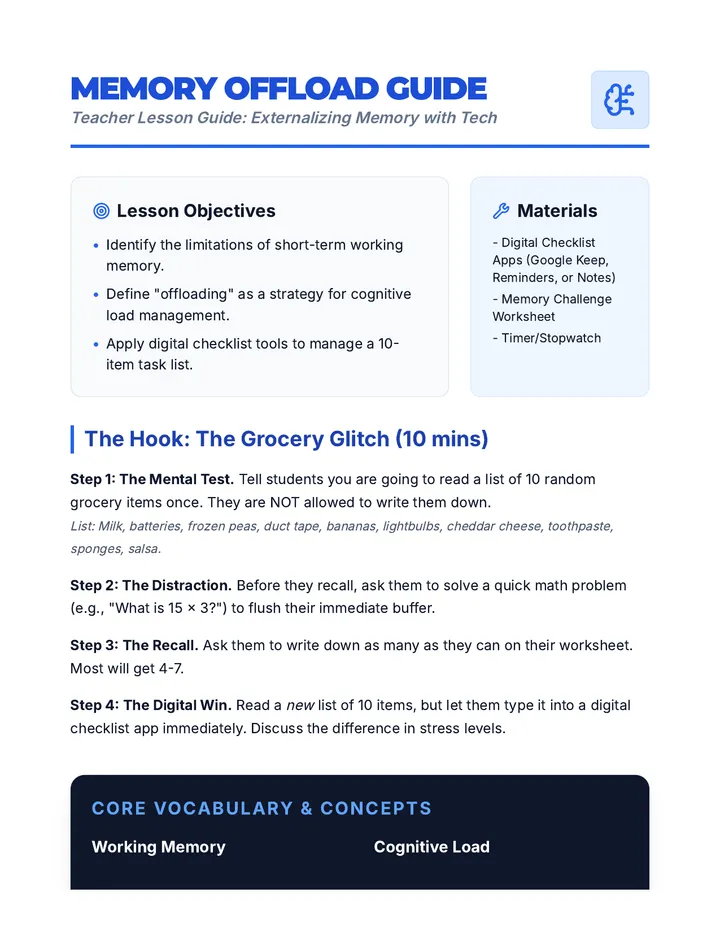
A 5-lesson unit for 8th-grade students focusing on using digital tools to offload working memory and manage cognitive load. Students learn to use task managers, focus modes, sequential reminders, and assistive speech technologies to create a personalized digital workflow for school success.
This sequence empowers 9th-grade students to integrate Text-to-Speech (TTS) into their high school workflows through self-advocacy and digital organization. Students move from identifying reading barriers in their schedules to creating a professional Access Plan for their teachers.
A 5-lesson sequence designed for 9th-grade students in an academic support setting to master digital annotation, highlighting, and collaborative text analysis tools. The sequence focuses on transitioning traditional paper-based strategies to digital environments like Google Docs and PDFs, emphasizing visible thinking and peer collaboration.
This sequence explores how graduate students can leverage assistive technology for digital annotation, moving from basic tool audits to advanced data extraction and AI integration to support students with disabilities.
A comprehensive sequence designed to help 9th-grade students with executive function challenges develop, implement, and test personalized organizational systems. Students explore analog and digital tools, master calendar management, organize digital and physical spaces, and simulate real-world 'stress tests' to refine their chosen frameworks.
A graduate-level sequence focused on the mechanics of administrative compliance in Special Education. Students will design and implement a comprehensive IEP workflow system using project management principles, automation, and deep work strategies to prevent burnout and ensure 100% legal compliance.
A comprehensive sequence for 11th-grade students focusing on the systems and environmental designs necessary for effective Special Education caseload management. Students explore physical workspace optimization, digital workflow tools, paperwork automation, and legal confidentiality requirements to build a personalized organizational toolkit.
Students design a comprehensive 'Teacher Command Center' for special education case management, focusing on reducing cognitive load through automated systems, checklists, and organized filing.
This sequence introduces 12th-grade students to the complex workload management required in Special Education. Students will learn to categorize tasks into instruction, compliance, and assessment pillars, improve their time estimation skills, and apply productivity strategies like time-blocking and task-batching to create a functional weekly schedule.
This sequence empowers 3rd-grade students to bypass physical writing barriers using assistive technology tools like speech-to-text, digital organizers, and word prediction. Students progress from basic dictation mechanics to publishing a fully edited personal narrative, fostering independence and confidence in their writing abilities.
A 5-lesson unit for 6th-grade students focused on mastering assistive writing technologies, including speech-to-text, word prediction, and digital graphic organizers, culminating in a personal narrative and a self-advocacy tech plan.
A 5-lesson sequence designed for 3rd-grade students to master the use of text-to-speech (TTS) technology for decoding informational texts, academic vocabulary, and non-linear text features like captions and sidebars. Students progress from decoding individual words to synthesizing information from multiple sources for research and presentation.
A sequence focused on empowering 3rd-grade students to customize their text-to-speech settings. Students experiment with speed, voice, and visual highlighting to create a personalized 'Assistive Tech Profile' for better reading retention and comfort.
This sequence teaches 3rd-grade students how to use text-to-speech (TTS) as a strategic tool for narrative comprehension. Students learn to use audio for identifying story elements, summarizing via the 'Listen-Stop-Think' routine, citing evidence by re-listening, and visualizing descriptive text.
A 5-lesson sequence for 3rd graders to master text-to-speech (TTS) technology. Students progress from identifying basic controls to independent 'ear reading' with grade-level digital texts.
A sequence for 2nd Grade students to master text-to-speech (TTS) as a tool for reading comprehension. Students transition from decoding mechanics to deep understanding by using auditory support to predict, pause, answer questions, visualize, and sequence stories.
A comprehensive 2nd-grade sequence focused on mastering Text-to-Speech (TTS) tools. Students learn to synchronize visual tracking with audio, adjust speech rates for optimal processing, and use digital tools to support decoding and fluency.
A project-based unit where 6th-grade students use text-to-speech technology to access and analyze complex informational texts. Students develop research skills, digital literacy, and metacognitive awareness of their own learning tools.
This sequence shifts the focus from assistive technology to the cognitive strategies required for auditory learning. Students engage in inquiry-based activities to distinguish between passive hearing and active listening, applying specific comprehension strategies while using text-to-speech (TTS) to access grade-level texts.
This sequence guides 6th-grade students through the technical mastery of text-to-speech (TTS) tools. It moves from basic navigation to personalized configuration, empowering students to treat assistive technology as a custom scaffold for their unique learning styles.
A comprehensive sequence for 4th-grade students to master Text-to-Speech (TTS) assistive technology. Students learn to navigate complex text features, clean up cluttered webpages, tackle math word problems, conduct research, and take effective notes using auditory tools.
This sequence prepares 10th-grade students for the transition to community and vocational life by mastering the navigation of Augmentative and Alternative Communication (AAC) devices. Students progress from identifying context-specific vocabulary to navigating complex, multi-folder social and professional interactions.
An advanced graduate-level course exploring the intersectional barriers to student self-advocacy. This sequence critiques traditional advocacy models through the lenses of Critical Race Theory and Disability Studies to develop culturally responsive strategies.
A comprehensive graduate-level sequence on implementing digital assistive technology for note-taking. It covers the transition from traditional methods to audio-synchronization, AI-driven summarization, and executive function-focused organization, concluding with IEP documentation.
A graduate-level course on the systematic instruction of replacement behaviors within a function-based framework. Students master shaping, chaining, FCT, DTT, and naturalistic teaching, culminating in advanced generalization and maintenance planning for long-term clinical success.
This sequence challenges undergraduate students to adapt standard behavioral check-in protocols for diverse student populations, focusing on developmental, cultural, and neurological differences. Students move beyond a one-size-fits-all approach to design equitable and effective behavioral supports.
A comprehensive sequence for 11th-grade students on behavioral support, focusing on the 'Fair Pair' rule. Students learn to identify, design, and implement functionally equivalent replacement behaviors (FERBs) to empower individuals to meet their needs pro-socially.
A comprehensive unit for high school students on the ethical and technical aspects of teaching replacement behaviors. Students move from the core philosophy of the 'Fair Pair' rule to technical skills like FCT, task analysis, and generalization planning.
A specialized sequence for 11th-grade AAC users focused on transitioning from basic needs-based communication to complex social interaction, storytelling, and peer connection through advanced device navigation.
This sequence focuses on developing motor automaticity for AAC device navigation through gamified drills and repetitive motor planning exercises. 11th-grade students will progress from single-word retrieval to complex, fluent sentence construction, reducing cognitive load for more authentic communication.
A comprehensive sequence for 11th-grade AAC users to transition from passive users to active system administrators by mastering folder logic, personalization, and system maintenance.
This 11th-grade sequence focuses on 'Descriptive Teaching' for AAC users. Students learn to navigate their devices strategically, using core vocabulary (adjectives, verbs, negation) to describe concepts and repair communication breakdowns rather than relying on specific fringe nouns.
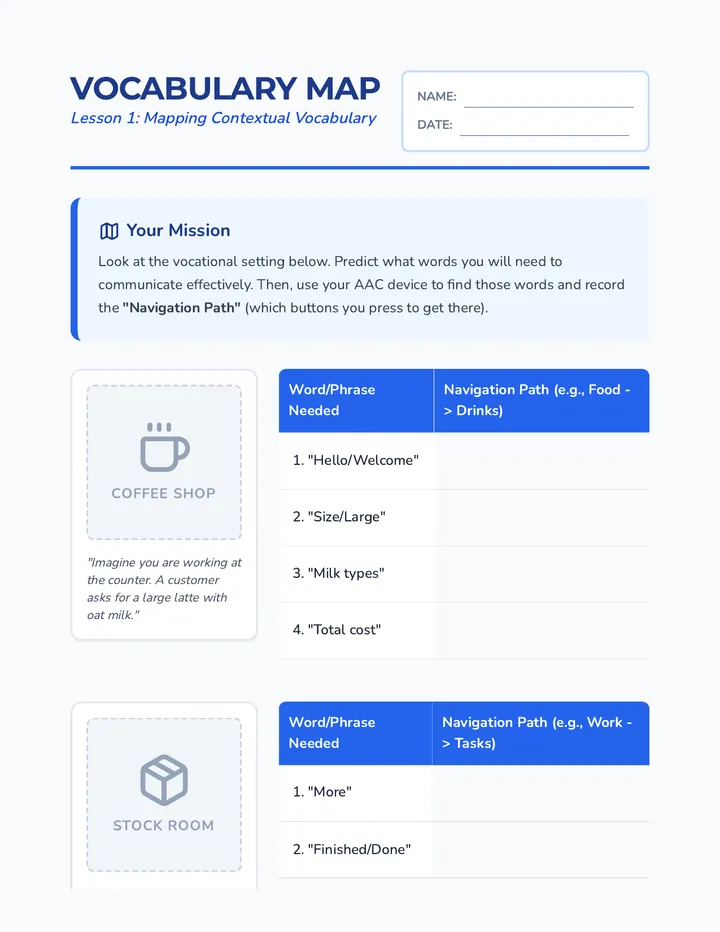
A comprehensive 5-lesson sequence designed for 11th-grade AAC users to master device navigation within vocational settings. Students progress from vocabulary mapping to high-stakes workplace simulations, focusing on speed, accuracy, and professional communication strategies.
A 30-minute one-on-one lesson teaching students how to use JAWS 2026 to navigate and edit Google Docs, focusing on the Virtual PC Cursor and essential keyboard shortcuts.
An individual coaching plan introducing and practicing assistive technologies (TTS, highlighting, dictation) to empower a 7th grade student with reading challenges.
A 30-minute professional development session for teachers focused on universal design principles to create inclusive Music, Physical Education, and Technology lessons for highly impacted, non-verbal students.
A 30-minute small group lesson for 2nd-5th grade students with ASD focused on selecting three personal strategies for each of the four Zones of Regulation. The lesson uses a superhero theme to empower students to build their own 'strategy superpower' toolkit.
A structured, interactive morning meeting routine for middle school students with significant cognitive disabilities, focusing on communication, temporal concepts, and social-emotional check-ins.
An introductory 15-minute lesson for 6th-grade students exploring long division through the lens of accessibility and UEB Braille. Students learn the DMSB steps while understanding how math is represented tactually for blind learners.
An individualized 90-minute lesson for adult students exploring the vital concept of communication accessibility, barriers, and inclusive strategies.
A Tier 2 ESE lesson for 2nd and 3rd-grade students focused on predicting using visual story sequences. Designed for small groups with heavy visual support for non-verbal learners.
A 30-minute Tier 3 individual lesson for a 1st-grade student focused on following 1 and 2-step visual directions using pictures and common objects.
A Tier 2 group lesson for middle school students with intellectual disabilities focused on social communication skills for holiday gatherings, including specific supports for AAC users.
A single-session lesson for K-2 students that introduces various communication devices, including Augmentative and Alternative Communication (AAC), to foster inclusion and understanding of how people connect.
This lesson helps adult learners accurately transcribe expressions with special symbols like currency, percent, and degrees, along with simple numeric fractions, into Braille. Mastering these transcriptions is crucial for effective communication and literacy in Braille.
This lesson helps adult learners accurately transcribe expressions with special print symbols (like currency, percent, and degrees) and simple numeric fractions into braille. it is designed for a 30-minute session focused on everyday literacy.
A Tier 3 intervention lesson for nonverbal 2nd grade students with ASD, focusing on using AAC devices and visual cues to communicate distress and request help during transitions to reduce aggressive behaviors.
This Tier 3 individual lesson introduces a 4th-grade student with ADHD, anxiety, and dysgraphia to the Question-Answer Relationship (QAR) strategy using high-interest soccer content. It focuses on 'Right There', 'Think and Search', and 'On My Own' question types through explicit modeling and scaffolded practice.