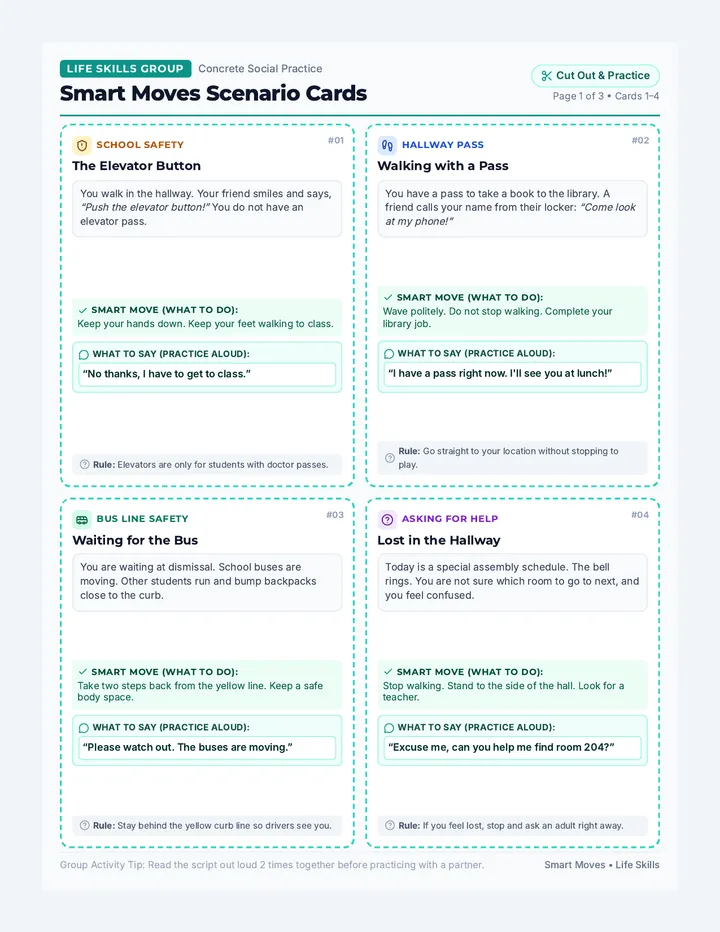
Verbal scripts and self-advocacy strategies for identifying when to request assistance and selecting appropriate communication partners. Addresses timing, tone, and persistence across academic and social environments.
This sequence empowers 5th-grade students to understand, use, and advocate for Text-to-Speech (TTS) as a vital learning tool. It focuses on the distinction between fairness and sameness, identifying specific tasks where TTS is most effective, and building the social-emotional confidence to communicate needs to teachers and peers.
A comprehensive sequence designed for Pre-K students to develop interoception skills and functional communication for requesting breaks. Students learn to recognize high-energy body states and use a visual break card to self-regulate.
A 1st Grade Special Education sequence focused on identifying common classroom obstacles. Students learn to recognize the feeling of being 'stuck' and categorize barriers like missing supplies, sensory distractions, and unclear instructions through game-based learning.
A Pre-K Special Education sequence focused on collaborative problem-solving. Students learn to work in pairs to overcome physical and communication-based obstacles through games, role-play, and hands-on tasks.
A Pre-K Special Education sequence focused on identifying obstacles and seeking help effectively. Students move from recognizing the physical sensation of being 'stuck' to using specific communication tools to solve problems.
A 5-lesson sequence designed for 3rd-grade students to transition from general problem-solving to self-advocacy. Students learn to distinguish between complaining and advocating, identify appropriate sources of help, draft personal advocacy scripts, and create a physical 'Help Menu' tool for daily use.
A Kindergarten sequence focused on task persistence and emotional regulation for Special Education students. Students learn to identify frustration, use 'yet', ask for help strategically, break tasks into steps, and apply these skills in an obstacle course.
A comprehensive sequence for graduate students to master the implementation of Student-Led IEPs (SLIEPs). This sequence explores the continuum of student involvement, preparation protocols, visual advocacy aids, meeting facilitation techniques, and post-meeting reflection to empower students as self-advocates for their own accommodations.
A graduate-level sequence focused on the instructional methodology for teaching self-advocacy skills, specifically requesting accommodations. Graduate students will learn to task-analyze requests, design tiered scripts, facilitate behavioral rehearsals, collect data on advocacy behaviors, and plan for generalization.
A simulation-based sequence for 6th graders to strengthen working memory and focus through precise, single-step instructions. Students engage in collaborative building, robotic programming, and assembly line tasks to master the art of sequential processing.
A self-advocacy sequence for 11th-grade students to manage working memory challenges by requesting single-step directions and professional modifications in fast-paced environments.
A vocational training sequence for 11th-grade students focusing on working memory through single-step directions in workplace safety contexts. Students practice interpreting signs, filtering auditory distractions, and following strict protocols in high-stakes simulations.
The culminating project template for the sequence—a 'User Manual' that students fill out to document their learning style, AT tools, usage map, and self-advocacy scripts.
A 5-slide presentation for the final lesson, framing the 'User Manual' project as a tool for student independence and future teacher communication.
A teacher guide for the final lesson, providing instructions for the 'User Manual' project and a sequence-wide reflection checklist for student independence.
A student activity sheet for Lesson 4 where students decode peer curiosity, select their favorite 'Power Reply', and practice the body language of confidence.
A 5-slide presentation for Lesson 4 that teaches students how to handle peer curiosity with short, confident 'Power Replies' and a positive attitude.
A teacher guide for Lesson 4 that addresses the social-emotional side of AT use, including a case study about hiding tools and strategies for confident, short replies to peer questions.
Handy role-play script cards for students to practice self-advocacy in different school scenarios, including a 'create-your-own' card and a peer review checklist.
A 6-slide presentation for Lesson 3 that defines self-advocacy, breaks down a respectful script template, and provides tips for using a 'Power Voice' during role-play.
A teacher guide for Lesson 3 detailing how to teach self-advocacy scripts, including role-playing the 'Substitute Challenge' and facilitating peer feedback on communication style.
A student activity sheet for Lesson 2 that guides students through sorting school reading tasks into traffic light categories and developing a personal 'deployment plan' for TTS use.
A 5-slide visual presentation for Lesson 2, focusing on the traffic light framework (Red, Yellow, Green) for TTS use and the concept of brain energy conservation.
A teacher guide for Lesson 2 that introduces the 'Red, Yellow, Green Light' framework for identifying reading tasks that require TTS, including workshop steps and energy conservation talking points.
Culminating project where students design a 'User Manual' for their brain, documenting their specific tech needs and preferences to share with future educators.
Focuses on building confidence when explaining assistive technology to peers. Students learn strategies to respond to curiosity or criticism with poise and clarity.
Students develop and practice verbal scripts to respectfully request TTS access from various adults, including substitutes. Role-playing builds the executive function and communication skills needed for self-advocacy.
Learners analyze their school day to identify high-need reading tasks that benefit from Text-to-Speech. Using a 'Red Light, Green Light' framework, they create a personal usage map for their technology.
Students explore the concept of fairness versus sameness using the Band-Aid activity to understand that everyone needs different tools to succeed. They define assistive technology as an essential accommodation for access rather than an unfair advantage.
Teaches students the routine of ending a break and transitioning back to the classroom group, using positive rituals to reduce re-entry anxiety.
Focuses on identifying 'in-the-moment' signs of dysregulation during classroom activities and using the break card with adult prompting and reinforcement.
Teachers and students practice the sequence of recognizing frustration or high energy and using the break card in a controlled, low-stress role-play environment.
Introduces the physical 'Break Card' as a communication tool. Students learn the basic mechanic of exchanging the card for immediate reinforcement (access to a sensory break).
Students learn to identify internal physical sensations by comparing 'fast' and 'slow' body energy using animal analogies. This foundational lesson focuses on labeling high-energy states as a precursor to requesting breaks.
Students solidify their ability to categorize classroom barriers by playing a Bingo game with scenarios and images representing missing items, noise, and confusion.
Students play games with gibberish or impossible instructions to practice identifying when a lack of information is the obstacle. They learn specific signals for 'I don't understand.'