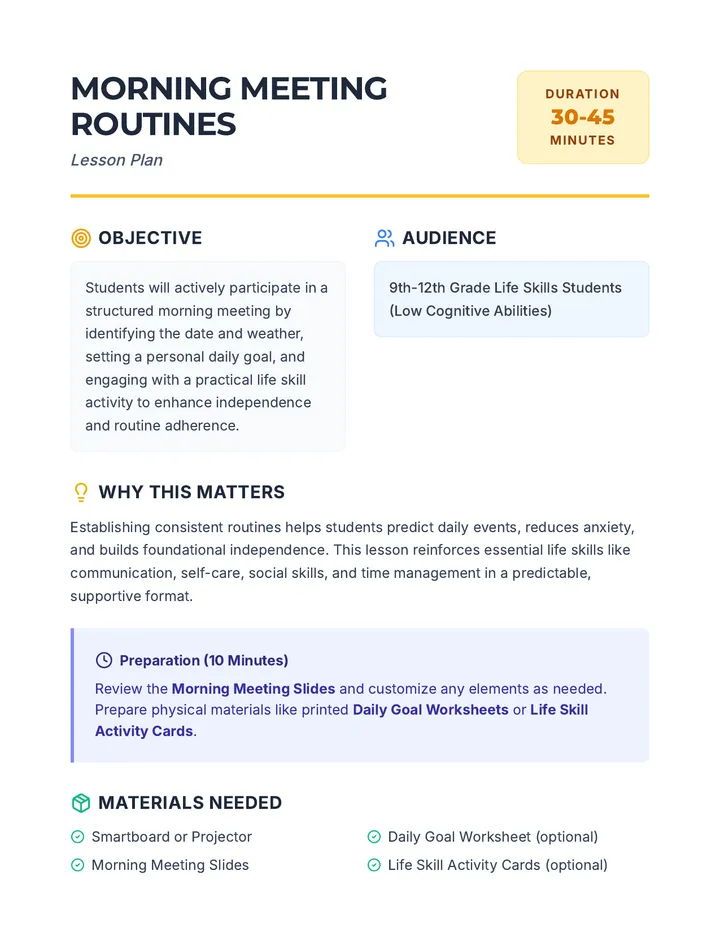
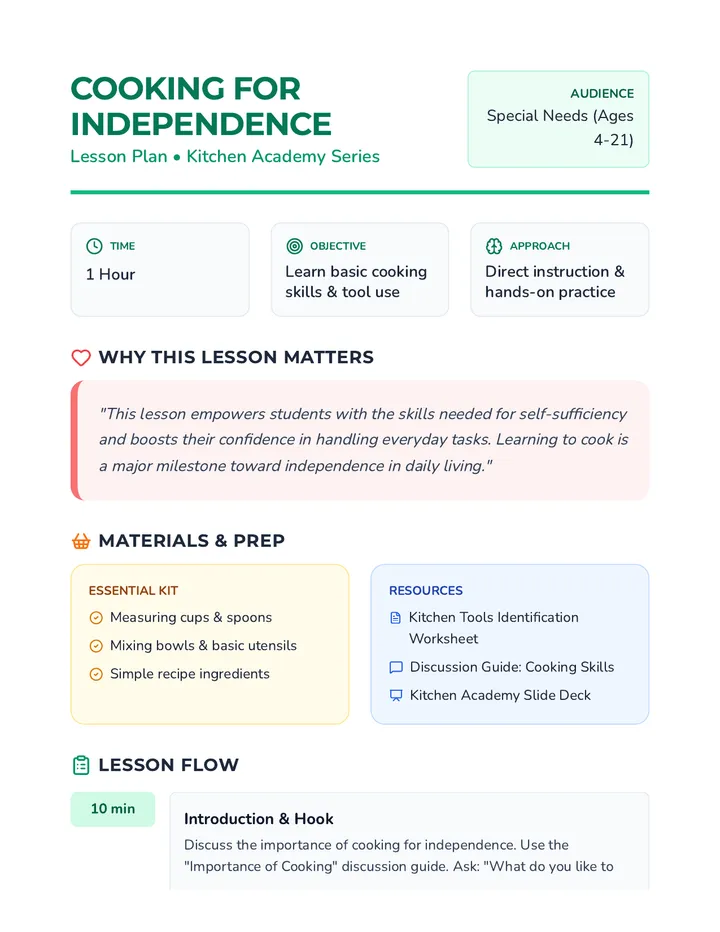
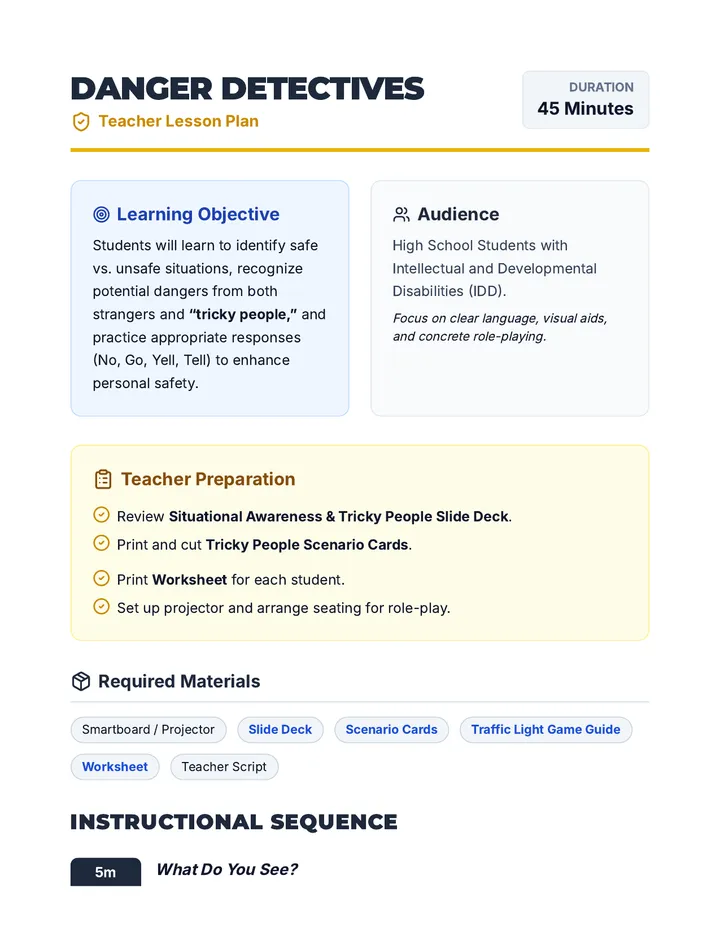
Targeted skill development for daily life activities including budgeting, meal preparation, and personal safety. Prepares students with IEPs for successful transitions to autonomous living environments.
A graduate-level sequence focused on the clinical transition from contrived token systems to natural reinforcement, covering social praise conditioning, schedule thinning, level systems, self-monitoring, and long-term exit strategies.
A professional, project-based sequence where students act as behavioral consultants to design, budget, and pitch a comprehensive token economy intervention. Students analyze complex cases, manage resources, and develop staff training protocols to ensure sustainable behavioral change.
This sequence teaches 11th-grade students how to use digital visual systems (calendars, Kanban boards, and widgets) to support working memory and executive function. Students transition from reactive list-making to proactive visual time and task management, preparing them for the demands of college and career environments.
A 5-lesson sequence for 12th-grade students with working memory challenges, focusing on using assistive technology to break down complex tasks into manageable single-step directions. Students explore checklists, voice assistants, photo-based instructions, and QR codes to build independence through digital literacy.
A specialized instructional unit for 12th-grade students focusing on overcoming working memory challenges through single-step task execution. This sequence teaches students to use 'masking', task deconstruction, and binary decision-making to master complex home maintenance and independent living tasks.
This sequence focuses on vocational and life skills, applying single-step direction following to physical assembly and procedural tasks. Students learn to navigate technical diagrams and standard operating procedures by isolating one action at a time to support working memory.
A comprehensive sequence for 12th-grade students on mastering web browser navigation using keyboard shortcuts. This unit covers address bar manipulation, tab management, link navigation, form interaction, and integrated research workflows to build independence and efficiency in digital environments.
A comprehensive sequence for 11th-grade students to master the organization, maintenance, and management of sensory tools and classroom resources. Students transition from identifying tools to designing professional-grade inventory and hygiene systems.
This sequence empowers 12th-grade students to identify and leverage digital accessibility tools for independent study. Students move from exploring assistive technology to curating a personalized digital study ecosystem, culminating in a self-advocacy portfolio for post-secondary success.
This sequence introduces students to Universal Design principles and data tracking through physical organization. Students will learn to design, implement, and stress-test labeling and storage systems that are accessible to diverse users, building vocational skills in logistics and systems design.
This sequence prepares 12th-grade students with working memory challenges for post-secondary life by teaching them how to deconstruct complex projects, externalize their executive functions, and monitor their own cognitive fatigue. Students progress from task analysis to a full independent workflow simulation, building a toolkit of strategies for sustained attention.
This graduate-level sequence explores the psychological and ethical complexities of reinforcement. It contrasts traditional behavioral perspectives with Self-Determination Theory, examines the overjustification effect, and addresses cultural responsiveness and ethical codes in behavioral support.
Instructor capstone assessment guide for the exit strategy. Includes a detailed grading rubric for thinning logic and natural contingencies, plus tips for facilitating the "Graduation" letter activity.
Comprehensive capstone document for graduate students to draft a client exit strategy. Includes sections for fading roadmaps, mediator training, relapse prevention, and a graduation letter narrative.
Graduate capstone slides for generalization and exit strategies in token economies. Covers the graduation letter hook, maintenance strategies, exit checklists, and post-exit monitoring protocols.
Instructor resource for teaching the Match Protocol of self-monitoring. Includes psychological insights, simulation facilitation steps, and high-level discussion questions for graduate students.
Protocol and training log for teaching client self-monitoring. Includes space for defining behavioral mastery anchors, a matching trial log, and practice for post-mismatch coaching scripts.
Graduate slides on self-monitoring and self-management, focusing on the "Match Protocol" for transferring behavioral responsibility to the client. Covers training steps, matching criteria, and clinical goals.
Student design blueprint for creating a three-tier level system. Includes sections for client profile, entrance criteria, privileges for each level, and back-step protocols.
Instructor case study analysis focusing on the "Podium System" trap. Provides red flags for public labeling, negative reinforcement, and a framework for clinical redesign.
Graduate slides on Level System design within token economies, focusing on bridging the gap to natural reinforcement, avoiding shaming traps, and fading contrived rewards.
Final teacher facilitation guide for Lesson 5, focusing on simulation management, boardroom Q&A facilitation, and providing professional feedback.
Instructor resource for teaching schedule thinning, including ratio strain indicators, a back-step protocol for regression, and a guide for calculated schedule transitions.
Worksheet for graduate students to practice the mathematical and clinical aspects of schedule thinning. Includes VR schedule design, trend analysis for clinical decision-making, and identifying ratio strain.
The capstone lesson on planning for skill maintenance and generalization across settings with a clear exit strategy.
Explores techniques for teaching clients to track and manage their own behavior, moving toward clinical independence.
Teaches students how to design and implement level systems that bridge the gap between token economies and real-world expectations.
Covers the technical process of thinning reinforcement schedules to build behavioral endurance and reduce dependency on frequent tokens.
Focuses on stimulus pairing procedures to transform social praise into a secondary reinforcer, essential for fading token systems.
The culmination of the project where students pitch their comprehensive proposals to a mock board of directors in a 'Shark Tank' format.
Students define success metrics and design evaluation tools, including satisfaction surveys, to ensure program accountability.
Focuses on instructional design for adult learners, where students create cheat sheets and protocols to train staff on the intervention.
Students calculate the financial and human resources required for their intervention, drafting budgets for reinforcers and staff time.
Students analyze complex client vignettes to identify behavioral needs and conduct a feasibility audit for a token economy implementation.
Students synthesize their learning by presenting their integrated 'Digital External Brain' system. They create a 'User Manual' that explains how their chosen tools support their specific memory needs.
Exploration of gamification elements like progress bars, streaks, and XP to motivate task completion. Students select a gamified tool to track a personal habit or goal.