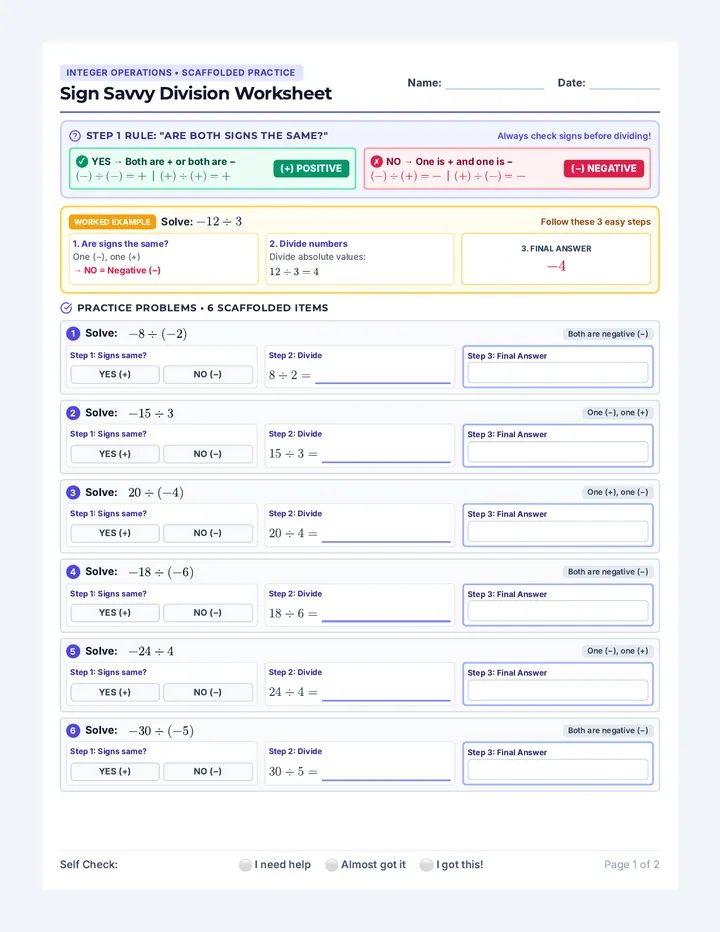
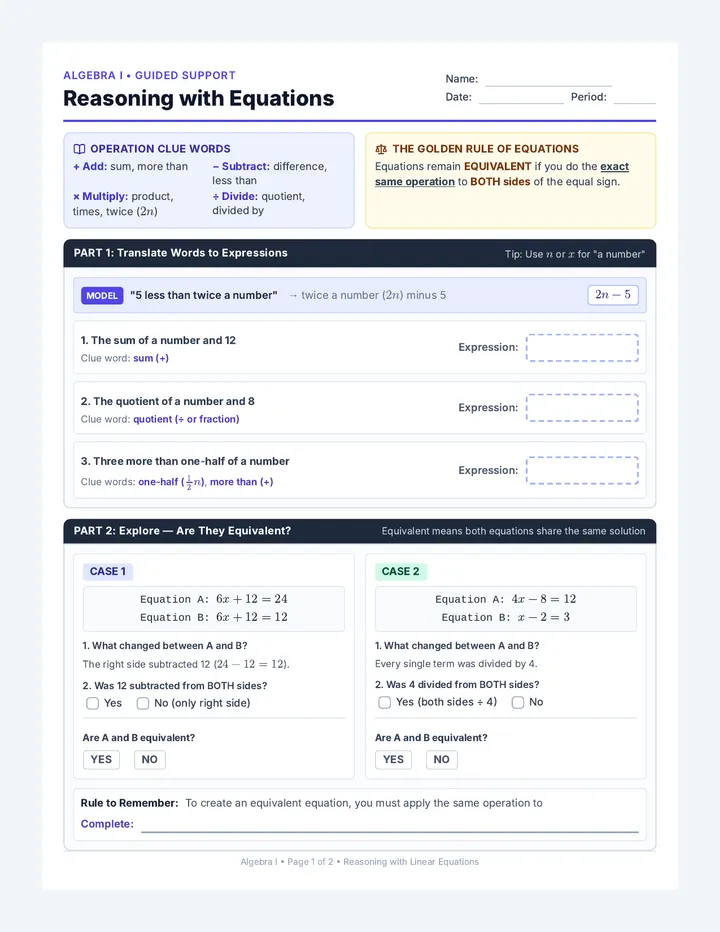
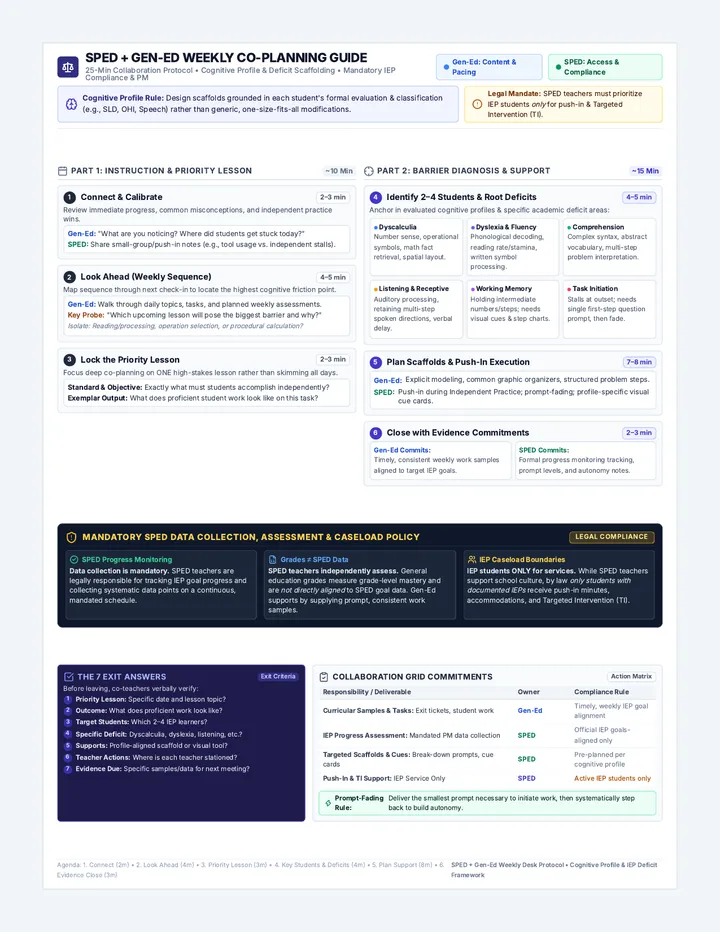
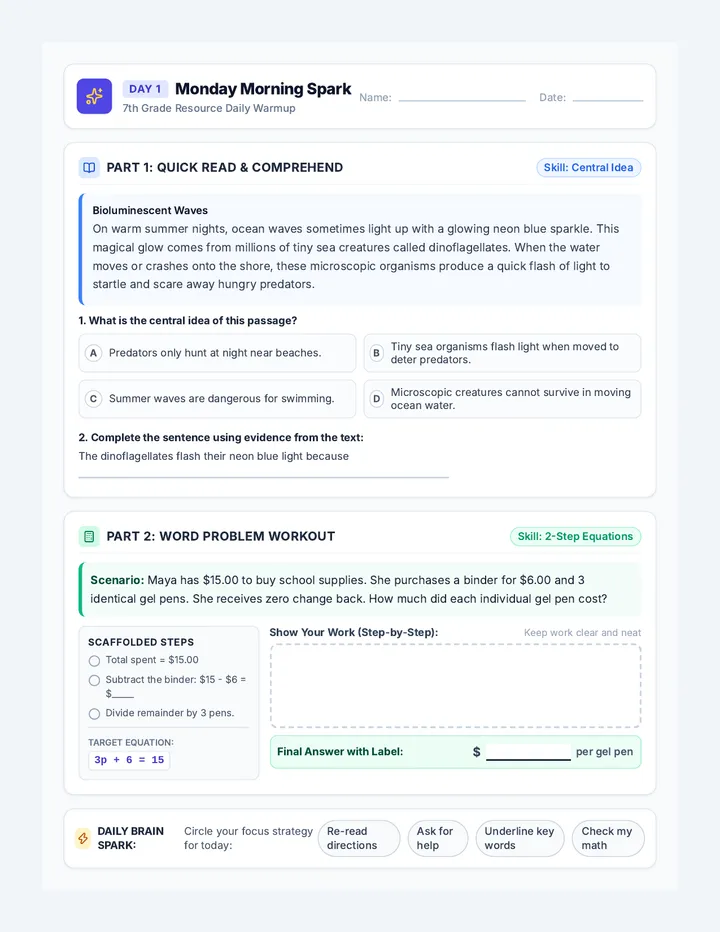
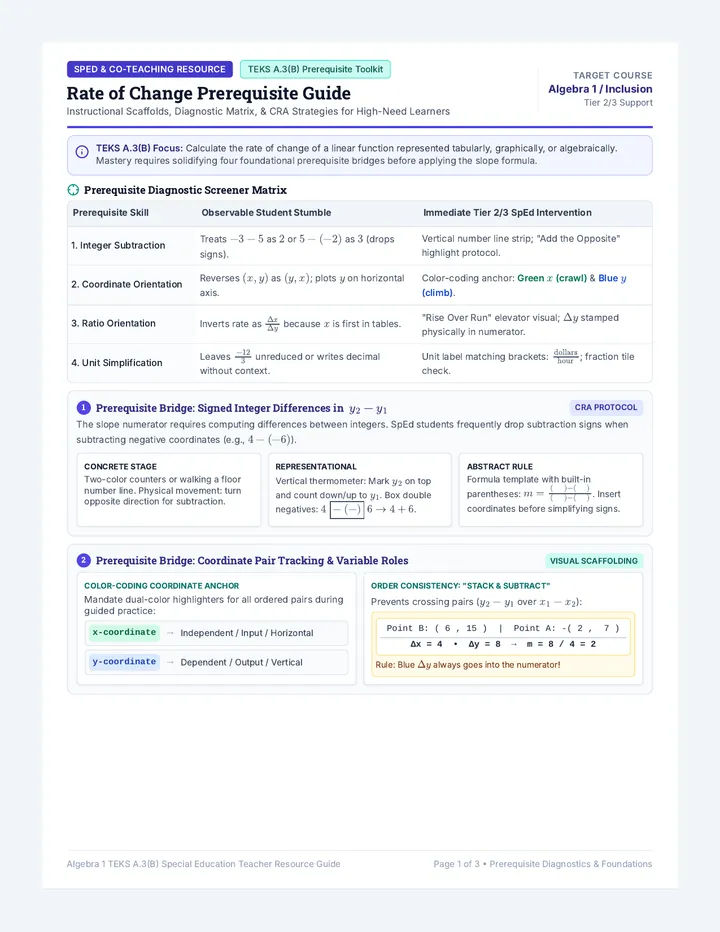
Multi-sensory math manipulatives, visual problem-solving, and text annotation strategies for literacy and numeracy. Employs graphic organizers, sentence frames, and assistive technology to support memory, comprehension, and writing development.
A comprehensive financial literacy sequence for Special Education students focusing on real-world budgeting, income analysis, and banking skills for independent living.
A project-based sequence for 4th-grade students in special education settings, focusing on moving from passive highlighting to active extraction, organization, and synthesis. Students learn to refine highlights, extract them onto cards, sort ideas logically, and create a visual 'One-Page Expert Guide' as a summary tool.
This sequence teaches 5th-grade students how to offload working memory demands using visual scaffolding. Students learn to use mind maps, color-coding, focused drafting techniques, and visual checklists to sustain attention during complex, multi-step tasks like writing and project management.
A comprehensive sequence for 4th-grade students to master Text-to-Speech (TTS) assistive technology. Students learn to navigate complex text features, clean up cluttered webpages, tackle math word problems, conduct research, and take effective notes using auditory tools.
A comprehensive graduate-level sequence focused on the pedagogical implementation of assistive writing technology. It shifts the focus from tool selection to instructional methodologies that scaffold digital organizers, dictation, and text-to-speech for student autonomy.
This graduate-level sequence prepares educators to evaluate and select assistive writing technologies using evidence-based frameworks like SETT. It covers the neurology of dysgraphia, technical analysis of speech-to-text and word prediction, and the legal requirements for IEP implementation.
A 5-lesson sequence designed for 6th-grade special education students to master text highlighting and annotation. Students act as 'Text Detectives' to identify, scan, categorize, and evaluate textual evidence to support argumentative writing.
This sequence prepares pre-service teachers to evaluate, select, and implement assistive technology (AT) tools specifically designed for students with dysgraphia and physical motor impairments. Students will move from understanding neurological barriers to designing comprehensive, data-driven AT implementation plans.
This sequence empowers 3rd-grade students to bypass physical writing barriers using assistive technology tools like speech-to-text, digital organizers, and word prediction. Students progress from basic dictation mechanics to publishing a fully edited personal narrative, fostering independence and confidence in their writing abilities.
A 5-lesson unit for 6th-grade students focused on mastering assistive writing technologies, including speech-to-text, word prediction, and digital graphic organizers, culminating in a personal narrative and a self-advocacy tech plan.
This sequence introduces 2nd-grade students to assistive writing technology, including speech-to-text, digital organizers, word prediction, and text-to-speech, to foster independence in writing.
This sequence transitions students from passive reading to active engagement using systematic annotation strategies designed for diverse learners. Students learn to distinguish essential information, apply a color-coding system, use marginalia, and extract evidence for writing.
A specialized sequence for 6th-grade students focusing on working memory support through visual encoding. Students learn to transform auditory single-step directions into mental images and physical sketches to improve recall and task execution.
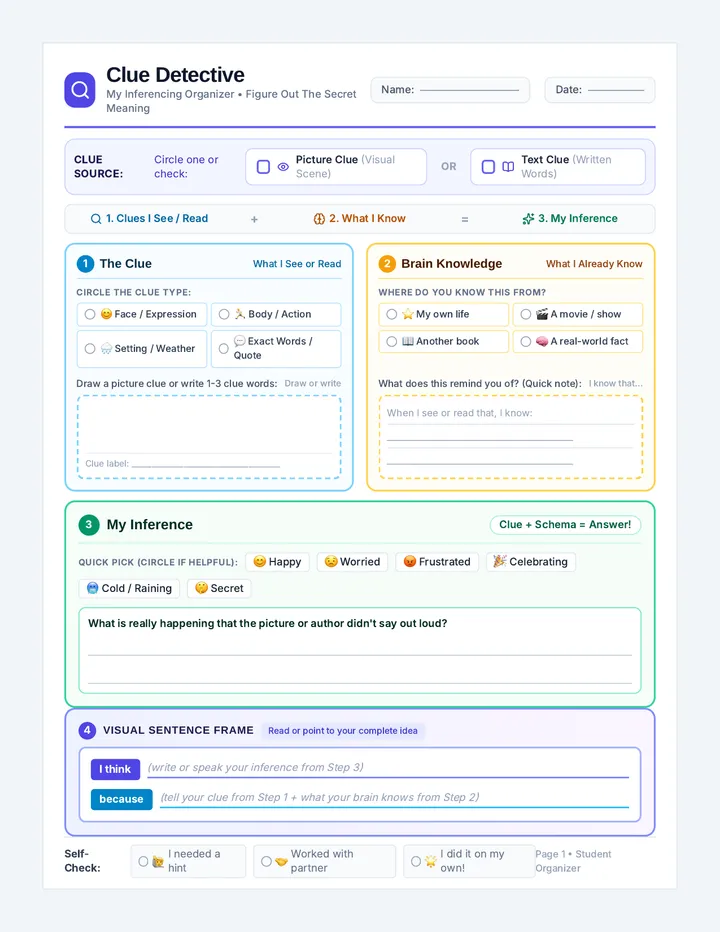
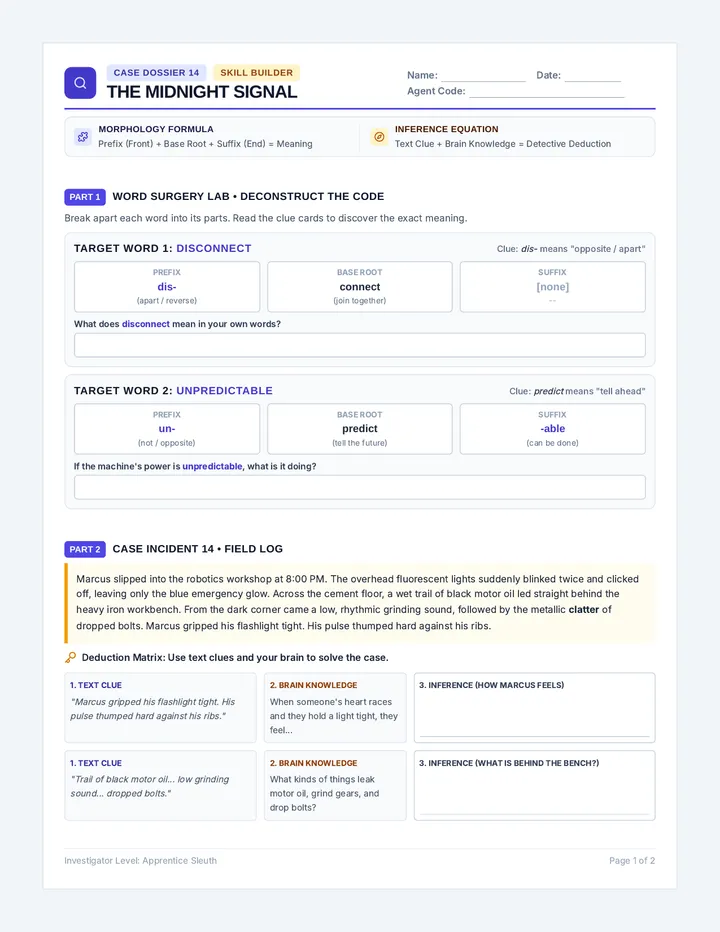
A detective-themed sequence for 1st-grade special education students to master inferencing through concrete objects, body language, sensory details, and text clues.
This sequence teaches 3rd-grade students how to use text-to-speech (TTS) as a strategic tool for narrative comprehension. Students learn to use audio for identifying story elements, summarizing via the 'Listen-Stop-Think' routine, citing evidence by re-listening, and visualizing descriptive text.
A 5-lesson sequence for 3rd graders to master text-to-speech (TTS) technology. Students progress from identifying basic controls to independent 'ear reading' with grade-level digital texts.
A sequence for 2nd Grade students to master text-to-speech (TTS) as a tool for reading comprehension. Students transition from decoding mechanics to deep understanding by using auditory support to predict, pause, answer questions, visualize, and sequence stories.
A project-based unit where 6th-grade students use text-to-speech technology to access and analyze complex informational texts. Students develop research skills, digital literacy, and metacognitive awareness of their own learning tools.
This sequence shifts the focus from assistive technology to the cognitive strategies required for auditory learning. Students engage in inquiry-based activities to distinguish between passive hearing and active listening, applying specific comprehension strategies while using text-to-speech (TTS) to access grade-level texts.
A 4th-grade sequence focused on using Text-to-Speech (TTS) technology as a multi-sensory reading comprehension tool. Students learn to synchronize visual tracking with audio, visualize content through pauses, clarify vocabulary, re-read for evidence, and summarize narratives.
This sequence guides 9th-grade students through the cognitive strategies of using Text-to-Speech (TTS) for deep comprehension. It moves from basic bi-modal tracking to advanced digital annotation and genre-specific strategy adaptation, culminating in a rigorous auditory comprehension assessment.
This sequence equips graduate students with the pedagogical and administrative skills to integrate text-to-speech (TTS) effectively within K-12 settings. It moves from mechanical operational training to strategic metacognitive instruction, psychosocial management, and data-driven evaluation, culminating in a school-wide implementation plan.
A comprehensive sequence for undergraduate special education students focused on tailoring text engagement and annotation strategies for learners with SLD, ADHD, and visual processing needs. Students analyze case studies, evaluate assistive technologies, and design bespoke support plans.
A 5-lesson sequence for 11th-grade students transitioning from physical math manipulatives to virtual tools. The curriculum emphasizes digital literacy, strategic tool selection, and self-advocacy to prepare students for post-secondary academic environments.
This sequence uses a Concrete-Representational-Abstract (CRA) approach to help 3rd-grade students in special education master multi-digit addition and subtraction. It moves from physical base-ten blocks to shorthand drawings and finally to the standard numeric algorithm, emphasizing the conceptual 'why' behind regrouping.
This advanced graduate sequence focuses on the design and implementation of the Concrete-Representational-Abstract (CRA) framework for learners with mathematics disabilities. Students will move from diagnostic error analysis to the creation of comprehensive, evidence-based intervention plans.
A 10th-grade special education sequence focused on the strategic use of virtual manipulatives to bridge the gap between concrete modeling and abstract algebraic reasoning. Students progress from tool exploration to independent selection and justification.
This sequence uses base-ten blocks to help 6th-grade students with learning disabilities visualize decimal place value and operations. By redefining the 'flat' as one whole, students tactilely explore tenths and hundredths to build a concrete foundation for addition and subtraction.
A comprehensive sequence for pre-service teachers on the Concrete-Representational-Abstract (CRA) framework. This unit covers place value, multi-digit addition, subtraction, and multiplication, focusing on explicit instruction and scaffolding for students with learning disabilities.
A comprehensive sequence for pre-service special education teachers focusing on diagnosing fraction misconceptions and implementing hybrid intervention strategies using physical and virtual manipulatives. Students move from error analysis to designing technology-integrated support plans for learners with disabilities.
This sequence teaches 3rd-grade students with working memory challenges how to decompose multi-step instructions into manageable 'chunks' using action verbs, sequencing, and visualization techniques. Students progress from identifying cognitive overload to independently managing complex academic tasks using self-created checklists.
A 5-lesson sequence for 11th-grade students focused on working memory support through cognitive offloading. Students learn to externalize complex STEM processes using flowcharts, reference anchors, and error analysis to reduce mental load and improve accuracy.
This sequence teaches 2nd-grade students how to use visual checklists and 'chunking' strategies to manage multi-step tasks. By breaking large goals into manageable steps, students develop the working memory supports needed for academic success and daily routines.
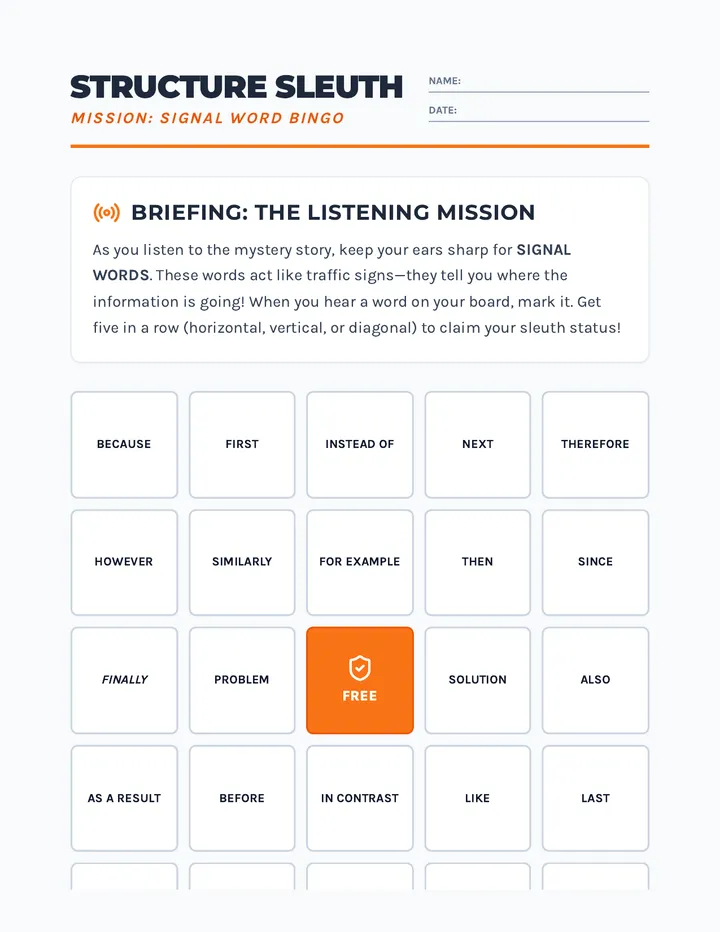
A 2nd-grade sequence designed for special education support, focusing on the compare and contrast text structure through the use of Venn diagrams. Students progress from sorting physical objects to comparing images, identifying signal words, and ultimately extracting information from text to populate diagrams and write comparative sentences.
A specialized sequence designed for 9th-grade students needing working memory support. It focuses on using visualization and spatial mapping to follow multi-step instructions in academic settings.
A 30-minute introductory lesson for elementary students on Discrete Trial Instruction (DTI) using numbers 1-5. Students learn the three-part DTI cycle (Antecedent, Behavior, Consequence) through interactive drills and practice.
A 30-minute preschool lesson featuring three multi-sensory learning centers focused on fine motor skills, pattern recognition, and early literacy with a festive winter theme.
This 30-minute professional development session equips Kindergarten teachers with practical, classroom-wide strategies to engage all learners. Learn to ignite curiosity and participation in students who may be disengaged, have fewer ways to show their thinking, or struggle with classroom routines and content.
A 50-minute individualized Orton-Gillingham lesson for 4th-grade students with dyslexia, focusing on decoding multisyllabic words through syllable division rules for closed, open, and r-controlled syllables.
A 10-day curriculum for Pre-K special education students to learn the concepts of 'whole' and 'half' through repetitive, hands-on, superhero-themed activities.
A 30-minute, multisensory lesson designed for a 7-year-old student with ADHD and dyslexia to master consonant 'l' blends using interactive 'Level Up' themed activities.
This lesson introduces equivalent fractions (wholes, halves, and fourths) using visual and hands-on activities, designed specifically for students with severe autism. It focuses on identifying that different fraction names can represent the same amount through physical manipulatives and clear visual aids.
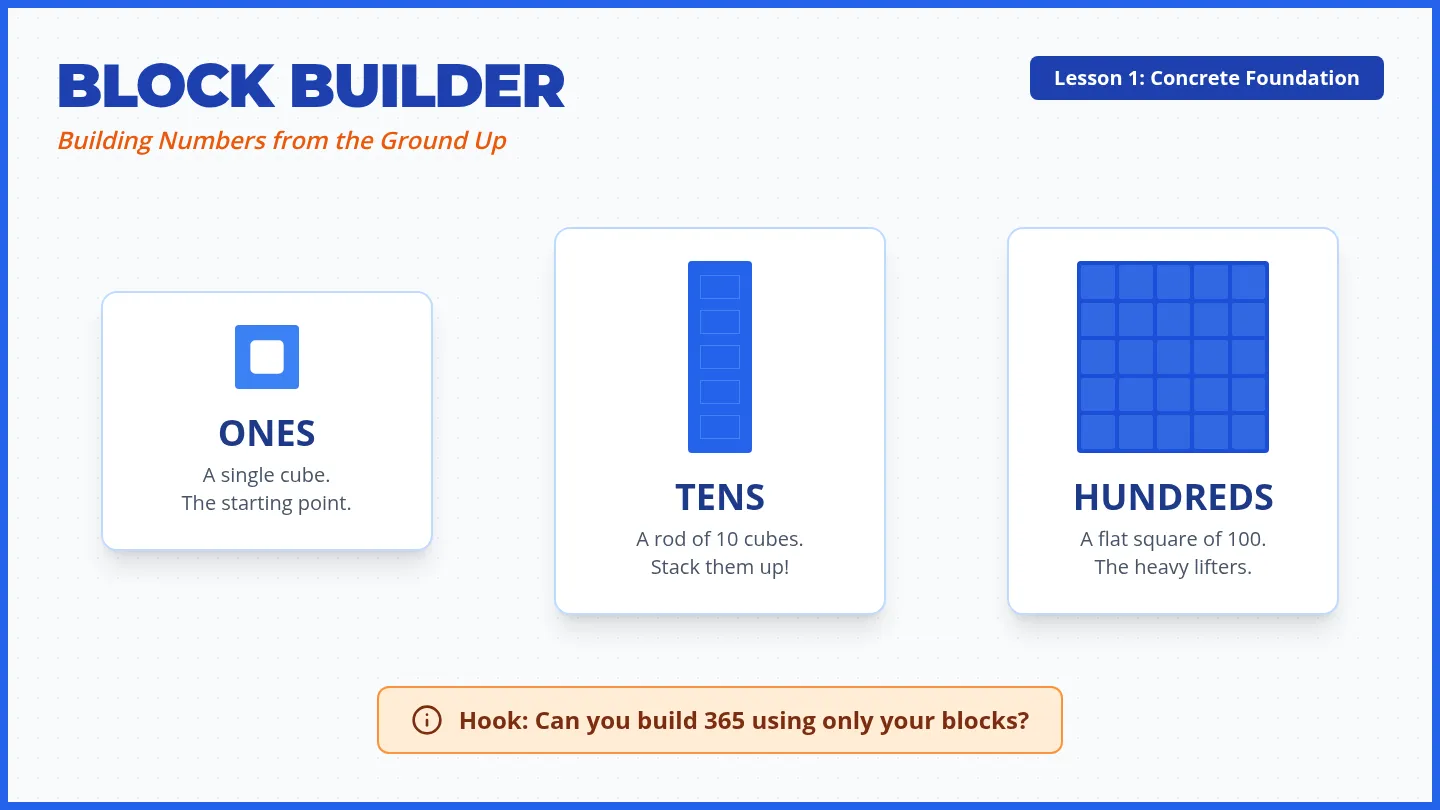
A foundational math lesson for 2nd-grade special education students focusing on understanding tens and ones using base-ten blocks and interactive activities.
A high-intensity Tier 3 intervention focused on phoneme segmentation and blending of CVC words using a 'Sound Construction' theme. This lesson provides explicit, systematic instruction for students requiring intensive literacy support.
An intensive, one-on-one Tier 3 intervention focusing on phoneme segmentation and blending in CVC words. This lesson uses multi-sensory Elkonin boxes and explicit teacher modeling to build foundational literacy skills.
A Tier 3 multiplication lesson designed for students with exceptionalities, focusing on concrete strategies like arrays, equal groups, and number lines to master facts up to 5x5.
A 30-minute professional development session empowering educators to design data-driven intervention plans through a collaborative design sprint approach. Participants analyze case studies, brainstorm strategies, and set SMART goals for student support.
A 15-minute interactive literacy lesson for 1st-grade subseparate classrooms based on Jan Brett's 'The Mitten,' focusing on animal identification and narrative sequencing.
A intensive Tier 3 lesson designed for individual students to master identifying the main idea and supporting details using visual strategies and explicit instruction.
A 90-minute lesson for 4th graders on creating concept maps. Students will learn to visualize relationships between ideas using nodes, linking words, and cross-links to enhance their comprehension and organizational skills.
A 30-minute individual session helping 4th-grade students master brainstorming and organizing thoughts using visual maps.
A 30-minute individualized Tier 3 lesson for 4th-grade students to master identifying the central idea and supporting details in informational texts using a detective-themed approach.
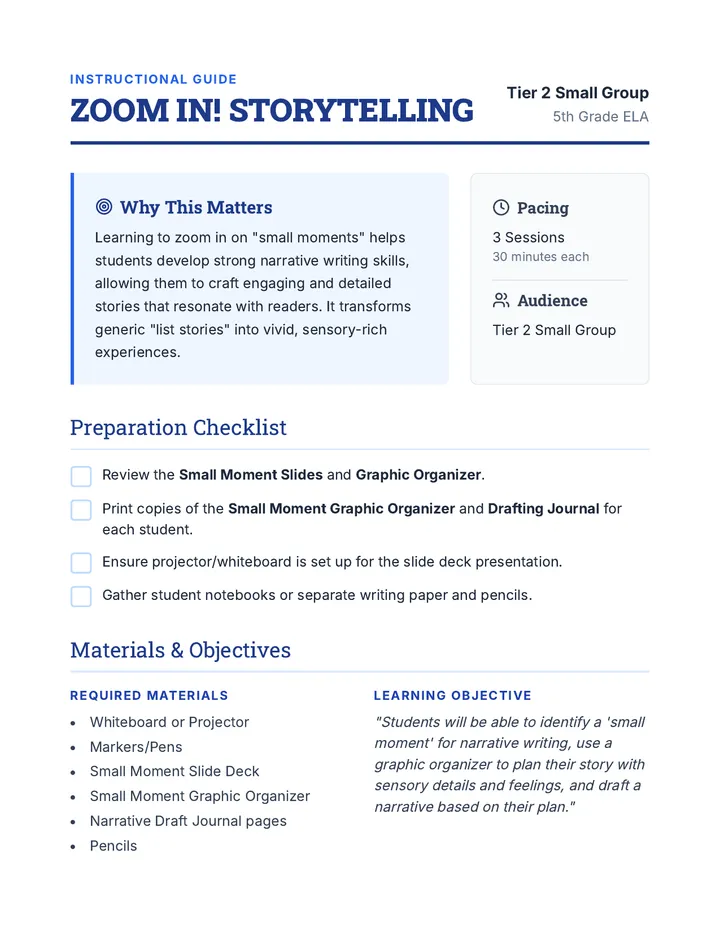
A 30-minute Tier 2 small group lesson focused on retelling the story of Mary Anning using a graphic organizer, word banks, and sequencing activity to support students with writing and comprehension challenges.
This lesson guides a 3rd-grade student with autism through the creative process of writing a Pixar-style screenplay, specifically 'Planes 3'. It breaks down storytelling into 7 visual steps, encouraging creativity, problem-solving, and emotional connection.
A three-week individualized intervention sequence designed to help 5th-grade students master the skill of identifying main ideas and supporting details across various texts.
A comprehensive 60-minute lesson for K-5 special education students exploring the pumpkin life cycle through slides, stories, sorting activities, and hands-on worksheets. Students will learn the journey from a tiny seed to a big orange pumpkin.
A 30-minute Tier 2 lesson for 5th-graders focusing on narrative retell skills, including story element identification, concise summaries, and strategic pausing. Students engage in interactive instruction and a peer-reviewed retelling game to build confidence and clarity.
A cozy 15-minute literacy lesson for 1st-grade subseparate classrooms based on Jan Brett's 'The Mitten,' focusing on animal identification and sequencing.
A 2nd-grade Tier 2 reading comprehension lesson where students become 'reading detectives' to find key details in 'The Sleepy Bear Story'. Includes guided reading, discussion, and a comprehension worksheet.
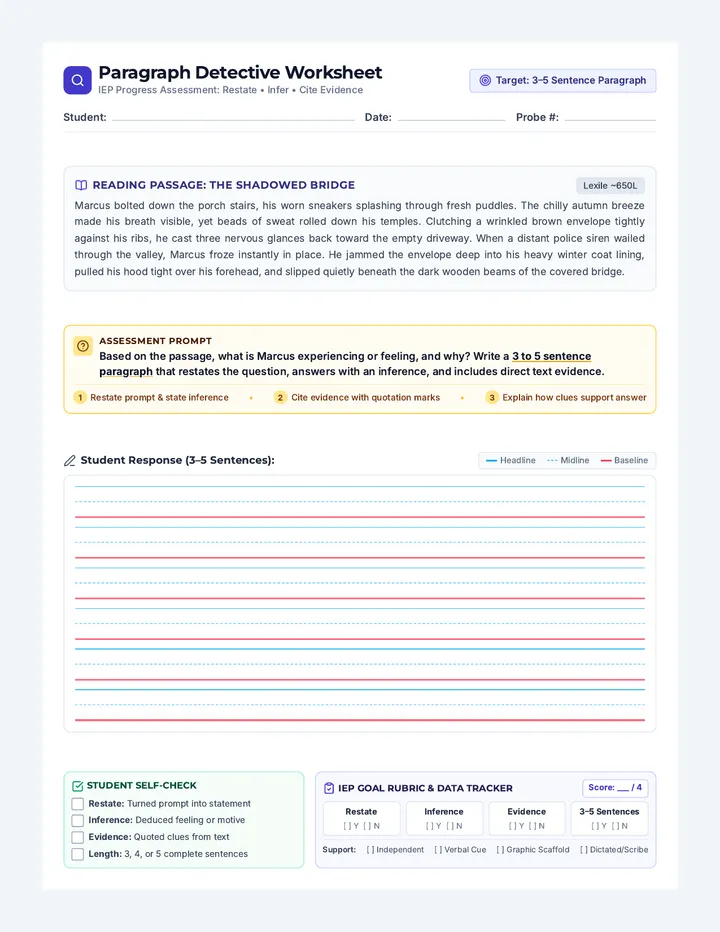
A foundational lesson for 6th-grade special education students on making inferences. Using a detective theme, students learn to combine text clues with background knowledge to uncover implied meanings in short passages.
A 30-minute Tier 3 lesson designed for students with exceptionalities, focusing on reading comprehension through a "detective" lens. Students learn to use reading "superpowers" to decode mysteries and find key details.
This 60-minute individualized lesson focuses on mastering the alternate long 'U' sounds (/oo/ and /yoo/) for a 6th-grade student with ADHD and dyslexia. It uses a detective theme and multi-sensory strategies to support engagement and phonemic awareness.
A high-energy Tier 2 intervention lesson for 7th graders to master tricky high-frequency words through reading passages, games, and writing challenges.
A multi-sensory Orton-Gillingham phonics lesson for third-grade students with dyslexia to master the /ar/ sound using a pirate-themed treasure hunt approach.
This Tier 3 individual lesson introduces a 4th-grade student with ADHD, anxiety, and dysgraphia to the Question-Answer Relationship (QAR) strategy using high-interest soccer content. It focuses on 'Right There', 'Think and Search', and 'On My Own' question types through explicit modeling and scaffolded practice.
A Tier 2 small-group lesson for 8th-grade students with ADHD, focusing on unlocking their 'superpowers' through effective study, time management, and organization strategies.
A 45-minute lesson for 3rd graders to build empathy and awareness of diverse learning needs through Universal Design for Learning (UDL) principles and hands-on station activities.
A targeted 50-minute individual lesson for 6th graders to strengthen working memory through visualization, chunking, and rehearsal strategies. This session includes interactive games, reading tasks, and structured reflection to build cognitive confidence.