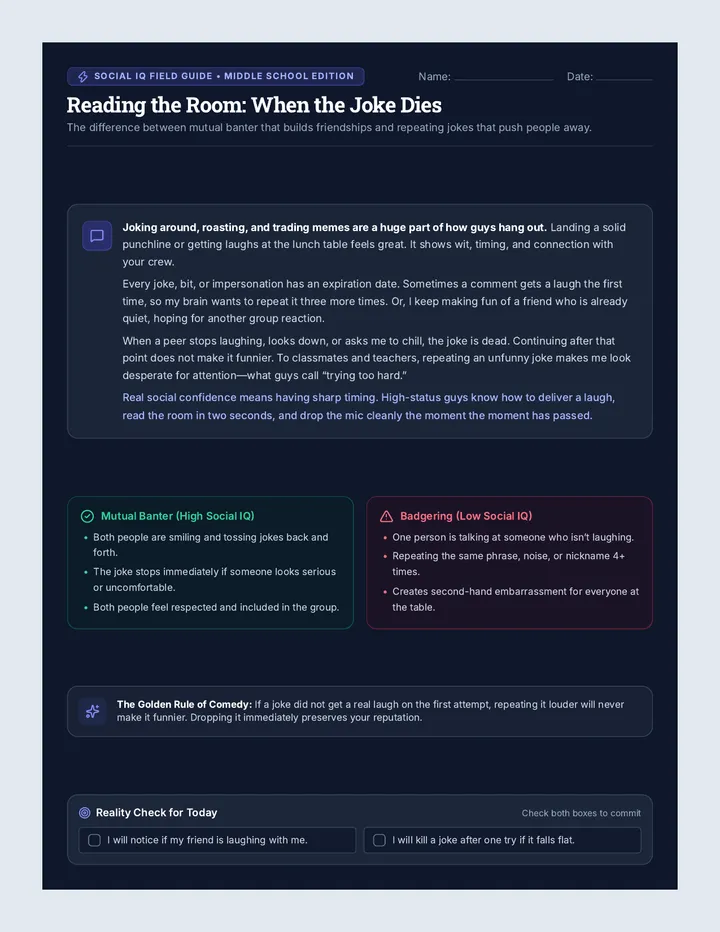
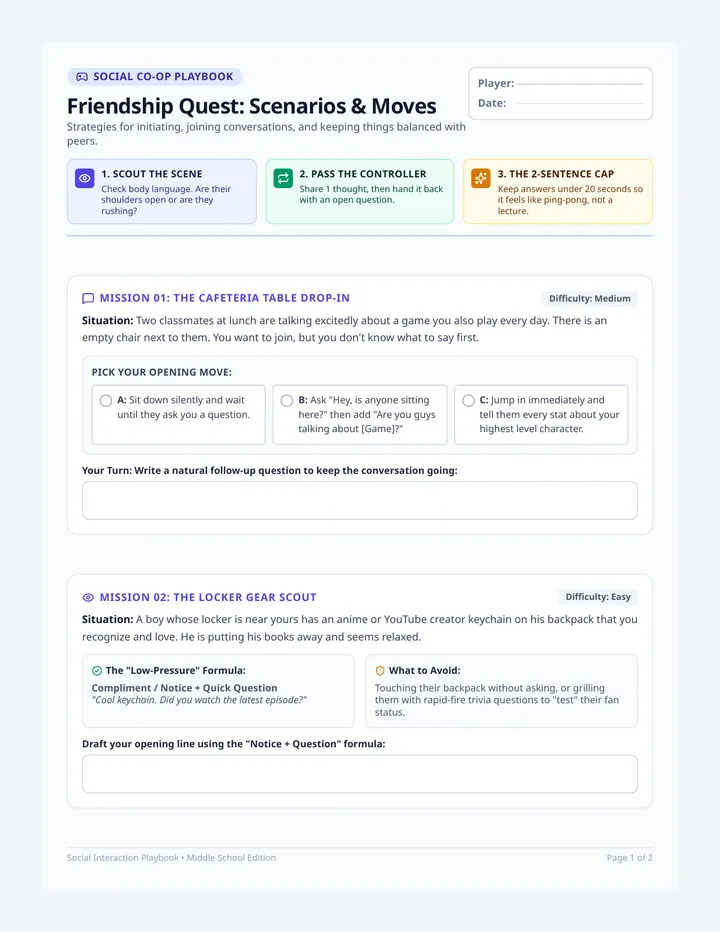
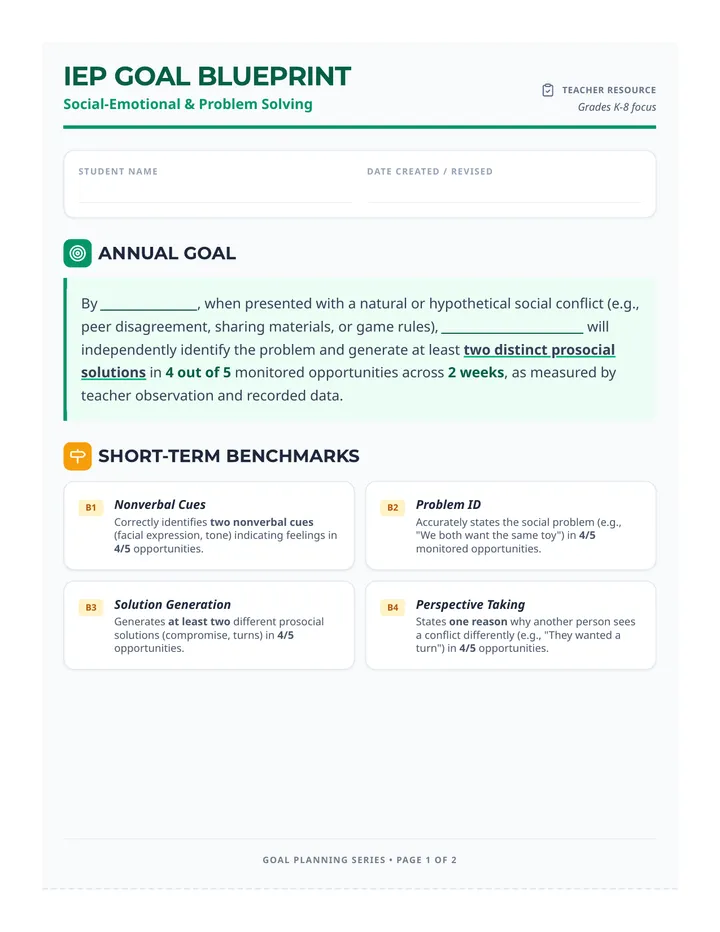
Identification of non-verbal cues including facial expressions, gestures, and posture. Develops the ability to infer emotions and social intent within diverse interpersonal contexts.
A visual, cooperative movement game based on Mo Willems' 'Don't Let the Pigeon Drive the Bus!' designed with sensory-friendly rules, visual schedules, and physical activity choices tailored for special education classrooms.
Students practice making independent choices, expressing preferences, and setting boundaries (saying "yes" or "no") using structured choice boards, tactile sorting mats, and interactive role-play.
Students practice identifying when they need help, who to ask (teachers, peers, or helpers), and how to communicate that need using visual phrase cards and guided collaborative practice.
Students learn to recognize and communicate physical and emotional states (like tired, hungry, overwhelmed, or ready to learn) using simple gestures, vocalizations, or visual symbol cards.
A comprehensive small-group counseling lesson designed to help high school special needs students use context clues to decode social intent in workplace, community, and safety situations.
A 15-minute playful social-skills intervention designed for a first-grade student with ADHD. It focuses on distinguishing between accidents and intentional actions (intent vs. accident) using interactive scenario cards and a structured visual choice board to maintain engagement and provide agency.
An engaging, transition-themed speech therapy lesson designed for 5th graders. It targets figurative language comprehension, situational inferencing, and evidence-based predictions using real-world middle school scenarios to prepare them for the social and academic transition.
An adventure-themed speech-language therapy lesson for middle schoolers to practice problem-solving, inferencing, and social communication. Students solve 'island dilemmas' to escape a mysterious tropical island before summer break begins.
Students apply unit learning to a chosen career or post-secondary education path, identifying workplace accommodations and constructing a self-advocacy plan.
Under the Pre-ETS category of Counseling on Post-Secondary Opportunities, this lesson equips transitioning high school students with knowledge of workplace accommodations, visible/invisible disabilities, and self-advocacy. Students explore equity rights to prepare for post-secondary career and vocational opportunities.
This lesson introduces students to real-world career fields (Healthcare, Trades, Education, Retail, Engineering, Restaurant, Animal Care) while exploring how each industry organizes authority and resolves crises. Students research job roles and solve situational scenarios using industry-specific chains of command.
A highly structured social-skills unit for 7th-grade students with ASD, focusing on non-verbal signals, group work compromise, and navigating peer conflicts.
A visual and interactive self-advocacy curriculum designed specifically for students with intellectual disabilities and diverse communication styles. This foundational series empowers students to express feelings, request assistance, and make independent choices through highly structured group games, partner interactions, and individual visual communication books.
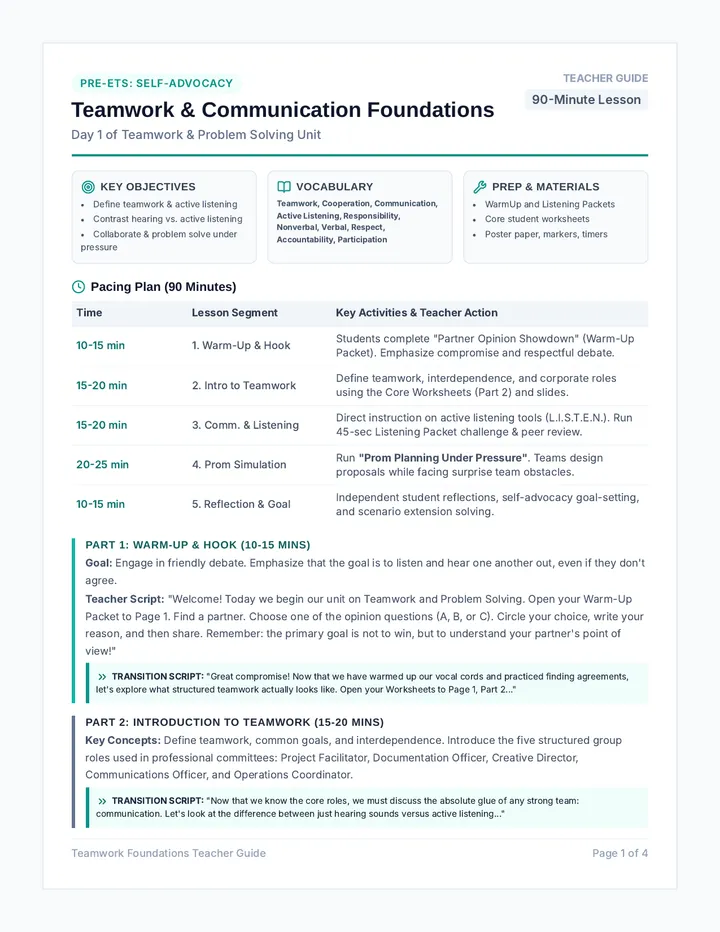
A unit introducing high school students to essential teamwork, communication, and problem-solving skills, focusing on workplace readiness, self-advocacy, and Pre-ETS skills.
A Tier 3 intervention focused on helping neurodiverse 5th-grade students navigate communication breakdowns and social nuances with peers. Students will learn to recognize different communication styles and use scripts and flowcharts to repair misunderstandings.
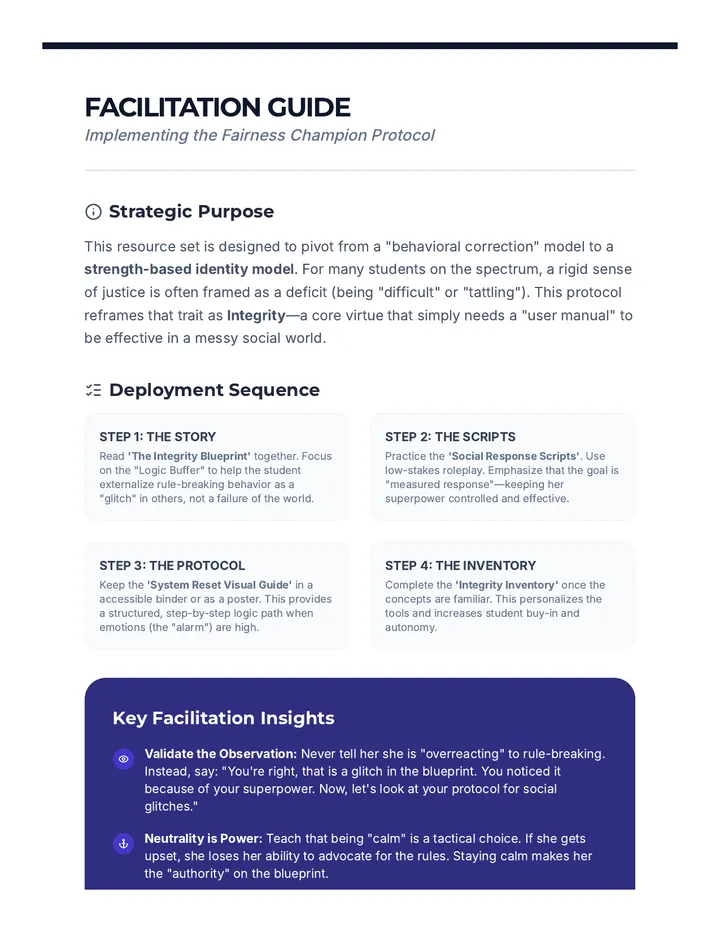
A video game-themed social skills sequence designed for high-ability students with autism. It uses gaming metaphors like 'glitches,' 'dialogue trees,' and 'system scans' to teach Social Thinking concepts, conversation drivers, and perspective-taking.
A series of five 15-minute assessment sessions designed for 3rd-5th grade special education students to collect data on key SEL competencies including Self-Awareness, Self-Management, Emotions, Relationship Skills, and Decision-Making.
A 15-lesson SEL sequence for Grade 9 students with ASD and LD, focusing on social nuance, self-regulation, and interpersonal skills within a math classroom context. This program uses a 'Lab Notebook' theme to gamify social learning and advocacy.
A comprehensive learning packet for 3rd-grade students performing at a Kindergarten level, focusing on foundational ELA (phonics and character traits) and Math (data and graphing) through a fun detective-themed curriculum.
A comprehensive SEL unit designed for 3rd-grade boys with autism, focusing on identifying internal emotional states, decoding facial expressions in others, and navigating classroom social dynamics through a 'Detective' theme.
A social-emotional unit for 3rd grade students in inclusive programs, focused on building 'Social Detective' skills. Students learn to scan environmental cues, interpret non-verbal communication, and flexibly adjust their behavior to match the social energy of different contexts.
A series of 3rd grade language therapy lessons targeting specific grammatical and sequencing goals through interactive activities and structured practice.
A comprehensive transition program for special education students, focusing on financial literacy, career readiness, and independent living skills through a 'blueprint' for adulthood.
A two-lesson sequence designed for Brooklyn middle schoolers, using the high-octane world of WWE to teach autism acceptance, neurodiversity, and peer advocacy. Students explore the 'Main Event' of being yourself and the 'Tag Team' power of inclusion.
A comprehensive 1-page teacher's guide detailing facilitation strategies, sensory modifications, AAC communication integration, and visual prompt hierarchies for using the board game and movement cards in special education settings.
A 2-page printout featuring 16 visual movement and social-emotional choice cards. The cards are categorized into Bus Cards (cooperative movement and sensory activities) and Pigeon Cards (cooperative emotional regulation and 'no' responses), complete with dashed cut lines and explicit visual indicators for student movement rewards.
A 2-page printable cooperative board game. Page 1 features parallel, visual progress tracks for the Bus and the Pigeon, complete with an on-board 'First-Then' visual schedule and a calming corner. Page 2 provides printable stand-up game tokens, a visual Pigeon 'Rage-o-Meter' emotion scale, and visual communication cards for student expression.
A student choice booklet page for Lesson 3: Choice Champions. Students circle their preference for daily tasks and breaks, mark their boundaries, and draw their chosen reward on a white student canvas.
Printable Choice Sorting Mat for Lesson 3: Choice Champions. A dual-category tactile mat dividing space into high-contrast 'YES' and 'NO' sections for students to place physical objects or cards to express preferences.
Visual presentation slides for Lesson 3: Choice Champions. Focuses on setting personal boundaries, choosing preferences, and practicing saying "Yes" or "No" with confidence and support.
A student reflection and match-up worksheet for Lesson 2: Help Helpers. Students identify when they need help, circle the correct helper, and sign their Help Star commitment.
Printable Helper Choice Board for Lesson 2: Help Helpers. A high-contrast, dual-category communication board helping students point to who they want to ask for help and what type of support they need.
Visual presentation slides for Lesson 2: Help Helpers. Focuses on identifying when students need help, who to ask, and how to communicate that request with simple visual scaffolds.
A visual reflection sheet and communication booklet page for Lesson 1: My Super Sign. Students check in on how their body feels, select their preferred communication style, and draw themselves using their super sign.
Printable game cards for Lesson 1: My Super Sign. Features a 4-card set of high-contrast state cards with clear icons, descriptive labels, and physical gesture guidelines to support non-verbal, gestural, and verbal expression.
Visual presentation slides for Lesson 1: My Super Sign. Features high-contrast cosmic superhero themes, huge text, clear visual cues, and guided group prompts to help students identify and express physical and emotional states.