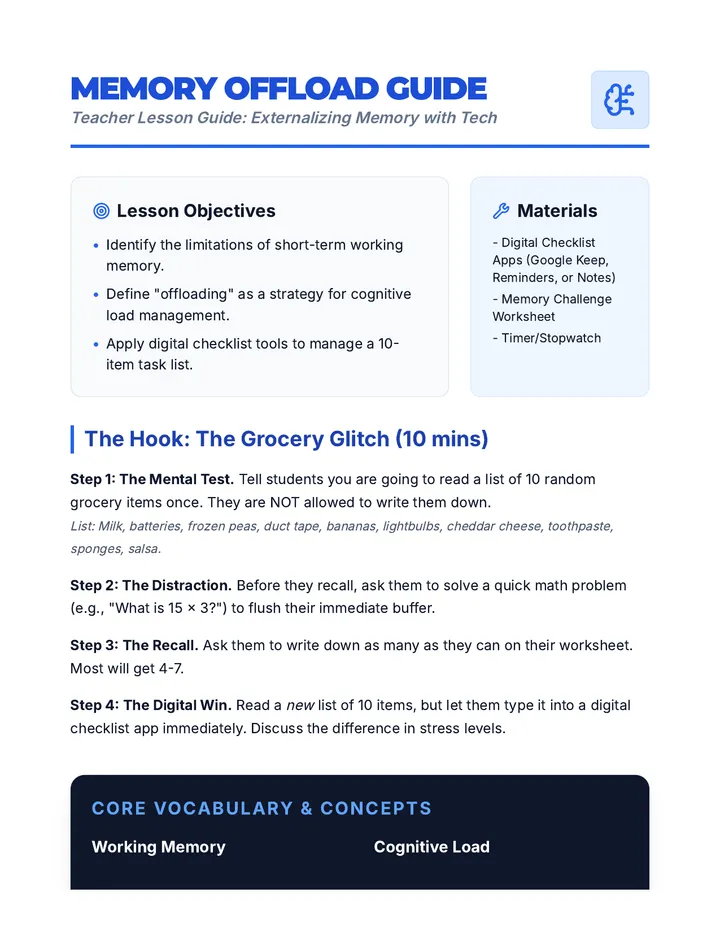
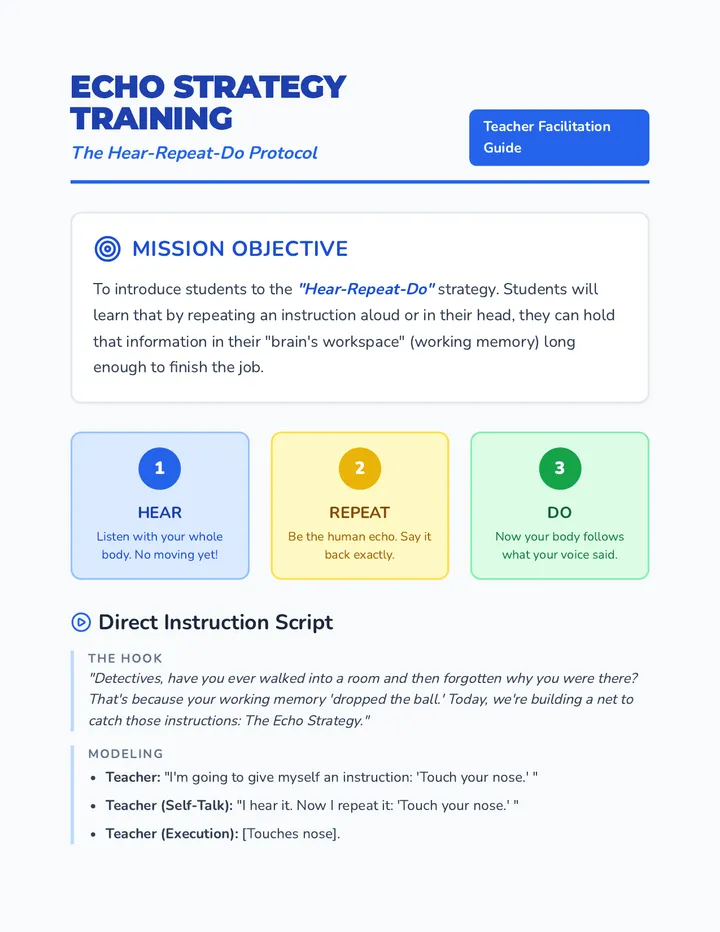
Graphic organizers, visual checklists, and instructional cues reduce cognitive load by externalizing information demands. Supports students in following multi-step directions and maintaining focus during complex tasks.
A sequence for 2nd Grade students to master text-to-speech (TTS) as a tool for reading comprehension. Students transition from decoding mechanics to deep understanding by using auditory support to predict, pause, answer questions, visualize, and sequence stories.
A comprehensive 2nd-grade sequence focused on mastering Text-to-Speech (TTS) tools. Students learn to synchronize visual tracking with audio, adjust speech rates for optimal processing, and use digital tools to support decoding and fluency.
This sequence shifts the focus from assistive technology to the cognitive strategies required for auditory learning. Students engage in inquiry-based activities to distinguish between passive hearing and active listening, applying specific comprehension strategies while using text-to-speech (TTS) to access grade-level texts.
A comprehensive sequence for 4th-grade students to master Text-to-Speech (TTS) assistive technology. Students learn to navigate complex text features, clean up cluttered webpages, tackle math word problems, conduct research, and take effective notes using auditory tools.
A 5th-grade sequence focused on using Text-to-Speech (TTS) technology as a cognitive strategy for reading comprehension. Students learn bi-modal reading, text chunking, evidence collection, and active annotation to transition from passive listening to active engagement with digital text.
A 3rd-grade sequence focused on teaching students with processing difficulties how to navigate informational texts using annotation and highlighting techniques. Through a 'text detective' theme, students analyze informational articles as 'specimens' to identify features, vocabulary, and main ideas.
A comprehensive graduate-level sequence focused on the pedagogical implementation of assistive writing technology. It shifts the focus from tool selection to instructional methodologies that scaffold digital organizers, dictation, and text-to-speech for student autonomy.
This graduate-level sequence prepares educators to evaluate and select assistive writing technologies using evidence-based frameworks like SETT. It covers the neurology of dysgraphia, technical analysis of speech-to-text and word prediction, and the legal requirements for IEP implementation.
A project-based sequence for 4th-grade students in special education settings, focusing on moving from passive highlighting to active extraction, organization, and synthesis. Students learn to refine highlights, extract them onto cards, sort ideas logically, and create a visual 'One-Page Expert Guide' as a summary tool.
This sequence guides 9th-grade students through the cognitive strategies of using Text-to-Speech (TTS) for deep comprehension. It moves from basic bi-modal tracking to advanced digital annotation and genre-specific strategy adaptation, culminating in a rigorous auditory comprehension assessment.
A graduate-level professional development sequence focused on designing customized text annotation and highlighting protocols for students with diverse learning needs, specifically targeting executive function and processing speed deficits.
This sequence explores how graduate students can leverage assistive technology for digital annotation, moving from basic tool audits to advanced data extraction and AI integration to support students with disabilities.
Student reflection and final assessment sheet for Lesson 5, allowing students to plan strategies and evaluate their comprehension performance.
A teacher guide for Lesson 5, focusing on assessing sustained attention and visual-auditory synchronicity during the 'Tracking Marathon' challenge.
Final assessment worksheet for Lesson 5, challenging students to map two contrasting auditory viewpoints and synthesize them into a coherent written summary.
A student reflection sheet for the Lesson 5 'Tracking Marathon', where they track their focus and success across checkpoints during a sustained reading session.
Teacher guide for Lesson 5, outlining the final synthesis task and providing a step-by-step facilitation plan for the culminating lesson.
Detailed teacher guide for Lesson 5, focusing on strategy selection, metacognitive reflection, and identifying when to use TTS support versus silent reading.
Slide deck for Lesson 5: Synthesizing Auditory Information, introducing the final challenge of summarizing contrasting viewpoints using all previous auditory strategies.
Introductory slides for Lesson 5, focusing on sustained attention and applying tracking skills to longer reading passages.
Teacher guide for the 'Fact Spy Academy' lesson, providing instructional steps, modeling scripts, and technical troubleshooting for using TTS for note-taking.
Slide deck for Lesson 5, focusing on strategy selection, metacognitive reflection, and identifying when to use TTS support versus silent reading.
Student note-taking template for the 'Fact Spy Academy' lesson. Features structured spaces for recording facts using the 'Pause-Think-Write' method.
A teacher resource for Lesson 4, focusing on using TTS to support word decoding and providing specific facilitation strategies and scripts.
Students use TTS to follow the plot of a full narrative and practice putting events in the correct chronological order, reinforcing story structure.
Focusing on mental imagery, students listen to descriptive passages via TTS and translate those auditory details into visual representations.
Students use TTS to locate specific details in a text, answering the core 'Wh-' questions (Who, What, Where, When). They practice navigating audio to find evidence.
Introducing the 'Chunk and Chew' strategy, where students listen to small sections of text, pause, and reflect on the meaning. This lesson focuses on self-monitoring during auditory reading.
Students apply their tracking skills to longer reading passages, monitoring their own attention and focus during a sustained reading session.
Students use TTS to listen to titles and introductory sentences, practicing the skill of predicting what comes next. They learn to stop and think before the story unfolds.
Students learn to use TTS to identify and decode unfamiliar words, acting as 'Word Detectives' to solve mysteries in the text.
Students use TTS as a model for phrasing and rhythm, practicing repeated readings of short passages to build oral reading fluency.
Learners experiment with different speech rates to find their 'Goldilocks' speed—not too fast, not too slow—for effective multimodal reading.
Students practice following a digital highlighter with their eyes as text is read aloud, focusing on maintaining visual synchronization with the audio output.
Students listen to two contrasting viewpoints on a topic using TTS and synthesize the information into a coherent summary. This tests their ability to maintain focus and organize auditory information over a longer duration.
Students encounter challenging vocabulary words within a text. They use TTS to hear proper pronunciation and use context clues from the audio flow to define words before checking definitions.