Picture Power Slides Picture Power
Matching Photos to Our Room
The Mystery!
I have these photos...
I took photos of things in our room.
But I forgot where they belong!
Can you help me find the real thing?
Look at this!
This is a picture .
Can you point to a real pencil ?
"They look the same!"
Try Another!
🪑
This picture shows a chair.
Touch a real chair !
Picture Power Help!
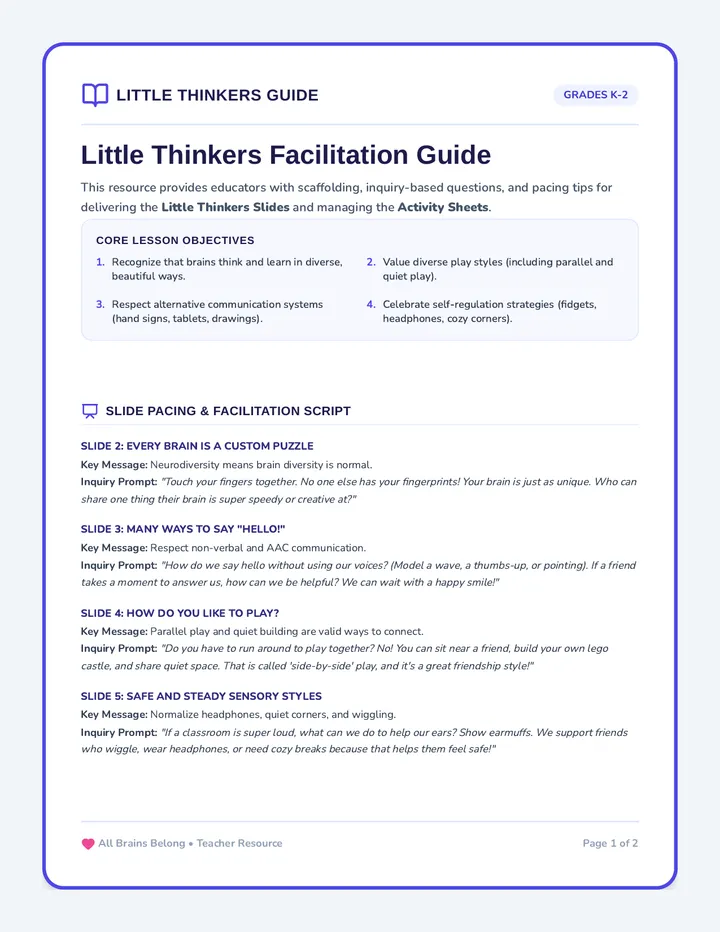
Pictures help our eyes remember when our ears forget!
No Listening
Just Looking
Room Matcher Worksheet Room Matcher
Draw a line to connect the photo to the real thing!
Name:
Date:
Match the picture to where it belongs!
Pencil Jar
Glue Tray
Book Shelf
Art Box
Teacher Tip: Help students point to the real items in the classroom before drawing their lines. For students with fine motor challenges, allow them to circle matching pairs in the same color.
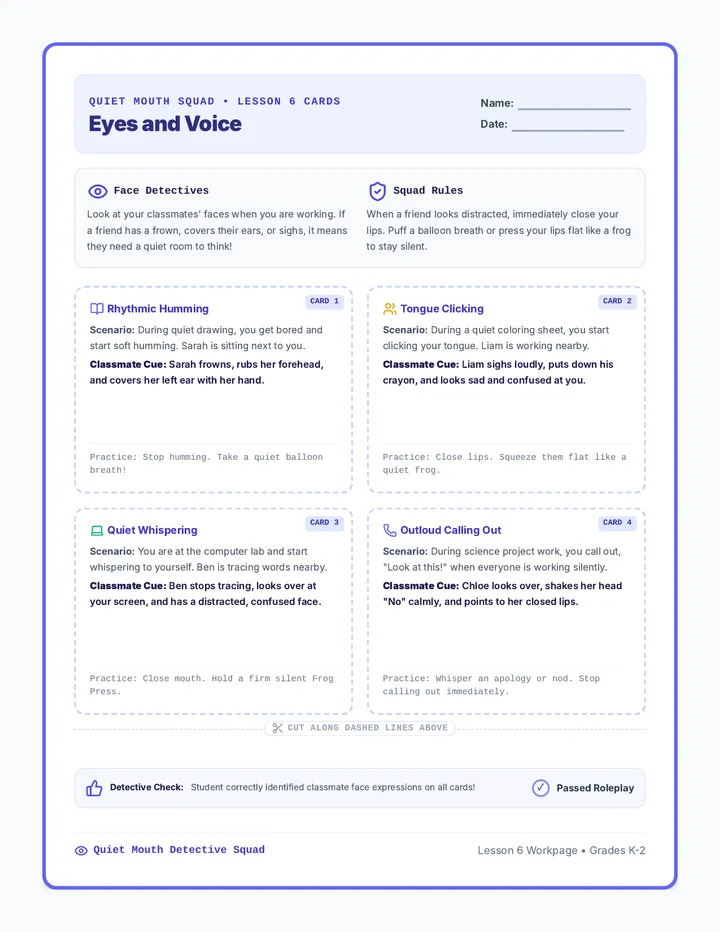
Object Match Cards Object Match Cards
Print, cut, and laminate to place on actual classroom items.
Teacher Tool
How to Use These Cards
Tape these cards to the corresponding objects or bins in your classroom before the lesson.
Hand a duplicate "mini" version to students during the hook activity.
Encourage students to "hunt" for the card that looks exactly like the one in their hand.
Pencil
Book
🪑
Chair
Backpack
Tissues
Trash
Silent Signals Slides Silent Signals
The No-Talking Game
Our Big Goal
We do NOT use our ears.
We ONLY use our eyes!
🪑
SIT
When you see this...
Find your chair and sit down quietly.
"Eyes on the card, body in the chair."
🧍
STAND
When you see this...
Stand up straight and tall.
"Stand like a soldier!"
Game Time!
I will hold up a card.
You do the action.
Ready? Go!
Teacher Holds
Class Acts
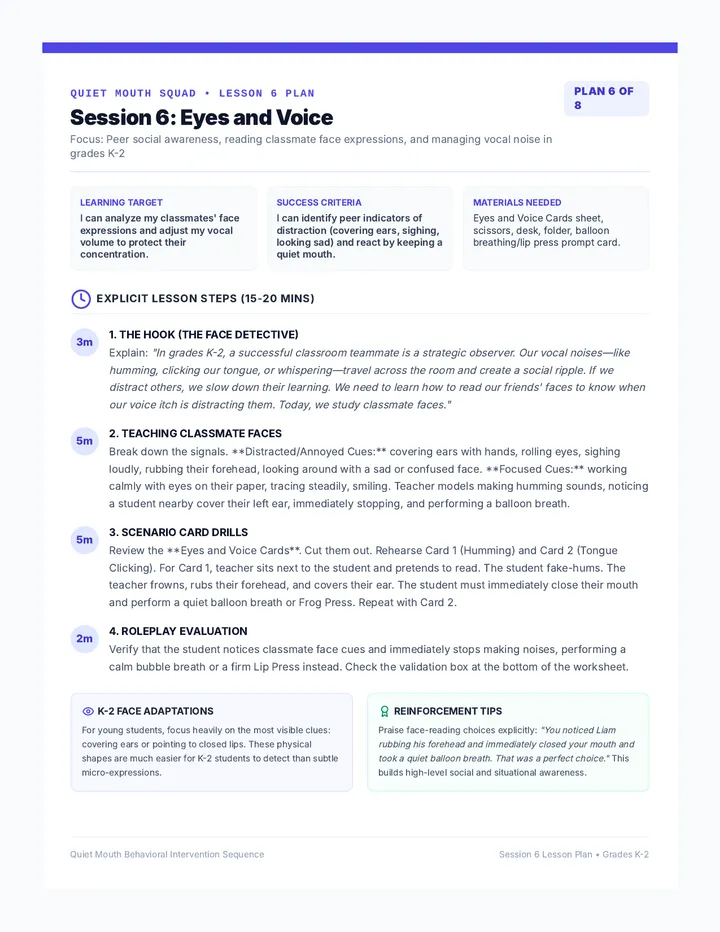
Action Icon Flashcards Action Flashcards
Student set for silent signaling and desk reminders.
🪑
SIT
🧍
STAND
🚶
🚶
🚶
LINE UP
WASH
Teacher Instructions
These cards are sized for student desks. Have students practice pointing to the card that matches your large signal during whole-group instruction. Laminate these for durability as they will be used frequently for non-verbal redirection.
Simon Says Signals Guide Simon Says Signals
Teacher Facilitation Guide
Objective
Students execute 1-step directions based solely on visual cues, bypassing the need for auditory processing.
Prep
Large teacher-sized Action Cards and individual student desk sets.
Duration
10-15 Minutes (Short, high-frequency practice is best).
Lesson Flow
1
The Silent Hook
Stand at the front of the room. Put a finger to your lips. Do not speak. Hold up the SIT card. If students don't react, tap the card and point to their chairs. Wait for 100% compliance.
2
Direct Modeling
Whisper: "My cards are talking today. When the card goes UP, your body moves. When I put the card DOWN, your body stays still."
3
The Signal Game
ROUND 1 Hold STAND card. Students stand. (Visual focus)
ROUND 2 Hold SIT card. Students sit. (Toggle focus)
THE TRICK Say "Stand" while holding the SIT card. Challenge students to follow the eye clue, not the ear clue.
Differentiation Tips
Support
Provide physical proximity. Tap the student's desk set to the matching card you are holding to direct their attention.
Challenge
Introduce the LINE UP signal with no verbal transition. See if students can navigate to the door based on the visual cue alone.
First Then Fun Slides 1
2
First & Then
Mastering the Order
What is FIRST?
OUR WORK
"First" is what we do right now.
It is the job we need to finish with our hands and eyes.
What is THEN?
OUR FUN
"Then" is what we get after.
It is the treat or game we earned for doing our "First" job!
Let's Try One!
First...
🧩
Do Puzzle
Then...
🎲
Play Game
Don't Forget!
If you forget what to do, don't ask!
LOOK AT YOUR BOARD.
The picture remembers for you!
My First Then Board My Task Board
Visual Work Schedule
Name:
FIRST
THEN
Cut these out for your board
🧱
Blocks
Draw
Music
Book
Clean
Write
Listen
Tablet
First Then Script First Then Script
Mastery-Based Teaching Guide
The Principle
Working memory is taxed by multi-step directions. The "First/Then" board offloads the sequence onto a visual field, allowing the student to focus 100% on the current task.
The Goal
Student looks at the 'First' box, completes the task, and then looks at the 'Then' box to receive their reinforcer without adult prompting.
Guided Practice Script
Introductory Modeling
Teacher Script:
"Today we have a new secret tool. Look at this board. It has two spots.
First is for our work. Then is for our fun.
Watch me: First I put on my coat (Place coat icon), Then I get to go outside (Place playground icon)."
Correction Procedure (The "Non-Verbal Point")
If student gets distracted:
Do NOT use words. Silence is key to reducing cognitive load.
1. Walk to the student.
2. Tap the FIRST icon on their board.
3. Point to their task (e.g., the paper).
4. Tap the THEN icon to remind them of the goal.
Reinforcement Phase
When task is done:
"Check your board! 'First' is all done (Flip card or remove). Now it is THEN time! You earned your [Activity]!"
Common Obstacles
X Too Many Steps: Only use ONE icon in the 'First' box. Do not clutter the board with multiple sub-tasks.
X Weak Reinforcer: If the student isn't motivated by the 'Then' choice, the strategy will fail. Let them choose their 'Then' icon.
Detective Quest Slides Detective Quest
The Visual Scavenger Hunt
Your Secret Mission
I will give you ONE CLUE.
It is a picture of something in our room.
Keep the picture in your BRAIN.
Walk across the room and find it!
Detective Rules
1. Look
Look at the card for 5 seconds.
2. Think
Close your eyes and see the picture inside.
3. Go
Find the object and stand next to it!
Ready for a Practice?
Where is the Light?
Mystery Solved!
When you find the object, freeze and wait for the Chief Detective (Teacher) to give you a high-five!
Detective Badge Worksheet Chief Detective
Unit 1: Room Search
Agent Name
Evidence Found
Item #1
Found at the designated spot
Item #2
Found at the designated spot
Item #3
Found at the designated spot
Teacher: Cut out the badge for the student to wear. Use the check-off sheet to help the student track their progress as they find each item hidden in the room.
Hunt Setup Guide Hunt Setup Guide
Teacher Logistics & Map
Preparation
1.Print two sets of icons (Pencil, Block, Book, etc).
2.Set A: Hide these around the room in visible spots.
3.Set B: Keep these at your desk as "Clue Cards".
4.Print badges for all "successful detectives".
Memory Constraint
The goal is to increase the delay between seeing the clue and finding the item. Start with immediate release, then build up to a 10-second wait before letting them move.
Hide Spot Map
Window Area
Back Sink
Reading Rug
Teacher Desk
Cubby Wall
Door
Sketch your hidden item locations here
The "Detective Protocol"
1. Show:
Hold clue card for 5 seconds. "Look at the shape. See the colors."
2. Hide:
Flip card face down. "Keep the picture in your head."
3. Move:
"Find the match!" (Observe if they wander or stay focused).
My Choice Slides My Choice
Choosing My Own Visual Tool
Being the Boss
MY DESK
You are the boss of your own desk!
You can pick a picture to help you remember what you love to do.
What do you want to do?
🎨
ART
🧱
BLOCKS
📚
READING
🧩
PUZZLE
How it Works
Put your picture on your desk.
When you feel like stopping, LOOK at your sign. It reminds you to keep going!
Creation Station
Time to pick your favorite activity and make your
Desk Task Anchor!
Desk Task Anchor MY JOB
I am working on...
Stick your favorite picture here!
STAY FOCUSED
I am working on...
Stick your favorite picture here!
Activity Choice Cards
🎨
Paint
🧱
Blocks
🎧
Music
📖
Books
🧩
Puzzles
🚂
Trains
🦕
Dinos
💻
Computer
Self-Regulation Tracker Guide Self-Reg Tracker
Teacher Observation Sheet
"Independence is the final stage of working memory support. This tracker monitors how effectively students use their self-selected visual anchors to redirect their own attention without teacher intervention."
Student Name Looked at Cue? Time on Task Observations
Yes
| ___ min |
|
|
|
Yes
| ___ min |
|
|
|
Yes
| ___ min |
|
|
|
Yes
| ___ min |
|
Debrief Questions
To the Student:
"When you felt like walking away, what did your picture say to you?"
Reflection for Teacher:
"Did the student reference the cue spontaneously, or did they require a non-verbal point?"
Growth Path
Once students can manage 1 self-selected visual cue for 5 minutes, begin introducing a 2-step visual sequence (First/Then) for their personal goals to further stretch working memory capacity.