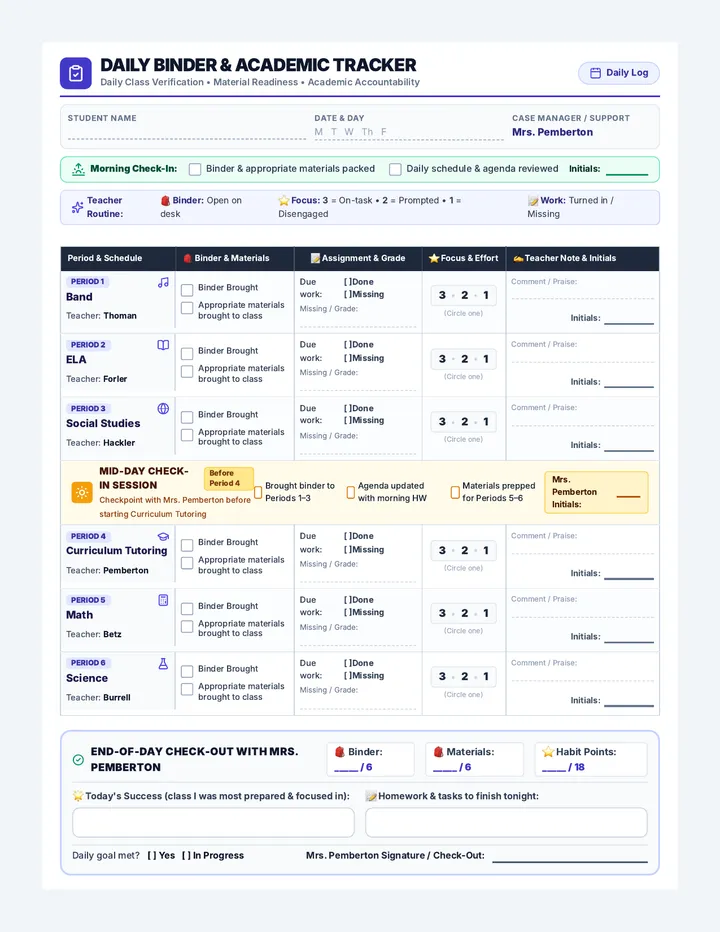
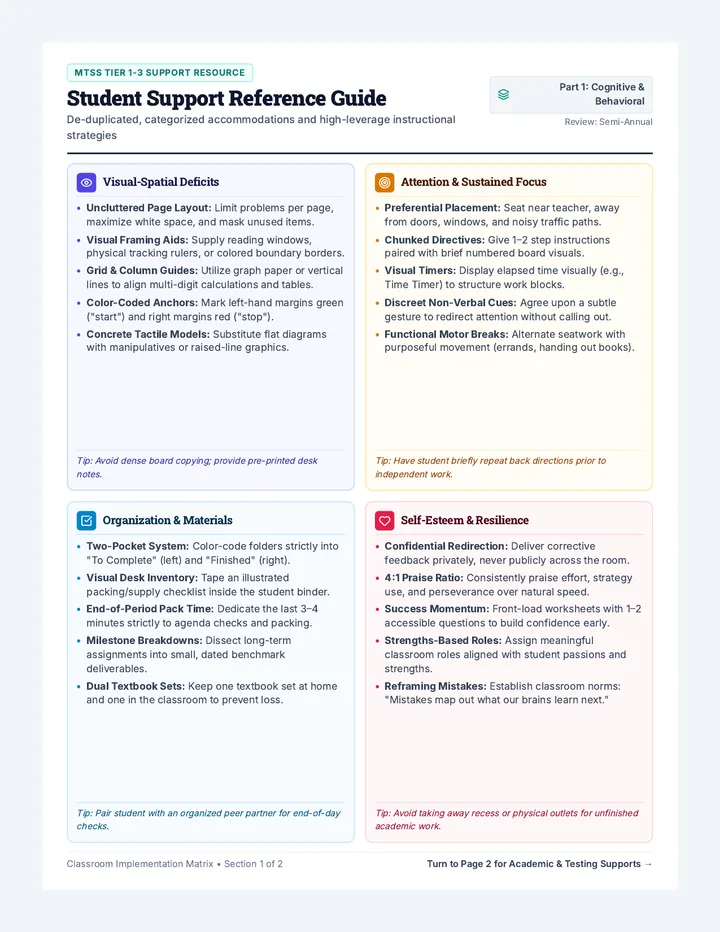
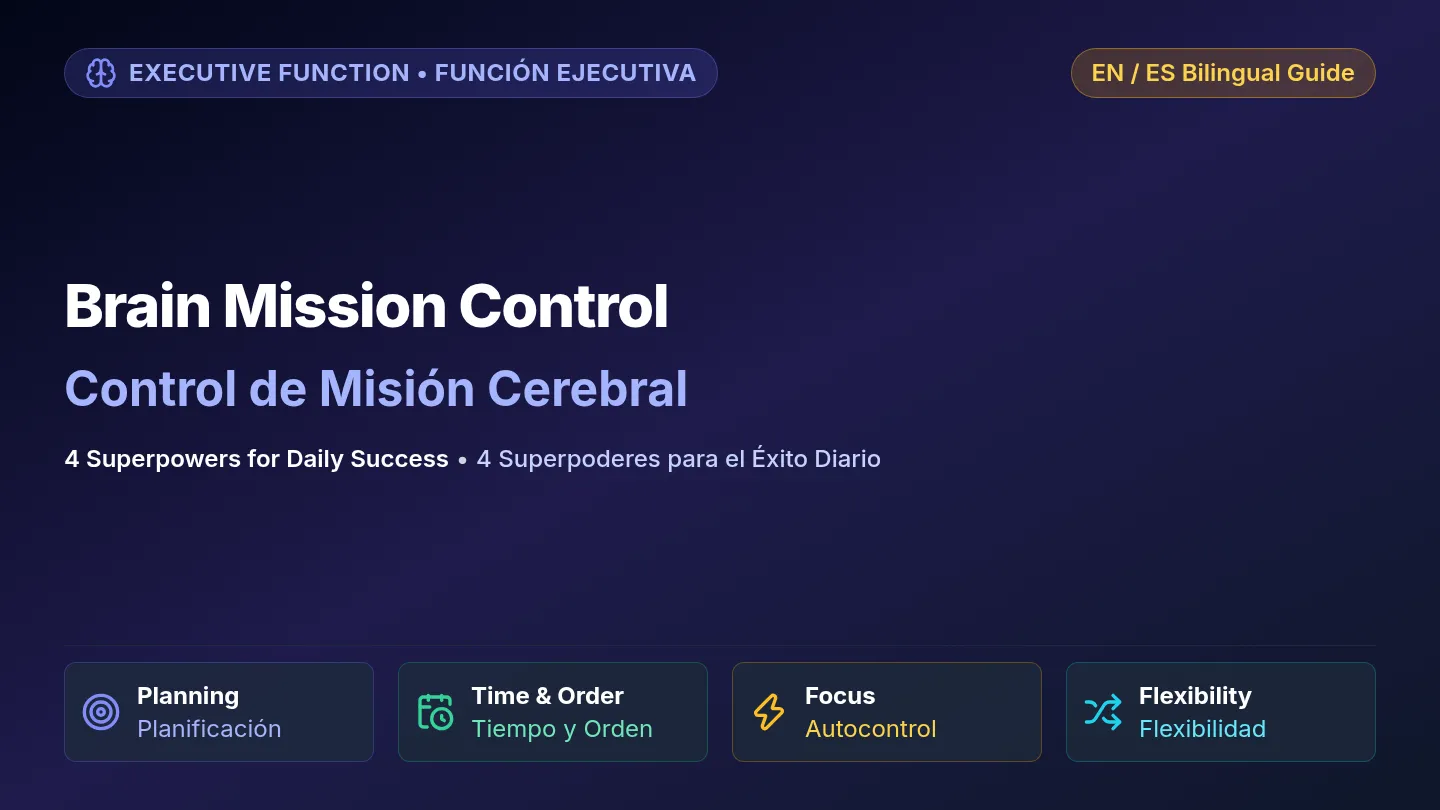
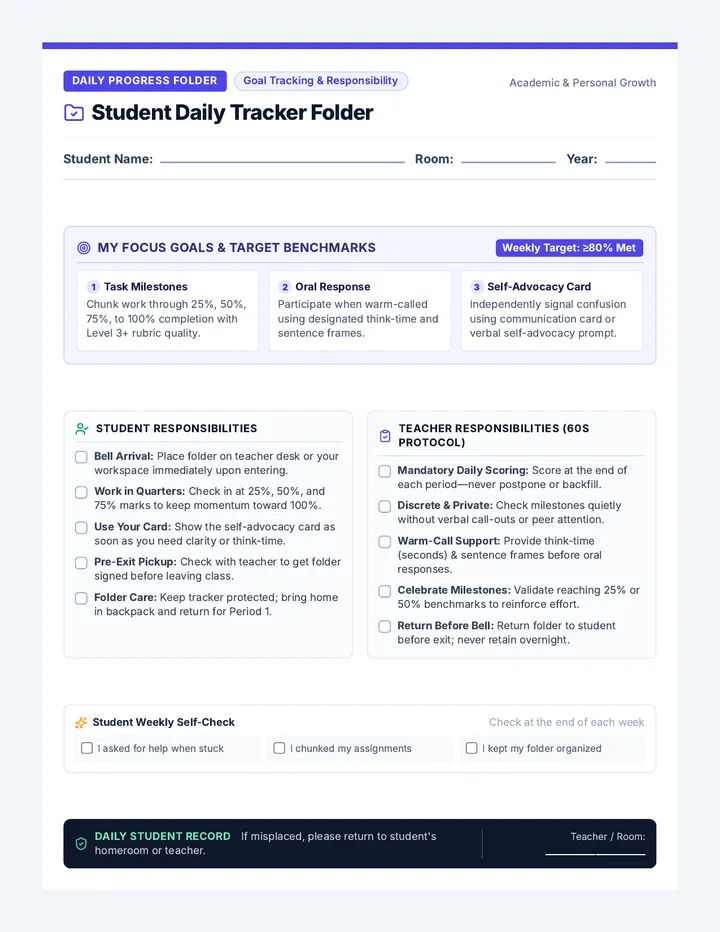
Systematic storage of IEP documentation, sensory tools, and student work bins. Addresses classroom efficiency through color-coding, visual labels, and streamlined data collection setups.
Final checklist for students to ensure they are prepared for their IEP meeting. Covers physical materials (gear), communication logistics, and mental preparation (mindset).
Planning worksheet for a student-led IEP presentation. Guides students through drafting their opening statement, data wins/challenges, and proposals for future accommodations/goals.
Capstone slides for Lesson 5. Focuses on student-led IEP meeting leadership, including analyzing a student-led meeting, a presentation script formula (Opening, Data, Ask), and the power of artifact evidence.
Facilitation guide for Lesson 4, including tips on helping students identify goals, leading an "Evidence Hunt," and using data as a diagnostic signal for adjusting educational supports.
Worksheet for student self-monitoring. Includes a goal selection section, a 5-point bar graph for tracking progress, and reflective questions for "pivoting" based on data results.
Slides for Lesson 4 on goal monitoring. Teaches students how to distinguish between quantitative and qualitative data, establishes a "Data Day" routine, and shows how to turn IEP goals into trackable data points.
A set of printable sorting cards for the "Paper Chase" activity. Includes various document scenarios (progress reports, invitations, permission slips) for students to categorize.
Worksheet for students to audit their current paperwork and design a personal compliance system. Includes sections for a physical/digital tool blueprint and a "Daily Reset" protocol.
Slides for Lesson 3 focusing on administrative organization. Introduces the "Backpack Abyss," a 3-folder compliance system (Inbox, Action, Archive), and hybrid digital/analog management strategies.
A handy reference sheet for students providing professional greetings/closings, fill-in-the-blank scripts for common IEP-related communication scenarios, and "Golden Rules" for student-teacher interactions.
Simulation worksheet where students identify schedule conflicts in a hypothetical Monday schedule and draft professional emails to resolve them using the "Option A/B" formula.
Slide deck for Lesson 2 focusing on schedule coordination. Introduces pull-out services, communication strategies for conflicts, and a professional email template for student-teacher coordination.
A 10th-grade sequence focused on empowering students to manage their own IEP/504 timelines, accommodations, and administrative responsibilities through the lens of project management. Students transition from passive recipients of services to active managers of their educational milestones.
A 2nd-grade special education unit focused on executive function. Students learn to recognize the physical signs of being 'stuck' and categorize barriers into materials, comprehension, and environment.
A comprehensive sequence for 11th-grade students focusing on the systems and environmental designs necessary for effective Special Education caseload management. Students explore physical workspace optimization, digital workflow tools, paperwork automation, and legal confidentiality requirements to build a personalized organizational toolkit.
Students design a comprehensive 'Teacher Command Center' for special education case management, focusing on reducing cognitive load through automated systems, checklists, and organized filing.
A Kindergarten sequence focused on teaching students to use environmental visual cues as memory aids to support working memory and independence in the classroom. Students learn to recognize labels, match objects to shadows, use color-coding, and create their own organizational systems.
A project-based sequence for 11th-grade special education students focusing on working memory through procedural assembly. Students learn to manage cognitive load by isolating single-step instructions and verifying their work during fabrication tasks.
This sequence focuses on vocational and life skills, applying single-step direction following to physical assembly and procedural tasks. Students learn to navigate technical diagrams and standard operating procedures by isolating one action at a time to support working memory.
A 5-lesson unit for 3rd graders on mastering memory using the Leitner System of spaced repetition. Students learn to build, manage, and reflect on a physical flashcard system to improve long-term retention of academic facts.
This sequence empowers 8th-grade students to take ownership of their learning by building and maintaining a student-led data binder. Students learn to translate IEP goals, organize physical evidence, graph their own progress, and use their data to advocate for themselves in educational settings.
A 5-lesson sequence designed for 8th-grade students to investigate, organize, and manage their personal sensory regulation tools. Students move from exploring sensory needs to designing personal storage systems and establishing protocols for non-disruptive use in the classroom.
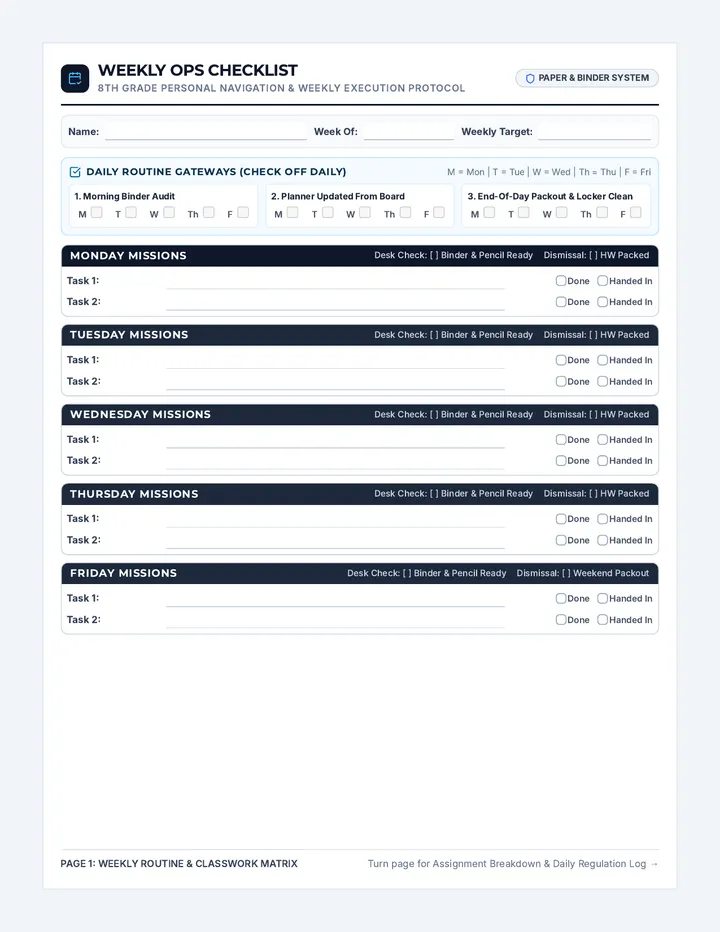
A comprehensive sequence designed for 8th-grade special education students to master physical organization. Through a workshop approach, students audit their current materials, implement color-coded systems, optimize their binders, plan leur storage spaces, and establish sustainable weekly routines.
A comprehensive sequence for 12th-grade students focusing on physical material organization through the lens of sensory regulation and universal design. Students learn to analyze environments, zone functional areas, and design accessible workstations for personal and professional success.
In the capstone lesson, students synthesize their scheduling, organization, and data-tracking efforts to prepare a professional presentation for their next IEP meeting. They practice leading the conversation about their own future.
Students take charge of their own progress by learning to track data against their IEP goals. They develop a 'Data Day' routine for self-reflection and objective performance monitoring.
Students tackle the administrative side of education, from permission slips to agenda management. They develop a personal 'compliance system' to stay organized and responsible for their own paperwork.
Students learn the art of coordinating conflicting schedules, focusing on the overlap between general education classes and mandated support services. They practice professional communication to resolve these conflicts.
Students act as project managers to deconstruct the annual IEP/504 cycle, identifying critical deadlines and mapping out their own educational timelines.
Culminating lesson where students label obstacles as material, comprehension, or distraction issues in various scenarios.
Focuses on sensory and environmental barriers like noise or visual clutter through a sensory audit.
Students learn to identify internal obstacles related to confusion and not knowing the next step.
Focuses on identifying external obstacles like missing or broken tools through visual scanning activities.
Students distinguish between 'smooth sailing' and 'bumpy road' task progression by identifying physical and emotional signs of being stuck.
Students synthesize their learning into a comprehensive 'Organizational Toolkit' proposal, pitching their systems for physical, digital, and administrative management.
Students navigate the legal requirements of FERPA and HIPAA through organizational systems that protect sensitive student information.