Structures daily routines using visual sequences and countdown tools to foster student autonomy. Addresses transition difficulties and time management skills for neurodivergent learners.
This sequence shifts the focus from assistive technology to the cognitive strategies required for auditory learning. Students engage in inquiry-based activities to distinguish between passive hearing and active listening, applying specific comprehension strategies while using text-to-speech (TTS) to access grade-level texts.
A 5-lesson sequence for 9th-grade students to master a systematic, three-color highlighting strategy, moving from identifying 'over-highlighting' pitfalls to independent application on non-fiction texts.
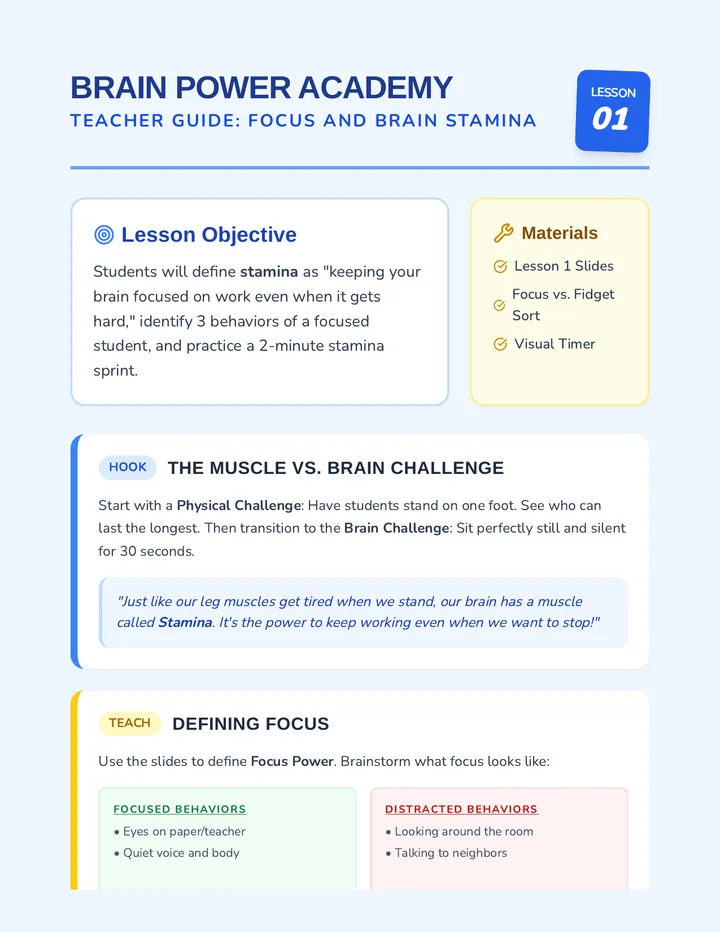
A 5-lesson sequence for 9th Grade Special Education students focused on the neurobiology of attention, interval-based work techniques, environmental management, and energy regulation to improve task execution and self-regulation.
A 2nd-grade Special Education sequence focused on cognitive flexibility, emotional regulation during transitions, and problem-solving when routines change. Students learn to transition from 'rigid' to 'flexible' thinking using the 'Plan B' detour metaphor.
A comprehensive sequence designed for Kindergarten students in Special Education to master the concept of time, transitions, and break management using visual timers and structured protocols.
This sequence introduces Pre-K students in Special Education to visual timers to manage transitions. It covers exploring timers, practicing waiting, working during timed intervals, responding to 'all done' signals, and moving to break zones.
An undergraduate-level course focusing on the data-driven application of break strategies for neurodivergent learners. Students analyze learner profiles, design schedules, create data collection tools, and draft legally sound IEP accommodations to optimize regulation and task management.
A workshop-style sequence for undergraduate education students focusing on the neurobiology, design, and implementation of strategic break systems for neurodivergent learners. Students transition from theoretical understanding to creating tangible visual supports and transition protocols.
A sequence for 6th-grade students focusing on identifying distractions, designing effective workspaces, and mastering time-management techniques like Pomodoro and single-tasking to improve executive function and focus.
This advanced sequence guides graduate students through the design, implementation, and evaluation of strategic break protocols for neurodivergent learners. It covers the neurobiological basis for self-regulation, visual supports, sensory modality matching, and data-driven efficacy evaluation to foster student independence.
A Kindergarten sequence focused on task persistence and emotional regulation for Special Education students. Students learn to identify frustration, use 'yet', ask for help strategically, break tasks into steps, and apply these skills in an obstacle course.
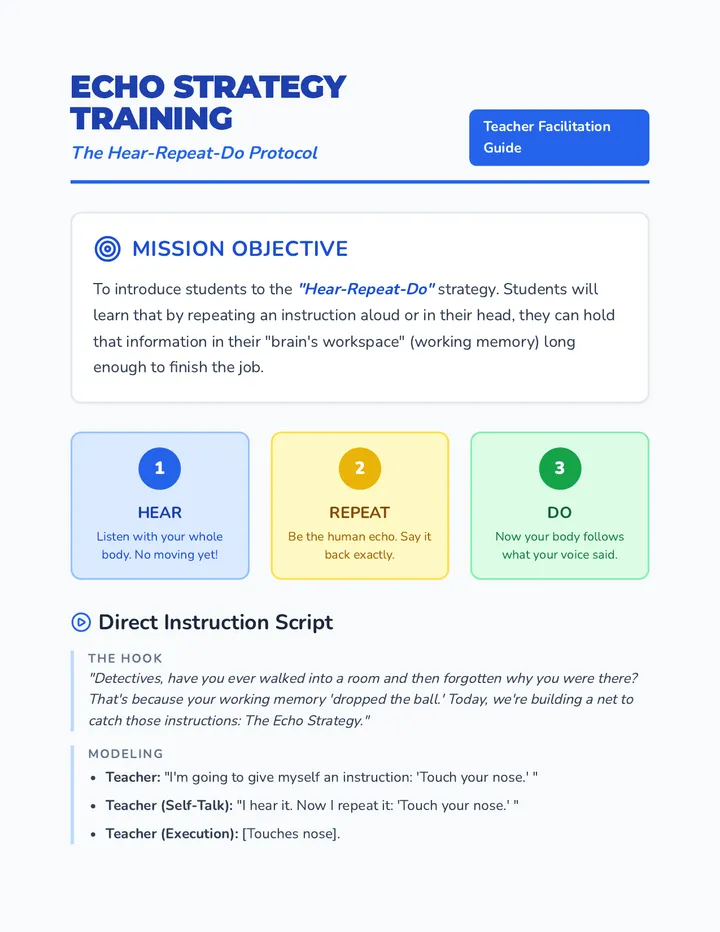
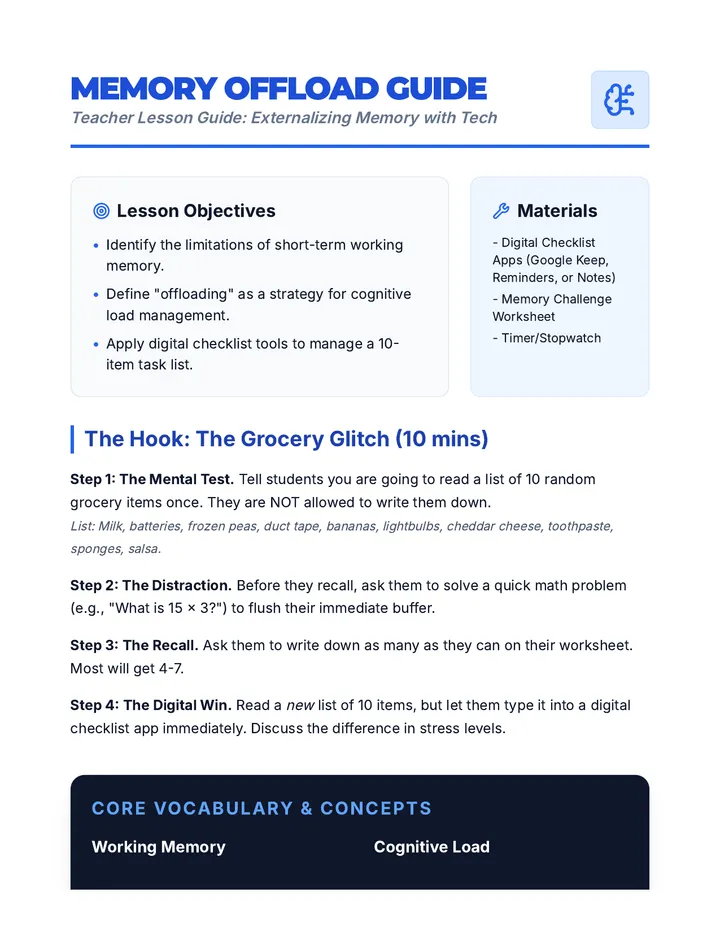
A sequence designed for Kindergarten students to develop self-regulation and executive function skills through the use of visual checklists. Students learn to analyze tasks, sequence steps, and monitor their own progress to support working memory and independence.
Final assessment worksheet for Lesson 5, challenging students to map two contrasting auditory viewpoints and synthesize them into a coherent written summary.
Teacher guide for Lesson 5, outlining the final synthesis task and providing a step-by-step facilitation plan for the culminating lesson.
Slide deck for Lesson 5: Synthesizing Auditory Information, introducing the final challenge of summarizing contrasting viewpoints using all previous auditory strategies.
Vocabulary worksheet for Lesson 4, allowing students to record unknown words, auditory context clues, and inferred definitions while using TTS.
Teacher guide for Lesson 4, providing instructions on using auditory context clues and managing the "Word Hunt" activity.
Slide deck for Lesson 4: Vocabulary Acquisition through Context, explaining how to use auditory context clues to define unknown words while using TTS.
Note-taking graphic organizer for Lesson 3, providing a central topic node and four branches for key ideas and supporting details.
Teacher guide for Lesson 3, providing instructions on teaching auditory shorthand and modeling graphic organizers for auditory input.
Slide deck for Lesson 3: Auditory Note-Taking Techniques, introducing graphic organizers and shorthand for auditory learning.
Activity log for Lesson 2, providing a structured way for students to practice chunking and paraphrasing informational text while using TTS.
Teacher guide for Lesson 2, outlining the "Firehose Effect" hook and the "Stop and Think" instructional routine.
Slide deck for Lesson 2: Chunking and Pausing Skills, introducing the "Stop and Think" routine and the concept of information chunking for TTS.
Students listen to two contrasting viewpoints on a topic using TTS and synthesize the information into a coherent summary. This tests their ability to maintain focus and organize auditory information over a longer duration.
Students encounter challenging vocabulary words within a text. They use TTS to hear proper pronunciation and use context clues from the audio flow to define words before checking definitions.
This lesson introduces graphic organizers designed for auditory learners. Students practice listening to a TTS-read article and simultaneously mapping out key ideas and supporting details.
Students learn the 'Stop and Think' method, using the pause button to break dense text into manageable chunks. They practice paraphrasing orally or in writing after every segment played by the TTS tool.
Students compare retention when passively listening to TTS versus active engagement. They identify distractions and brainstorm environments and behaviors that support deep listening.
Students apply their systematic strategy to a multi-page non-fiction text and engage in peer review to refine their judgment.
Teaches students the 'Read, Pause, Evaluate, Mark' cycle to improve executive function and prevent impulsive highlighting.
Introduces additional colors for supporting details and vocabulary, building a visual hierarchy for efficient information retrieval.
Focuses on the cognitive skill of isolating main ideas using a single dedicated color to distinguish the core message from secondary information.
Students analyze the 'painted page' phenomenon to understand why over-highlighting fails and learn to set a purpose before reading.
Students differentiate between restorative and depleting breaks, creating a personalized 'menu' of energy-management strategies.
Students learn about body doubling and social accountability to leverage the presence of others for sustained task persistence.