Conflict identification, brainstorming alternative responses, and evaluating social consequences. Builds student capacity to navigate peer disagreements and select appropriate communication strategies.
A comprehensive, autism-friendly visual choice board inspired by "What Would Danny Do?" for a third-grade student. It breaks the school day into six key settings with concrete "Power Choices" and calming "Power Resets" to support positive behavior and self-regulation.
A set of six communication cards designed for use on a lanyard. Each card features a clear, colorful icon and a high-contrast social phrase to help students communicate needs like "Please Stop," "My Turn," or "Play With Me."
A simplified, highly structured 12-slide interactive presentation designed for 6th grade autistic students in a small group. Uses short bulleted scenarios, clear visual icons, simplified vocabulary, and direct matching choices for emotions, intentions, sarcasm, and problem solving.
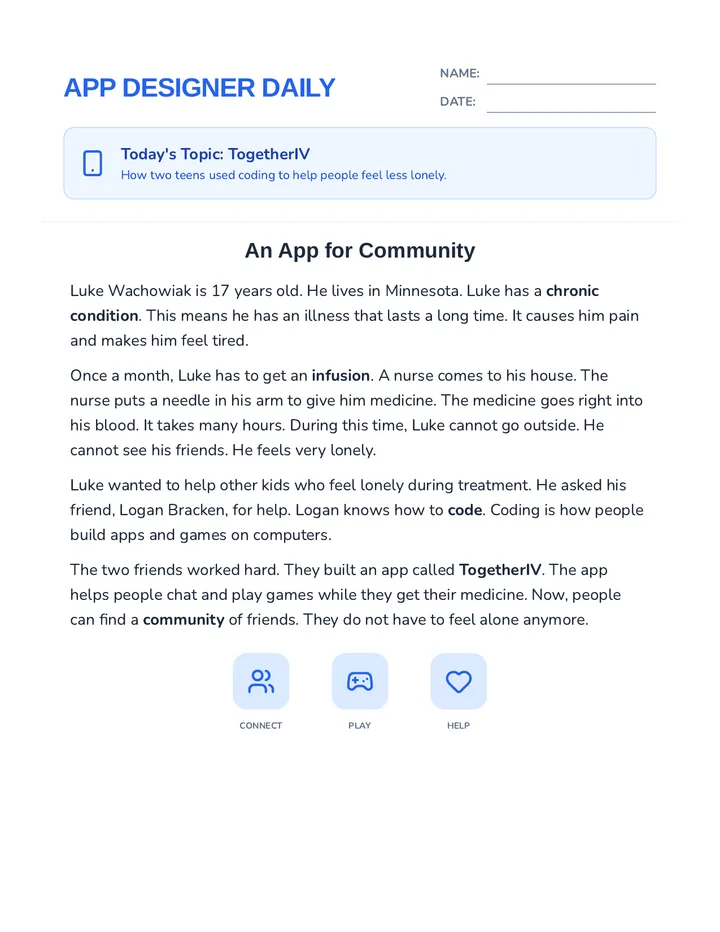
A 3-page comprehensive reading packet for 8th-grade students working at a 3rd-grade reading level. Includes a simplified article about the TogetherIV app, vocabulary exercises, comprehension questions, a sequencing activity, and a scaffolded writing response section.
An expanded set of nine large-format printable desk strips with high-contrast visual reminders, including specific calming techniques and a "Safe Choices" strip for unwanted behaviors.
A comprehensive facilitator guide for running a Problem vs. Solution Circuit with adult or youth clients. It includes step-by-step facilitation routines, whiteboard layout schematics, accessibility adaptations, and 12 concise, board-ready scenarios across workplace, daily living, and social communication settings.
A single-page classroom anchor chart and desk poster formatted for perfect single-page printing. Features a clean 3x3 layout of color-coded school scenarios and 5 structured fill-in-the-blank sentence starters to support student voice and expression.
A 5-page social story booklet designed for students with autism, now updated to remove all written output requirements. It uses visual selection grids and drawing spaces instead of writing lines.
A comprehensive social/emotional IEP Goal Guide and Progress-Monitoring Tool designed to assist educators in tracking conflict resolution skills. It includes a complete measurable IEP goal, progressive objectives (benchmarks), a structured peer strategy menu, an active classroom progress tracker, and a printable visual desk prompt card.
An IEP Goal Blueprint focused on social problem solving. It includes a SMART annual goal with fillable blanks, four scaffolded benchmarks (including nonverbal communication and perspective taking), and a comprehensive data tracking table.
A revised two-page resource guide for special education teachers and parents, organized by type of need. This update fixes page-break issues and ensures all resource entries include relevant links and descriptions.
A 4x6 desk mat visual for a 7th-grade student with Autism, featuring a brain vs. mouth 'Social Filter' prompt with specific examples for sharing opinions on hobbies and interests.
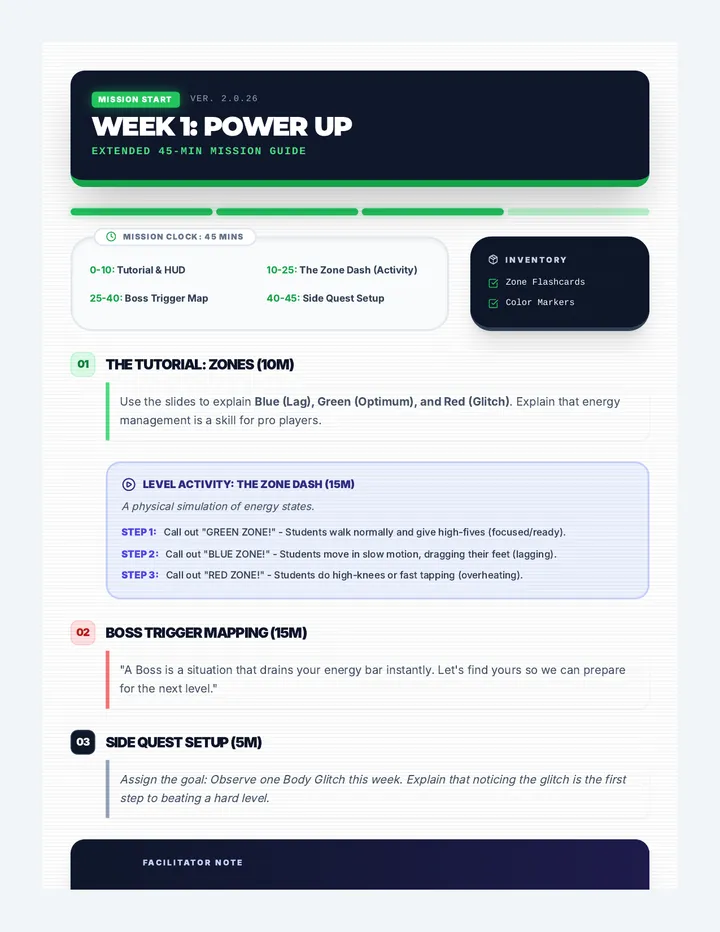
A 6-week social-emotional learning program for teenagers on the autism spectrum, delivered in focused 20-minute sessions. The program uses visual "blueprints" to teach energy management, body awareness, and Comic Strip Conversation techniques for emotional regulation and perspective taking.
An 8-week deep dive into Kafka's Metamorphosis for special education students, focusing on abstract thinking, social value, and the human condition through high-engagement activities and visual organizers.
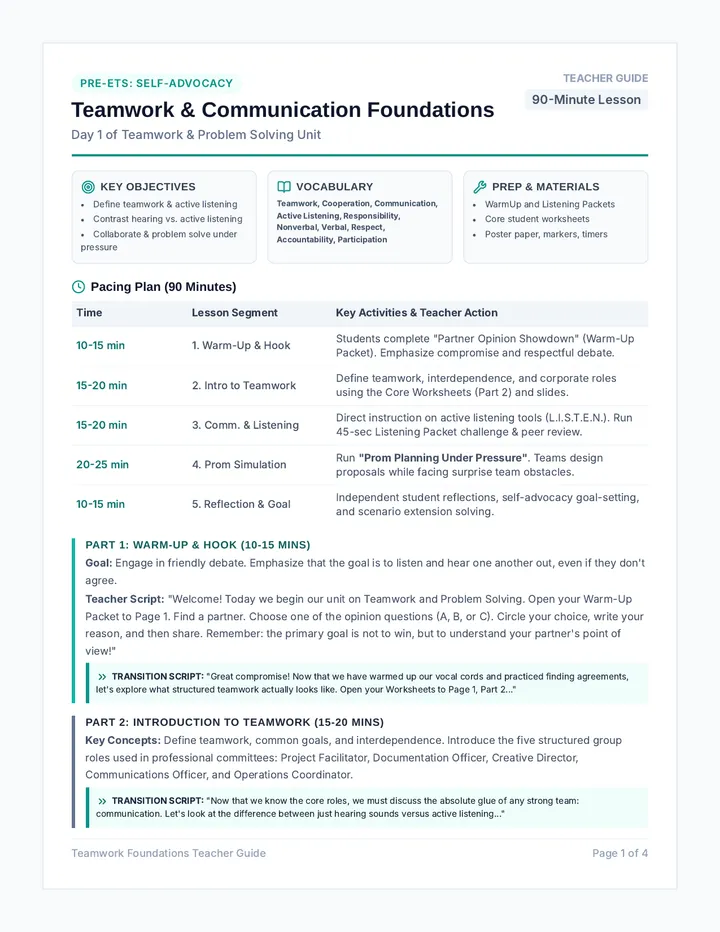
A unit introducing high school students to essential teamwork, communication, and problem-solving skills, focusing on workplace readiness, self-advocacy, and Pre-ETS skills.
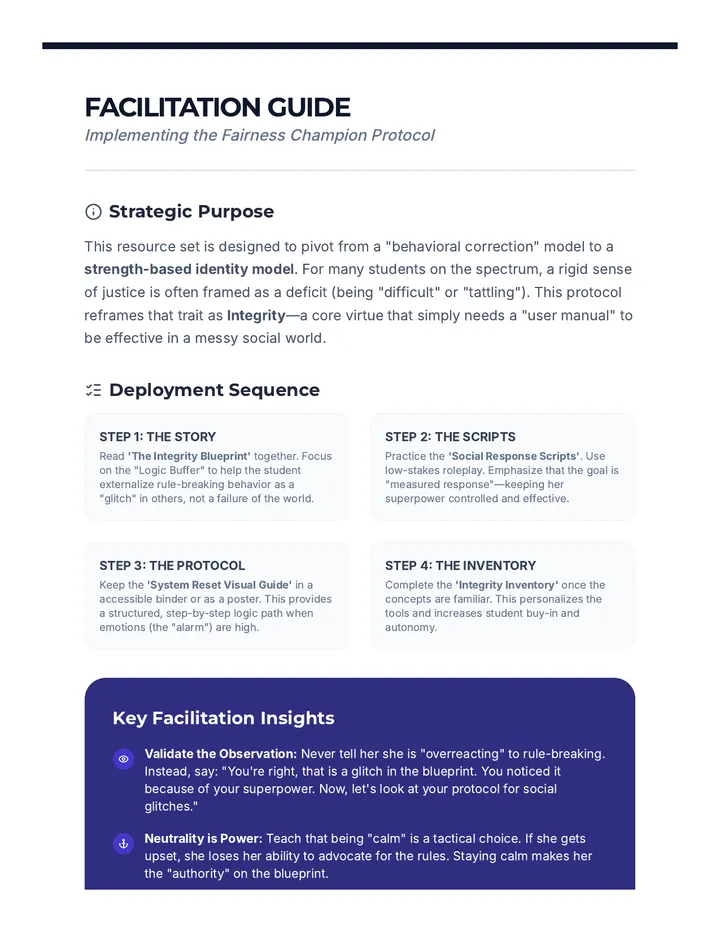
A 6-week social-emotional learning curriculum for a 13-year-old girl on the autism spectrum, focusing on managing specific triggers through a strength-based "Integrity Blueprint" lens.
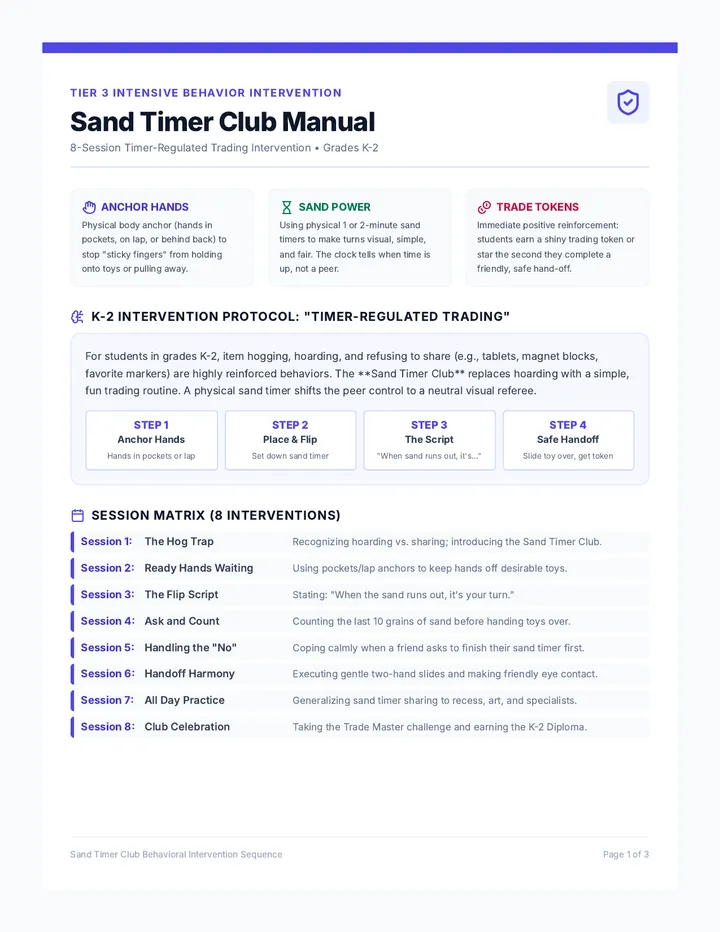
An 8-session intensive behavioral intervention sequence for students in grades K-2. It targets the reduction of item hogging and refusal to share, teaching a 'Timer-Regulated Trading' replacement behavior using sand timers, cooperative scripts, and token hand-offs.
A comprehensive 7-day unit for Grade 11/12 Designing Your Future students, focusing on leveraging AI tools like Gemini for workplace and college success. Designed for special education contexts, it emphasizes self-advocacy, professional communication, research, and project management through visual and digital tasks.
A 6-week social-emotional learning curriculum designed for 4th-grade students with ADHD, focusing on self-regulation, flexible thinking, and respectful communication through a high-engagement 'Level Up' video game theme.
A 6-session transition bootcamp for 5th graders moving to middle school, focusing on executive functioning skills like planning, task initiation, and independence within a 'Mission to Middle School' space theme.
A comprehensive 5-lesson series designed for high school students with intellectual disabilities, Down Syndrome, and autism. The series uses a 'Social Signals' framework to help students distinguish between genuine kindness and manipulative behavior, fostering independence and safety in community settings.
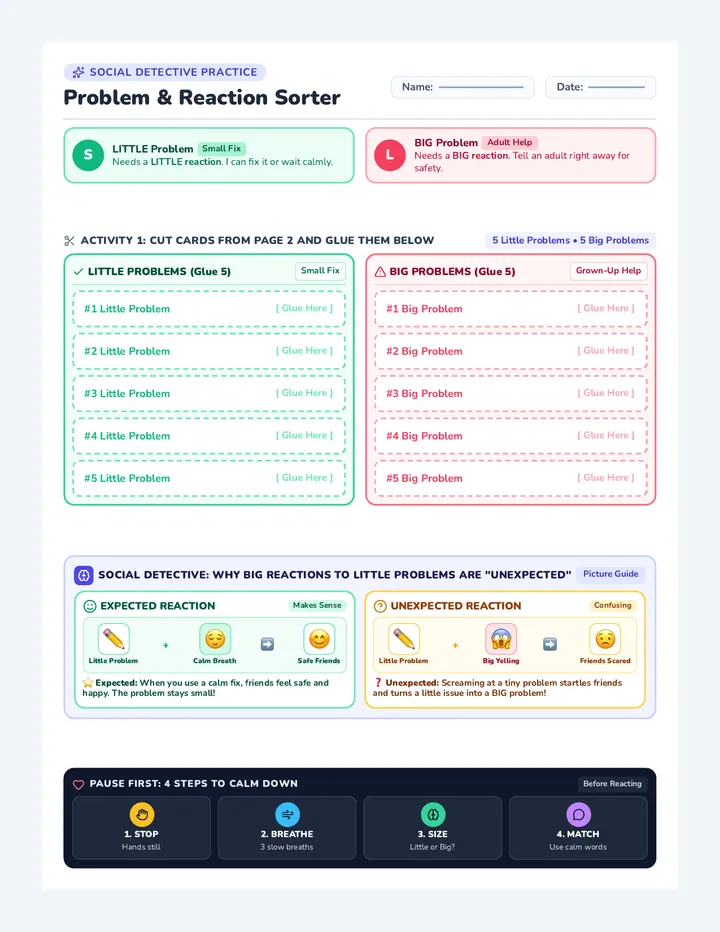
A comprehensive 6-week social skills and problem-solving program designed specifically for 2nd-grade students with ASD. The sequence uses a 'Social Detective' theme to teach self-regulation, perspective taking, empathy, and social problem-solving through visual supports and concrete activities.
A set of visual supports and interactive activities designed to help students with ASD understand the consequences of elopement and learn safe replacement behaviors.
A Tier 3 social-emotional curriculum designed for middle school students on the autism spectrum, focusing on self-regulation, social cues, and conflict resolution through a 'Social Architect' theme.
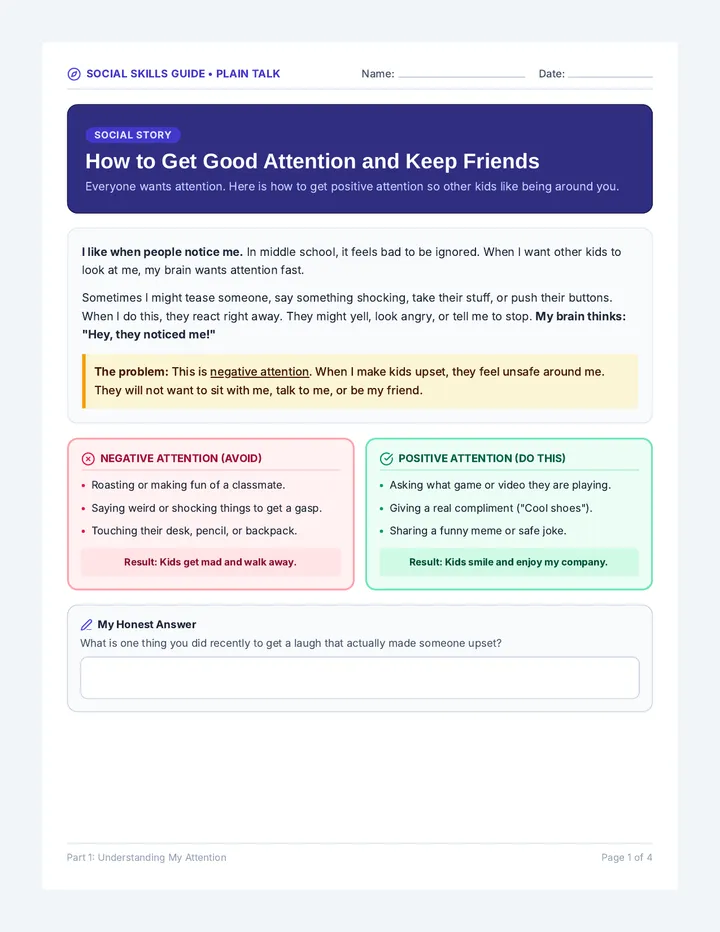
A Tier 2 social skills lesson for 7th-grade boys with autism to differentiate between shared laughter and mockery through cue identification and scenario practice.
A comprehensive Tier 3 behavior support system for a second-grade student with ADHD, focusing on emotion regulation, safe choices, and positive reinforcement through a structured daily check-in/check-out (CICO) process.
A 20-day series of functional math, life skills, and vocational morning worksheets designed to build real-world independence. Each daily worksheet includes personal information practice, coin and bill calculations, budgeting, next-dollar-up calculations, and real-world functional reading.
A comprehensive social story and supporting tools designed for an academically advanced 2nd grader to manage non-preferred tasks, transitions, and big emotions using verbal communication and solution-seeking strategies instead of screaming or eloping.
A collaborative, non-verbal activity designed for high school Directed Studies students to build executive functioning, teamwork, and communication skills under constraints. Includes a guided presentation and printable reflection and support materials.
A comprehensive life skills rotation lesson covering budgeting, social interactions at a cafe, job skills (stocking/packing), and self-advocacy through role-play and game-based learning.
A high-energy, superhero-themed lesson designed for students with autism to learn the 'superpower' of self-advocacy. This lesson covers standing up for oneself at home, school, and in the community through interactive slides, stories, and games.
A lesson designed for students with disabilities focusing on three core kindness skills: sharing, using kind words, and keeping hands and feet to oneself. This lesson uses the 'Kindness Superpowers' theme to engage students in social-emotional learning.
An introductory training and orientation framework for inclusive music classrooms, pairing peer partners with special education students to foster musical expression, collaboration, and mutual growth.
A social boundaries lesson designed for a student who uses PECS and enjoys counting songs. The lesson focuses on identifying safe touches and using numbers to regulate social interactions.
A lesson designed to support adults with cognitive decline in nursing home settings, focusing on the social and emotional skills needed to wait for staff assistance patiently.
A lesson for highly intelligent 1st grade students with autism focused on turn-taking and classroom flexibility using the metaphor of a 'Classroom Garden' to illustrate how every student's voice needs space to grow.