Translates abstract word problems into concrete visual models using bar diagrams, number lines, and manipulative sketches. Supports cognitive processing and multi-step problem solving for students with diverse learning needs.
A pair of targeted 15-minute Tier 2 intervention lessons for 1st grade, focusing on foundational phonics (Short 'a' CVC words) and mental math (Number Bonds to 10).
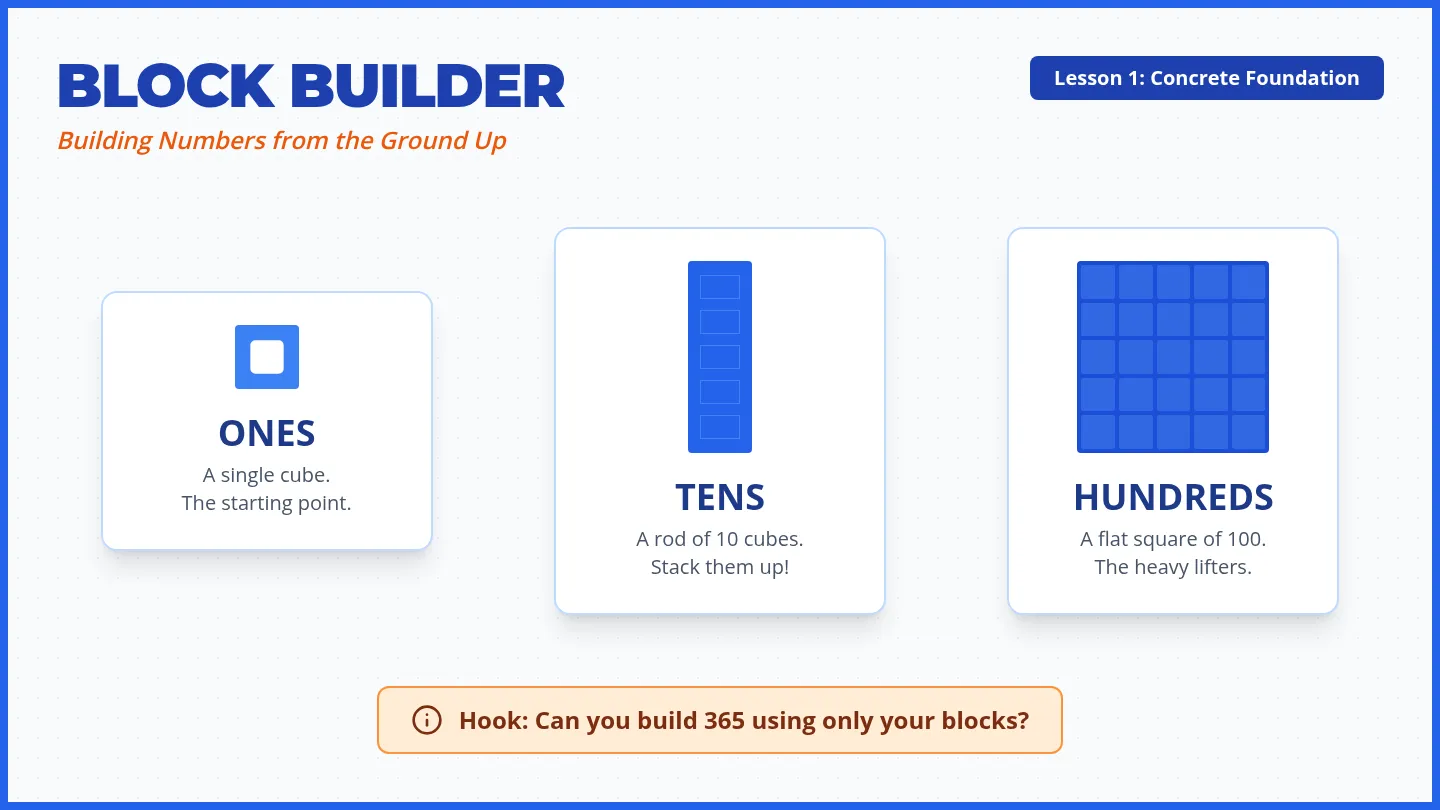
This sequence uses a Concrete-Representational-Abstract (CRA) approach to help 3rd-grade students in special education master multi-digit addition and subtraction. It moves from physical base-ten blocks to shorthand drawings and finally to the standard numeric algorithm, emphasizing the conceptual 'why' behind regrouping.
This advanced graduate sequence focuses on the design and implementation of the Concrete-Representational-Abstract (CRA) framework for learners with mathematics disabilities. Students will move from diagnostic error analysis to the creation of comprehensive, evidence-based intervention plans.
A 10th-grade special education sequence focused on the strategic use of virtual manipulatives to bridge the gap between concrete modeling and abstract algebraic reasoning. Students progress from tool exploration to independent selection and justification.
A 5-lesson sequence for 11th-grade students transitioning from physical math manipulatives to virtual tools. The curriculum emphasizes digital literacy, strategic tool selection, and self-advocacy to prepare students for post-secondary academic environments.
This sequence uses base-ten blocks to help 6th-grade students with learning disabilities visualize decimal place value and operations. By redefining the 'flat' as one whole, students tactilely explore tenths and hundredths to build a concrete foundation for addition and subtraction.