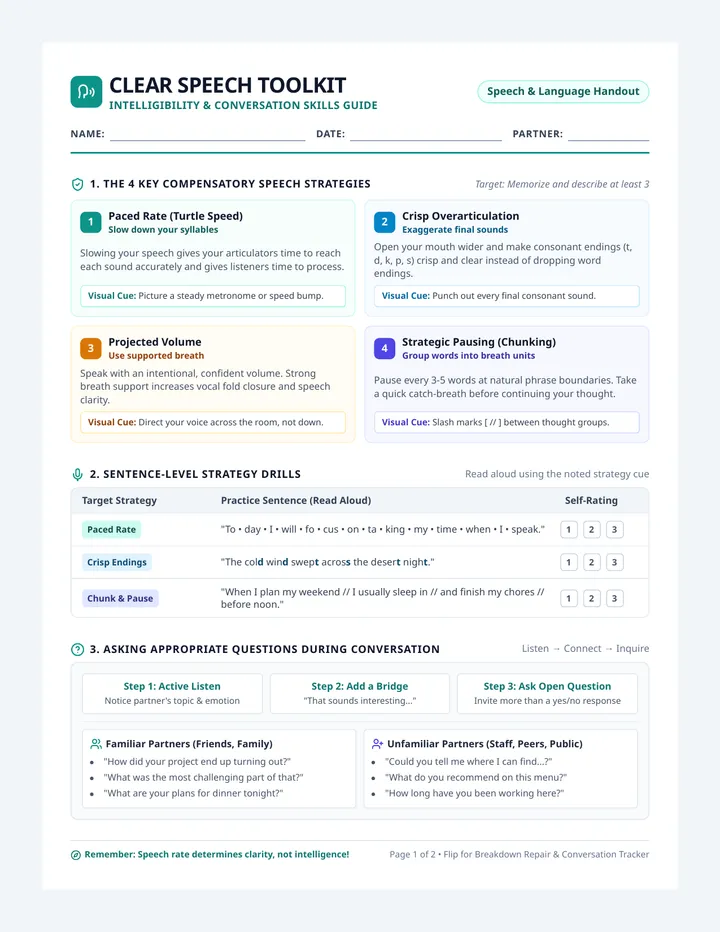
Verbal modulation, body language interpretation, and turn-taking strategies for effective social interaction. Addresses social problem identification, help-seeking, and the comprehension of figurative language across varied contexts.
A comprehensive, autism-friendly visual choice board inspired by "What Would Danny Do?" for a third-grade student. It breaks the school day into six key settings with concrete "Power Choices" and calming "Power Resets" to support positive behavior and self-regulation.
A comprehensive facilitator guide for running a Problem vs. Solution Circuit with adult or youth clients. It includes step-by-step facilitation routines, whiteboard layout schematics, accessibility adaptations, and 12 concise, board-ready scenarios across workplace, daily living, and social communication settings.
A comprehensive, 3-page clinical and instructional guide detailing how communication impairments manifest in the classroom across academic, social-emotional, and executive domains. It equips teaching staff with concrete observational frameworks, high-impact Tier 1/Tier 2 accommodations, and actionable strategies for collaborative family-school partnerships.
A gentle, 4-page printable social story designed for incoming Pre-K students. Features structured photo placeholders for real-life school pictures alongside reassuring text covering classroom routines, teachers, circle time, bathroom needs, snack, recess, cleanup, and dismissal.
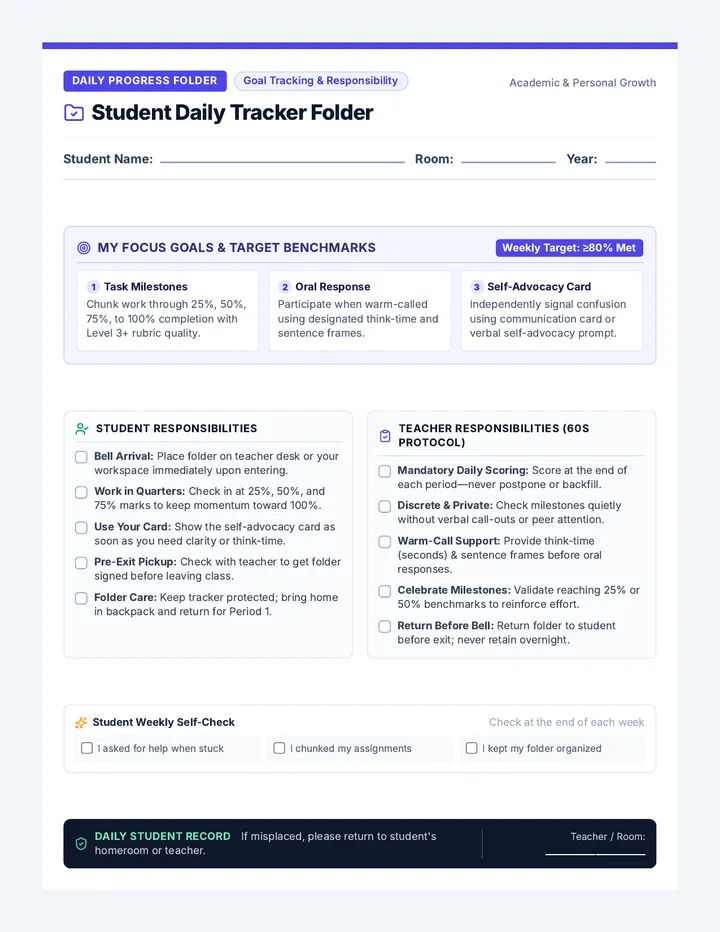
A comprehensive, PBIS-aligned daily Check-In Check-Out (CICO) monitoring sheet designed for an ADHD student focusing on peer relationships, calm transitions, and task completion.
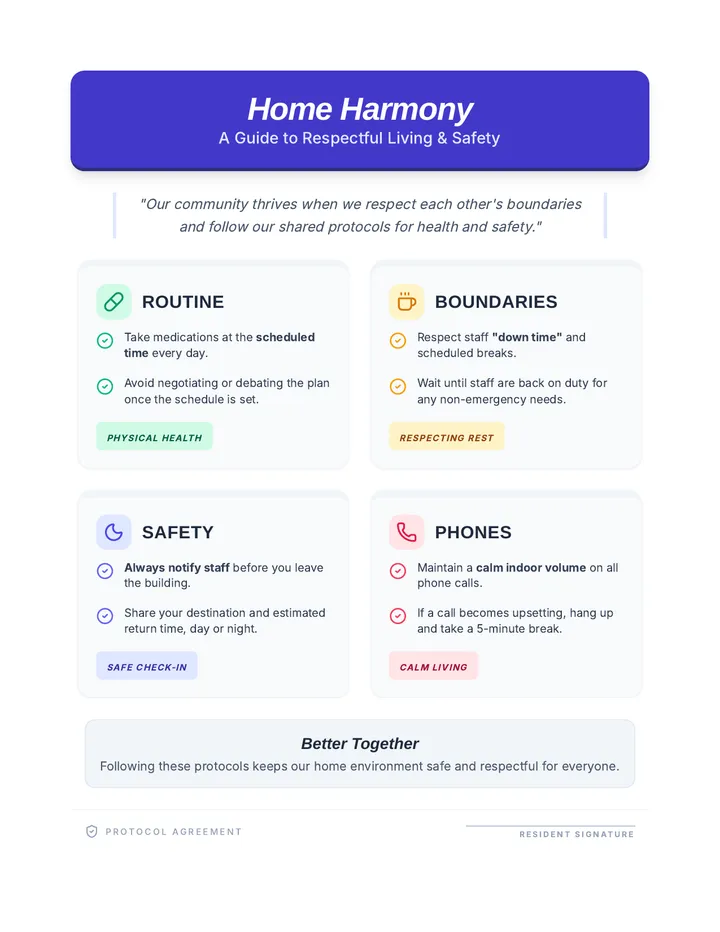
A single-page visual poster summarizing behavioral expectations for a client, strictly optimized to fit on exactly one side of a letter-sized sheet by using a fixed-height container and precise spacing.
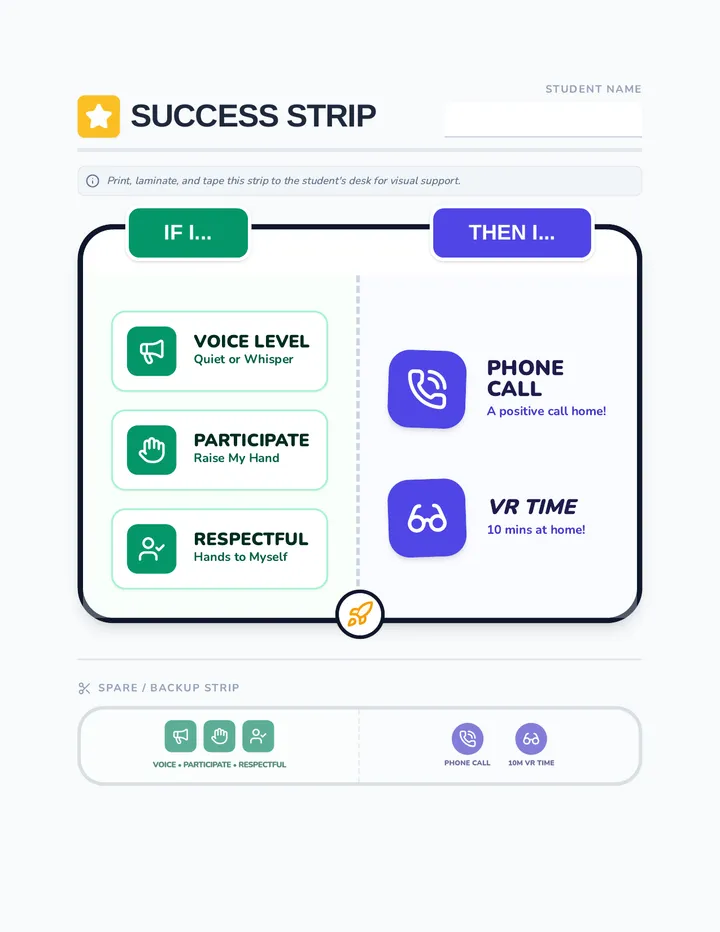
A behavior support strip for a 2nd grade student featuring an 'If-Then' visual reinforcement system. It outlines classroom expectations such as voice level and participation, linked to rewards like a positive phone call and VR time at home (now updated to 10 minutes).
A simplified, highly structured 12-slide interactive presentation designed for 6th grade autistic students in a small group. Uses short bulleted scenarios, clear visual icons, simplified vocabulary, and direct matching choices for emotions, intentions, sarcasm, and problem solving.
A set of four printable, square-shaped voice level desk cards for classroom management. Color-coded levels 0 to 5 are stacked in a compact, highly visible 2x2 grid, featuring custom icons and a left-side clip track.
An expanded set of nine large-format printable desk strips with high-contrast visual reminders, including specific calming techniques and a "Safe Choices" strip for unwanted behaviors.
An ultra-minimalist set of voice level cards featuring large numbers, bold icons, and single labels for instant recognition.
A professional checklist for instructors titled 'Neurodiverse Supports', containing exactly the 13 points provided.
A single-page visual checklist social story for students who struggle with repeating the teacher's words. It includes specific goals for circle time and reading with clear visual icons, large check-off boxes, and a daily reflection section.
A behavior tracking point sheet organized by subject area, featuring a 3-point smiley face scale for monitoring following directions and social interactions. Designed for student self-reflection or teacher feedback.
A clear, visual poster designed for adult supported living environments (ABI focus). It uses color-coded sections (Emerald for expected, Rose for unacceptable) with simple icons and direct language to promote respect, privacy, and safety.
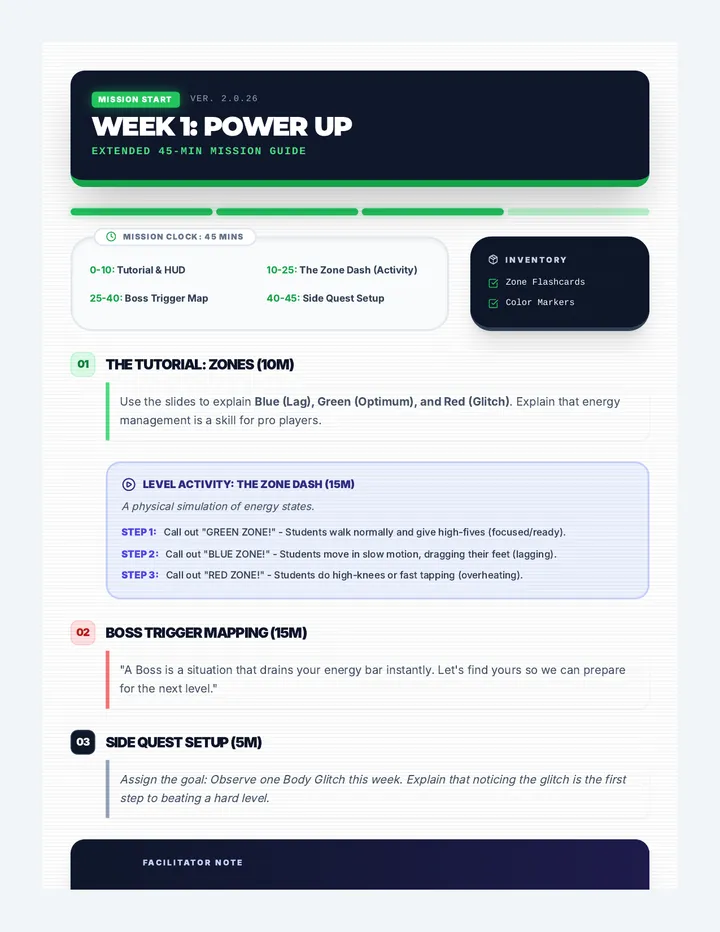
A 6-week social-emotional learning program for teenagers on the autism spectrum, delivered in focused 20-minute sessions. The program uses visual "blueprints" to teach energy management, body awareness, and Comic Strip Conversation techniques for emotional regulation and perspective taking.
An 8-week deep dive into Kafka's Metamorphosis for special education students, focusing on abstract thinking, social value, and the human condition through high-engagement activities and visual organizers.
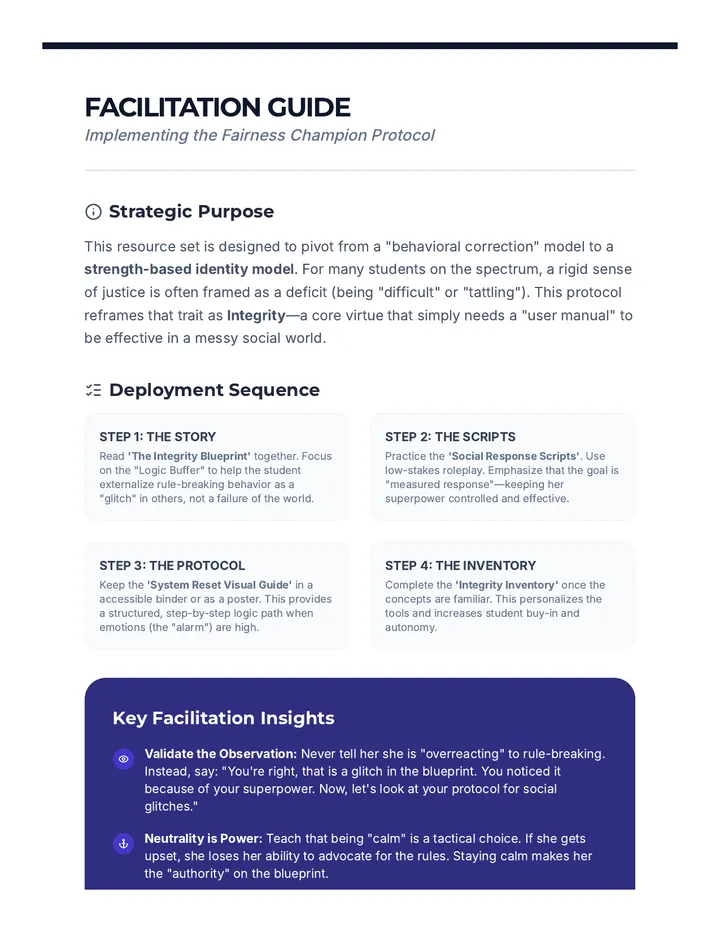
A 6-week social-emotional learning curriculum for a 13-year-old girl on the autism spectrum, focusing on managing specific triggers through a strength-based "Integrity Blueprint" lens.
A social-emotional unit for 3rd grade students in inclusive programs, focused on building 'Social Detective' skills. Students learn to scan environmental cues, interpret non-verbal communication, and flexibly adjust their behavior to match the social energy of different contexts.
A comprehensive 6-week social skills and problem-solving program designed specifically for 2nd-grade students with ASD. The sequence uses a 'Social Detective' theme to teach self-regulation, perspective taking, empathy, and social problem-solving through visual supports and concrete activities.
A comprehensive three-lesson sequence designed for intellectually disabled students to identify and analyze character traits, physical features/feelings, and internal motivations using visual cues.
A 6-week social-emotional learning sequence for 4th-grade students with IEPs, focusing on perspective-taking, tone of voice recognition, and decoding the function of communication.
A Tier 3 social-emotional curriculum designed for middle school students on the autism spectrum, focusing on self-regulation, social cues, and conflict resolution through a 'Social Architect' theme.
A multi-part speech-language therapy unit for middle schoolers focused on vocabulary development through the lens of NASA's Artemis II mission. Students use context clues strategies (IDEAS) to master mission-specific terminology.
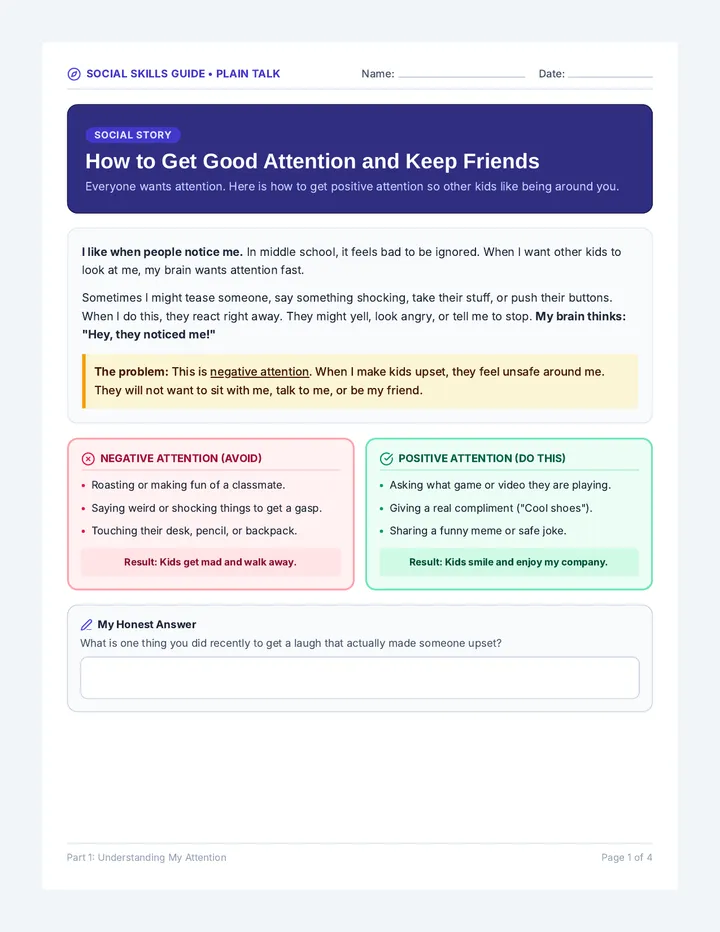
A 6-week individual behavior intervention sequence for 1st grade students struggling with emotional regulation, elopement, and attention-seeking behaviors. The sequence focuses on identifying feelings, sizing problems, and using functional communication to seek attention appropriately.
An 8-session intensive behavioral intervention sequence for students in grades 3-5. It targets disruptive playground game entry (such as barging in, interrupting play, or imposing rules) and teaches the three-step replacement behavior 'Watch, Match, Ask' to help students successfully and cooperatively join peer games.
A 10-session social skills curriculum designed for 1st graders with autism and ADHD, focusing on social behaviors, boundaries, and emotional regulation using a "Social Stars" space quest theme.
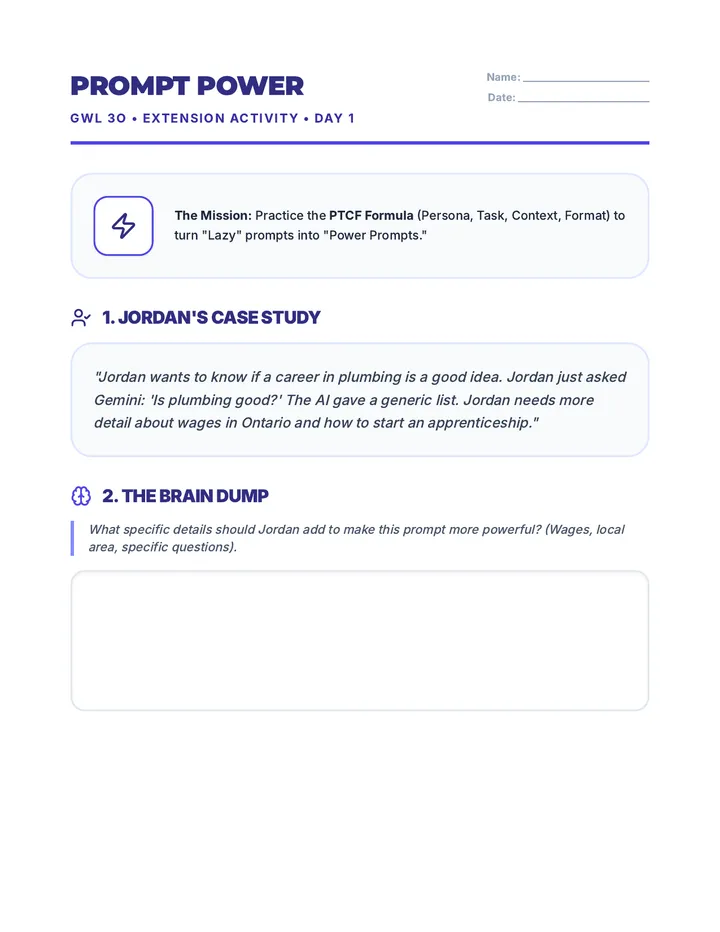
A comprehensive 7-day unit for Grade 11/12 Designing Your Future students, focusing on leveraging AI tools like Gemini for workplace and college success. Designed for special education contexts, it emphasizes self-advocacy, professional communication, research, and project management through visual and digital tasks.
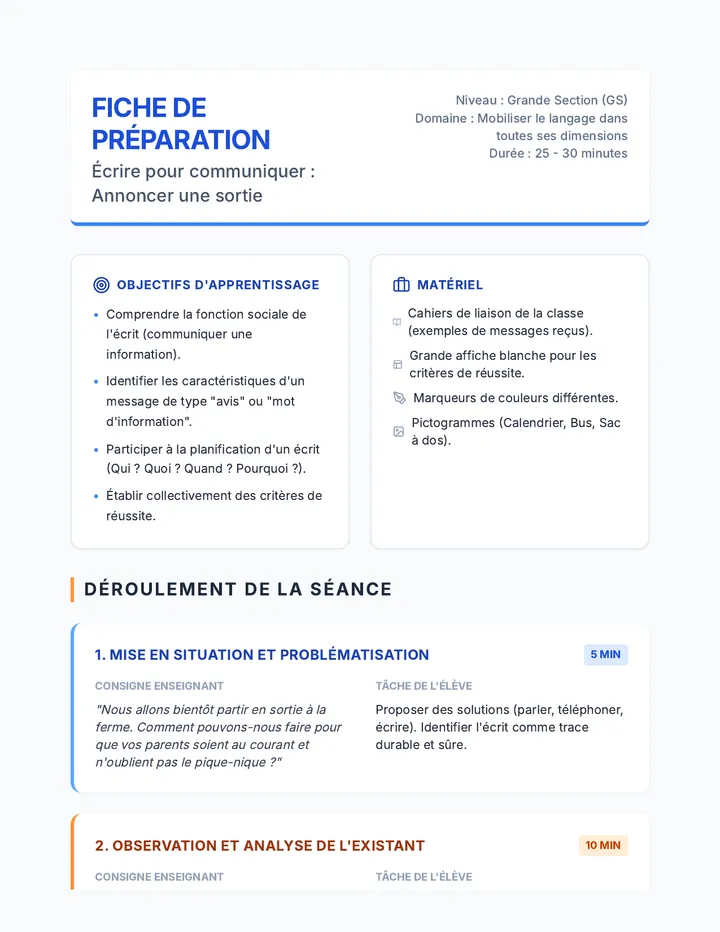
Une série de modules de formation destinés aux conseillers pédagogiques pour renforcer leur expertise en ingénierie de formation continue, spécifiquement appliquée à l'enseignement du français à l'école primaire.
A 4-week social skills program designed for students with autism, focusing on nonverbal communication, emotion recognition, personal space, and social interaction through visual stories and structured activities.
A comprehensive 12-session social skills program designed for a 1st-grade student with Autism, focusing on social norms, personal boundaries, and school safety through the engaging themes of Toy Story and NumberBlocks.
A comprehensive workplace simulation program for Club Challenge of Orange Park, designed to teach vocational skills through a realistic café environment. The sequence includes orientation materials, operational tools for students, and tracking resources for staff.
A comprehensive, highly visual curriculum sequence designed to prepare high school special needs students for employment. It covers critical social-emotional and practical work skills, starting with the job interview process and continuing with key on-the-job expectations, workplace etiquette, and self-advocacy.
A sequence of lessons designed for young adults with cognitive disabilities to navigate social boundaries and consent. It transitions from foundational personal boundaries to complex professional and community-based interactions.
A 5-week social skills curriculum designed for 5th-grade students with Autism, focusing on conversation mechanics, initiation, maintenance, and appropriate responding through high-visual, fast-paced lessons.
This sequence uses a 'Social Detective' theme to help 6th-grade students analyze environmental clues, social rules, and communication partner availability to determine context-appropriate greetings. Students move from basic environmental observation to complex social decision-making and code-switching.
A comprehensive sequence designed for 10th-grade Special Education students to build vocational readiness. It covers identifying soft skills, crafting resumes, completing applications, mastering workplace etiquette, and practicing mock interviews to prepare students for the transition to employment.
This sequence prepares 10th-grade students for the transition to community and vocational life by mastering the navigation of Augmentative and Alternative Communication (AAC) devices. Students progress from identifying context-specific vocabulary to navigating complex, multi-folder social and professional interactions.
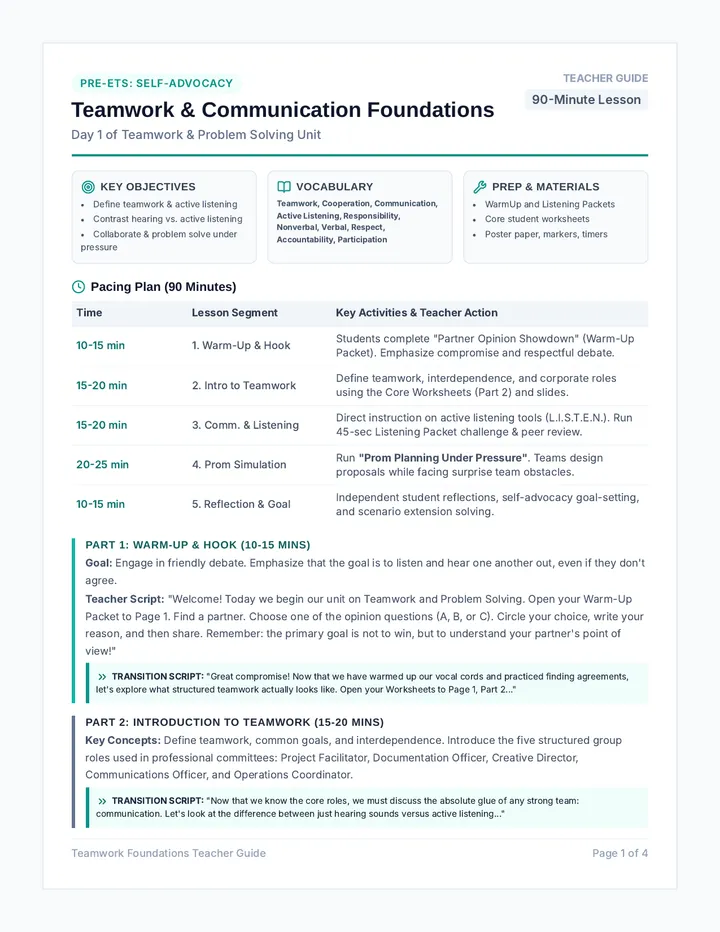
A unit introducing high school students to essential teamwork, communication, and problem-solving skills, focusing on workplace readiness, self-advocacy, and Pre-ETS skills.
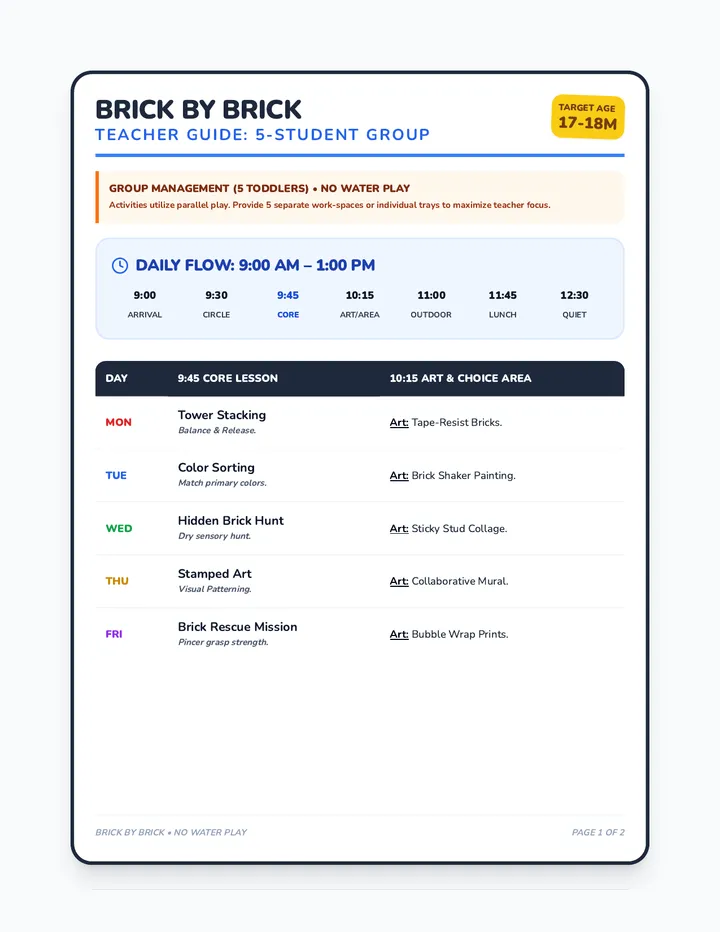
A collection of comprehensive week-long curricula for toddlers aged 17-18 months. Each themed week focuses on developmental play, sensory exploration, and fine motor skills for a group of 5 students with zero water play.
A 6-week social-emotional learning curriculum designed for 4th-grade students with ADHD, focusing on self-regulation, flexible thinking, and respectful communication through a high-engagement 'Level Up' video game theme.
A multi-lesson unit for 4th-grade students with limited literacy, focusing on mastering and applying foundational academic vocabulary words like fact, information, alike, difference, and topic.
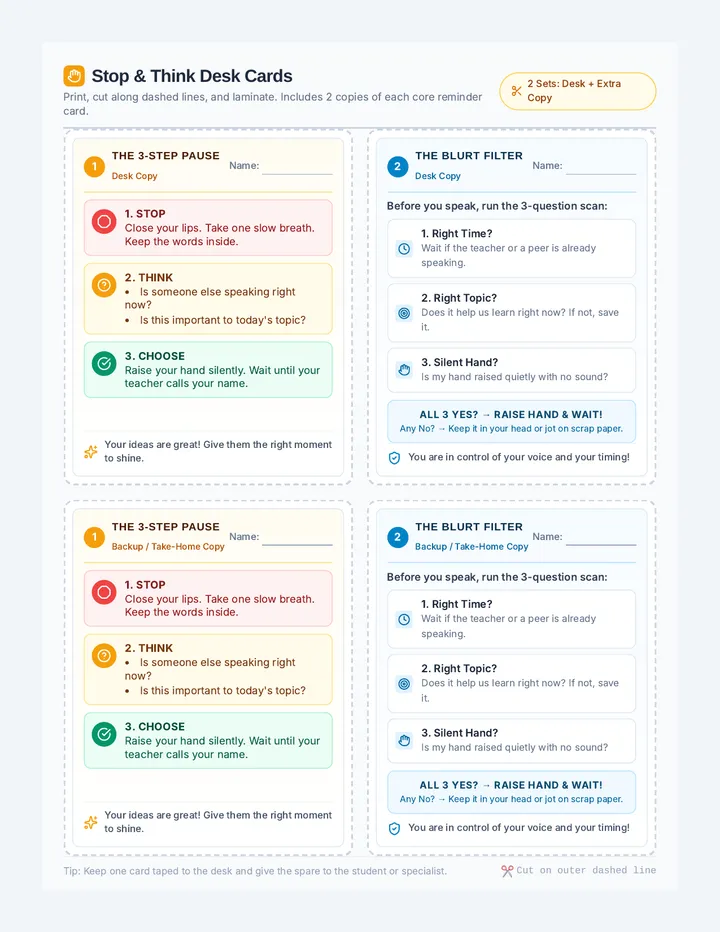
A series of resources designed to help students with autism navigate social boundaries, specifically focusing on blurting out and staying on-task during group lessons.
A comprehensive unit on executive functioning skills, focusing on active listening, reading comprehension for instructions, and sequence execution across academic and social settings.
A game-based lesson designed for low-level SPED students to learn about and practice respecting personal boundaries and space through interactive play.
This lesson teaches 11th-grade students with autism essential conversation skills, including how to initiate and sustain meaningful interactions with peers. Students will watch a video, engage in guided discussions, and practice real-world scenarios through role-play.
A visual life skills lesson for high school students with intellectual disabilities, focusing on personal space, asking for help, and conversational turn-taking through concrete visual cues and structured practice.
A 20-minute Tier 3 lesson for individual students with autism, focusing on identifying expected versus unexpected behaviors and developing impulse control strategies using the 'Stop and Think' method.
This lesson helps 3rd-grade students understand the difference between expected and unexpected behaviors through personalized discussion, role-playing, and reflection. It is designed for individual (Tier 3) support to help students improve their social skills and classroom interactions.
A 30-minute introductory lesson on gratitude for K-3 students with autism and developmental disorders, using visual aids, a story, and a hands-on activity.
A 15-minute individual Tier 3 lesson designed to teach a non-verbal 3-year-old foundational turn-taking skills using visual supports, tokens, and structured play.
A targeted 30-minute social skills session designed for a 2nd grader with autism, focusing on greetings, turn-taking, and sharing. This individual Tier 3 lesson builds confidence and practical strategies for positive peer interactions.
A 30-minute individualized lesson for a 3rd-grade autistic student focused on following multi-step directions through engaging activities and visual supports.
A functional communication and life skills lesson designed for high school students learning foundational social skills. Students learn safe boundaries, warm greetings, self-introductions, simple question-asking, and back-and-forth conversational turn-taking through visual supports and structured role-play.
A targeted 20-minute social skills lesson for 2nd and 3rd-grade students on the autism spectrum, focusing on eye contact, active listening, and making connected comments.
A participatory town hall lesson designed for young adults in independent living transition programs. Members learn civic dialogue protocols, practice self-advocacy, and generate meaningful questions and solutions for member clubs, community living, and program improvements.
A comprehensive 3-hour one-on-one session designed for adults with disabilities, covering pre-interview routines, professional presentation, and effective communication strategies during a job interview.
A Tier 2 social skills lesson for 7th-grade boys with autism to differentiate between shared laughter and mockery through cue identification and scenario practice.
A foundational social skills lesson focused on introducing oneself, active listening, and discovering common interests through interactive activities and visual guides.
A collaborative, non-verbal activity designed for high school Directed Studies students to build executive functioning, teamwork, and communication skills under constraints. Includes a guided presentation and printable reflection and support materials.
A set of cognitive behavioral tools and flowcharts designed to help students with OCD navigate intrusive thoughts about social rejection and moral scrupulosity.
An introductory training and orientation framework for inclusive music classrooms, pairing peer partners with special education students to foster musical expression, collaboration, and mutual growth.
A social boundaries lesson designed for a student who uses PECS and enjoys counting songs. The lesson focuses on identifying safe touches and using numbers to regulate social interactions.
A lesson for highly intelligent 1st grade students with autism focused on turn-taking and classroom flexibility using the metaphor of a 'Classroom Garden' to illustrate how every student's voice needs space to grow.
A 30-minute social skills lesson designed for a 7th-grade student with Autism, focusing on personal space and appropriate classroom boundaries using visual aids.
A comprehensive set of materials designed for a 10th-grade student with Autism to master identifying social intent and unspoken rules in complex, gray-area scenarios involving sarcasm, white lies, hidden cues, and dating nuances.
An 8-week individualized program for a 3rd-grade student with autism to identify and manage emotions using a 'toolbox' of coping strategies. Each 30-minute session focuses on self-awareness, trigger identification, and practical regulation skills.
A 30-minute social skills lesson designed for Tier 2 special education groups, focusing on identifying and interpreting non-verbal cues to improve social communication.
A 20-minute Tier 1 lesson for exceptional children introducing the concept of personal space bubbles to improve social comfort and reduce task avoidance.
A comprehensive life skills rotation lesson covering budgeting, social interactions at a cafe, job skills (stocking/packing), and self-advocacy through role-play and game-based learning.
A high-energy, superhero-themed lesson designed for students with autism to learn the 'superpower' of self-advocacy. This lesson covers standing up for oneself at home, school, and in the community through interactive slides, stories, and games.
A lesson designed for students with disabilities focusing on three core kindness skills: sharing, using kind words, and keeping hands and feet to oneself. This lesson uses the 'Kindness Superpowers' theme to engage students in social-emotional learning.
A social-emotional learning lesson designed for kindergarteners with autism, focusing on the concepts of personal space and 'keeping hands to self' through the metaphor of a protective 'Space Bubble'.