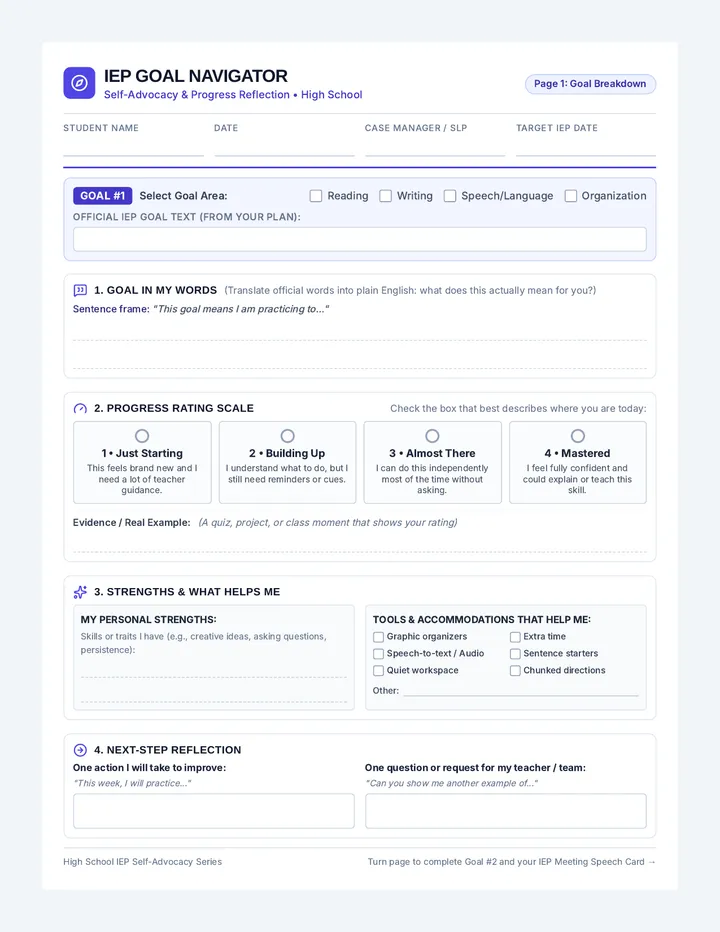
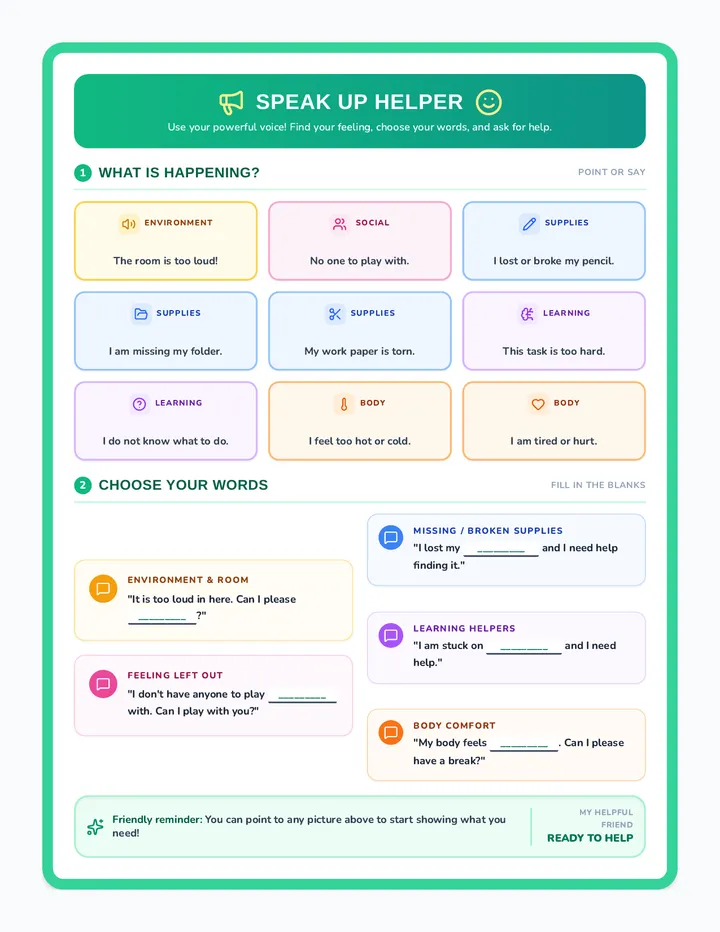
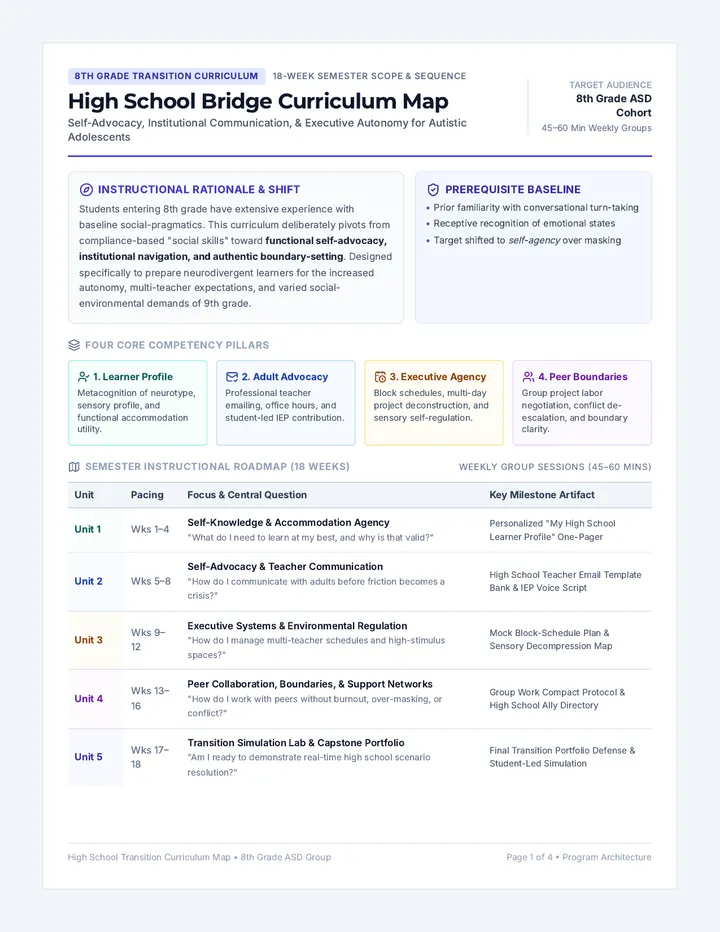
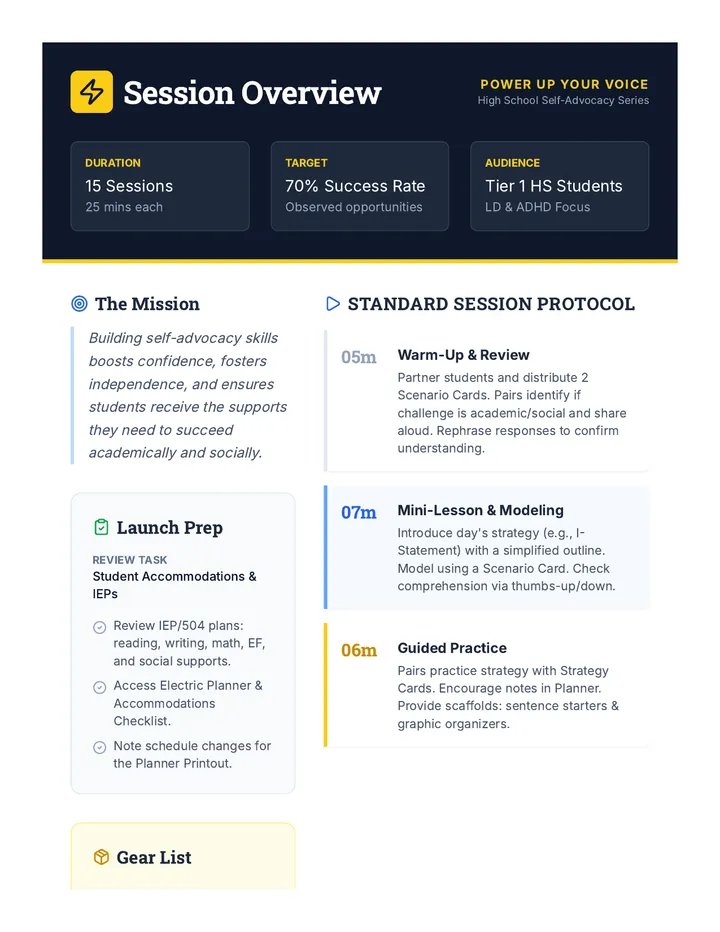
Strategies for identifying specific learning needs and articulating accommodation requests to educators. Equips students with communication skills to advocate for necessary environmental, academic, and social supports.
A sequence focused on empowering 3rd-grade students to customize their text-to-speech settings. Students experiment with speed, voice, and visual highlighting to create a personalized 'Assistive Tech Profile' for better reading retention and comfort.
A sequence designed for 2nd grade students to master the use of text-to-speech (TTS) technology. Students move from basic identification of tools to independent navigation and troubleshooting, viewing TTS as a helpful 'reading buddy'.
A 10th-grade sequence focused on empowering students to manage their own IEP/504 timelines, accommodations, and administrative responsibilities through the lens of project management. Students transition from passive recipients of services to active managers of their educational milestones.
A project-based unit where 6th-grade students use text-to-speech technology to access and analyze complex informational texts. Students develop research skills, digital literacy, and metacognitive awareness of their own learning tools.
This sequence guides 6th-grade students through the technical mastery of text-to-speech (TTS) tools. It moves from basic navigation to personalized configuration, empowering students to treat assistive technology as a custom scaffold for their unique learning styles.
A 5-lesson inquiry-based sequence for 4th graders to explore and customize text-to-speech (TTS) settings, focusing on self-advocacy and personal learning profiles.
This sequence empowers 5th-grade students to understand, use, and advocate for Text-to-Speech (TTS) as a vital learning tool. It focuses on the distinction between fairness and sameness, identifying specific tasks where TTS is most effective, and building the social-emotional confidence to communicate needs to teachers and peers.
A comprehensive transition sequence for 12th-grade students focusing on the legal, professional, and practical aspects of using Text-to-Speech (TTS) and other assistive technologies in higher education and the workplace. Students learn to advocate for their rights under the ADA and Section 504 through role-play, professional writing, and portfolio building.
This sequence empowers 9th-grade students to integrate Text-to-Speech (TTS) into their high school workflows through self-advocacy and digital organization. Students move from identifying reading barriers in their schedules to creating a professional Access Plan for their teachers.
A technical sequence designed for high school students to master text-to-speech (TTS) tools. It covers tool selection, voice optimization, navigation shortcuts, troubleshooting inaccessible formats like PDFs, and ends with students creating a personal accessibility profile for independent academic success.
A 5-lesson sequence for 7th-grade students focusing on text-to-speech (TTS) as a tool for writing revision and a foundation for self-advocacy. Students progress from technical editing skills to understanding neurodiversity and communicating their accommodation needs to others.
A comprehensive, 1-page teacher-facing lesson plan and pacing guide to deliver the Access Architects curriculum. Includes clear instructions for guiding the reading, managing the school accessibility audit, facilitating discussions, and a complete answer key for the student journal.
A premium, visually-engaging 5-slide presentation to introduce elementary students to school accessibility, support specialists (OT, PT, SLP, and Co-teachers), and the hands-on student advocacy audit.
An engaging 3-page student-facing workbook designed to build school accessibility awareness. Page 1 contains a high-interest, kid-friendly reading passage about special education support teams and classroom/physical barriers. Page 2 features career-matching activities and comprehension questions. Page 3 provides a hands-on school access audit and changemaker proposal template.
A comprehensive 6-page printable classroom kit for the 'Build the Workday' activity, containing a front-and-back group reflection packet with massive writing lines, simplified task cards, and matching-size 12-hour and 8-hour schedule templates.
A 3-page guided Executive Functioning Workbook to help students identify distractions, practice self-calming strategies, and build confidence in self-advocacy.
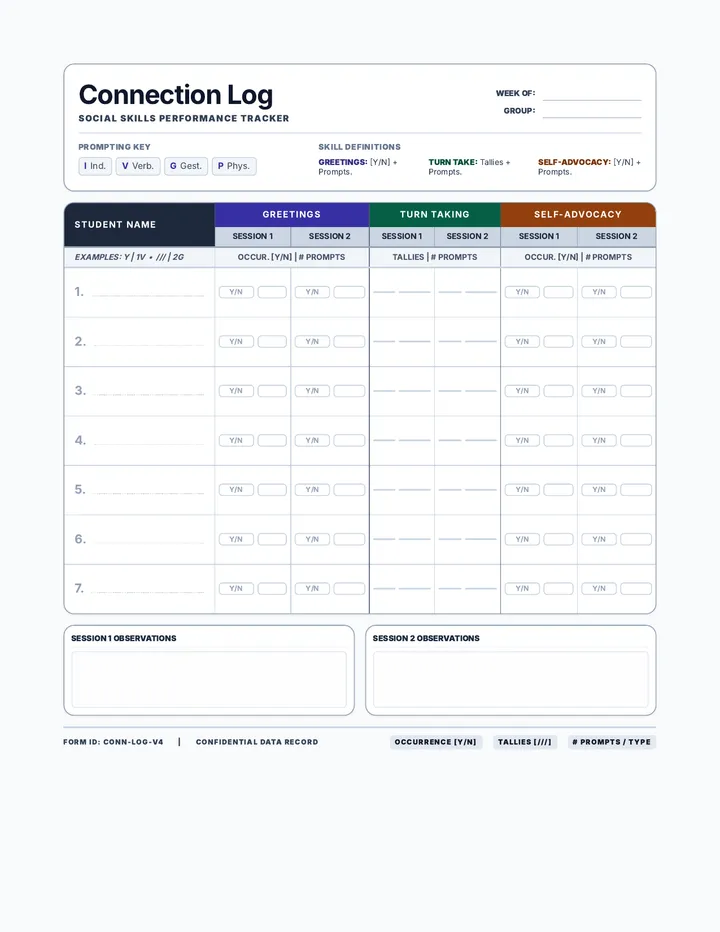
A weekly self-monitoring tracker for students with ADHD to monitor focus, calming strategies, and self-advocacy with a teacher-signed verification box.
A comprehensive guide for teachers and IEP teams containing SMART goals, objectives, accommodations, and tracking strategies for ADHD students focusing on emotional regulation, self-advocacy, and attention.
A premium 3-page printable student web quest focused on Workplace Transition. Each page targets a specific focus area: Disclosure & Accommodations, Employment Rights & Standards, and Succeeding on the Job. Includes defined vocabulary sidebars, direct web links, and scaffolded sentence starters for short-answer questions.
A 1-page visual choice board (document format) that offers three targeted research pathways with specific, concrete transition questions. Students select two paths to investigate assistive technology, intake rules, or BSWD funding rules, and complete their notes in stacked, full-width journal boxes with extra space for the second entry.
A highly engaging, 3-page independent transition quest (document format) that frames post-secondary preparation as a series of structured scouting tasks. Students research Ontario college accessibility rules, inventory their documentation, explore the BSWD bursary, draft an introductory email, and evaluate their progress with an integrated grading rubric.
A comprehensive 5-slide presentation designed to guide students through the legal, administrative, and practical differences between high school and college accommodations in Ontario. It details documentation requirements, assistive technology tools, and Ontario-specific funding opportunities like the BSWD.
A student-facing 3-page interactive transition workbook designed specifically for Ontario. It features Ontario Human Rights Code guidelines, accommodation self-assessments, a customizable disclosure decision pathway, and structured self-advocacy scripting worksheets.
Students practice making independent choices, expressing preferences, and setting boundaries (saying "yes" or "no") using structured choice boards, tactile sorting mats, and interactive role-play.
Students practice identifying when they need help, who to ask (teachers, peers, or helpers), and how to communicate that need using visual phrase cards and guided collaborative practice.
Students learn to recognize and communicate physical and emotional states (like tired, hungry, overwhelmed, or ready to learn) using simple gestures, vocalizations, or visual symbol cards.
An introductory get-to-know-you lesson utilizing visual sentence starters and structured options to support students of all communication styles in sharing their preferences, feelings, and strengths.
A comprehensive preparation resource set for Field Day, designed for upper elementary and sensory-sensitive students. It includes a structured, coping-strategy-focused social story booklet and a beautifully organized, visual rotation schedule poster to support seamless transitions.
A comprehensive suite of materials designed to support students with ADHD in emotional regulation, focus, self-advocacy, and goal setting. Includes a SMART IEP Goal Bank & Accommodations Guide, a printable Student Progress Tracker, and a 3-page guided Executive Functioning Workbook.
A lesson focused on supporting students with disabilities as they transition into the workplace, utilizing resources from the Ontario Transition Resource Guide.
A comprehensive transition planning lesson designed to help high school students with disabilities successfully navigate the shift to Ontario colleges. Students learn the differences between high school and college accommodations, explore documentation requirements, and research specific college accessibility services.
An empowering, Ontario-specific transition unit helping students with disabilities navigate workplace accommodations, disclosure choices under the Ontario Human Rights Code, and self-advocacy strategies.
A student-focused lesson introducing adult community services, self-advocacy, and financial funding in Ontario. Includes an interactive transition booklet and a comprehensive facilitation guide for teachers.
A career-focused lesson where students explore apprenticeships and trades using the Transition Resource Guide. Students complete a WebQuest to understand the apprenticeship path and use a Graphic Organizer to map out their chosen trade.
A comprehensive annual functional skills pacing framework for grades K-8. This framework structures a whole-school alignment across living, social-emotional, and community safety domains, optimized for special education administrators, resource teachers, and service providers.