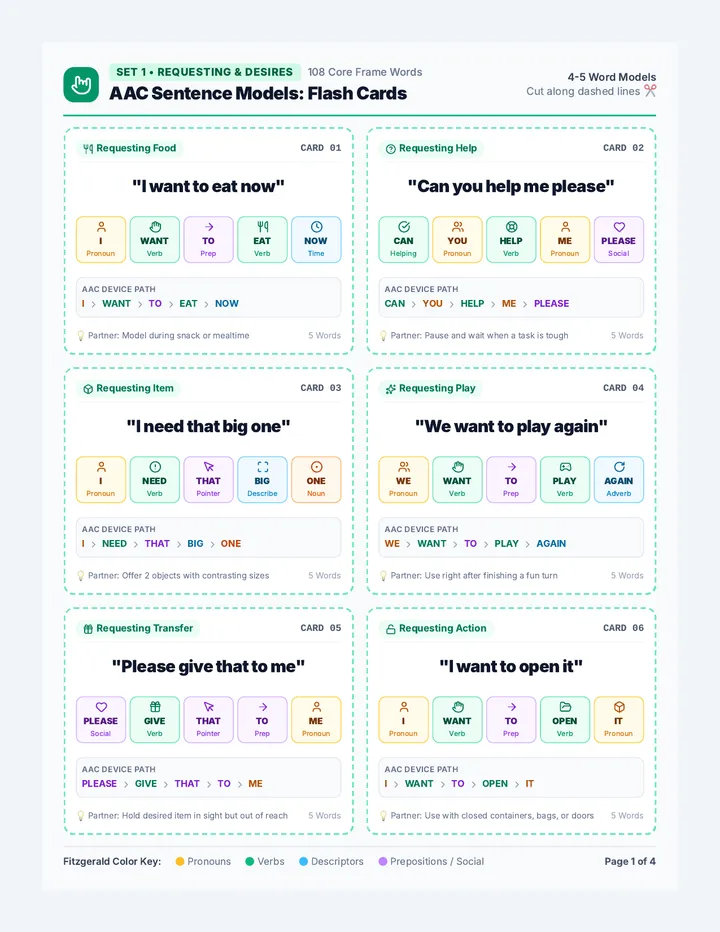
Motor planning, symbol hierarchies, and folder organization for high-tech communication tools. Develops speed and accuracy in locating vocabulary across diverse page sets.
An advanced graduate-level course exploring the intersectional barriers to student self-advocacy. This sequence critiques traditional advocacy models through the lenses of Critical Race Theory and Disability Studies to develop culturally responsive strategies.
A comprehensive graduate-level sequence on implementing digital assistive technology for note-taking. It covers the transition from traditional methods to audio-synchronization, AI-driven summarization, and executive function-focused organization, concluding with IEP documentation.
A graduate-level course on the systematic instruction of replacement behaviors within a function-based framework. Students master shaping, chaining, FCT, DTT, and naturalistic teaching, culminating in advanced generalization and maintenance planning for long-term clinical success.
This sequence challenges undergraduate students to adapt standard behavioral check-in protocols for diverse student populations, focusing on developmental, cultural, and neurological differences. Students move beyond a one-size-fits-all approach to design equitable and effective behavioral supports.
A comprehensive sequence for 11th-grade students on behavioral support, focusing on the 'Fair Pair' rule. Students learn to identify, design, and implement functionally equivalent replacement behaviors (FERBs) to empower individuals to meet their needs pro-socially.
A comprehensive unit for high school students on the ethical and technical aspects of teaching replacement behaviors. Students move from the core philosophy of the 'Fair Pair' rule to technical skills like FCT, task analysis, and generalization planning.
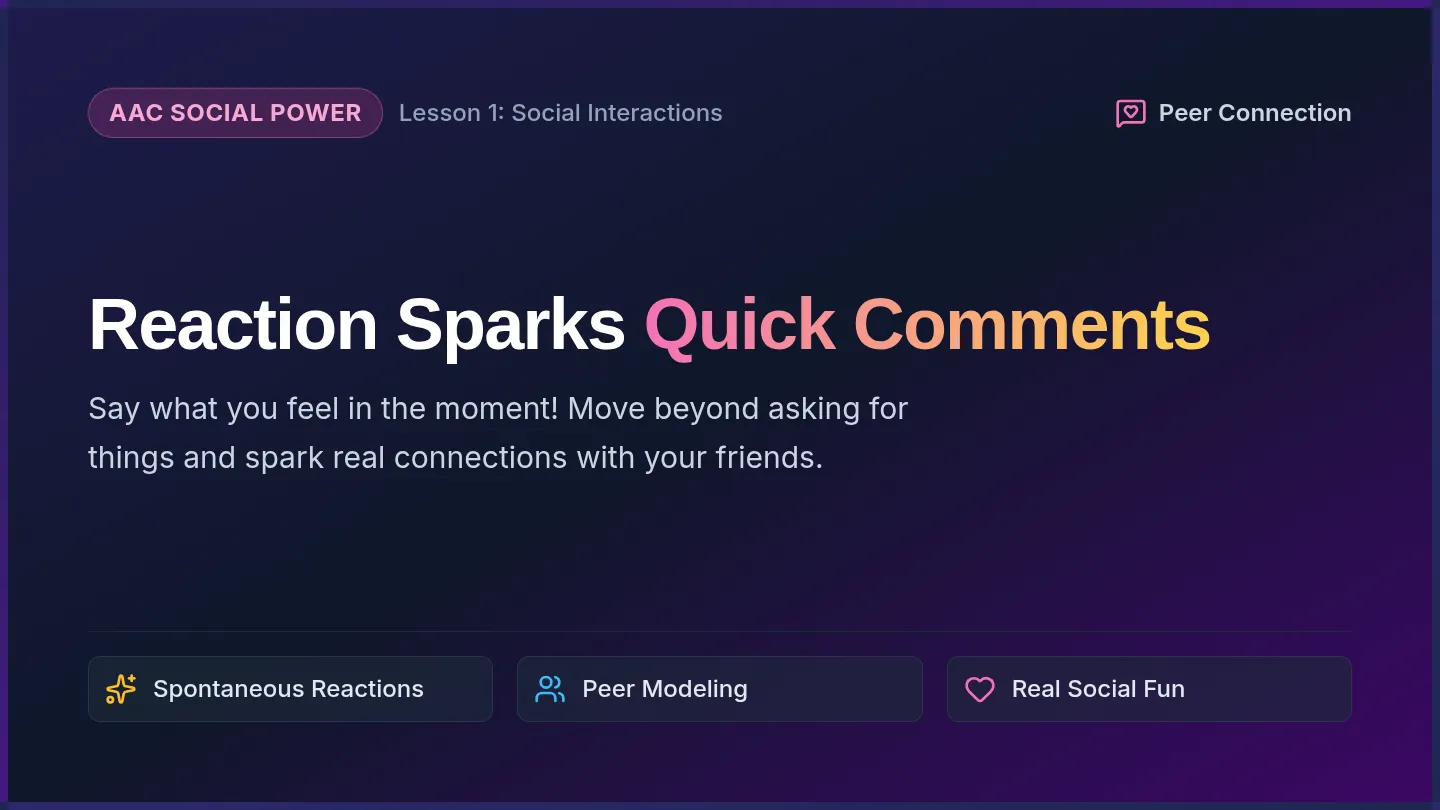
A specialized sequence for 11th-grade AAC users focused on transitioning from basic needs-based communication to complex social interaction, storytelling, and peer connection through advanced device navigation.
This sequence focuses on developing motor automaticity for AAC device navigation through gamified drills and repetitive motor planning exercises. 11th-grade students will progress from single-word retrieval to complex, fluent sentence construction, reducing cognitive load for more authentic communication.
A comprehensive sequence for 11th-grade AAC users to transition from passive users to active system administrators by mastering folder logic, personalization, and system maintenance.
This 11th-grade sequence focuses on 'Descriptive Teaching' for AAC users. Students learn to navigate their devices strategically, using core vocabulary (adjectives, verbs, negation) to describe concepts and repair communication breakdowns rather than relying on specific fringe nouns.
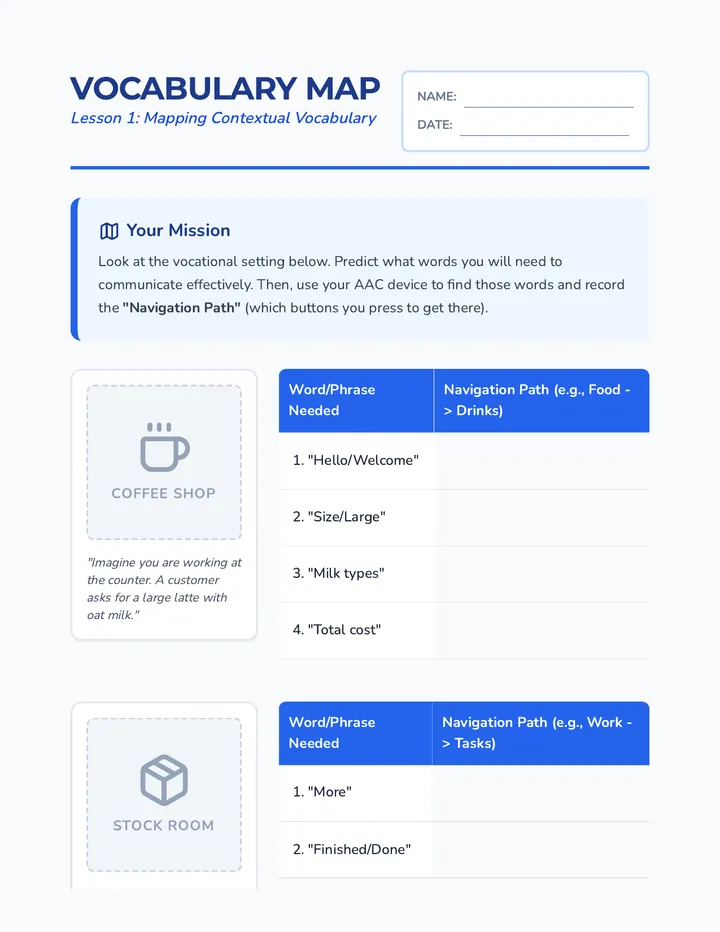
A comprehensive 5-lesson sequence designed for 11th-grade AAC users to master device navigation within vocational settings. Students progress from vocabulary mapping to high-stakes workplace simulations, focusing on speed, accuracy, and professional communication strategies.
A project-based sequence where 3rd-grade students use AAC device navigation to compose and present a personal or fictional narrative. Students progress from vocabulary selection to sequencing, drafting actions, and adding emotional depth, culminating in a public presentation.
A final reflection journal for graduate students to synthesize their learning from the sequence and develop a personal philosophy of culturally responsive advocacy instruction.
A debate guide for Lesson 5, outlining affirmative and negative positions on the ethics of teaching self-advocacy and providing Socratic prompts for deep ethical reasoning.
Graduate-level slides exploring the ethical balance between teaching student resilience and institutional responsibility, concluding the sequence with critical debate themes.
A student activity for auditing a syllabus to identify barriers that necessitate self-advocacy and redesigning policies using UDL principles to move toward proactive accessibility.
Graduate-level slides exploring the transition from individual accommodations to Universal Design, focusing on conducting institutional audits to identify and remove barriers.
A student activity for designing a non-verbal advocacy protocol for a student using eye-gaze AAC, focusing on signals, pre-set phrases, and environmental waiting norms.
Graduate-level slides exploring the barriers and strategies for students with complex communication needs to engage in self-advocacy using AAC and other tools.
A teacher guide for Lesson 2, providing strategies for culturally responsive family engagement in advocacy, focusing on shifting from individual to interdependent models of help-seeking.
A student worksheet for analyzing the friction between Western advocacy norms and diverse cultural communication styles, power distances, and social orientations.
Graduate-level slides exploring how cultural values, authority structures, and disability conceptions impact help-seeking behaviors and self-advocacy.
A teacher guide for Lesson 1, providing instructional context, discussion prompts, and a checklist for deconstructing traditional advocacy scripts through an intersectional lens.
A student worksheet for analyzing a "neutral" accommodation request transcript through various intersectional identity profiles to identify potential perception biases in faculty.
Critically debate the ethical balance between teaching student resilience and institutional responsibility. Synthesize a personal philosophy of advocacy instruction.
Conduct institutional audits to identify barriers that necessitate self-advocacy. Shift the focus from modifying student behavior to modifying the educational environment using UDL principles.
Design advocacy protocols for students with significant cognitive disabilities or those who use AAC. Focus on building autonomy for students without reliance on verbal fluency.
Examine how cultural values regarding authority, independence, and disability impact help-seeking behaviors. Develop strategies for culturally responsive family engagement in advocacy.
Analyze how race, gender, and disability intersect to influence faculty and institutional perceptions of student advocacy efforts. Analyze research on the 'perception gap' and critique standard advocacy scripts.
Translates technical knowledge into legal documentation. Students practice writing specific, measurable IEP goals for assistive technology use and implementation.
Addresses the "after" of note-taking: retrieval and organization. Students design systems to support students with executive dysfunction in managing digital files.
Explores Speech-to-Text (STT) and AI summarization. Students evaluate the accuracy and pedagogical implications of automated classroom supports.
Focuses on audio-synchronization tools like Glean and Notability. Students learn to use bookmarking strategies to reduce cognitive load during lectures.
A survey of current note-taking hardware and software. Students categorize tools by the cognitive deficit they address and discuss the phenomenon of technology abandonment.
Addresses the critical phase of ensuring behaviors persist across time, people, and environments. Students move beyond 'train and hope' to strategic programming for maintenance.
Contrasts structured teaching with incidental and naturalistic strategies. Students learn how to contrive learning opportunities and capture motivation in real-world settings.