Smooth Transitions Lesson Plan Smooth Transitions
Empowering Communication with AAC
30 Minutes
Tier 3 Intervention
Why This Matters
Clear communication during transitions can mitigate distress and prevent aggressive behaviors, enhancing the student’s ability to navigate daily routines safely.
Learning Objective
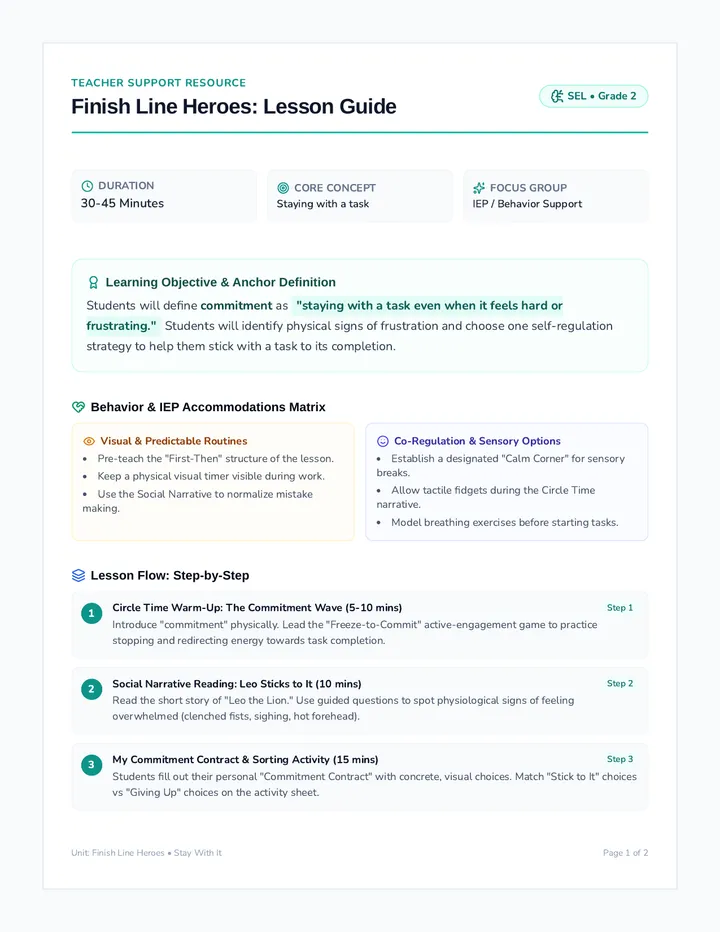
The student will use their AAC device or visual cue cards to communicate distress or request help during transitions, reducing aggressive behaviors and increasing safety.
Materials Needed
AAC Device / Visual Cue Cards
Sensory Bin (Preferred Fillers)
Preferred Puzzle Activity
Transition Slide Deck
Preparation
Review session flow and transition slide deck.
Ensure AAC device is charged and visual cards are accessible.
Set up sensory bin and puzzle stations in advance.
Minimize environmental distractions to reduce unpredictability.
Instructional Steps
1 Warm Up: Puzzle Play
5 Minutes
• Engage the student with a short, preferred puzzle activity to capture attention and create a calm starting point.
• Introduce the AAC device/visual cue cards by briefly explaining (using visual and gestural cues) that these tools will help express feelings during the session.
2 Core Transition Activity
15 Minutes
• Present the transition slide deck to visually show what the next part of the routine looks like.
• Prompt the student to use their AAC device or visual cue cards to indicate distress or ask for help if the transition feels challenging.
• Use sensory bin activities to reinforce calming strategies during the transition moment.
• Monitor and provide immediate praise or gentle guidance when the student successfully uses the communication tools.
3 Cool Down: Reflection
5 Minutes
• Conclude with a calm down activity; revisit a familiar puzzle to signal the end of the session.
• Discuss (using visuals) how using the AAC or visual cues helped during the transition, reinforcing the connection between communication and support.
Puzzle Play Warm Up Guide Puzzle Play Warm-Up
Session Entry & Engagement
5 MIN
Activity Overview
The Puzzle Play Warm-Up is designed to engage the student using a preferred puzzle activity. This helps create a calm, focused start to the session, establishing a predictable routine that signals a safe learning environment.
Activity Objectives
Capture the student's attention in a familiar, low-stress manner.
Establish a structured routine that signals the session start.
Create a smooth, positive entry into the learning environment.
Activity Steps
1
Warm Greeting
Greet the student in a warm, familiar manner. Use a specific visual greeting cue if established in their routine.
2
Present Puzzle
Present the puzzle activity. Highlight that it is a fun and engaging task to build positive momentum.
3
Supported Play
Allow the student to engage with the puzzle. Provide scaffolding or "hand-over-hand" support only as needed to ensure success.
4
Intro Communication Tools
Briefly introduce the AAC device or visual cards. Use gestural cues to show they will help express feelings later in the session.
This activity prepares the student for transition tasks by anchoring them in a preferred, successful routine.
Puzzle Reflection Cool Down Guide Puzzle Reflection Cool Down
Predictable Closure & Strategy Reinforcement
5 MIN
Activity Overview
The Puzzle Reflection Cool Down provides a comforting and familiar closure to the session. By returning to the puzzle activity, the student can transition out of the session in a calm, structured manner while reinforcing the communication skills practiced.
Activity Objectives
Ease the transition out of the session using a low-stress activity.
Reflect on communication outcomes from the session.
Connect AAC/Visual cue usage to feeling safe and supported.
Activity Steps
1
Return to Puzzle
Transition back to the puzzle area. Invite the student to engage with the familiar task to lower arousal levels.
2
Visual Review
Once settled, use simple visuals to briefly review how the AAC device or cards were used. Show a "success" icon or photo of the student using the tool.
3
Reinforce Support
Ask (using visual/gestural questions) if the student felt supported. Reinforce success with specific verbal/visual praise: "You used your words to stay safe!"
4
Final Affirmation
End with positive feedback. Reiterate that these tools help keep them safe and supported during all transitions throughout the day.
Predictable closure reduces anxiety and helps generalize the communication skills learned during the session.
Transition Slide Deck Welcome to Our Session
Today, we'll have fun with puzzles and learn to use our AAC device or visual cues during changes in our routine.
Teacher: Set a calm tone and use simple gestures.
Our Routine
1
Puzzle Play Warm-Up
2
Transition Activity
3
Puzzle Reflection
Transition Time
When it's time to change, use your AAC device or tap the visual cue card.
Ask for help
Tell us if you feel upset
You Are Supported!
"Great job using your tools! Remember, asking for help keeps you safe during changes."
Safe
Happy
Strong
Session Recap
Puzzle Fun
Using AAC/Visual cues during transitions
Feeling Supported
Well Done!