Evaluation of student performance data to determine when to intensify, fade, or change instructional interventions. Supports teachers in documenting progress and justifying evidence-based modifications for individual learners.
A 12-session Tier 2 intervention series focusing on making ten and decomposing strategies for addition and subtraction word problems within 20 and 200. Designed for students with learning and intellectual disabilities using direct instruction and hands-on practice.
This sequence teaches undergraduate students how to use systematic data collection to identify behavioral escalation patterns. Students transition from subjective descriptions to objective operational definitions, analyze antecedents, track behavior metrics, and use scatterplots to predict future incidents, culminating in the creation of data-driven Behavior Intervention Plans.
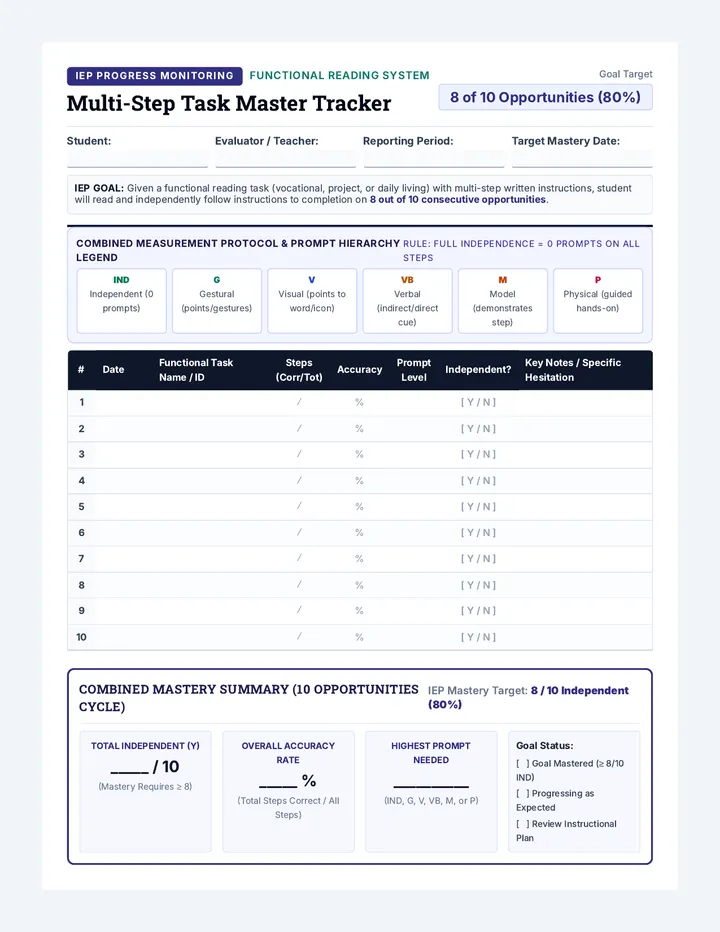
This sequence explores the implementation and monitoring of IEPs for 11th-grade students, focusing on data collection, progress reporting, secondary transition planning (ITP), and the ethical balance between legal compliance and educational quality. Students transition from being passive participants to active designers and evaluators of the IEP process.
A comprehensive graduate-level sequence on the visual analysis of behavioral data, covering graph construction, interpretive dimensions (level, trend, variability), statistical aids, and experimental design logic. Students learn to make evidence-based clinical decisions through rigorous data interpretation.
This graduate-level sequence focuses on the technical proficiencies required for high-quality Functional Behavior Assessments (FBAs). Students will master indirect assessment methods and direct observation techniques, critiquing the validity and reliability of various data systems to ensure accurate behavioral triangulation.
This advanced sequence explores the integration of measurement and analysis into behavioral intervention decision-making. Students learn to establish stable baselines, monitor treatment fidelity, and use quantitative data to determine when to modify, fade, or maintain supports.
An advanced cognitive-behavioral sequence for 11th-grade students focusing on the emotional and analytical aftermath of sensory dysregulation. Students learn to challenge post-crisis shame, conduct root cause analysis, track behavioral data, and design preventative environments to build long-term resilience.
This theoretical sequence establishes the foundational knowledge required to understand Daily Check-In procedures within a Multi-Tiered System of Supports (MTSS). Students analyze the psychological principles behind Check-In/Check-Out (CICO) interventions, examine feedback loops, review evidence-based research, and investigate trauma-informed perspectives and organizational readiness.
This sequence equips graduate-level special education students with the systems-thinking and logistical skills required to manage complex caseloads. It covers the mathematical realities of service delivery, the strategic selection of instructional models, master scheduling, and compliance-driven contingency planning.
A 10th-grade sequence focused on empowering students to manage their own IEP/504 timelines, accommodations, and administrative responsibilities through the lens of project management. Students transition from passive recipients of services to active managers of their educational milestones.
A comprehensive graduate-level sequence focused on the pedagogical implementation of assistive writing technology. It shifts the focus from tool selection to instructional methodologies that scaffold digital organizers, dictation, and text-to-speech for student autonomy.
A comprehensive graduate-level course on diagnosing and remediating failures within behavioral token economies, covering satiation, security, hoarding, and response costs.
An individualized Tier 3 lesson designed to help students with learning disabilities enhance word recognition through specific decoding strategies like chunking and blending. This 30-minute session aligns with IEP goals, focusing on phonics and building reading confidence.
A 30-minute Tier 3 intervention lesson for individual students with learning disabilities, focusing on mastering CVC (Consonant-Vowel-Consonant) words through explicit phonics instruction and multi-sensory strategies.
A Tier 3 individualized support lesson for a kindergarten student, setting up a sensory-friendly corner to de-escalate using visual and tactile tools. This session guides the teacher in creating the space, demonstrating tools, and training the student on self-calming strategies.
A 30-minute Tier 3 training for clinical staff focused on designing and implementing personalized behavior support plans through assessment, strategy selection, and progress monitoring.
A professional development session for 10th-grade teachers and school leaders focused on using a structured observation tool to track and analyze student responses to classroom redirections. This data-driven approach helps identify behavior patterns and informs the creation of effective, individualized support plans.
A comprehensive four-month individual project for a 9th-grade student with autism, focusing on the creation of a mural to develop artistic skills, project management, and self-expression.
This lesson helps teachers identify individual student preferences in a fun, interactive way. Understanding student preferences can enhance engagement and tailor instruction. Designed for Pre-K students, 1 session, 30 minutes.
A 30-minute professional development session for school staff introducing the Multi-Tiered System of Supports (MTSS) for behavior, specifically focusing on Tier 2 group interventions and practical strategies.
A 90-minute Tier 2 professional development workshop for educators focusing on evidence-based strategies to promote student compliance through positive reinforcement and structured routines.
A specialized 45-minute Tier 3 SLP session focusing on auditory processing, figurative language, and vocabulary through a fun detective-themed mission. Students identify target words from audio clips and investigate analogies, idioms, and similes.
A 30-minute professional development session for support staff exploring the Multi-Tiered System of Supports (MTSS) for behavior, with a specific focus on implementing Tier 2 group interventions.
A 5-minute, Tier 3 check-in designed for students with intellectual disabilities to communicate their emotional state and immediate needs through visual supports.