Data Tool Mastery Slides Unit: IEP Implementation
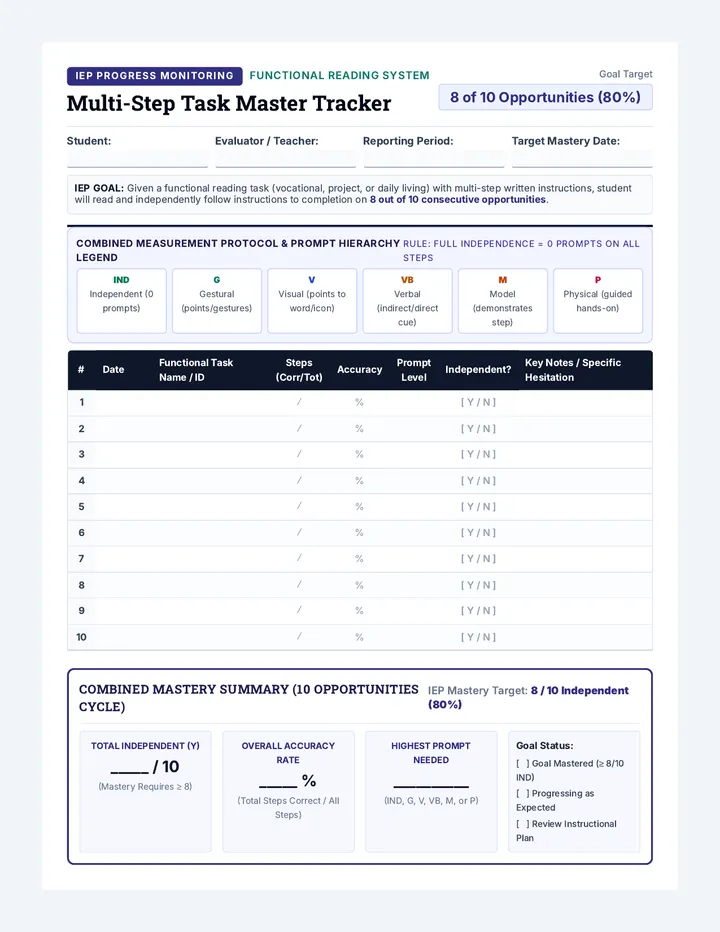
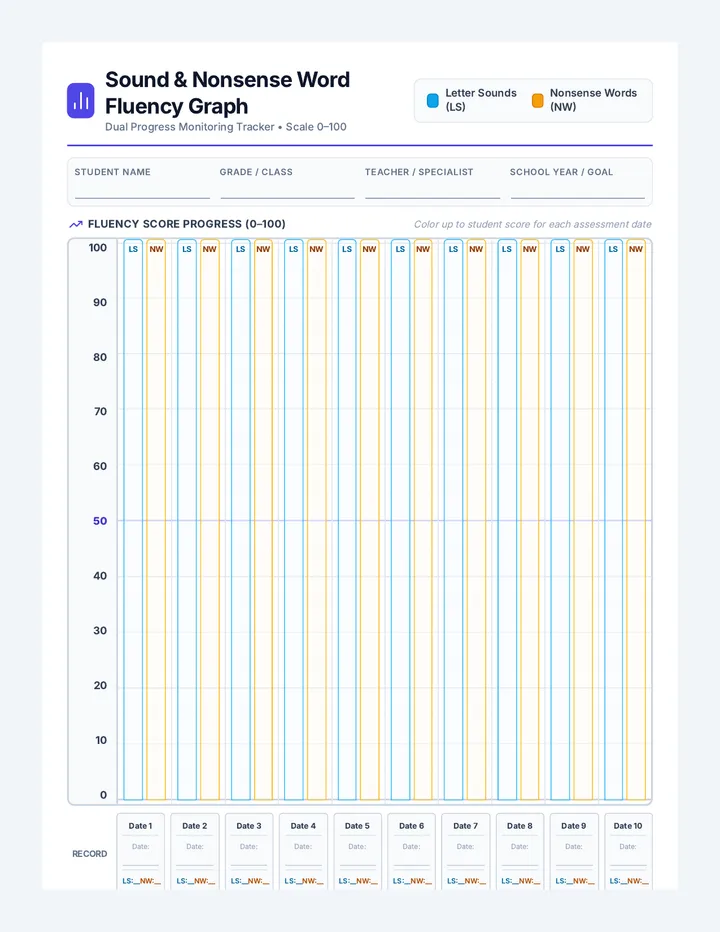
DESIGNING DATA
TOOLS
Creating systems to track progress that actually work in the real world.
DATA ARCHITECTS
Why Collect Data?
Accountability
We must prove that the services we provide are actually helping the student reach their goals.
Instructional Insight
Data tells us when to change our teaching methods or provide more support.
"Without data, you're just another person with an opinion."
— W. Edwards Deming
The Toolkit: Data Types
Frequency
How often?
Counting every time a behavior or skill occurs. (e.g., Raising a hand, using a specific word).
Duration
How long?
Measuring the length of time a student engages in a behavior. (e.g., Reading for 15 minutes).
Latency
How delayed?
Time between a prompt and the start of the response. (e.g., Time to start work after instruction).
Usability: The Golden Rule
A data sheet that is too complex to use in a classroom is a useless data sheet. Teachers have 25 other students and 1,000 other tasks.
1
Keep it Simple
Use checkmarks or tally marks rather than long notes.
2
Clear Definitions
Define the goal exactly so anyone can track it the same way.
3
Visible Cues
Include the goal text directly on the tracking sheet.
4
Ready Access
Place the sheet where the skill happens (desk, clipboard, lanyard).
LAB TIME: DATA ARCHITECTS
You will be given a specific student goal. Your mission is to design a one-page data tracking tool that a busy teacher could use without stopping their lesson.
Select your measurement type
Draft the layout
Test for "speed"
Data Sheet Architect Worksheet Data Sheet Architect
Unit: IEP Implementation | Lesson 1: Designing Data Tools
Student Name
Date
Case Assignment
You are the Special Education teacher for Marcus , a 9th-grade student with an IEP goal for social-emotional learning. Your job is to design a tracking tool that his General Education English teacher can use.
Marcus's Goal:
"When given a group work task, Marcus will contribute at least two relevant comments to the discussion in 4 out of 5 opportunities over a 2-week period."
Part 1: Strategy Choice
1. What type of measurement is best for this goal?
Frequency (Count of comments)
Duration (Length of participation)
Latency (Time to first comment)
2. Why did you choose this type?
Part 2: The Architect's Grid
Design a layout that is easy to use. Consider including dates, a place for tally marks, and a simple "Goal Met (Y/N)" column.
Tool Layout Workspace
Part 3: The 10-Second Test
Can a teacher understand how to use this in 10 seconds?
Yes
Almost
No
One change to make it even simpler:
Tracking Workshop Teacher Guide Tracking Workshop
Teacher Facilitation Guide
Lesson
01
Objective
Students will understand the necessity of structured data collection by experiencing the failure of unstructured observation. They will then apply principles of usability to design a tool for a specific social-emotional IEP goal.
Materials Needed
Video Clip (Fast-paced)
Architect Worksheet
Mastery Slides
The Hook: The Chaos Observation
Instructions:
Tell students: "We're going to watch a 2-minute clip of a group discussion. Your job is to count every time the student in the blue shirt interrupts someone else. Just use a blank piece of paper."
Play a clip where multiple people are talking quickly (a debate or a fast-paced sitcom scene works well).
After the clip: Ask students for their counts. You will likely get a wide range of numbers (e.g., 4, 12, 7).Discuss: "Why did we get different numbers? What made this hard?" (Expected answers: It was too fast, I lost track, I wasn't sure what counted as an 'interruption').
Workshop Phases
1
Direct Instruction (15 min)
Use the Data Tool Mastery Slides . Focus on the difference between Frequency and Duration . Many students default to frequency even when duration is more appropriate for the goal.
2
Design Lab (20 min)
Distribute the Data Sheet Architect Worksheet . Circulate and ask: "If I were a teacher who didn't know Marcus, could I pick this up and use it right away?"
Pro-Tip
Look for students who include a 'Key' or 'Legend'—this is a sign of high-quality tool design.
3
Peer Stress Test (10 min)
Have students swap tools. They must explain their tool to their partner. If the explanation takes more than 30 seconds, they need to simplify.
Debrief Questions
"How does a well-designed data tool protect the rights of the student?"
"What happens to the IEP if the data collection tool is too hard to use?"
"Should the student ever be involved in tracking their own data?"
Reporting Bridge Slides Lesson 02
THE PROGRESS
BRIDGE
Translating raw data into meaningful parent partnerships.
The "Must Do"
IDEA requires that parents are informed of their child's progress on IEP goals at least as often as parents of non-disabled peers.
Sent with every report card.
Must use the same goals from the IEP.
Must be based on the data you collected.
Why it matters:
"A report card grade of 'C' doesn't tell a parent if their child is actually learning to manage their anxiety or read multi-syllabic words."
Avoid the Jargon Trap
What we say:
"The student demonstrated 75% accuracy in phonological awareness tasks involving initial phoneme substitution across three consecutive probes."
What parents hear:
"Your child is getting better at changing the first sound in words (like 'cat' to 'bat'). They are getting 3 out of every 4 right and doing it consistently!"
The goal: Clarity + Empathy + Data
Anatomy of a Strong Update
The Status
Is the student on track, making slow progress, or met the goal?
The Proof
Cite specific numbers or examples from your data sheets.
The Path Forward
What are you doing next to keep momentum or fix a slide?
TRANSLATION LAB
You've got the data, but can you tell the story? Your next task is to take "Compliance Speak" and turn it into a "Parent Partnership."
Jargon
Connection
Translation Lab Worksheet Translation Lab
Unit: IEP Implementation | Lesson 2: Reporting Progress
Student
Date
1
The Jargon De-Coder
Translate the following "Compliance Speak" into language that a parent would find encouraging and clear. Focus on meaning rather than technical terms.
Original Jargon
"Student exhibits a lack of inhibitory control during transition periods, resulting in non-compliant behavior 40% of the time."
Your Translation
Original Jargon
"Target student demonstrated proficiency in multi-digit algorithmic computation but requires high-frequency prompting for carry-over tasks."
Your Translation
2
Data-to-Narrative
Case Data: Sarah (Reading Goal)
Goal: Sarah will read 100 high-frequency words with 90% accuracy over 3 trials.
October Data
62%
November Data
78%
December Data
85%
Write a 3-4 sentence progress report for Sarah's parents. Use the Status → Proof → Path Forward structure.
The Clarity Checklist
Did I avoid acronyms?
Did I use specific numbers?
Is my tone supportive?
Future Foundations Slides The Launchpad
Future
Foundations
Mastering the Individual Transition Plan (ITP) for life after 12th grade.
Age 16+ Requirement
The Roadmap
?
What is it?
The section of the IEP that plans for what happens after high school graduation.
!
When?
Must be in place by the first IEP to be in effect when the student turns 16 (sometimes 14 depending on state law).
Key Principle:
"The ITP is driven by student interests and strengths, not just what the school offers."
The Three Pillars of ITP
Education
College, trade school, vocational training, or adult education.
Employment
Competitive jobs, supported employment, or military service.
Independent Living
Budgeting, cooking, using public transit, or self-advocacy.
The Alignment Check
Post-Secondary Goal
"After high school, Marcus will enroll in a culinary arts program."
Must Align
Current IEP Goal
"Marcus will accurately measure ingredients with 100% accuracy in 5/5 trials."
Everything we do in 11th grade should build the bridge to the post-secondary goal.
Pathway Mapping
It's time to build a future. You'll take an interest inventory to see where your path leads, then draft the goals to get there.
Begin Lab
Path Planner Activity My Path Planner
Transition (ITP) Workshop
Designer
Target Date
STEP 01
The Interest Inventory
Interests & Hobbies
What do you enjoy doing in your free time? What subjects do you actually like?
Strengths & Skills
What are you good at? What do people often ask you for help with?
STEP 02
The Post-Secondary Pillars
Draft a specific goal for your life after 12th grade. Each goal must start with: "After graduation, [Name] will..."
Pillar 1: Education / Training
Pillar 2: Employment
Pillar 3: Independent Living
STEP 03
The Alignment Bridge
Connection Analysis
Pick ONE of your pillars above. What is something you need to learn this year (in 11th grade) to help you reach that goal? This will become your 11th-grade IEP goal.
Selected Post-Secondary Goal
11th Grade IEP Goal Idea The IEP Pivot Point Slides Decision Lab
THE PIVOT
POINT
When and how to change the IEP when the data says it's time.
AMENDMENTS & REVIEWS
Two Paths to Change
Failure to Meet
Data shows the student is not making enough progress to reach the goal by the end of the IEP year.
"We must adjust the goal, the support, or the teaching method."
Early Mastery
Data shows the student met the goal within the first 3 months. Keeping the goal would "stall" their learning.
"We must raise the bar and set a more challenging target."
The Amendment Process
01
Notice of Change
The school informs the parents that data suggests a change is needed.
02
The Agreement
The team agrees to change the IEP without holding a full meeting (if allowed by state/district).
03
The Implementation
The new goals or services start immediately, and the IEP is formally updated.
Legal Tip: You can't just "white-out" the IEP. It must be an official amendment document signed by both parties.
CRISIS CASE
COURSE CORRECTION
A student is failing 4 out of 5 classes despite having an IEP. The data says the current plan isn't working.
WHAT DO WE PIVOT?
Goal? Placement? Support?
Crisis Course Correction Worksheet Crisis Case
Course Correction Simulation
Case ID: IEP-REVISION-404
Student Profile: Jackson (Grade 11)
Jackson has an IEP for ADHD and Specific Learning Disability (Dysgraphia). He is currently in a full-inclusion setting with 30 minutes of specialized academic instruction (SAI) twice a week.
Current Goal:
"When given a multi-step writing assignment, Jackson will use a graphic organizer to outline his work independently in 4 out of 5 trials."
GPA Trend
1.2
Academic Crisis
The Performance Data (Quarter 2)
Metric Target Actual Trend Graphic Organizer Use 80% (4/5) 20% (1/5) Assignment Completion 90% 45% SAI Session Attendance 100% 60%
Part 1: The Root Cause Analysis
Why is Jackson failing? Look at the attendance and the goal use. Is it a skill deficit or a motivation/attendance issue?
Part 2: The Pivot Decision Matrix
Select the ONE most critical change needed and justify it based on the data above.
Pivot the Goal
The current goal (organizers) is too difficult or irrelevant to his current needs.
Pivot the Service
30 mins x 2/week is not enough. He needs more intensive support to stay on track.
Pivot the Placement
Full inclusion is not working. He needs a more restrictive, supportive environment.
Justification (using specific data):
Does your suggested pivot follow the Least Restrictive Environment (LRE) principle? Remember: only increase restrictiveness if all other supports have failed.
Beyond the Checklist Slides Final Reflection
BEYOND THE
CHECKLIST
Distinguishing between a compliant IEP and a quality education.
ETHICS & IMPACT
The Great Divide
Compliance
Meeting the letter of the law. All boxes are checked, timelines are met, and signatures are in place.
Legal? Yes.
Defensible? Yes.
Procedurally correct? Yes.
Quality
Meeting the spirit of the law. The document actually helps the student grow and succeed.
Ambitious? Yes.
Relevant? Yes.
Transformative? Yes.
The "Legal But Useless" Trap
A Compliant Goal:
"The student will read 5th-grade level text with 80% accuracy."
A Quality Goal:
"The student will use text-to-speech software to independently research and summarize a career of their choice."
The Difference?
The first is a generic academic target. The second builds a functional skill for the student's actual life.
The Ethical Compass
As you finish this unit, ask yourself these three questions for every IEP you touch:
Does it see the student?
Or is it a copy-paste of a generic disability profile?
Does it aim high?
Does it presume competence and set ambitious targets?
Does it empower?
Will this student be more independent a year from now?
THE FINAL DEBATE
"Is a legally compliant IEP always a 'good' IEP?"
Compliance
vs
Quality
Prepare your arguments.
Quality IEP Rubric Quality IEP Rubric
The "Beyond Compliance" Evaluation Tool
Evaluation Purpose
Use this tool to evaluate an IEP document. While an IEP may be legally compliant (checked boxes, correct dates), this rubric measures its quality (usefulness, ambition, and student-centeredness).
Dimension Low Quality Compliance Only High Quality Student Voice
Self-Determination
| No mention of student interests or future goals. | Standard interest inventory results included as a list. | Student's own words and specific future vision drive every goal. |
|
Goal Ambition
Presumed Competence
| Goals are repetitive from previous years. | Goals meet grade-level "standard" but lack innovation. | Goals are challenging, functional, and aim for true independence. |
|
Transition Alignment
The Roadmap
| Transition plan is generic (e.g., "will get a job"). | Education and employment goals are filled out correctly. | Direct link between current skills and specific post-secondary path. |
|
Communication
Partnership
| Report is jargon-heavy and confusing. | Data is reported clearly but without narrative context. | Data is translated into a narrative "story" of growth and next steps. |
The Quality Audit
Review the sample IEP provided by your instructor. Choose ONE goal and audit it below.
Original Goal Text
Compliance Check:
Is it measurable?
Does it have a timeline?
Quality Check:
Does it help the student's *actual* life?
Is it presuming competence?
Suggested "Quality" Revision:
Rewrite the goal to make it more meaningful for the student's future.