Sixes Sevens Tiered Worksheet Eureka Math • Grade 3 • Module 3 (Lessons 1–7) Modification: Reduced Workload & Visuals
Sixes & Sevens: Break-Apart Power
Core Strategy: Break 6 into 5 + 1 • Break 7 into 5 + 2
Name:
Date:
Level 1 • Visual Array Solve \(6 \times 4\) by breaking apart 6 into \(5 + 1\)
High Support
4 rows of 5 4 rows of 1
Step 1: Multiply the two parts
\(4 \times 5 = \) 20 \(4 \times 1 = \)
Step 2: Add the parts together
20 + =
Level 2 • Number Bond Frame Solve \(7 \times 6\) by breaking apart 7 into \(5 + 2\)
Guided
7
↙ ↘
5
2
\(7 = 5 + 2\)
Write the equation parts:
\((6 \times 5) + (6 \times 2) =\) +
So, \(7 \times 6 =\)
Division Check: \(42 \div 7 =\)
Level 3 • Word Problem Read • Draw Tape Diagram • Solve
Independent
Story: Maya organizes 6 boxes of markers. Each box holds 7 markers. How many markers does Maya have in all?
Tape Diagram Box (6 units of 7)
7
7
7
7
7
7
Total = ?
Multiplication Sentence:
\(\times\) \(=\)
Answer Sentence:
Maya has markers in all.
Self-Check: Needs Help Getting There Got It!
Strategy: Use known 5s facts to find unknown 6s & 7s.
Sixes Sevens Modification Guide Teacher & Co-Teacher Guide Eureka Math Grade 3 • Module 3 (Lessons 1–7)
Units of 6 & 7: Modification Blueprint
Focus: Distributive Property \((5 + n)\)
Core Concrete-Representational Model: The "5-Group Break"
For Unit of 6: Think \(5 + 1\)
Students break down unknown 6-facts into a known 5-fact and a 1-fact:
For Unit of 7: Think \(5 + 2\)
Students break down unknown 7-facts into a known 5-fact and a double:
Manipulative Supports (IEP / Tier 2)
• Two-Color Counters: Build rows with 5 yellow counters and 1 red counter so the boundary is physically visible.
• Array Folding: On grid paper, draw a \(6 \times n\) array and fold back the 6th column to see the \(5 \times n\) foundation first.
• Number Line Hops: Mark multiples of 5 in green and multiples of 6 in blue to observe the "+1 per group" pattern.
Verbal Scaffolding Prompts
Prompt 1: "What easier 5s multiplication fact can you solve in your head first?"
Prompt 2: "How many more are in each row? So how many more do we add altogether?"
Sentence Stem: "I can solve \(6 \times \text{\_\_}\) by doing \(5 \times \text{\_\_}\) plus \(1 \times \text{\_\_}\)."
Common Misconceptions & Rapid Fixes
Error: Adding 1 instead of \(1 \times n\)
Student solves \(6 \times 4\) as \((5 \times 4) + 1 = 21\) instead of \(20 + 4 = 24\).
Fix: Have student point to each extra row and chant: "1 group of 4, not just 1 dot!"
Error: Dividing by 5 instead of the whole unit
In division (\(42 \div 7\)), student stops after finding \(35 \div 7 = 5\).
Fix: Use tape diagram: "How many total are left over? 7 more is 1 more group!"
Tiered Practice Answer Key & Mastery Criteria Lessons 1–7
Level 1:
\(4 \times 1 = \mathbf{4}\)
\(20 + 4 = \mathbf{24}\)
Level 2:
\((6 \times 5) + (6 \times 2) = \mathbf{30} + \mathbf{12}\)
\(7 \times 6 = \mathbf{42}\) • \(42 \div 7 = \mathbf{6}\)
Level 3:
Sentence: \(6 \times 7 = \mathbf{42}\)
Maya has 42 markers in all.
Accommodation Check: Allow multiplication grid for 5s facts if automaticity is not yet achieved. Eureka Math Modification Sequence • Lesson 1
Eights Power Tiered Practice Eureka Math • Grade 3 • Module 3 (Lessons 8–11) Modification: Doubling & Visual Grouping
Eights: The Double-Double Hack
Core Strategy: To multiply by 8, double the 4s fact OR break into 5 + 3
Name:
Date:
Level 1 • Doubling Model Solve \(8 \times 3\) by Doubling \(4 \times 3\)
High Support
First 4 groups of 3:
3 3 3 3
\(4 \times 3 = 12\)
Next 4 groups of 3 (Double it!):
3 3 3 3
\(4 \times 3 = 12\)
Step 1: Solve the known 4s fact
\(4 \times 3 = \) 12
Step 2: Double the answer (\(12 + 12\))
12 + 12 =
Therefore, \(8 \times 3 =\)
Level 2 • Parentheses Grouping Solve \(8 \times 6\) using \((5 \times 6) + (3 \times 6)\)
Guided
8 is split into 5 and 3:
5 groups of 6
\(5 \times 6 = 30\)
3 groups of 6
\(3 \times 6 = 18\)
Add the two results:
30 + 18 =
So, \(8 \times 6 =\)
Division: \(48 \div 8 =\)
Level 3 • Word Problem Read • Model • Solve
Independent
Story: Coach buys 8 packs of tennis balls. Each pack has 4 balls. How many balls does Coach buy altogether?
Tape Diagram (8 units of 4)
4
4
4
4
4
4
4
4
Total = ?
Equation:
\(\times\) \(=\)
Answer Sentence:
Coach buys balls in all.
Confidence Check: Still Learning Almost There Mastered It!
Strategy: \(8 = 4 \times 2\) (Double twice) or \(8 = 5 + 3\)
Eights Power Modification Guide Teacher & Co-Teacher Guide Eureka Math Grade 3 • Module 3 (Lessons 8–11)
Units of 8: Modification Blueprint
Focus: Doubling & Associative Grouping
Core Strategy: "Double-a-Double" & Parentheses Grouping
Strategy A: Double the 4-fact
Since \(8 = 2 \times 4\), any 8-fact is double its 4-fact:
Strategy B: The \(5 + 3\) Break
For students struggling with large doubles:
Manipulative Accommodations (Tier 2/3)
• Snap Cube Towers: Build a tower of 4. Double it by snapping another tower of 4 alongside it to physically model \(2 \times 4\).
• Colored Parentheses Strips: Give students plastic colored brackets to place around equations to reduce visual crowding.
• Half-Fold Paper: Fold the paper in half. Solve 4 groups on the left; unfold to reveal the other 4 groups.
Verbal Scaffolding Prompts
Prompt 1: "What is the 4-fact first? What is double that number?"
Prompt 2: "Look inside the parentheses. Which operation do our eyes solve first?"
Sentence Stem: "To solve \(8 \times \text{\_\_}\), I find \(4 \times \text{\_\_}\) and add it twice."
Targeted Misconceptions & Rapid Fixes
Error: Doubling the wrong factor
In \(8 \times 3\), student doubles 3 to get 6, and then stops.
Fix: Use color tags: "The 8 is what we broke apart into \(4 + 4\). Keep the 3 the same!"
Error: Ignoring Parentheses Order
Student calculates left to right ignoring groupings.
Fix: Use highlighters around parentheses and call them "First-Place Hugs".
Tiered Practice Answer Key & Criteria Lessons 8–11
Level 1:
\(12 + 12 = \mathbf{24}\)
\(8 \times 3 = \mathbf{24}\)
Level 2:
\(30 + 18 = \mathbf{48}\)
\(8 \times 6 = \mathbf{48}\) • \(48 \div 8 = \mathbf{6}\)
Level 3:
Sentence: \(8 \times 4 = \mathbf{32}\)
Coach buys 32 balls in all.
Accommodation Check: Allow addition doubling reference chart if mental 2-digit addition is slow. Eureka Math Modification Sequence • Lesson 2
Nines Patterns Tiered Practice Eureka Math • Grade 3 • Module 3 (Lessons 12–15) Modification: Visual 10s Subtract & Digit Patterns
Nines: The 10 Minus 1 Superpower
Core Strategy: Multiply by 10, then subtract 1 group • Digits always add to 9!
Name:
Date:
Level 1 • 10 Minus 1 Model Solve \(9 \times 4\) by doing \((10 \times 4) - 4\)
High Support
4 rows of 10 Minus 4
✕
✕
✕
✕
Step 1: Multiply by 10 (Easy fact!)
\(10 \times 4 = \) 40
Step 2: Subtract 1 group of 4
40 − 4 =
Therefore, \(9 \times 4 =\)
Level 2 • 9s Pattern Frame Solve \(9 \times 7\) using 10 Minus 1 & Digit Check
Guided
1. Multiply by 10: \(10 \times 7 =\) 70
2. Subtract 7: \(70 - 7 =\)
So, \(9 \times 7 =\)
Division: \(63 \div 9 =\)
Magic 9s Digit Sum:
\(6 + 3 = \mathbf{9}\)
The digits in any 9s answer always add up to 9!
Level 3 • Word Problem Read • Model • Solve
Independent
Story: A baker puts 9 blueberry muffins on each tray. He bakes 5 trays. How many muffins did he bake altogether?
Tape Diagram (5 units of 9)
9
9
9
9
9
Total = ?
Equation:
\(\times\) \(=\)
Answer Sentence:
He baked muffins in all.
Confidence Check: Still Learning Almost There Mastered It!
Strategy: \(9 \times n = (10 \times n) - n\)
Nines Patterns Modification Guide Teacher & Co-Teacher Guide Eureka Math Grade 3 • Module 3 (Lessons 12–15)
Units of 9: Modification Blueprint
Focus: 10 Minus 1 & Digit Sums
Core Strategy: "10 Minus 1" & Self-Checking Patterns
The 10 Minus 1 Algorithm
Multiplying by 10 is intuitive for 3rd graders. Since \(9 = 10 - 1\):
The Digit Sum Rule (Self-Check)
The sum of digits in multiples of 9 is always 9:
Kinesthetic & Visual Accommodations
• 10-Frame Sliders: Fill a 10-frame completely, then physically flip or remove 1 counter from each frame to simulate \(-1\).
• The 9s Finger Kinesthetic: Hold up 10 fingers. To solve \(9 \times 4\), fold down finger #4. Fingers to left = 3 tens; fingers to right = 6 ones (\(36\)).
• Hundreds Chart Shading: Shade multiples of 9 to see the diagonal visual staircase across the chart.
Verbal Scaffolding Prompts
Prompt 1: "What is that number times 10? Add a zero!"
Prompt 2: "Now take away ONE group of that number. What is left?"
Self-Check Stem: "Do my two digits add up to 9? If yes, my answer is correct!"
Targeted Misconceptions & Rapid Fixes
Error: Subtracting 1 instead of \(1 \times n\)
In \(9 \times 4\), student computes \(40 - 1 = 39\).
Fix: Emphasize "unit": "You had 4 tens. You take away 4 ones, not 1 one!"
Error: Tens digit off by one
Student writes 46 for \(9 \times 4\) because of the factor 4.
Fix: Rule cue: "The tens digit is always one LESS than the factor! \(4 - 1 = 3\), so thirty-something!"
Tiered Practice Answer Key & Criteria Lessons 12–15
Level 1:
\(40 - 4 = \mathbf{36}\)
\(9 \times 4 = \mathbf{36}\)
Level 2:
\(70 - 7 = \mathbf{63}\)
\(9 \times 7 = \mathbf{63}\) • \(63 \div 9 = \mathbf{7}\)
Level 3:
Sentence: \(5 \times 9 = \mathbf{45}\)
He baked 45 muffins in all.
Accommodation Check: Provide laminated finger pattern reference sheet for Tier 3 intervention. Eureka Math Modification Sequence • Lesson 3
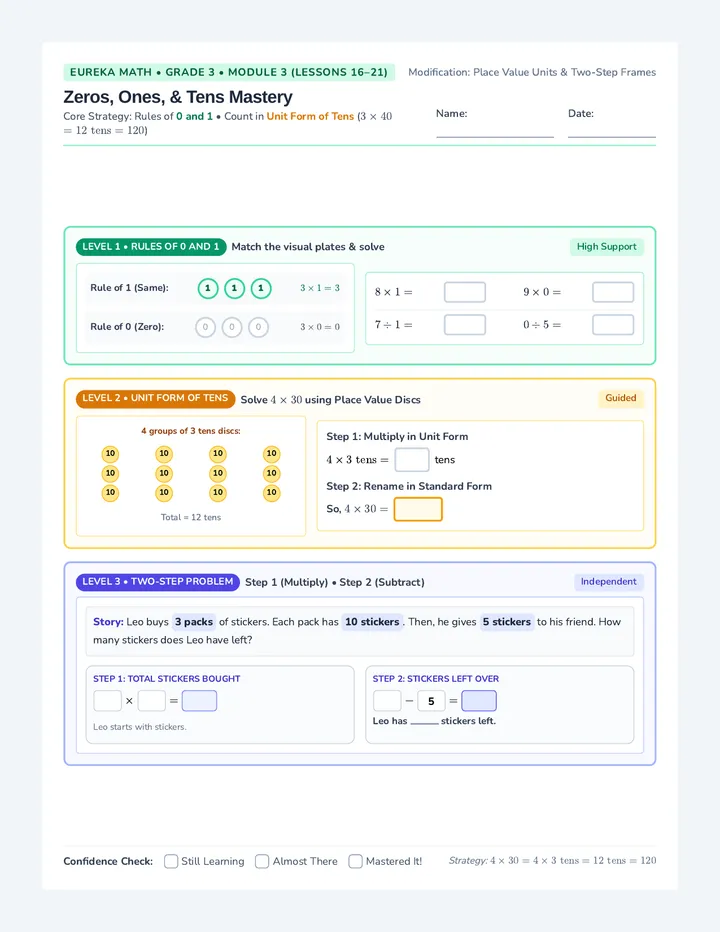
Zeros Ones Tens Tiered Practice Eureka Math • Grade 3 • Module 3 (Lessons 16–21) Modification: Place Value Units & Two-Step Frames
Zeros, Ones, & Tens Mastery
Core Strategy: Rules of 0 and 1 • Count in Unit Form of Tens (\(3 \times 40 = 12\text{ tens} = 120\))
Name:
Date:
Level 1 • Rules of 0 and 1 Match the visual plates & solve
High Support
Rule of 1 (Same):
1 1 1
\(3 \times 1 = 3\)
Rule of 0 (Zero):
0 0 0
\(3 \times 0 = 0\)
\(8 \times 1 =\) \(9 \times 0 =\)
\(7 \div 1 =\) \(0 \div 5 =\)
Level 2 • Unit Form of Tens Solve \(4 \times 30\) using Place Value Discs
Guided
4 groups of 3 tens discs:
10 10 10
10 10 10
10 10 10
10 10 10
Total = 12 tens
Step 1: Multiply in Unit Form
\(4 \times 3 \text{ tens} =\) tens
Step 2: Rename in Standard Form
So, \(4 \times 30 =\)
Level 3 • Two-Step Problem Step 1 (Multiply) • Step 2 (Subtract)
Independent
Story: Leo buys 3 packs of stickers. Each pack has 10 stickers. Then, he gives 5 stickers to his friend. How many stickers does Leo have left?
Step 1: Total Stickers Bought
\(\times\) \(=\)
Leo starts with stickers.
Step 2: Stickers Left Over
\(-\) 5 \(=\)
Leo has stickers left.
Confidence Check: Still Learning Almost There Mastered It!
Strategy: \(4 \times 30 = 4 \times 3 \text{ tens} = 12 \text{ tens} = 120\)
Zeros Ones Tens Modification Guide Teacher & Co-Teacher Guide Eureka Math Grade 3 • Module 3 (Lessons 16–21)
Units 0, 1, & Tens: Modification Blueprint
Focus: Properties & Unit Form of Tens
Core Strategy: "Unit Form" for Tens & 0/1 Visual Anchors
Multiples of 10 in "Unit Form"
Prevent "zero adding confusion" by treating 10 as a countable unit:
Rules of 0 and 1
Anchor to real objects:
Place Value & Manipulative Accommodations
• Place Value Discs: Use tangible 10-discs on a place value chart so bundling 10 tens into 1 hundred is tactile.
• Two-Color Tape Strip: For 2-step problems, color Step 1 in blue (Total) and Step 2 in red (Leftover) to reduce cognitive load.
• Empty Bowls: For 0, use physical empty bowls so the concept of zero groups or zero in each group is literal.
Verbal Scaffolding Prompts
Prompt 1: "How many tens is that? Multiply the front numbers first!"
Prompt 2: "Twelve tens is the same as what number in standard form?"
Two-Step Stem: "First I found the total by multiplying. Then I took away what was given away."
Targeted Misconceptions & Rapid Fixes
Error: Confusing \(n \times 0\) with \(n + 0\)
Student writes \(5 \times 0 = 5\).
Fix: Concrete bowl prompt: "Look in the 5 bowls. Are there any candies? No, zero candies!"
Error: Forgetting Step 2 in Word Problems
Student solves \(3 \times 10 = 30\) and stops, omitting the subtraction.
Fix: Checklist box: Checkbox 1: "Total" Checkbox 2: "Leftover".
Tiered Practice Answer Key & Criteria Lessons 16–21
Level 1:
\(8 \times 1 = \mathbf{8}\) • \(9 \times 0 = \mathbf{0}\)
\(7 \div 1 = \mathbf{7}\) • \(0 \div 5 = \mathbf{0}\)
Level 2:
\(4 \times 3 \text{ tens} = \mathbf{12} \text{ tens}\)
\(4 \times 30 = \mathbf{120}\)
Level 3:
Step 1: \(3 \times 10 = \mathbf{30}\)
Step 2: \(30 - 5 = \mathbf{25}\)
Leo has 25 stickers left.
Accommodation Check: Provide place value disc template for students requiring tactile movement of tens. Eureka Math Modification Sequence • Lesson 4